 ProMapRanker
The Search Monitor Alternatives in 2026


Paid search and affiliate compliance · Pricing starts at: See website
Key takeaways
- BrandVerity, AdPolice and Marcode are the closest matches for paid search and affiliate monitoring, with trademark checks and enforcement evidence.
- Adthena, SpyFu, Semrush and Similarweb add competitor intelligence, showing what rivals bid on and how their ads change over time.
- Most tools in this niche use custom pricing, so a demo and a written quote matter more than a price page.
- Search monitor alternatives differ in scope, so pick one that matches the main risk: affiliate abuse, trademark bidding, counterfeits or competitor tracking.
Quick comparison
| Pick | Great for | Pricing starts at | Free tier | |
|---|---|---|---|---|
| BrandVerity | Paid search and affiliate compliance | See website | No | Visit |
 Adthena | Competitor paid search intelligence | See website | No | Visit |
 AdPolice | Global paid search monitoring | See website | No | Visit |
 Marcode | High-frequency affiliate checks | See website | No | Visit |
 SpyFu | Affordable competitor research | See website | Free trial | Visit |
 Semrush | All-in-one search toolkit | See website | Free trial | Visit |
 Similarweb | Market and traffic intelligence | See website | Free trial | Visit |
 Red Points | Multi-channel brand protection | See website | No | Visit |
The best search monitor alternatives
We compared tools that monitor paid search, trademarks and affiliate activity, plus wider search intelligence tools that cover similar ground. This list contains alternatives only, and never lists The Search Monitor itself. The right pick depends on the main job: stopping affiliate abuse, protecting a trademark, or tracking competitors.
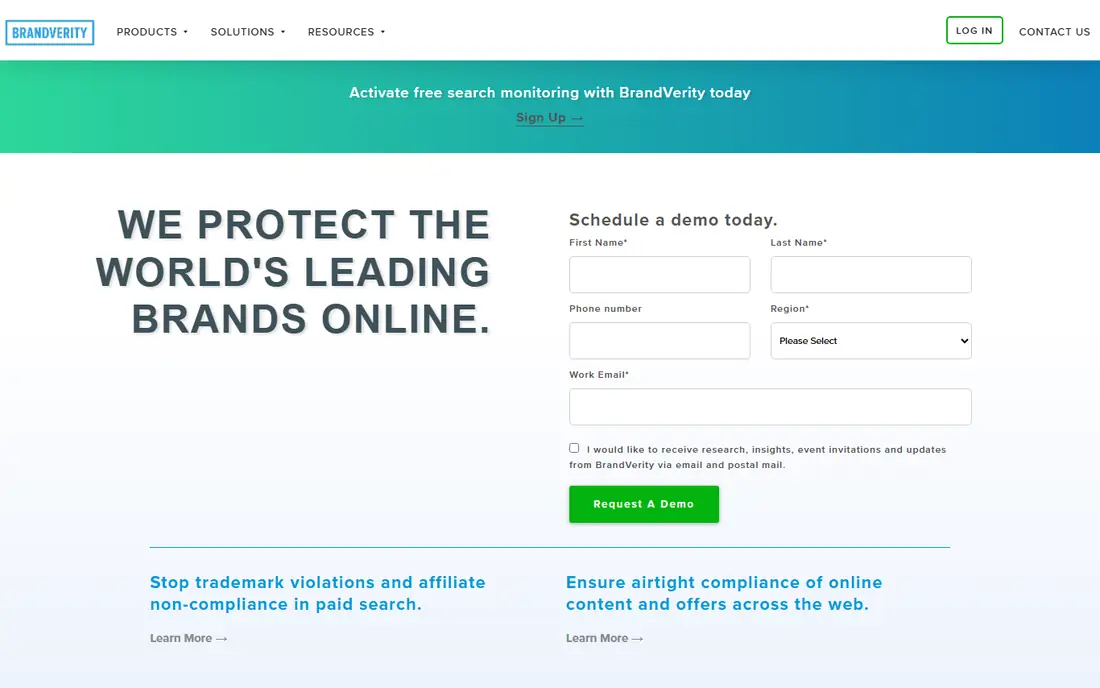
BrandVerity focuses on the core job of paid search and affiliate monitoring. It checks search ads for trademark use, unauthorised brand bidding and misleading landing pages, then stores screenshots and logs that support a takedown or an affiliate warning. That evidence trail matters, since a complaint without proof is easy to ignore. Coverage spans major search engines and many countries, which suits brands with large affiliate programmes.
Custom pricing is the main drawback. Brands need a demo and a quote, and costs vary with keyword count, geography and check frequency. The interface also feels less modern than newer tools, though the reports are clear. For teams whose main risk is affiliate abuse on brand terms, BrandVerity remains a direct and practical alternative.
- Paid search monitoring across major engines
- Affiliate compliance checks
- Screenshot and log evidence for enforcement
- Pricing is custom and not published
- Interface feels older than newer rivals
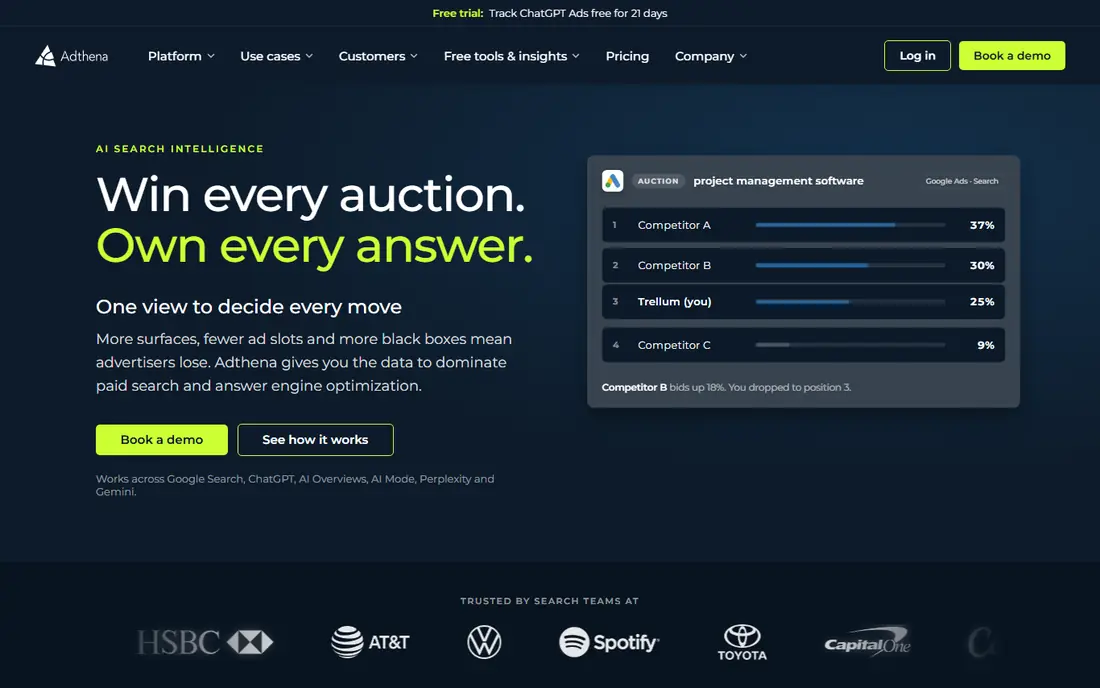
Adthena blends brand protection with competitor intelligence, which makes it useful for teams that want both jobs in one tool. It tracks rival ad copy, bidding patterns and market share, and sends alerts when a competitor moves on key terms. Trademark monitoring adds protection for brand terms, with support for submitting complaints to search engines. That combination suits marketing teams that report on both protection and performance.
Cost is the honest weakness. Adthena is priced for larger advertisers and agencies, and smaller brands may find the quote hard to justify for monitoring alone. The platform also has a learning curve, since the intelligence features go beyond simple violation alerts. For teams that already spend heavily on paid search, Adthena adds context that pure monitoring tools do not offer.
- Strong competitor ad intelligence
- AI-driven alerts for market shifts
- Trademark monitoring with takedown support
- Higher price than simpler monitoring tools
- Best value needs a larger advertising budget
AdPolice focuses on paid search monitoring and affiliate fraud detection, with a clear alert system for brand teams. It checks ads across search engines and flags trademark misuse, unauthorised affiliates and misleading claims. Cases can be tracked through a workflow, which helps small brand teams manage violations without a separate system. Setup is straightforward, with keyword lists and geography settings that do not need technical help.
Scope is the limit. AdPolice does not cover marketplaces, social media or counterfeit goods in the way Red Points does, so brands with those risks need a second tool. Pricing is also custom, so a quote is needed before budgeting. For paid search protection alone, AdPolice is a focused and easy-to-use alternative.
- Global paid search and affiliate monitoring
- Clear alerts and case workflow
- Easy setup for brand teams
- Limited scope beyond paid search
- Pricing is custom
Marcode is a newer tool built for affiliate hijacking and ad fraud detection, with checks that run far more often than a daily scan. High frequency matters, because some affiliates bid on brand terms for short bursts that a daily check can miss. The platform uses AI detection to flag suspicious patterns, and it offers a usage-based plan that suits brands testing the category. That pricing model is clearer than the custom quotes used by most rivals.
Youth is the trade-off. Marcode has a smaller track record than BrandVerity or Adthena, and its channel coverage is narrower than full brand protection suites. Brands that need marketplace or social monitoring should pair it with another tool or pick a broader suite. For affiliate-heavy brands that want frequent checks, Marcode is a modern and focused option.
- High-frequency checks catch short-lived violations
- AI detection for affiliate hijacking
- Usage-based pricing option
- Newer vendor with a smaller track record
- Less broad channel coverage than larger suites
SpyFu is best known for competitor research, showing the keywords rivals bid on, their ad copy history and their organic rankings. That data helps a brand spot a competitor bidding on its terms, even though SpyFu is not built as a trademark enforcement platform. Small teams like the lower price and the simple interface, which make it easy to check a rival in minutes. Ad history over many years also helps when building a case about long-term bidding behaviour.
Enforcement is the gap. SpyFu does not offer the same takedown workflow, screenshot evidence system or affiliate compliance checks as BrandVerity or AdPolice. It works best as a research companion beside a dedicated monitoring tool, or as a standalone pick for teams whose main need is competitor insight rather than enforcement. For budget-conscious teams, it is a useful starting point.
- Long history of paid search and SEO competitor data
- Affordable plans for small teams
- Easy keyword and ad history lookup
- Not a dedicated trademark enforcement tool
- Monitoring alerts are less detailed than BrandVerity
Semrush is an all-in-one search toolkit, with advertising research that shows competitor ad copy, budgets and keyword overlap. That breadth suits marketing teams that already use Semrush for SEO and want paid search insight in the same login. Alerts and scheduled reports keep teams informed about rival moves, and the platform covers many countries and languages. For a team that needs search intelligence across SEO and paid search, Semrush avoids buying several separate tools.
Dedicated protection is thinner. Semrush does not match BrandVerity on affiliate compliance workflows or enforcement evidence, so brands with serious affiliate abuse still need a specialist tool. Pricing also rises with the plan tier, and the full toolkit can feel large for a team that only wants monitoring. Semrush fits best when search intelligence is the main job and brand protection is a secondary need.
- Advertising research, keyword tracking and site audits in one platform
- Large data coverage
- Regular reports and alerts
- Brand protection features are part of a larger suite, not a dedicated tool
- Full value needs a paid plan
Similarweb gives a market-level view of search, showing traffic, referral sources and paid search patterns for websites and rivals. That view helps a brand understand where competitors get traffic and how paid search fits into their mix. Benchmarking features compare a brand against a set of rivals, which suits planning and reporting. A free tier lets teams test basic data before paying for deeper access.
Trademark monitoring is not its job. Similarweb will not flag affiliate abuse or build a takedown case in the way BrandVerity does. It works best as a companion tool for strategy, beside a dedicated monitor for enforcement. For teams that need market context around their search monitoring, Similarweb adds a useful layer.
- Website traffic and market share data
- Paid search and referral insight
- Useful for benchmarking against rivals
- Not a trademark monitoring tool
- Detailed data needs a paid plan
Red Points goes wider than paid search, covering counterfeit listings, impersonation on social media, fake apps and domain abuse. That breadth suits brands that face risks beyond search ads, such as fake products on marketplaces. AI detection scans many channels at once, and enforcement workflows handle takedowns at scale. For a brand protection team with a broad remit, Red Points can replace several single-channel tools.
Scope can be a drawback for small brands. The platform is enterprise-focused, with custom pricing that may exceed a small monitoring budget. Teams that only need paid search checks will find simpler tools cheaper and easier. Red Points fits best when search monitoring is one part of a wider brand protection programme.
- Covers marketplaces, social media, apps and domains as well as search
- AI detection across channels
- Automated enforcement workflows
- May be more than small brands need
- Pricing is custom and enterprise-focused
How we picked these
We compared official feature pages, pricing pages, review listings and public documentation for search monitoring and brand protection tools available in October 2026. We kept tools that monitor paid search, trademarks, affiliates or competitor search activity today, and that state their scope clearly. We left out tools that had closed, tools that only track organic rankings, and general SEO tools with no paid search or protection features. Where a price could not be confirmed on the vendor site, we wrote See website rather than guessing.
How to choose a search monitor alternative
Start with the main risk. Affiliate abuse points to BrandVerity, AdPolice or Marcode, while counterfeit goods point to Red Points. Competitor insight points to Adthena, SpyFu, Semrush or Similarweb, depending on budget and depth. Write down the keywords, geographies and devices that matter most, since check frequency and coverage drive the quote. A tool that checks daily may miss short-lived affiliate bids, while a tool that checks hourly costs more.
Next, test the evidence and workflow. Ask for a sample report, a sample screenshot and a walkthrough of how a violation becomes a takedown. Check whether the tool integrates with affiliate networks or ticketing systems the team already uses. Finally, get a written quote that states keyword limits, check frequency and contract length, since most prices in this niche are custom. A short pilot on real brand terms gives a better answer than a sales demo alone.
Frequently asked questions
What are the best search monitor alternatives?
BrandVerity, AdPolice and Marcode are the closest alternatives for paid search and affiliate monitoring, with trademark checks and enforcement evidence. Adthena adds competitor intelligence, while SpyFu and Semrush suit teams that want research depth at a lower cost. The best pick depends on the main risk, since no single tool covers every channel at the lowest price.
Do search monitor alternatives offer free plans?
Most dedicated monitoring tools use custom pricing and do not offer a free plan, though demos are common. SpyFu, Semrush and Similarweb offer free trials or limited free tiers for their research features. A trial is useful for testing data quality, but enforcement workflows usually need a paid plan and a demo. Ask vendors about pilot pricing before signing a long contract.
How often should paid search be monitored?
Daily checks catch most persistent violations, while hourly or high-frequency checks catch short-lived affiliate bids that appear and disappear quickly. The right frequency depends on affiliate programme size, brand term value and past violation patterns. Brands with large programmes or high-value terms benefit from more frequent checks, while small brands can start with daily monitoring and increase frequency if violations appear.
Can these tools submit trademark takedowns?
BrandVerity, AdPolice, Adthena and Red Points support takedown workflows, with evidence such as screenshots and logs to support complaints. The exact process varies by search engine and marketplace, and some takedowns still need manual review by the platform. Check the workflow during a demo, and confirm who handles submissions, since some vendors manage the process and others only provide evidence.
What is the difference between monitoring and brand protection?
Monitoring detects violations, such as trademark bidding or affiliate abuse, while brand protection adds enforcement across more channels, including marketplaces, social media and domains. A monitoring tool suits a team focused on paid search, while a protection suite suits a team facing counterfeits and impersonation. Many brands start with monitoring and expand to wider protection as risks grow.
Sources
See where you really rank - block by block
ProMapRanker scans Google Maps across a grid of your service area. Simple monthly plans from $19, white-label on every plan.
Start freeKeep reading
 twitch alternatives
Twitch Alternatives in 2026
Explore the best Twitch alternatives in 2026 for live streaming, with free platforms, monetisation options, audiences, chat tools, and tips for new streamers.
Read → firebase alternatives
Best Firebase Alternatives in 2026
Looking for Firebase alternatives? We compare 9 backend platforms for auth, databases, realtime, storage, functions, self-hosting, and pricing for your app.
Read → companies with best work life balance
Companies With Best Work Life Balance in 2026
See companies with best work life balance in 2026, ranked by employee ratings, with flexible work options, benefits, and what to check before applying.
Read →