 ProMapRanker
Splunk Alternatives in 2026: 8 Tools Compared


Managed logs, metrics and traces in one platform · Pricing starts at: $15.00 per host per month
Key takeaways
- Datadog and New Relic suit teams that want logs, metrics and traces in one managed platform.
- Elastic Stack and OpenSearch suit search-heavy teams that want control over indexing and retention.
- Graylog suits teams that want self-hosted log management without paying for a full observability suite.
- Sumo Logic and Logz.io suit teams that want a managed log platform with security analytics built in.
- Dynatrace suits teams that need application tracing alongside logs, rather than log search alone.
Quick comparison
| Pick | Great for | Pricing starts at | Free tier | |
|---|---|---|---|---|
| Datadog | Managed logs, metrics and traces in one platform | $15.00 per host per month | Free trial | Visit |
 Elastic Stack | Search-heavy log and security analytics | Free | Yes | Visit |
 Dynatrace | Logs alongside application performance tracing | See website | Free trial | Visit |
 New Relic | Logs in context with application monitoring | Free | Yes | Visit |
 Sumo Logic | Managed log management and cloud SIEM | See website | Yes | Visit |
 Graylog | Self-hosted log management on a predictable licence | Free | Yes | Visit |
 Logz.io | Managed logs built on open source tools | See website | Free trial | Visit |
 OpenSearch | Fully open source log search and analytics | Free | Yes | Visit |
The best Splunk alternatives
We compared official feature pages, pricing pages and product docs for tools that replace Splunk for log search, observability or security analytics. Splunk itself is not listed here, since this article covers replacements. Some tools are full platforms, while others focus on logs alone, so each entry notes that scope. Pricing in this category is often usage-based, so we mark quoted or variable prices as See website rather than guessing.
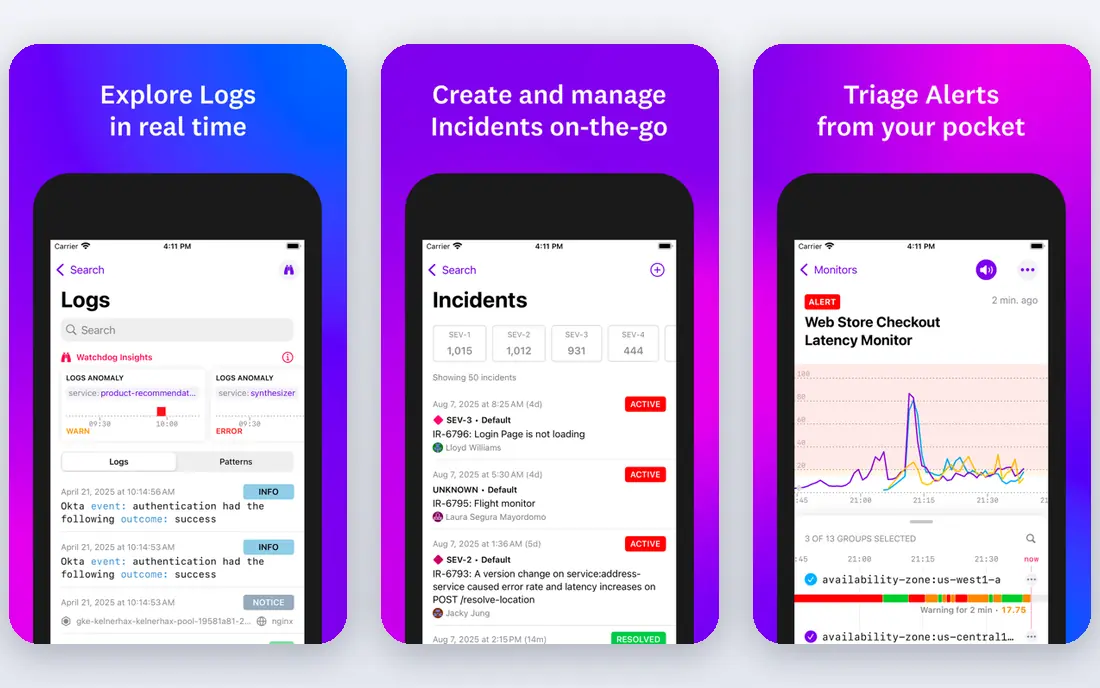
Datadog is the most direct managed replacement for teams that use Splunk for both logs and observability. You can search logs, link a log line to a trace and a host metric, and build alerts from any of those signals. That linkage helps when a log error is only the symptom of a wider service failure.
Cost control is the main work. Log pricing depends on ingest and indexing choices, so teams need to set retention, exclusion and pipeline rules early. If you want one vendor for logs and observability and you can model data volume, Datadog is a strong first choice.
- Logs, metrics, traces and infrastructure in one interface
- Log pipelines and parsing
- Anomaly detection on log patterns
- Log ingest and indexing costs can rise fast at high volume
- Per-host pricing adds up for large estates

Elastic Stack, built around Elasticsearch, Kibana and Logstash, suits teams where search depth matters most. It indexes full log content, which supports detailed queries, security hunting and long investigations. The self-hosted version is free, and Elastic Cloud offers a managed path for teams that do not want to run clusters.
The trade-off is operations. Elasticsearch needs memory, storage planning and upgrades, and costs can grow with retention. If your team already knows Elastic or needs deep search, it is a proven Splunk replacement. If you want a hands-off service, a managed option like Sumo Logic or Logz.io may fit better.
- Powerful full-text search
- Self-hosted version is free
- Security analytics and machine learning features
- Large community
- Running Elasticsearch at scale needs tuning and hardware
- Managed cloud costs vary by deployment
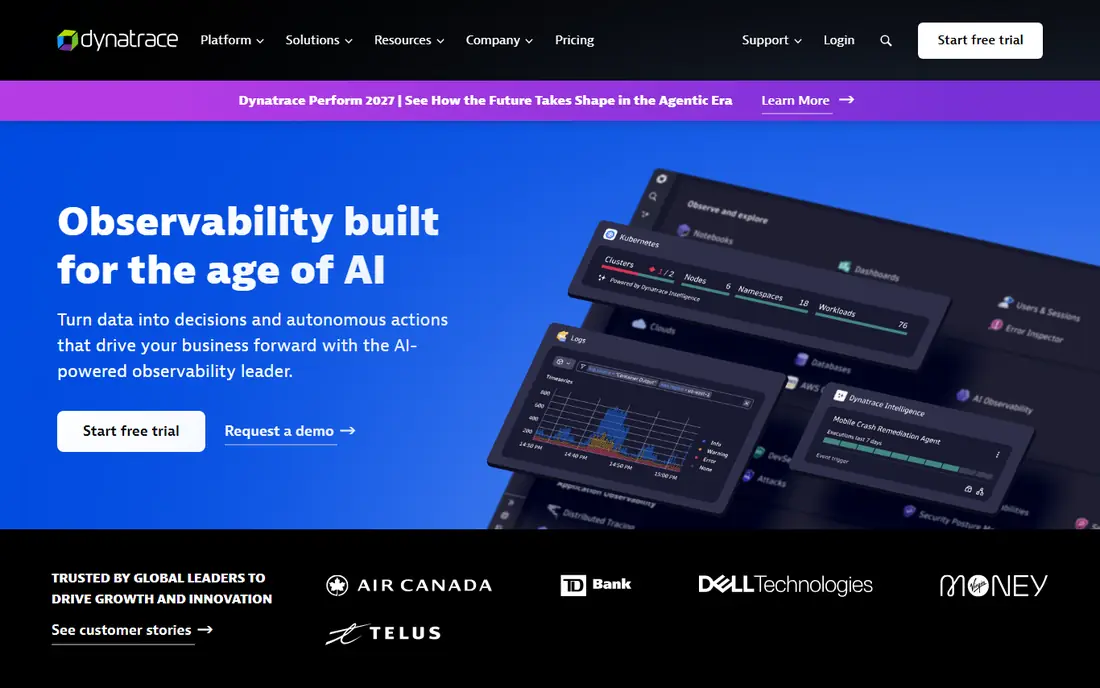
Dynatrace suits teams that use Splunk for logs but also need to explain application failures. It discovers services automatically, links logs to distributed traces and highlights the likely root cause, rather than leaving analysts to join signals by hand. That helps for complex microservices where a log line alone does not explain an outage.
It is an enterprise platform with usage-based pricing, so it is more than a simple log search swap. Teams that only need cheap log storage will find Graylog or OpenSearch more direct. Teams that need logs in the context of application performance will find Dynatrace worth the trial.
- Automatic service discovery
- Logs linked to traces and metrics
- AI-assisted root-cause analysis
- Enterprise pricing, often quoted
- More platform than a team needs for log search alone
New Relic is a good managed option for teams that want logs without a separate log vendor. Logs appear in the same interface as application traces and infrastructure metrics, so you can move from an error log to the slow transaction behind it in a few clicks. The free tier covers a monthly data allowance, which is enough to test with a small service.
Beyond the free tier, pricing depends on data volume and user seats, so model your log volume before a full migration. It is also stronger on observability than on dedicated security analytics, so SIEM-heavy teams should compare Sumo Logic or Elastic security features too. For observability-led teams, New Relic is a practical Splunk alternative.
- Free tier with monthly data allowance
- Logs shown next to traces and metrics
- Simpler query language than Splunk SPL
- Costs rise with data and paid users beyond the free tier
- Some security features sit on higher plans
Sumo Logic suits teams that want to leave log infrastructure behind. As a managed service, it handles ingest, storage and scaling, while offering log search, dashboards and a cloud SIEM layer for security teams. That combination covers both DevOps log work and security investigations in one platform.
Pricing is the part to study. Flexible licensing ties spend to storage and analytics use, so a team with high search volume should model that pattern before migrating. A free tier exists for small use, which helps for a trial. For teams that want managed logs plus security analytics, Sumo Logic is a strong contender.
- Fully managed, no infrastructure to run
- Log search with security analytics
- Flexible licensing for ingest and analytics
- Pricing model needs careful reading
- Costs vary by storage and analytics choices
Graylog is the pick for teams that want to replace Splunk log collection without paying for application monitoring they do not use. The Open edition covers log collection, parsing and search, with a clear interface for analysts. Paid tiers add correlation, security and enterprise features for teams that need them.
Self-hosting is the cost. You run the servers, manage storage and handle upgrades, which suits teams with operations capacity. If you want a free, focused log platform and you can host it, Graylog offers predictable costs and a clear scope. If you want zero hosting, look at Sumo Logic or Logz.io instead.
- Open edition is free
- Clear log collection and search
- Paid tiers add correlation and security features
- Self-hosting needs servers and upkeep
- Advanced correlation sits on paid tiers
- Smaller integration catalog than Datadog
Logz.io suits teams that like the Elastic ecosystem but do not want to run it. It offers a managed log platform with search, dashboards and alerting, plus AI-driven insights that surface unusual patterns in telemetry data. Auto-scaling helps when log volume spikes during an incident.
The trade-off is control. You give up the tuning freedom of self-hosted Elastic in return for less operational work, and larger pricing is usage-based. For teams that want Elastic-style search without cluster management, Logz.io is a useful middle ground between self-hosted Elastic and a full platform like Datadog.
- Managed Elastic-based log platform
- AI-driven insights on telemetry
- Auto-scaling for traffic spikes
- Pricing is usage-based and needs a quote for larger volumes
- Less control than self-hosted Elastic
OpenSearch suits teams that want open source log search with no licence bill. It offers indexing, search, dashboards and alerting, and it can be self-hosted or run through managed services. That freedom matters for teams with strict data control or a policy against vendor lock-in.
As with other open source tools, the bill moves to infrastructure and operations. You need to plan storage, retention and upgrades, or pay a managed provider to do it. For teams that value openness and control above a polished managed experience, OpenSearch is a solid Splunk alternative.
- Free under an open source licence
- Full-text search and dashboards
- No vendor licence fees
- Managed options exist
- You run the infrastructure or pay a managed provider
- Ecosystem is smaller than Elastic in some areas
How we picked these
We compared official feature pages, pricing pages and product docs, and we kept only tools that are live and replace Splunk for log search, observability or security analytics today. We looked for a mix of managed platforms, self-hosted options and open source stacks, and we noted where pricing is usage-based or quoted. Prices are starting rates shown in October 2026 listings, and they change with data volume, so confirm the rate for your ingest and retention needs before migrating.
What to check before you migrate
Start with your log volume and retention needs. Splunk replacements price very differently by ingest, indexing and storage, so a tool that looks cheap at 10 gigabytes a day can look costly at 500 gigabytes a day. List your daily ingest, your required retention and your search patterns, then ask each vendor for a quote on those exact numbers.
Next, test query speed and analyst workflow on your real logs. A platform that is fast for metrics may be slow for full-text log search, and a security team needs different features from a DevOps team. Check parsing, dashboards, alerting, audit trails and data residency together. Finally, plan the migration in stages, starting with a single service or team, so you can compare cost and query results before moving critical security logs.
Frequently asked questions
What are the best Splunk alternatives?
Datadog and New Relic suit managed observability, Elastic Stack and OpenSearch suit search-heavy teams, Graylog suits self-hosted log management, and Sumo Logic suits managed log and security analytics.
What is the best open source Splunk alternative?
Elastic Stack and OpenSearch are the strongest open source options for full-text log search, while Graylog Open suits focused log management. All three are free to download, but you still pay for hosting and upkeep.
Which Splunk alternative is best for observability?
Datadog, New Relic and Dynatrace suit observability, since they link logs to metrics and traces. If you only need log search, Graylog, Elastic or OpenSearch may be cheaper and simpler.
Is there a free Splunk alternative?
Yes. Elastic Stack, OpenSearch and Graylog Open are free to self-host, and New Relic and Sumo Logic offer free tiers for small use. Free software still needs servers, storage and maintenance time.
How much does a Splunk alternative cost?
It depends on log volume, retention and user count. Managed pricing is often per gigabyte ingested or per host, while open source tools shift cost to infrastructure. Model your daily ingest and retention before comparing headline prices.
Sources
See where you really rank - block by block
ProMapRanker scans Google Maps across a grid of your service area. Simple monthly plans from $19, white-label on every plan.
Start freeKeep reading
 venmo alternatives
Venmo Alternatives in 2026: 8 Apps Compared
Venmo alternatives compared for sending money to friends, paying businesses and sending abroad, with fees, speed, limits and free plans explained here.
Read → microsoft access alternatives
Microsoft Access Alternatives in 2026
Looking for microsoft access alternatives? We compare 8 database tools for teams that need web access, sharing, and apps without old desktop limits in 2026.
Read → jamboard alternatives
Best Jamboard Alternatives in 2026
Jamboard closed in 2024, so here are the best Jamboard alternatives for classrooms and teams, from Miro and FigJam to free whiteboards, compared here.
Read →