 ProMapRanker
Best Raspberry Pi Alternatives in 2026


Media and home server performance · Pricing starts at: See website
Key takeaways
- This article covers Raspberry Pi single-board computer alternatives, with real boards that exist and are sold today.
- Libre Computer Le Potato is the cheapest drop-in style pick, while Orange Pi 5 Plus offers far more performance for media and server use.
- Radxa ROCK 5B+ and Orange Pi 5 Ultra class boards suit demanding desktop, media, and development work with up to 32GB of RAM.
- NVIDIA Jetson Orin Nano Super is the specialist pick for AI and robotics, not a general-purpose desktop replacement.
- Check operating system support and accessory needs before buying, since boards vary in software maturity and included parts.
Quick comparison
| Pick | Great for | Pricing starts at | Free tier | |
|---|---|---|---|---|
| Orange Pi 5 Plus | Media and home server performance | See website | No | Visit |
 Radxa ROCK 5B+ | High-performance all-round board | See website | No | Visit |
 Libre Computer Le Potato | Budget Pi-compatible board | See website | No | Visit |
 ODROID N2+ | Home servers and media centers | See website | No | Visit |
 BeagleY-AI | Embedded vision and AI learning | See website | No | Visit |
 NVIDIA Jetson Orin Nano Super | AI and robotics projects | See website | No | Visit |
 ASUS Tinker Board 2S | IoT and robotics projects | See website | No | Visit |
 Orange Pi Zero 3 | Low-cost compact projects | See website | No | Visit |
 ZimaBoard 2 | Home server and NAS projects | See website | No | Visit |
The best raspberry pi alternatives
Raspberry Pi remains popular, but supply, price, and performance needs push many makers to other single-board computers. These nine Raspberry Pi alternatives cover budget builds, home servers, media centers, and AI projects.
Orange Pi 5 Plus is a strong general-purpose upgrade for makers who want more power than a basic Pi. The RK3588S chip handles media playback, home server duties, and desktop Linux work with ease, and higher RAM options help with Docker containers and multitasking. NVMe support gives storage a useful speed boost over microSD alone.
Software is the main caution. Orange Pi OS, Ubuntu, and Debian are available, but support quality varies by release, so check the current image for your use before buying. For a capable home server or media board at a mid-range price, Orange Pi 5 Plus offers excellent performance per dollar.
- Rockchip RK3588S performance
- Up to 16GB of RAM
- NVMe storage support
- Software support varies by operating system
- Accessories sold separately
Radxa ROCK 5B+ is one of the most powerful ARM boards in this list, with an eight-core RK3588 chip, up to 32GB of LPDDR5 RAM, and a neural processor for AI workloads. Dual display output, fast USB, and M.2 expansion suit desktop replacement, development, and media projects that strain smaller boards. It is a genuine step up in capability, not just a Pi clone.
The price reflects that power, and first-time makers may find setup less guided than Raspberry Pi documentation. Check power supply requirements and cooling before ordering. For demanding projects where RAM and CPU headroom matter, ROCK 5B+ is our top performance pick.
- RK3588 chip with 6 TOPS NPU
- Up to 32GB of RAM
- Full-size HDMI and strong expansion
- Higher price than budget boards
- Setup needs more care than a Pi
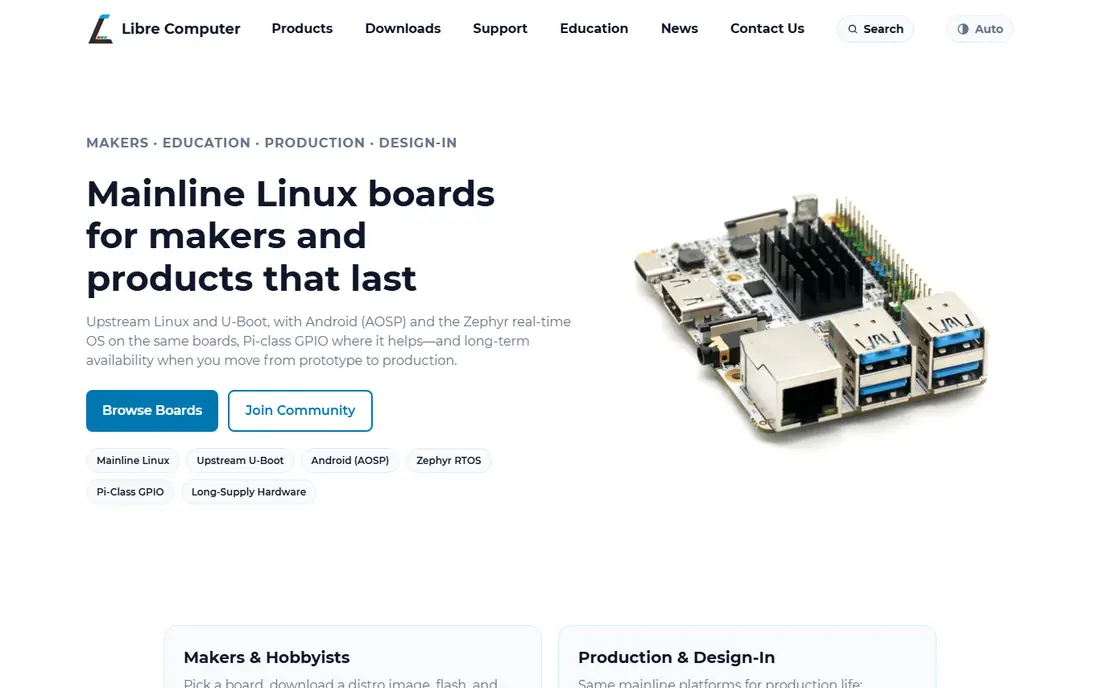
Libre Computer Le Potato, model AML-S90X-CC, is designed to be as close to a Raspberry Pi drop-in replacement as possible. It shares the Pi 2 and 3 form factor and GPIO layout, runs Raspberry Pi OS alongside Ubuntu and Android, and handles 4K video decoding for media centers. For wired home servers and learning projects, it is excellent value.
The limits are clear. There is no onboard wireless, so Wi-Fi needs a USB dongle, and 2GB of RAM caps heavier multitasking. Still, at a budget price, Le Potato is the easiest switch for makers who already know Pi hardware and software. Buy it for simple, wired projects rather than a desktop replacement.
- Same form factor as Pi 2 and 3
- Raspberry Pi OS support
- Low price for basic projects
- No onboard Wi-Fi or Bluetooth
- Only up to 2GB of RAM
ODROID N2+ from Hardkernel is a proven board for home servers, media centers, and light gaming. Its six-core processor handles media playback and server software well, and the board has a loyal community sharing images and guides. It strikes a useful balance between budget boards and high-end RK3588 options.
The ecosystem is smaller than Raspberry Pi, so expect fewer ready-made cases and accessories. Power and cooling choices also matter for always-on use. For a reliable home server or media center that runs for months without fuss, ODROID N2+ remains a respected choice.
- Six-core performance
- Good media playback
- Active community for server use
- Accessories and case sold separately
- Smaller ecosystem than Pi
BeagleY-AI is built for embedded vision and AI learning rather than general computing. Its TI AM67A processor includes DSP and AI acceleration for camera and sensor projects, and the BeagleBoard community supports open hardware development. Students and engineers learning embedded AI will find it a focused, well-documented platform.
It is not the best pick for a desktop or media center, since its strengths lie in vision and real-time tasks. Software support is narrower than Pi, though BeagleBoard images are solid for the intended uses. Choose BeagleY-AI when your project centers on cameras, sensors, and on-device AI.
- TI AM67A chip with AI accelerators
- Strong for machine vision
- Open hardware community
- Less suited to general desktop use
- Smaller software library than Pi
NVIDIA Jetson Orin Nano Super is the AI specialist here, with 67 INT8 TOPS of AI performance for robotics, vision, and edge inference. The NVIDIA software stack, including JetPack and CUDA tools, gives developers a mature path from prototype to deployed model. Robots, smart cameras, and local AI demos are its natural home.
Price, power, and cooling are all higher than a typical Pi project, and it is overkill for a simple server or media center. Developers who need real AI throughput will find it worth the cost, while casual makers should pick a cheaper board. For AI and robotics, no other board here matches its performance.
- Strong AI performance at 67 INT8 TOPS
- Good for robotics and vision
- NVIDIA software stack
- Higher price
- Needs more power and cooling than small boards
ASUS Tinker Board 2S suits IoT, robotics, and maker projects that need solid I/O and reliable performance. Its six-core Rockchip chip handles control, sensing, and light media work, and onboard storage options reduce reliance on microSD cards. ASUS branding also gives some buyers confidence in build quality and support.
The board costs more than budget alternatives, and its community is smaller than Raspberry Pi, so tutorials are fewer. For classroom, IoT, and robotics projects where reliability matters, Tinker Board 2S is a solid mid-range pick. Check current operating system images before committing to a classroom rollout.
- Six-core Rockchip performance
- Good I/O for IoT
- Onboard storage option
- Higher price than budget rivals
- Community smaller than Pi
Orange Pi Zero 3 is the budget compact pick, offering built-in Wi-Fi, Ethernet, and enough performance for embedded projects at a low price. It suits home automation nodes, small servers, retro gaming experiments, and sensor projects where size and cost matter more than raw speed. Its value undercuts many Pi Zero alternatives.
Desktop use and heavy multitasking will strain its limited resources, and software images need checking for your specific project. For small, headless projects that run quietly in the background, Orange Pi Zero 3 is an excellent cheap board. Buy a spare, since the price makes experimentation painless.
- Very low price
- Built-in Wi-Fi and Ethernet
- Compact size for embedded projects
- Limited RAM and performance for desktop use
- Software support varies
ZimaBoard 2 takes a different route by using x86 architecture instead of ARM, which widens software compatibility for home servers and network storage. It suits NAS builds, media servers, and self-hosted services where x86 software support matters. Expansion options help with storage and networking for always-on use.
It costs more than ARM boards and uses more power, so it is not a like-for-like Pi replacement for battery or tiny projects. For a compact home server that runs standard x86 server software, ZimaBoard 2 is a practical alternative. Confirm storage and case options before ordering, since builds vary.
- X86 architecture for wide software compatibility
- Good for NAS and home server use
- Expansion options
- Higher price than ARM boards
- Larger and more power-hungry than a Pi
How we picked these
We compared official board pages, specifications, and recent single-board computer roundups for boards sold in October 2026. We included budget, mid-range, high-performance, AI, and x86 options so readers can match a board to project type. Prices are marked See website because board prices vary by retailer, RAM option, and kit contents, and quoting a single retailer price would mislead. Specifications noted are from vendor pages and reputable roundups.
How to choose a single-board computer
Start with the project, not the spec sheet. A home server needs storage and networking, a media center needs video decoding, a robot needs I/O and AI, and a learning project needs documentation. Write down the must-have features, including RAM, storage type, wireless, GPIO, and display output, then shortlist boards that meet all of them. A faster chip does not help if the board lacks the port your project needs.
Check software before you buy. Confirm that a current operating system image exists for your use, that updates are recent, and that the community has guides for your project type. Raspberry Pi wins on documentation, so alternatives require more checking. Also budget the full kit, since most boards ship without a power supply, case, storage, or cables, and those extras change total cost.
Finally, think about power and heat for always-on projects. A board that runs hot in a closed case will throttle or fail early, so allow for a case with airflow or a heatsink where needed. Test with a spare microSD card first, so a bad image does not risk your main setup.
Frequently asked questions
What are the best Raspberry Pi alternatives?
Orange Pi 5 Plus, Radxa ROCK 5B+, and Libre Computer Le Potato are among the best Raspberry Pi alternatives. Le Potato suits budget Pi-compatible projects, Orange Pi 5 Plus suits media and servers, and ROCK 5B+ suits high-performance work.
Is there a cheap Raspberry Pi alternative?
Yes. Libre Computer Le Potato and Orange Pi Zero 3 are both low-cost boards for basic projects. Le Potato suits Pi-style learning and wired servers, while Zero 3 suits compact, headless projects with Wi-Fi.
Which Raspberry Pi alternative is best for a home server?
Orange Pi 5 Plus and ODROID N2+ are strong picks for home servers, thanks to performance and storage options. ZimaBoard 2 suits NAS builds where x86 software compatibility matters.
Which board is best for AI and robotics?
NVIDIA Jetson Orin Nano Super is the best pick for AI and robotics, with 67 INT8 TOPS of AI performance and NVIDIA software support. BeagleY-AI suits embedded vision learning at a lower price.
Can Raspberry Pi alternatives run Raspberry Pi OS?
Some can, including Libre Computer Le Potato, which is designed for Pi compatibility. Most other boards run their own Linux images, Ubuntu, or Debian, so check operating system support for your chosen board.
Do single-board computers include a power supply and case?
Usually not. Most boards ship as the board alone, so budget for a suitable power supply, microSD card or SSD, case, and cables. Kit bundles exist for some boards but cost more than the board alone.
Sources
See where you really rank - block by block
ProMapRanker scans Google Maps across a grid of your service area. Simple monthly plans from $19, white-label on every plan.
Start freeKeep reading
 who has best internet service
Who Has the Best Internet Service in 2026
Who has best internet service for US homes? We compare fiber, cable, fixed wireless and satellite providers on speed, price, availability and terms today.
Read → which survey tool has the best analytics
Which Survey Tool Has the Best Analytics in 2026
Find which survey tool has the best analytics in 2026, comparing Qualtrics, SurveyMonkey, Typeform, Alchemer, and more on reports, text, and stats today.
Read → which streaming service has the best movies
Which Streaming Service Has the Best Movies in 2026
Answering which streaming service has the best movies, with Netflix, Max, Criterion and more compared on libraries, prices and free options in this guide.
Read →