 ProMapRanker
Best Paycor Alternatives in 2026

Key takeaways
- Paylocity is the closest direct mid-market rival to Paycor, with HR, payroll, time, learning, and engagement in one platform.
- Gusto and OnPay suit smaller US teams that want published pricing and fast setup, while Rippling suits firms that want HR, payroll, and IT together.
- ADP Workforce Now and Paychex Flex suit larger or more complex payroll needs, with broad compliance and service depth.
- BambooHR suits HR-first teams that need core HR and onboarding more than deep payroll complexity.
- Most mid-market platforms price by quote, so ask every vendor to price the same module list before you compare.
Quick comparison
| Pick | Great for | Pricing starts at | Free tier | |
|---|---|---|---|---|
 Gusto | Small US payroll teams | $49 per month | No | Visit |
 Rippling | HR, payroll, and IT together | See website | Free trial | Visit |
 Paylocity | Mid-market HCM | See website | Free trial | Visit |
 ADP Workforce Now | Complex mid-market payroll | See website | Free trial | Visit |
 Paychex Flex | Scalable payroll and HR | $39 per month | No | Visit |
 BambooHR | Core HR for growing teams | See website | Free trial | Visit |
 OnPay | Simple transparent payroll | $49 per month | No | Visit |
 Deel | Global hiring and payroll | See website | Free trial | Visit |
 Justworks | PEO for small teams | See website | Free trial | Visit |
The best Paycor alternatives
We compared HR and payroll platforms on payroll coverage, HR depth, recruiting, time tracking, benefits, compliance, and pricing transparency. Paycor itself is not listed, since this guide covers alternatives to it, and we note where pricing is published versus quote based.
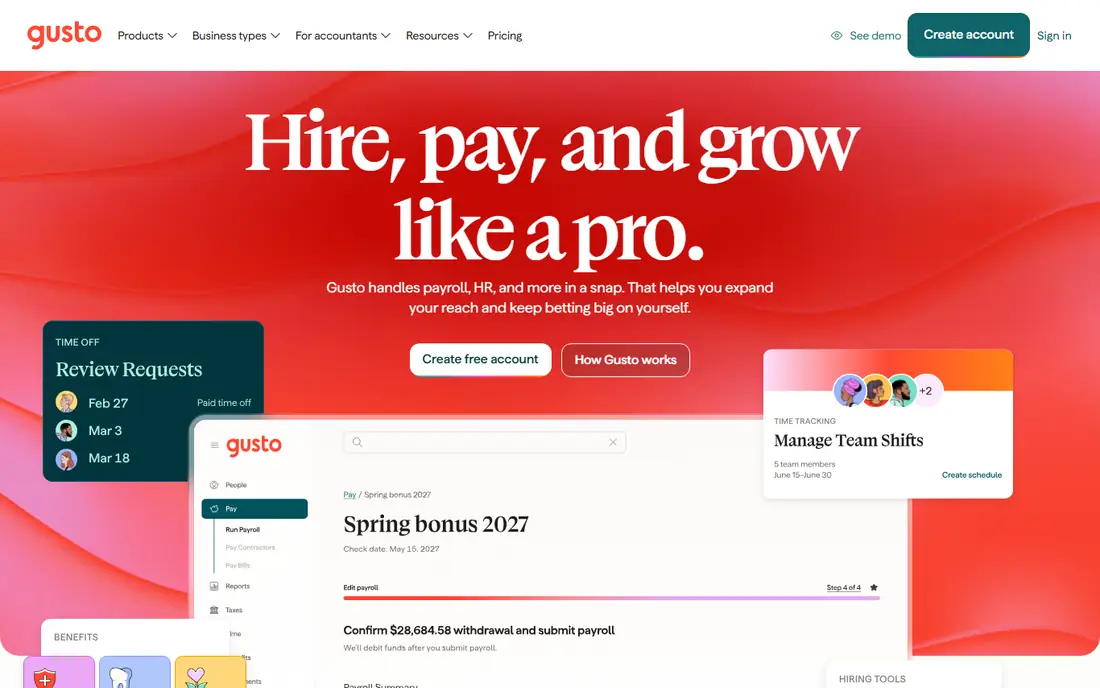
Gusto is our pick for smaller US teams leaving Paycor for simplicity and price transparency. The Simple plan starts at $49 per month plus $6 per person, with higher tiers adding HR, time tracking, and performance tools. Payroll runs, tax filings, and benefits live in one clean interface, and setup is faster than a typical mid-market HCM implementation.
The limit is scale. Teams above 100 employees, or firms with complex multi-entity payroll, often need the depth that Paylocity, ADP, or Paychex offer. Global hiring also needs care, since Gusto Global is delivered through a partner. For a US team under 100 that wants payroll done well without a long sales cycle, Gusto is a strong first shortlist pick.
- Published pricing with a low entry tier
- Full 50-state US payroll
- Automated tax filings and benefits administration
- HR depth is thinner than Paycor for larger firms
- Global hiring is delivered through a partner, not natively
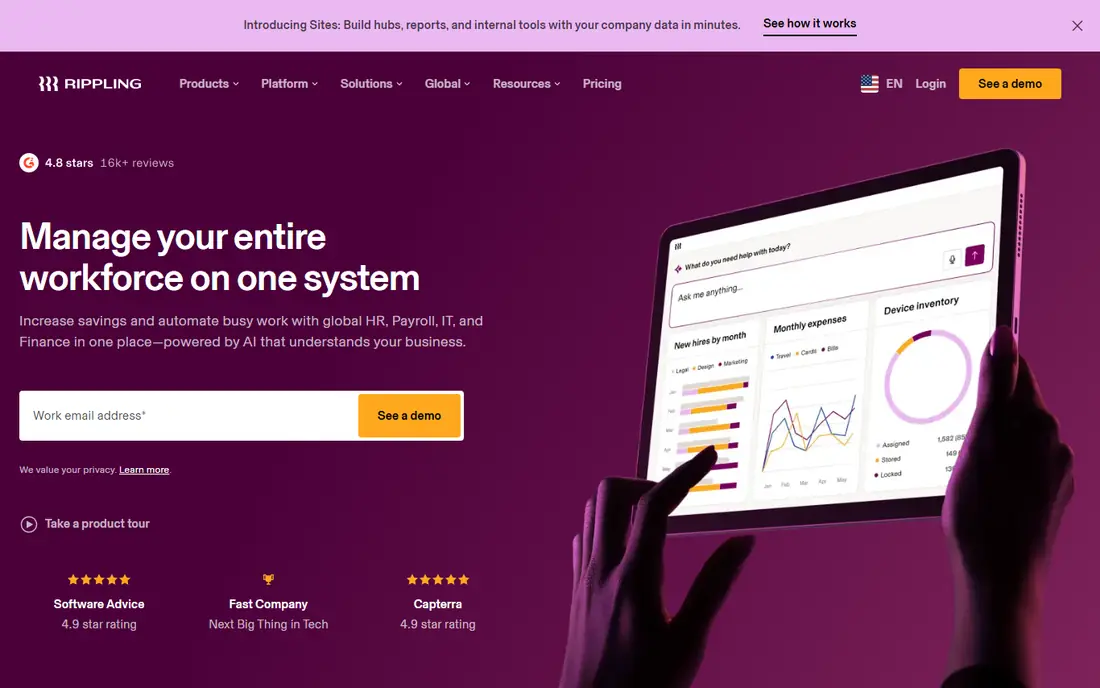
Rippling suits firms that want Paycor HR depth plus IT automation. When HR records a hire or a departure, Rippling updates payroll, app access, and devices together, which cuts manual work and stale accounts. That automation is the main reason firms choose Rippling over a payroll-only tool, since it ties people data to systems access in one place.
Pricing is quote based, so ask for a breakdown by module, including payroll, HR, benefits, and IT. A firm that only needs payroll may find Rippling more than it needs, but a firm planning to modernize HR and IT together will see the value. Trial the joiner and leaver flows with real HR data before you commit, since those flows are where Rippling earns its price.
- HR, payroll, IT, and device management in one platform
- Automation driven by HR data
- Strong app provisioning
- Quote based pricing
- Best value when you adopt several modules together
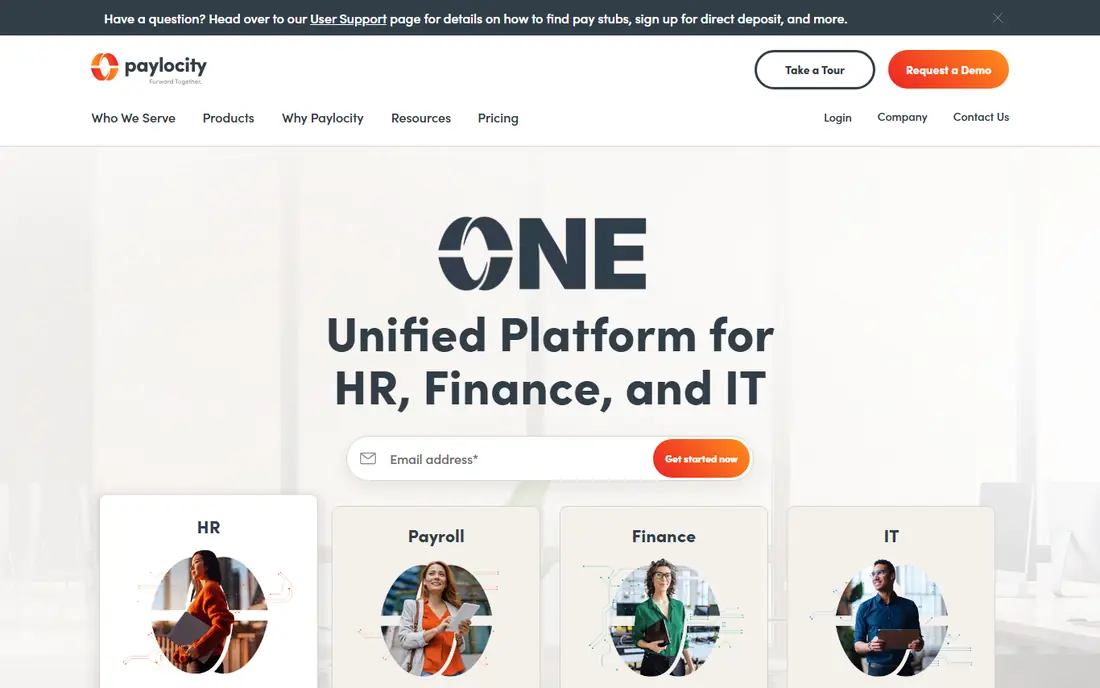
Paylocity is the closest direct Paycor rival for mid-market firms. It covers payroll, HR, time and attendance, recruiting, learning, and employee engagement in one platform, with a focus on communication and community features that Paycor matches less directly. For firms with 50 to 1,000 employees, Paylocity offers a similar breadth without the Paychex ownership question that now surrounds Paycor.
Implementation is a real project, typically measured in weeks, and pricing needs a quote based on modules and headcount. Ask for the same module list you would ask Paycor for, including payroll, time, benefits, and learning, so the comparison is fair. For mid-market firms that want a full HCM replacement, Paylocity should be first on the shortlist.
- Full HCM with payroll, HR, time, learning, and engagement
- Strong community and engagement features
- Large independent mid-market vendor
- Pricing is quote based
- Implementation takes weeks, not days
ADP Workforce Now suits firms with complex pay rules, multi-state payroll, and a need for proven compliance depth. ADP has handled payroll at scale for decades, and its marketplace covers many accounting, time, and benefits integrations. That depth helps firms with shift differentials, multi-entity setups, or complex benefits that simpler tools handle less well.
The trade-off is complexity and sales process. Pricing is quote based, setup takes time, and smaller teams may find the platform heavier than Gusto or BambooHR. For firms where payroll accuracy and compliance matter more than a slick interface, ADP remains a safe, scalable pick, and it pairs well with a separate HR tool if you do not need full HCM depth in one place.
- Deep payroll compliance across states
- Large integration marketplace
- Scalable from mid-market to enterprise
- Pricing is quote based
- Interface and setup can feel heavier than newer rivals
Paychex Flex is a practical Paycor alternative, especially since Paychex now owns Paycor, which makes Flex a related but distinct platform choice. Essentials starts at $39 per month plus $5 per employee in published pricing, with higher tiers adding HR, time, and benefits depth. A PEO option also exists for firms that want to outsource more HR responsibility.
Check tier details carefully, since payroll, HR, and benefits features differ across Flex tiers. A firm that buys Essentials expecting full HCM depth will be disappointed, while a firm that prices the right tier gets a scalable platform with strong service support. For firms that want a vendor with both software and service options, Flex is a solid shortlist pick.
- Published entry pricing for Essentials
- Payroll, HR, benefits, and PEO options
- Scales from small to large firms
- Higher tiers are quote based
- Feature depth varies by tier, so check module inclusion carefully
BambooHR suits HR-first teams that need a clean system of record more than deep payroll complexity. Core HR, onboarding, time off, and basic reporting work well for small to mid-size firms, and the interface is easier for non-HR managers than many HCM platforms. That simplicity helps when HR is a team of one or two people.
Payroll is available, but it is not the center of BambooHR in the way it is for Paycor or Paylocity. Firms with complex payroll should pair BambooHR with a dedicated payroll tool or choose a payroll-first platform instead. For firms whose main gap is HR organization, onboarding, and employee data, BambooHR is a strong, focused pick.
- Clean core HR, onboarding, and time off
- Easy for small HR teams
- Good reporting for headcount and turnover basics
- Payroll is an add-on and less central than in Paycor
- Pricing is quote based for many plans
OnPay is the simplest transparent alternative for small US firms. At $49 per month plus $6 per worker, it covers payroll across all 50 states, with tax filings and compliance reminders built in. Setup is fast, pricing is clear, and there is no long sales cycle to learn the cost.
It does not try to be a full HCM platform. Recruiting, learning, and deep engagement features are thinner here than in Paycor or Paylocity, and global hiring is not covered. For a small firm that mainly needs payroll done correctly at a known price, OnPay is an excellent pick. For a firm that needs full HR depth, pair it with BambooHR or choose a full HCM platform instead.
- Published flat pricing
- Multi-state payroll with compliance reminders
- Simple setup for small US firms
- HR depth is thinner than full HCM platforms
- No global payroll
Deel suits firms that hire across borders, which is a gap for US-centered Paycor alternatives. It handles employer of record services, contractor payments, and global payroll compliance in many countries, so a firm can hire abroad without setting up a local entity in each place. That global reach is the reason distributed teams choose Deel over a US payroll tool.
US domestic payroll alone is not where Deel shines, and pricing depends on whether you hire employees through an employer of record, run global payroll, or pay contractors. Get a quote by country and hiring type, since a single headline rate does not cover all models. For firms with a real global footprint, Deel belongs on the shortlist alongside Rippling.
- Employer of record and contractor management in many countries
- Global payroll and compliance
- Strong fit for distributed teams
- US-only payroll is not its main strength
- Pricing varies by hiring model and country
Justworks suits small firms that want to outsource more HR responsibility, not just buy software. As a professional employer organization, it handles payroll, tax filings, benefits administration, and compliance support under a co-employment model. That model can give small teams access to benefits and support that would be hard to arrange alone.
Co-employment is also the main decision point. Your firm shares employer responsibilities with Justworks, which suits firms that want support but not firms that want full control over every HR process. Pricing is quote based in many cases, so ask for a clear per-employee cost and a list of included benefits. For small teams that want payroll plus benefits plus compliance help in one relationship, Justworks is a strong alternative path.
- PEO model with payroll, benefits, and compliance handled together
- Simple pricing structure for small firms
- Good benefits access for small teams
- PEO means Justworks co-employs staff, which changes the HR relationship
- Pricing is quote based for many setups
How we picked these
We compared official product and pricing pages for HR and payroll platforms that cover a meaningful part of what Paycor offers, from payroll and tax filing to HR, recruiting, time, and benefits. We kept platforms that are live in October 2026, that serve US firms or global firms with US operations, and that fit a clear company size or hiring model. We excluded point tools that only handle scheduling or only handle recruiting, since those do not replace Paycor as a platform.
How to choose by company size
Under 50 employees, start with published pricing. Gusto and OnPay give you a clear monthly cost, fast setup, and full US payroll without a sales cycle. Add BambooHR if HR organization matters more than payroll depth, or Justworks if you want a PEO to handle benefits and compliance for you. Do not buy a full HCM platform at this size unless you have complex needs that justify the implementation time.
From 50 to 1,000 employees, shortlist Paylocity, Rippling, ADP Workforce Now, and Paychex Flex, and ask each to price the same modules. Include payroll, time, benefits, recruiting, and learning in the request, and ask about implementation time, data migration, and support model. Above 1,000 employees, or with a global footprint, add Deel for international hiring and test ADP or Workday style enterprise depth alongside mid-market HCM. In every case, run a parallel payroll for at least one cycle before you switch, since payroll errors cost trust fast.
Frequently asked questions
What are the best Paycor alternatives?
Paylocity is the closest mid-market HCM rival, while Gusto and OnPay suit smaller teams, Rippling suits HR plus IT automation, and ADP Workforce Now and Paychex Flex suit complex payroll. BambooHR suits HR-first teams, Deel suits global hiring, and Justworks suits firms that want a PEO. The best pick follows your headcount, payroll complexity, and global needs.
Is Paylocity better than Paycor?
For many mid-market firms, Paylocity matches Paycor on HCM breadth and adds stronger engagement and community features, while Paycor has historically led on workforce analytics and recruiting reach. Since Paychex acquired Paycor, Paylocity is now the largest independent pure-play mid-market HCM vendor, which matters to firms that prefer an independent vendor. The right choice depends on which modules you actually use.
Which Paycor alternative is cheapest for small businesses?
Gusto and OnPay both start at $49 per month plus $6 per person in published pricing, which makes them the clearest low-cost options for small US teams. Paychex Flex Essentials starts at $39 per month plus $5 per employee, though higher tiers cost more. Quote based platforms may cost more or less depending on modules, so compare the same module list across vendors.
Can I switch from Paycor without losing payroll history?
Yes, with planning. Export payroll history, employee records, tax filings, and benefits data before you migrate, and confirm what the new vendor can import. Run parallel payroll for at least one cycle, check tax filings and direct deposits carefully, and keep Paycor access until the new system has completed a full payroll and a quarter-end check.
Does Gusto handle global hiring?
Gusto handles US payroll directly, and its global hiring for employees abroad is delivered through a partner, Remote, rather than natively. If global hiring is central, Deel or Rippling may be a better fit, since they offer employer of record and global payroll more directly. Check the partner arrangement and per-country pricing before you rely on it for a large international team.
What is the difference between HCM software and a PEO?
HCM software, such as Paycor or Paylocity, gives you tools to run HR and payroll yourself. A PEO, such as Justworks, co-employs your staff and handles payroll, benefits, and compliance on your behalf, for a fee. Software gives you more control, while a PEO gives you more outsourced support, which suits small teams that lack a large HR staff.
Sources
See where you really rank - block by block
ProMapRanker scans Google Maps across a grid of your service area. Simple monthly plans from $19, white-label on every plan.
Start freeKeep reading
 who has best internet service
Who Has the Best Internet Service in 2026
Who has best internet service for US homes? We compare fiber, cable, fixed wireless and satellite providers on speed, price, availability and terms today.
Read → which survey tool has the best analytics
Which Survey Tool Has the Best Analytics in 2026
Find which survey tool has the best analytics in 2026, comparing Qualtrics, SurveyMonkey, Typeform, Alchemer, and more on reports, text, and stats today.
Read → which streaming service has the best movies
Which Streaming Service Has the Best Movies in 2026
Answering which streaming service has the best movies, with Netflix, Max, Criterion and more compared on libraries, prices and free options in this guide.
Read →