 ProMapRanker
Local Pack Ranking Factors: What Drives the Top Three Spots

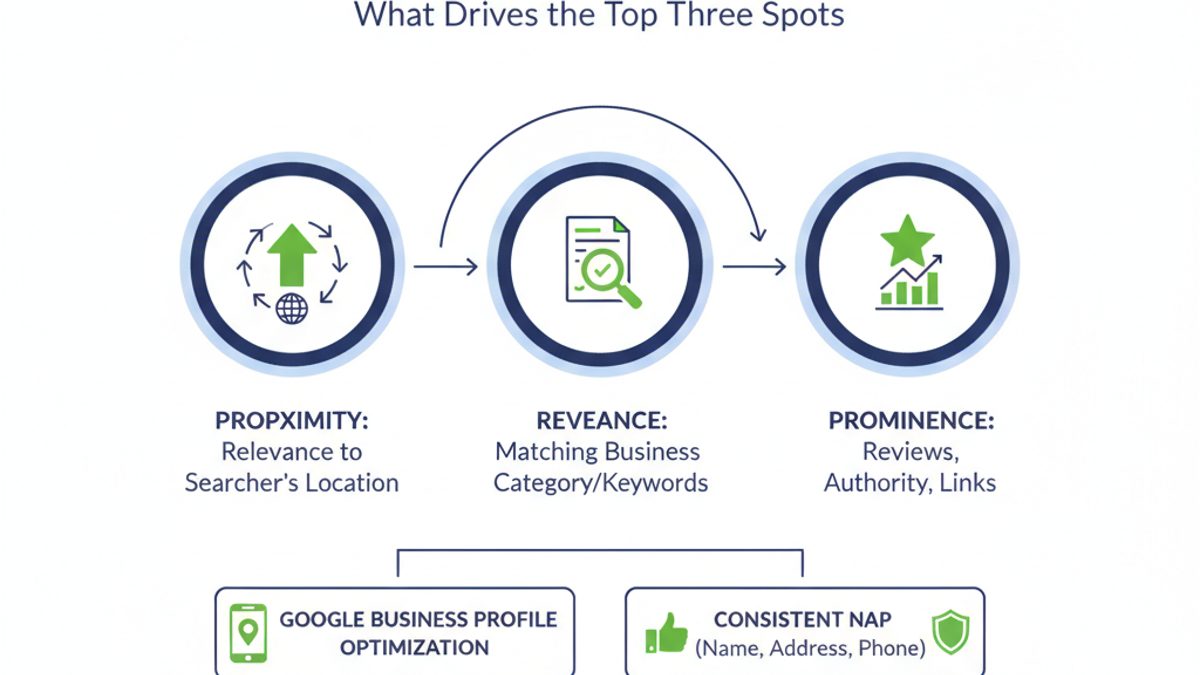
As Md Shihab Mia, founder of ProMapRanker, I've spent years dissecting the complexities of local search algorithms. The Google Local Pack, often called the 3-Pack, showcases the top local businesses directly within search results, driving immense visibility and customer traffic. Ranking in these coveted top three spots is primarily determined by three core factors: Proximity, how close your business is to the searcher; Relevance, how well your Google Business Profile (GBP) and website match the search query; and Prominence, your business's overall online authority and reputation. Mastering these elements through meticulous Google Business Profile optimization, website SEO, and consistent reputation management is crucial for local pack success.
What are the primary local pack ranking factors?
The primary local pack ranking factors are Proximity, Relevance, and Prominence, working in concert to determine which businesses appear in the top three results. Google's algorithm evaluates how close your business is to the searcher, how accurately your business information and services match the query, and your business's overall online reputation and authority. Optimizing for these three pillars is fundamental for achieving and maintaining high local rankings.
Google explicitly states that local results are based primarily on relevance, distance, and prominence. Understanding how each factor contributes to your ranking strategy is essential:
- Proximity: This is arguably the most influential factor, especially for "near me" searches. Google prioritizes businesses closest to the searcher's physical location or the location specified in the query.
- Relevance: Your business must be highly relevant to the search query. This means your Google Business Profile categories, services, description, and website content should accurately and comprehensively describe what you offer.
- Prominence: This refers to how well-known and authoritative your business is online and offline. It's a measure of your overall reputation, reflected through reviews, links, citations, and even real-world recognition.
How does proximity influence local pack rankings?
Proximity is a critical local pack ranking factor, directly measuring the physical distance between a searcher's location and a business's verified address. Google's algorithm heavily favors businesses that are geographically closest to the user's current location or the location specified in their search query. Even a slight distance difference can significantly impact visibility, making precise location data and service area optimization vital.
For many local searches, proximity is the single most defining factor. Consider a search for "plumber near me." Google will prioritize plumbers within a very tight radius of the searcher's exact location. This is why a business might rank #1 for a search conducted a block away but drop significantly for a search five miles out.
Understanding Proximity's Nuances:
- Searcher's Location: Google uses GPS data from mobile devices or IP addresses for desktop users to determine the searcher's precise location.
- Query Location: If a search includes a specific location (e.g., "coffee shop in downtown Austin"), Google prioritizes businesses within that defined area, regardless of the searcher's current location.
- Business Address: Your verified address in your Google Business Profile is the central anchor point for proximity calculations. Ensure it's accurate and consistent across all online platforms.
- Service Area Businesses (SABs): If you don't have a physical storefront but serve customers at their locations (e.g., plumbers, electricians), you'll define a service area in your GBP. While you won't appear on the map at a specific point, Google will still consider the centroid of your service area and the searcher's location. For SABs, optimizing your website for specific towns and neighborhoods within your service area becomes even more critical.
At ProMapRanker, our geo-grid rank tracker is designed specifically to visualize the impact of proximity. It performs searches from multiple points on a grid (e.g., a 5x5 grid at 1, 3, 5, 7, and 10-mile radii) around your business, showing exactly where you rank and how those rankings shift with distance. This granular data is indispensable for understanding your true local footprint.
How does relevance impact local search results?
Relevance dictates how well your business's offerings align with a user's search query, primarily driven by your Google Business Profile and website content. Google assesses keywords in your GBP categories, services list, business description, and on your linked website to determine if your business provides what the searcher is looking for. A precise and comprehensive portrayal of your services directly boosts your relevance score for specific queries.
Achieving high relevance means meticulously detailing every aspect of your business that could match a potential customer's need. This isn't about keyword stuffing, but about providing clear, accurate, and comprehensive information.
Key Relevance Signals:
- Google Business Profile Categories: These are arguably the most crucial relevance factor. Choose the most specific primary category and add all relevant secondary categories. For example, a "Dentist" might also list "Cosmetic Dentist" and "Orthodontist."
- Google Business Profile Services: Detail all services you offer within your GBP. Use keywords that potential customers would search for.
- Business Description: Use your GBP description to naturally include keywords and phrases that describe your business and its unique selling propositions.
- Website Content: Ensure your website's landing pages, service pages, and blog posts are rich with relevant keywords and detailed information about your products and services. Google crawls your linked website to understand your offerings better.
- Posts and Q&A: Regularly publishing Google Business Profile posts and actively answering questions in the Q&A section can introduce new relevant keywords and signal activity to Google.
Our free GBP audit at ProMapRanker helps identify gaps in your categories, services, and description, ensuring your profile is fully optimized for maximum relevance.
What is prominence, and how does it affect local rankings?
Prominence reflects a business's overall authority, reputation, and online presence, signaling to Google how well-known and trustworthy it is. This factor is built through a combination of positive customer reviews, high-quality backlinks to your website, consistent NAP (Name, Address, Phone) citations across directories, and the general strength of your website's SEO. Businesses with greater prominence are perceived as more established and reliable, earning them higher local pack positions.
Prominence is Google's way of determining which businesses are respected and well-regarded in their community and online. It's a holistic measure that combines several signals.
Elements of Prominence:
- Online Reviews:
- Quantity: More reviews generally mean more prominence. Aim for a consistent flow of new reviews.
- Quality/Sentiment: High star ratings (e.g., 4.5+ out of 5) are crucial. Positive sentiment in review text can also be a ranking signal.
- Recency: Recent reviews are more impactful than old ones. Actively solicit new reviews.
- Response Rate: Responding to all reviews, positive or negative, shows engagement and professionalism.
- Review Diversity: Reviews from various platforms (Google, Yelp, Facebook, industry-specific sites) contribute to a broader prominence signal.
According to a BrightLocal study, 85% of consumers trust online reviews as much as personal recommendations. This highlights their importance not just for rankings, but for conversions too.
- Citations:
- NAP Consistency: Your business Name, Address, and Phone number (NAP) must be identical across all online directories (e.g., Yelp, Yellow Pages, Facebook, industry-specific sites). Inconsistent NAP data can confuse Google and dilute your prominence.
- Quantity & Quality: Aim for citations on 20+ high-authority, relevant directories. Prioritize those relevant to your industry and location.
ProMapRanker's NAP consistency checker helps identify and rectify discrepancies that can hurt your prominence.
- Link Building:
- Quality & Relevance: Backlinks from authoritative, locally relevant websites (e.g., local news sites, chamber of commerce, community blogs) signal trust and authority to Google.
- Quantity: A healthy number of diverse backlinks contributes to overall domain authority, which indirectly boosts local prominence.
- Website Authority & SEO:
- Organic Ranking Power: A website that ranks well organically for non-local keywords often has higher domain authority, which can spill over into local pack rankings.
- Technical SEO: A technically sound website (fast loading, mobile-friendly, secure HTTPS, proper schema markup) provides a strong foundation for prominence.
- User Experience: Factors like low bounce rate, high dwell time, and good Core Web Vitals (LCP under 2.5s, INP under 200ms, CLS under 0.1) indicate a positive user experience, which Google values.
- Offline Prominence:
- Brand Recognition: While harder to measure directly, Google's algorithm may factor in real-world brand recognition, such as mentions in local news or public perception.
- Claim and Verify Your Profile: This is the absolute first step. You cannot optimize what you don't control.
- Complete All Sections:
- Business Name: Use your exact legal business name. Do not keyword stuff.
- Categories: Select the most specific primary category and add all relevant secondary categories. This is critical for relevance.
- Address: Ensure it's precise and matches your real-world location (for storefronts). For SABs, set your service area correctly.
- Phone Number: Use a local number if possible, consistent with your website.
- Website URL: Link to your primary business website.
- Hours of Operation: Keep these updated, especially for holidays.
- Services/Products: Detail everything you offer. This is a huge relevance signal.
- Business Description: Write a concise, keyword-rich (natural, not stuffed) description of your business.
- Attributes: Add relevant attributes like "wheelchair accessible," "free Wi-Fi," "online appointments," etc.
- Upload High-Quality Photos and Videos:
- Profile photo, cover photo, exterior, interior, team photos, photos of your work.
- Businesses with photos receive 42% more requests for directions and 35% more clicks to their websites than businesses without photos (Google).
- Actively Manage Reviews:
- Encourage customers to leave reviews.
- Respond to every review, positive or negative. Personalized responses are key.
- Publish Google Posts:
- Regularly share updates, offers, events, or product news. This signals activity and provides fresh content for Google.
- Answer Questions in Q&A:
- Monitor and respond to questions asked by users. You can also proactively add your own FAQs.
- Local Keyword Optimization:
- Include local keywords (e.g., "plumber [city name]", "HVAC repair [neighborhood]") naturally on your homepage, service pages, and blog content.
- Create dedicated landing pages for specific services or locations if you serve multiple areas.
- Schema Markup:
- Implement LocalBusiness schema markup on your website. This tells search engines specific details about your business (name, address, phone, hours, services) in a structured format.
- Also consider Product, Service, and Review schema.
- Mobile-Friendliness:
- Ensure your website is responsive and provides an excellent experience on mobile devices. Most local searches happen on smartphones.
- Page Speed and Core Web Vitals:
- Optimize for fast loading times. Google prioritizes websites that offer a good user experience. Aim for LCP (Largest Contentful Paint) under 2.5 seconds, INP (Interaction to Next Paint) under 200 milliseconds, and CLS (Cumulative Layout Shift) under 0.1.
- You can check your site's performance using Google's PageSpeed Insights.
- Content Quality and Depth:
- Create valuable, informative content that answers potential customer questions and demonstrates your expertise.
- This includes service pages, location-specific pages, FAQs, and blog posts addressing common problems your business solves.
- Internal and External Linking:
- Use internal links to connect relevant pages on your site, helping Google understand your site structure.
- Earn high-quality backlinks from other reputable websites to boost your domain authority, a key aspect of prominence.
- NAP Consistency on Website:
- Ensure your Name, Address, and Phone number are consistently displayed in your website's footer and contact page, matching your GBP exactly.
- Google Business Profile Optimization (Relevance & Prominence)
- [ ] Claim and verify your GBP.
- [ ] Complete all fields accurately: Name, Address, Phone, Website, Hours.
- [ ] Select the most specific primary category and all relevant secondary categories.
- [ ] Add a comprehensive list of all services and products.
- [ ] Write a compelling, keyword-rich business description.
- [ ] Upload high-quality photos and videos (exterior, interior, team, work samples).
- [ ] Actively solicit new customer reviews.
- [ ] Respond to ALL reviews promptly and professionally.
- [ ] Publish Google Posts regularly (offers, updates, events).
- [ ] Monitor and answer questions in the Q&A section.
- Website Optimization (Relevance & Prominence)
- [ ] Ensure NAP consistency across your website and GBP.
- [ ] Optimize website content with local keywords (city, neighborhood names).
- [ ] Implement LocalBusiness schema markup on your contact/homepage.
- [ ] Verify mobile-friendliness and responsive design.
- [ ] Improve page speed and Core Web Vitals (LCP < 2.5s, INP < 200ms, CLS < 0.1).
- [ ] Create high-quality, informative content relevant to local search queries.
- [ ] Build high-quality, local backlinks to your website.
- Citation & Reputation Management (Prominence)
- [ ] Audit and ensure NAP consistency across all major online directories (Yelp, Facebook, industry-specific sites).
- [ ] Build citations on 20+ high-authority, relevant directories.
- [ ] Monitor mentions of your business online and address any inaccuracies.
- Proximity & Geo-Targeting (Proximity)
- [ ] Ensure your physical address in GBP is accurate and verified.
- [ ] For Service Area Businesses, clearly define your service area.
- [ ] Use a geo-grid rank tracker (like ProMapRanker) to monitor your rankings from various points around your business.
- [ ] Optimize website content for specific neighborhoods and towns within your service radius.
ProMapRanker Insight: SoLV & ARP
Our ProMapRanker platform introduces advanced metrics like Share of Local Voice (SoLV) and Average Ranking Position (ARP). SoLV measures your percentage of top local rankings across a grid compared to competitors, giving you a clear picture of your overall local search visibility. ARP tracks your average position across all search points. Both are crucial for understanding and improving your prominence over time, allowing you to prove SEO ROI to local clients.
Ready to see your true local prominence? Start tracking with ProMapRanker today!
What role does Google Business Profile optimization play?
Google Business Profile (GBP) optimization is foundational for local pack rankings, acting as the primary data source Google uses to understand your business. A fully completed, accurate, and actively managed GBP directly influences all three core ranking factors: Proximity (verified address), Relevance (categories, services, description), and Prominence (reviews, posts). It's the single most impactful tool for local SEO.
Think of your GBP as your digital storefront on Google. Without it, or with an incomplete one, Google struggles to present your business accurately to local searchers.
Essential GBP Optimization Steps:
For a comprehensive guide, check out our Google Business Profile optimization checklist. ProMapRanker's GBP audit tool can quickly pinpoint areas for improvement, helping you achieve maximum visibility.
How important is website SEO for local pack rankings?
Website SEO, though not as direct as GBP optimization, significantly contributes to local pack rankings by strengthening prominence and relevance. A well-optimized website with strong technical foundations, relevant content, and authoritative backlinks signals to Google that your business is legitimate and trustworthy. It supports your GBP by providing deeper information, improving user experience, and ultimately boosting your overall online authority, which is a key component of local prominence.
Your website serves as the ultimate source of truth about your business beyond the concise details in your GBP. Google uses it to validate and expand upon the information it has.
Key Website SEO Factors for Local Pack Success:
Checklist for Boosting Your Local Pack Rankings
This actionable checklist summarizes the critical steps to optimize for Proximity, Relevance, and Prominence, driving your business into the top three local pack spots.
Frequently asked questions
How long does it take to rank in the local pack?
Ranking in the local pack is not an instant process; it typically takes 3 to 6 months to see significant results from consistent optimization efforts. Factors like competition level, the age of your business, and the intensity of your SEO strategy can influence this timeline, but continuous improvement is key to sustaining top positions.
Can I rank in the local pack without a physical address?
Yes, you can rank in the local pack without a physical storefront if you operate as a Service Area Business (SAB). You must hide your physical address in your Google Business Profile and define specific service areas. However, without a physical location for Google to anchor to, your proximity ranking is based more on the centroid of your service area and the searcher's location.
What's the difference between local pack rankings and organic search rankings?
Local pack rankings display businesses on a map and in a three-listing snippet, specifically for geographically-oriented searches, pulling data primarily from Google Business Profiles. Organic search rankings, conversely, list websites based on overall relevance and authority for broader queries, without a direct map integration, and primarily rely on traditional website SEO signals.
How important are customer reviews for local rankings?
Customer reviews are extremely important for local rankings, significantly contributing to your business's prominence and trust signals. Quantity, quality (star rating), recency, and your responses to reviews all play a role. Businesses with more positive, recent reviews and active engagement tend to rank higher in the local pack.
Do local SEO ranking factors change frequently?
While the core local SEO ranking factors (Proximity, Relevance, Prominence) remain consistent, the weighting and specific signals Google uses within these categories can evolve. Google continuously refines its algorithm, often with minor updates, to provide the most accurate and useful local results. Staying updated with best practices and monitoring your rankings with tools like ProMapRanker is crucial.
What is a geo-grid rank tracker, and why do I need it?
A geo-grid rank tracker, like the one offered by ProMapRanker, performs local searches from multiple specific points on a grid around your business or service area. It shows you exactly how your rankings fluctuate across different locations, providing crucial insights into the impact of proximity. This granular data helps you pinpoint areas of weakness and optimize your strategy more effectively than single-point tracking.
See where you really rank - block by block
ProMapRanker scans Google Maps across a grid of your service area. Simple monthly plans from $19, white-label on every plan.
Start free