 ProMapRanker
Best Scheduling Software for Gyms in 2026


Established studios and multi-location fitness businesses · Pricing starts at: $79 per month per location (Starter)
Key takeaways
- PushPress is the best value for an independent gym, with a free Core plan and Pro at $159 a month, all month to month with no contract.
- TeamUp is the simplest choice for a class-based studio, at $119 a month for up to 100 customers with every feature included.
- Zen Planner fits CrossFit boxes and martial arts schools, from $99 a month, with programming and skill tracking built in.
- Mindbody starts at $79 a month per location, but the upper tiers are quote only and the branded app costs extra.
- The scheduling feature that matters most is the waitlist, because it fills cancelled class spots without extra work from the front desk.
Quick comparison
| Pick | Great for | Pricing starts at | Free tier | |
|---|---|---|---|---|
| Mindbody | Established studios and multi-location fitness businesses | $79 per month per location (Starter) | No | Visit |
 TeamUp | Class-based studios with memberships and courses | $119 per month (up to 100 customers) | Free trial (14 days) | Visit |
 Zen Planner | Boutique studios, martial arts schools and CrossFit affiliates | $99 per month (Studio, 0-45 active members) | Free trial | Visit |
 PushPress | Independent gyms and CrossFit boxes | $0 (Core Free; Pro $159 per month) | Yes | Visit |
 ABC Glofox | Boutique fitness studios that want a branded member app | $99 per month | No | Visit |
 Wodify | CrossFit boxes that want WODs and leaderboards | quote only | No | Visit |
 WellnessLiving | Small studios that want scheduling and marketing together | $69 per month (Starter) | Free trial (14 days) | Visit |
 Vagaro | Solo trainers and small studios on a tight budget | $30 per month (1 bookable calendar) | Free trial (30 days) | Visit |
The best scheduling software for gyms
Mindbody
Great for: Established studios and multi-location fitness businesses
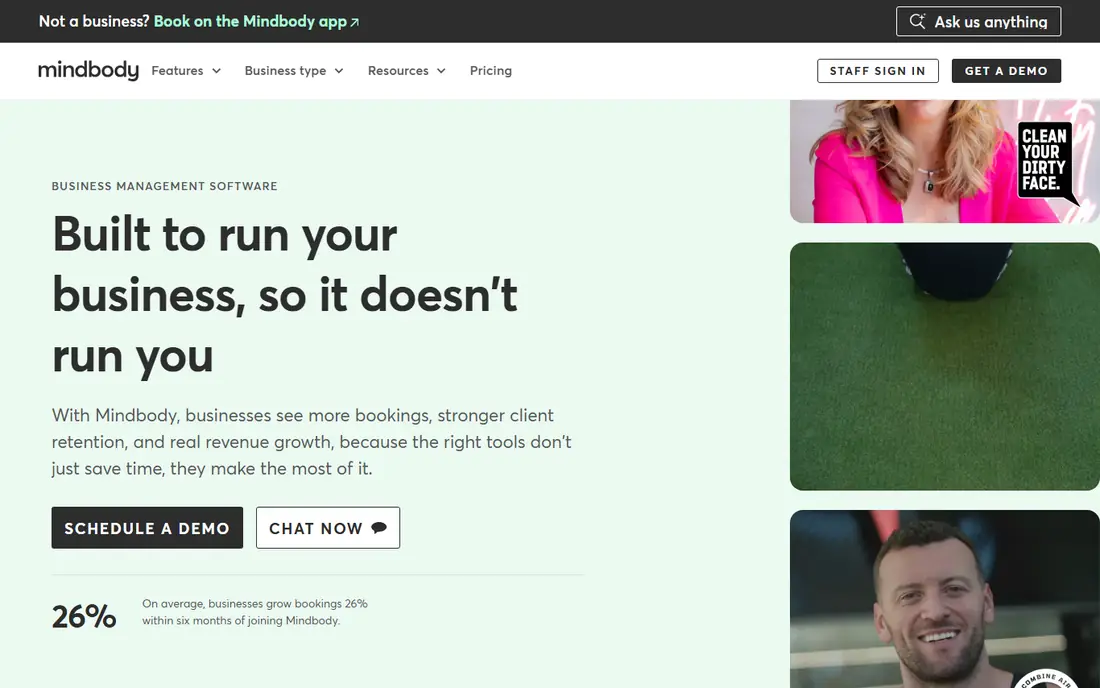
Mindbody is the biggest name in fitness scheduling, and its main strength is the consumer marketplace. Members can find and book classes through the Mindbody app, which brings new clients to a studio that would not find it otherwise. The Starter plan starts at $79 a month per location and includes class scheduling, payments, a branded booking widget, a marketplace listing and basic reporting, with unlimited users at each location. Accelerate and Ultimate add analytics, room and resource management, reserved spots and marketing automation.
The price beyond Starter is the problem. Accelerate and Ultimate are quote only, so you cannot compare them to the rest of this list without a sales call, and owners report roughly $99 to $159 a month for Starter and $499 or more for Ultimate. The branded mobile app is an extra add-on on the higher tiers and is not available on Starter at all. Card processing rates are not published either, and marketplace bookings carry a 20 percent fee on a new client first purchase, capped at $30. For an established studio that can use the marketplace, Mindbody is still a strong choice, but get every price in writing before you sign.
- Large consumer marketplace brings new members
- Unlimited users per location
- Upper tiers are quote only
- Branded app is an extra add-on, not included in Starter
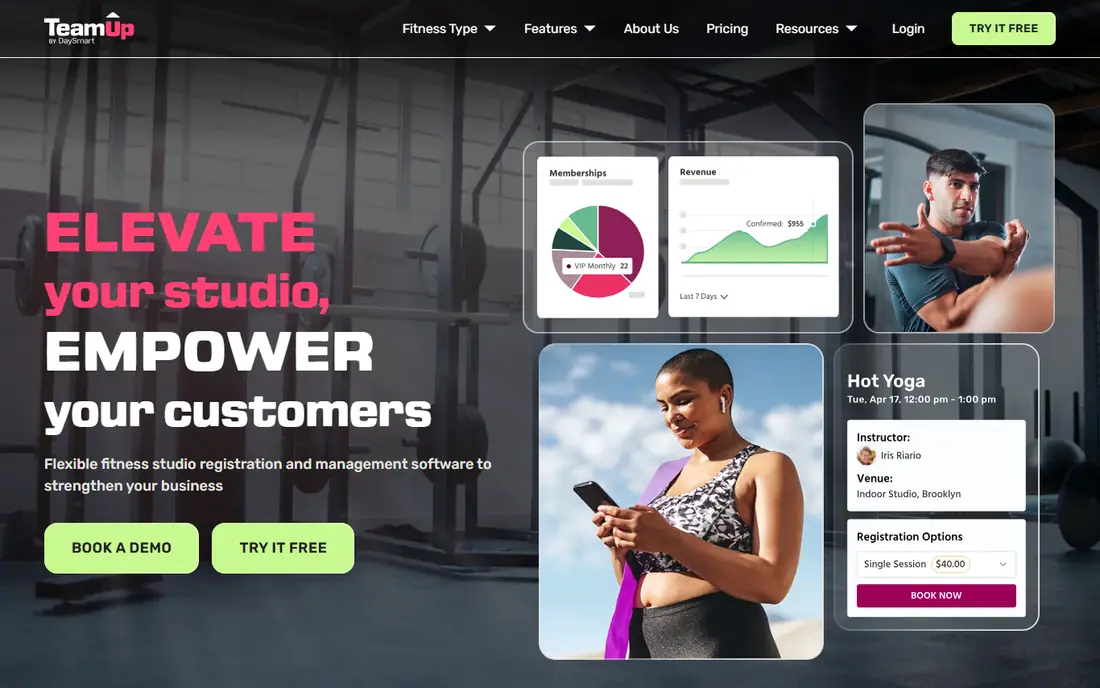
TeamUp is the simplest pricing model on this list. Every customer gets the full feature set, and the only thing that changes the price is the active customer count, starting at $119 a month for up to 100 customers and rising in bands as the count grows. That covers class scheduling, recurring timetables, memberships, class packs, courses, payments and reporting, with no tiers to climb and no features held back. The 14-day trial lets you test it on your real timetable before you commit, and there is no setup fee.
The catch is the branded app, which costs $99 a month extra, so a studio that wants its own app will pay $218 a month at the entry band. TeamUp also has no free plan, only the trial, and it is built for class-based studios rather than open gyms, so a facility that sells mostly open access will find some features less useful. For a studio running classes, memberships and courses together, TeamUp is the most honest pricing on this list, and the lack of upsell makes it easy to budget a year ahead.
- Every feature included at every price
- Price changes only with customer count
- Branded app is a $99 a month add-on
- No free plan, only a trial
Zen Planner
Great for: Boutique studios, martial arts schools and CrossFit affiliates
Zen Planner is the specialist pick for gyms where programming is the product. Belt tracking for martial arts, WOD logging for CrossFit boxes and attendance workflows are native features, not bolt-ons, and the automated billing includes failed-payment recovery that wins back real revenue. Pricing starts at $99 a month for the Studio plan with up to 45 active members, with Essentials and Ultimate tiers above it, reaching $289 a month at the top Studio band. The platform also covers scheduling, memberships, retail and reporting.
The real bill is higher than $99 once you add the common modules. The website module is $99 a month, marketing is $249 a month, and the branded app is $39 a month, so a gym that takes the core plus the common modules can pass $480 a month. Zen Planner is also heavier to set up than a simpler tool, because there is more to configure. For a martial arts school or a CrossFit affiliate that needs skill tracking and programming, the depth is worth it. For a general gym that only needs classes and billing, a simpler tool will cost less.
- Programming, WOD logging and belt tracking built in
- Automated billing with failed-payment recovery
- Common modules cost extra and push the real bill higher
- Branded app is a $39 a month add-on
PushPress is the value pick for an independent gym. The Core Free plan costs $0 a month with unlimited members, and the subscription tiers are published in full: Pro at $159 a month and Max at $229 a month, all month to month with no contract. The platform covers class scheduling, membership billing, check-ins and a member app, with Stripe-based payment processing. That transparency is rare in this market, where most vendors hide their prices behind a sales call, and it makes PushPress easy to compare against the rest of this list.
The trade off is that some features are add-ons. Workout tracking starts from $79 a month, lead follow-up tools are a separate module, and the branded app costs extra, so a gym that wants the full stack will pay more than the $159 Pro figure. Card processing on the free plan is also higher, at 4.99 percent plus 30 cents, against 2.89 percent on Pro. Even with the add-ons, PushPress undercuts the legacy vendors by a wide margin. For a CrossFit box or an independent gym that wants clear prices and no contract, it is the first tool to shortlist.
- Free Core plan with unlimited members
- Transparent prices and no annual contract
- Workout tracking and lead follow-up are separate add-ons
- Branded app costs extra
ABC Glofox is built for boutique fitness studios that want the member experience to feel like their own brand. The branded app carries your logo and colours, and members book classes, buy memberships and manage their accounts from it. Class, appointment and membership management are solid, and the platform covers lead capture, waitlists and push notifications. Ownership by ABC Fitness means the product keeps getting investment, and it now sits alongside Mindbody in the same group. Entry starts at $99 a month, with four plans listed, though only the entry figure is published.
The limits are price transparency and scale. The upper tiers, Boost, Elite and Enterprise, are quoted by sales, and field reports put Elite near $250 to $400 a month and Enterprise above $500, so a growing studio cannot budget the full stack from the pricing page alone. Multi-location management also sits on the higher plans, which makes Glofox a weaker fit for a franchise that is still small. For a single boutique studio that wants a premium branded app and is happy to talk to sales, Glofox is one of the best-looking options on this list.
- Branded member app looks like your own product
- Strong class and membership management
- Upper tiers are quoted by sales
- Multi-location features sit on higher plans
Wodify is built for CrossFit boxes, and it shows in the member experience. Athletes log WODs, track personal records, check the leaderboard and book classes from the app, while coaches manage programming, attendance and billing from the same system. That focus is why boxes choose Wodify over a general gym tool, because the daily workout is the product and the software treats it that way. The platform also covers memberships, retail and reporting, and it integrates with the tools a box already uses.
The drawback is that Wodify does not publish a price, so you cannot compare it to the rest of this list without a sales conversation and a custom quote. That makes budgeting harder, and it puts Wodify at a disadvantage against PushPress and Zen Planner, which both publish their prices. Wodify is also less suited to a general gym, because the WOD and leaderboard features are wasted on a facility that does not run programmed classes. For a CrossFit affiliate that wants the workout at the centre of the software, Wodify is worth a demo.
- WOD tracking, leaderboards and coach tools built for CrossFit
- Strong member app
- No published price, so budgeting needs a sales call
- Less suited to general gyms
WellnessLiving
Great for: Small studios that want scheduling and marketing together
WellnessLiving is a scheduling and business platform for small fitness and wellness studios, and its strength is that marketing sits next to the timetable. The Starter plan is $69 a month and covers online booking, class scheduling, client management and basic marketing, with higher tiers adding automated campaigns, rewards and advanced reporting. Members can book classes, buy memberships and manage their accounts online, and the system sends reminders that cut no-shows. A 14-day trial lets you test it on your real timetable.
The limits appear as the studio grows. The higher tiers climb fast, and some features that look included on the pricing page turn out to need a higher plan, so the real bill for a busy studio is higher than the $69 entry figure. Support is also thinner than the bigger vendors, with fewer onboarding resources for a team that is switching systems for the first time. For a small studio that wants scheduling and marketing in one low-cost system, WellnessLiving is a sensible pick. For a larger gym, a specialist platform will usually fit better.
- Scheduling, marketing and rewards in one system
- Low Starter price
- Higher tiers climb fast and hide some features
- Support is thinner than bigger vendors
Vagaro is the budget option for a solo trainer or a very small studio. The base subscription is $30 a month for one bookable calendar, with each extra calendar at $10 a month, and the ladder stops at seven licences, so a seven-coach studio pays $90 a month before add-ons. That price includes online booking, a client database, basic marketing and a listing in the Vagaro marketplace. A six-month introductory rate of $23.99 a month is often shown on the pricing page before the list price applies.
Vagaro is not gym software, and that is the limit. There are no membership plans, no WOD logging, no check-in system and no class capacity management of the kind a gym needs, so a growing gym will outgrow it fast. Forms, text marketing and the website builder are all add-ons with their own monthly fees, and those can push the real bill well above $30. Even so, for a solo trainer who books sessions one to one, Vagaro is the cheapest way to take bookings online, and the 30-day trial gives you a full month to test it.
- Low starting price with a cap on calendar fees
- Marketplace listing brings new clients
- No gym features such as memberships, WODs or check-ins
- Forms and text marketing are extra add-ons
Scheduling cost by gym type
| Gym type | Best pick | Monthly subscription | What you give up | | Solo trainer | Vagaro | $30 | No memberships, no check-ins | | CrossFit box | PushPress Pro | $159 | Workout tracking is an add-on | | CrossFit box | Zen Planner Studio | $99 | Modules push the real bill higher | | Class-based studio | TeamUp | $119 | Branded app costs $99 extra | | Boutique studio | ABC Glofox | $99 | Upper tiers are quote only | | Small studio | WellnessLiving Starter | $69 | Higher tiers climb fast | | Multi-location group | Mindbody Starter | $79 per location | Branded app costs extra, upper tiers quote only |
How we chose
We compared vendor pricing pages, product documentation and feature lists for each tool on 14 November 2026. Prices here come from the pricing pages linked in Sources, and where a vendor hides the price we wrote quote only instead of guessing. We did not claim hands-on testing. The ranking reflects fit for a gym schedule: class timetable quality, waitlists, recurring classes, coach scheduling, price transparency, and how the cost scales as the member count grows.
What to check before you buy
Ask whether the plan includes a waitlist that fills cancelled class spots automatically, because that single feature can recover hours of lost revenue each week. Check whether recurring classes and coach schedules are supported, since a gym timetable repeats weekly and re-entering it by hand wastes time. Confirm whether the branded app is included or an add-on, because on several tools here it costs $39 to $99 a month extra. Ask about contract length and cancellation terms, since some tools are month to month while others lock you in. Test the member booking flow on a phone, because a clumsy app loses class bookings.
Frequently asked questions
What is the best scheduling software for a gym?
For most gyms, PushPress is the best pick, because the Core plan is free and Pro at $159 a month covers scheduling, billing and check-ins with no contract. If you run classes and courses together, TeamUp at $119 a month is simpler, and Zen Planner at $99 a month suits CrossFit boxes and martial arts schools. The right tool depends on whether you run classes, open gym or both.
How is scheduling software different from booking software?
Booking software is the member-facing side, the page or app where members pick a class and confirm. Scheduling software is the full timetable behind it, with recurring classes, coach schedules, rooms, capacity limits and waitlists. Most gym tools do both, but a tool can have good booking and weak scheduling, so check the timetable features before you buy.
How much does gym scheduling software cost?
Expect $0 to $159 per month for tools with published prices, with PushPress free at the low end and Pro at $159. Mindbody starts at $79 a month per location, TeamUp at $119 a month, Zen Planner at $99 a month, and WellnessLiving at $69 a month. ABC Glofox and Wodify are quote only above the entry tier, so you need a sales call to learn the full price, and card processing sits on top of every subscription.
Does scheduling software handle waitlists?
Yes, most gym tools include a waitlist that moves members into a class automatically when a spot opens. Mindbody, TeamUp, Zen Planner, PushPress and ABC Glofox all support waitlists, though the feature may sit on a higher tier on some tools. A waitlist matters most for popular classes that fill up, because it recovers revenue from cancellations without extra work from the front desk.
Can I schedule recurring classes?
Yes, every tool on this list supports recurring classes, so a weekly timetable can be set once and repeated. TeamUp, Zen Planner and PushPress make it simple to copy a week of classes forward, while Mindbody adds room and resource management for studios that share space. Check that recurring classes are included in the plan you buy, because some tools keep advanced scheduling on a higher tier.
Sources
See where you really rank - block by block
ProMapRanker scans Google Maps across a grid of your service area. Simple monthly plans from $19, white-label on every plan.
Start freeKeep reading
 best scheduling software for med spas
Best Scheduling Software for Med Spas in 2026
Compare the best scheduling software for med spas, with real prices and calendar features, so you can run staff schedules and waitlists without double bookings.
Read → best scheduling software for law firms
Best Scheduling Software for Law Firms
Compare the best scheduling software for law firms, with real 2026 prices, intake forms, and calendar sync, so clients can book easily without phone tag.
Read → best scheduling software for dentists
Best Scheduling Software for Dentists in 2026
Compare the best scheduling software for dentists, with real 2026 prices, chairside features and booking tools, so you can pick the system your practice needs.
Read →