 ProMapRanker
Geo-Grid Visibility Metric: The Single Number That Captures Local Reach

As Md Shihab Mia, founder of ProMapRanker, I'm here to demystify one of the most powerful metrics in local SEO. The geo-grid visibility metric is a single, quantifiable score that represents your business's average local search ranking across a defined geographical area on Google Maps. Instead of relying on a single ranking from your business's address, this metric captures your true local reach by aggregating performance from multiple search points within a grid, providing an immediate, clear picture of your dominance or weakness in a specific service area. It simplifies complex local search data into an actionable number, revealing where you truly stand against competitors and guiding your strategy to capture more local customers.
What is the Geo-Grid Visibility Metric?
The geo-grid visibility metric is an aggregated score reflecting a business's average local search ranking across a specific grid of locations in Google Maps. It provides a holistic view of local search performance, moving beyond single-point rankings to reveal true local market penetration for a given keyword or set of keywords.
Traditionally, local businesses might check their ranking by searching from their own physical address. However, Google's local search results are highly dynamic and personalized, meaning a user searching a few miles away might see vastly different results. The geo-grid visibility metric addresses this by simulating searches from numerous points within a defined radius, typically a grid like 5x5 or 7x7, with each point representing a distinct search location. For example, a 5x5 grid with 1-mile spacing covers a 25-square-mile area, performing 25 individual searches.
Each search point yields a ranking for your business for the target keyword (e.g., "plumber near me," "best pizza"). These individual rankings are then averaged or weighted to produce a single, comprehensive visibility score. A higher score (meaning lower average rank number) indicates better overall visibility across that geographical footprint. This approach offers a far more accurate and actionable understanding of your local reach than any single-point check ever could.
Why is a Single Geo-Grid Visibility Score Crucial for Local Businesses?
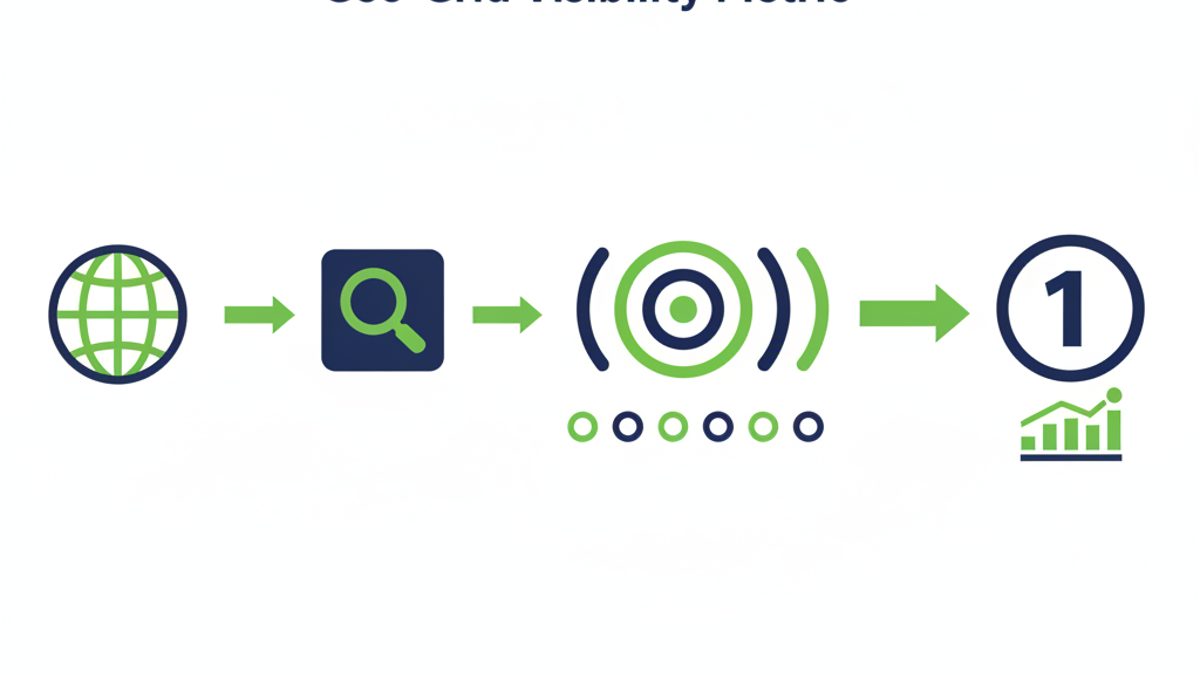
This single metric simplifies complex local search data, offering a clear benchmark for performance and easy communication of progress. It helps businesses understand their actual reach, identify weak spots, and prioritize SEO efforts to dominate their service areas effectively and efficiently.
For local businesses, understanding their true reach is paramount. A single geo-grid visibility score offers several critical advantages:
- Holistic Performance View: It moves beyond the limited perspective of a single ranking point (your business address) to show how you perform across your entire service area. This reveals areas where you're strong and, more importantly, where you're virtually invisible.
- Simplified Reporting: For agencies and businesses alike, a single number is easier to track, report, and understand than dozens of individual ranking positions. It provides a clear, digestible KPI for local SEO success.
- Strategic Resource Allocation: By identifying specific grid points or clusters with low visibility, you can strategically allocate resources. Perhaps a particular neighborhood needs more targeted local citations, community engagement, or an optimized Google Business Profile (GBP) address.
- Competitive Benchmarking: This metric allows you to directly compare your local search performance against key competitors across the same grid. You can see who is truly dominating which areas and why, informing your competitive strategy.
- Demonstrable ROI: When showing clients or stakeholders the impact of SEO efforts, a tangible increase in their geo-grid visibility score provides clear evidence of progress and justifies continued investment.
- Early Warning System: A drop in your overall geo-grid visibility score can signal a broader issue before it severely impacts your bottom line, allowing for proactive adjustments to your local SEO strategy.
How is the Geo-Grid Visibility Metric Calculated?
The metric is typically derived by performing multiple Google Maps searches from various points within a defined geographical grid. Each point's ranking for a target keyword is recorded, and these individual rankings are then averaged or weighted to produce a single, comprehensive visibility score.
The calculation process involves several key steps:
- Define the Grid: First, you select a central point (usually your business address) and then define the grid's size and spacing. Common configurations include a 5x5 grid with 1-mile spacing, which generates 25 distinct search points, or a 7x7 grid with 0.5-mile spacing, generating 49 points. The choice depends on the density of your service area and the granularity of data you need.
- Select Keywords: You choose the primary and secondary keywords for which you want to track visibility (e.g., "dentist," "emergency dental care," "dental implants").
- Simulate Searches: Specialized tools, like ProMapRanker, simulate Google Maps searches from each of these grid points. This involves sending requests to Google's API as if a user were physically located at that specific latitude and longitude and searching for the chosen keywords.
- Record Rankings: For each search point and keyword, the tool records your business's ranking position in the local pack (typically the top 3 results) and organic Google Maps results. If your business doesn't appear, it's often assigned a placeholder rank (e.g., 20 or 30) to represent its absence from the top results.
- Aggregate Scores: Finally, all the individual rankings from each grid point are combined. A simple approach is to calculate the arithmetic mean of all rank positions. More sophisticated methods, such as those used by ProMapRanker, might apply weighting to give more significance to higher rankings (e.g., a rank of #1 having more positive impact than a rank of #10). The resulting single number is your geo-grid visibility metric for that keyword and grid.
This process is repeated for each keyword you wish to track, providing a multi-faceted view of your local search performance.
What Factors Influence Your Geo-Grid Visibility Score?
A business's geo-grid visibility is influenced by traditional local SEO factors like Google Business Profile optimization, local citations, online reviews, and website authority. Proximity of the searcher to the business, prominence, and relevance are key ranking signals Google uses across the grid.
Google's local ranking algorithm primarily relies on three core factors, often referred to as the "Big 3":
- Proximity: This is arguably the most significant factor influencing geo-grid visibility. Google aims to show results closest to the searcher's perceived location. The further away a grid point is from your business, the harder it is to rank well, especially if competitors are closer. Optimizing for proximity is inherently why geo-grid tracking is so valuable.
- Prominence: How well-known is your business? This encompasses a range of signals:
- Reviews: Quantity, quality, and recency of customer reviews are crucial. Businesses with a high volume of positive reviews and a strong average star rating (e.g., 4.5+) tend to rank higher. Responding to all reviews further boosts prominence. According to Google's guidelines, review snippets can also enhance search appearance.
- Citations: Consistent Name, Address, Phone (NAP) information across numerous online directories (e.g., Yelp, Yellow Pages, industry-specific sites) signals legitimacy and prominence. Aim for consistency on at least 20+ authoritative local citation sites. Learn more about top local citation sites.
- Links & Mentions: Inbound links from other reputable websites and mentions of your business name (even without a link) contribute to your online authority and prominence.
- Relevance: How well does your Google Business Profile (GBP) match what someone is searching for?
- GBP Categories: Selecting the most accurate and specific primary and secondary categories is vital. Google uses these to understand what your business offers. Explore effective Google Business Profile categories.
- GBP Services & Products: Filling out your services and products sections thoroughly, using keywords customers might search for, helps Google match your business to relevant queries.
- GBP Description & Posts: While less impactful than categories, a well-written description and regular GBP posts using relevant keywords can reinforce relevance.
Other influencing factors include:
- Google Business Profile Optimization: A complete, accurate, and actively managed GBP is fundamental. This includes current hours, up-to-date photos, Q&A responses, and regular posts. Discover how to optimize your Google Business Profile.
- Website SEO: A fast, mobile-friendly website with relevant content and proper local schema markup (e.g., LocalBusiness schema) supports your GBP. Core Web Vitals, such as an INP (Interaction to Next Paint) under 200ms and LCP (Largest Contentful Paint) under 2.5s, are critical for user experience and ranking. Learn more about Core Web Vitals.
How Does the Geo-Grid Visibility Metric Relate to Share of Local Voice (SoLV)?
The geo-grid visibility metric is a foundational component of Share of Local Voice (SoLV), which quantifies a business's total market presence compared to competitors. While visibility score measures your presence, SoLV expands on this by integrating competitor data to show your percentage of local search dominance.
Think of it this way:
- Your geo-grid visibility metric tells you, "On average, for this keyword across this grid, my business ranks #X." It's a measure of your absolute performance.
- Share of Local Voice (SoLV) then takes that data and asks, "Compared to my top 3, 5, or 10 competitors, what percentage of the local search market am I capturing?" It's a measure of your relative market share.
ProMapRanker's SoLV metric goes beyond just your rankings. It analyzes the entire competitive landscape within your geo-grid. For each grid point and keyword, it identifies which businesses are appearing in the top local pack results. By aggregating this data, ProMapRanker can calculate what percentage of potential local searches your business appears for, relative to your specified competitors. This means if you rank #1 for a specific point, you capture 100% of the "voice" for that point, but if a competitor ranks #1, they capture it. SoLV gives you a true competitive benchmark, showing you not just how well you're doing, but how well you're doing compared to those you're trying to outrank. Understand the power of Share of Local Voice.
For instance, if your geo-grid visibility score improves from an average rank of 7 to 5, that's good. But if your SoLV also jumps from 30% to 50%, it means you're now appearing more frequently and prominently than your rivals, directly translating into more potential customer impressions and clicks.
Step-by-Step: Improving Your Geo-Grid Visibility Score
Improving your geo-grid visibility requires a systematic approach to local SEO, focusing on Google's core ranking factors. Here's a practical checklist:
- Conduct a Thorough Google Business Profile Audit:
- Ensure your GBP is 100% complete with accurate information (Name, Address, Phone, Website, Hours).
- Select the most relevant primary and secondary categories. Be specific.
- Upload high-quality photos regularly (exterior, interior, team, products/services).
- Fill out your services and products sections comprehensively, using relevant keywords.
- Ensure your business description is compelling and keyword-rich, without keyword stuffing.
Start by making sure your Google Business Page is optimized.
- Actively Solicit and Manage Reviews:
- Implement a strategy to consistently ask happy customers for reviews.
- Respond to ALL reviews, positive and negative, in a professional and timely manner. This shows engagement and builds trust.
- Use a consistent flow of reviews, rather than getting a large batch all at once.
- Build and Maintain Consistent Local Citations:
- Verify your NAP (Name, Address, Phone) information is identical across all major directories (Yelp, Facebook, industry-specific sites).
- Aim for consistency on at least 20-30 high-authority local citation sites. Inconsistencies (data discrepancies) can confuse Google.
- Engage with Google Business Profile Posts:
- Regularly publish posts (offers, updates, events, products) to keep your profile active and provide fresh content to Google.
- Use keywords naturally within your posts.
- Optimize Your Website for Local SEO:
- Ensure your website is mobile-friendly and loads quickly. Check your Core Web Vitals; aim for an INP under 200ms and LCP under 2.5s.
- Implement local business schema markup (LocalBusiness schema) on your contact page or homepage.
- Create location-specific landing pages if you serve multiple areas, each optimized with local keywords and NAP.
- Ensure your website content aligns with your GBP categories and services, reinforcing relevance.
- Monitor and Adapt with a Geo-Grid Tracker:
- Use a tool like ProMapRanker to regularly monitor your geo-grid visibility for target keywords.
- Analyze the heatmaps to identify specific areas where your rankings are weak.
- Adjust your strategy based on these insights. For example, if a specific neighborhood has low visibility, consider targeted local outreach or content for that area.
Choosing the Right Geo-Grid Tracking Tool (and Why ProMapRanker Excels)
Selecting a geo-grid tracking tool requires considering grid size options, reporting capabilities, competitive analysis features, and integration with other SEO tools. ProMapRanker stands out by offering customizable grids, advanced Share of Local Voice (SoLV) metrics, comprehensive GBP audits, and AI-powered insights, all designed for actionable local SEO strategy.
When evaluating geo-grid tracking tools, look for these essential features:
- Customizable Grid Sizes and Spacing: You need flexibility to define grids that accurately reflect your service area, from dense urban cores (e.g., 0.5-mile spacing) to broader rural regions (e.g., 5-mile spacing).
- Accuracy and Reliability: The tool must consistently provide accurate ranking data from Google Maps.
- Competitive Tracking: The ability to track not just your own rankings but also those of your key competitors is crucial for strategic insights.
- Share of Local Voice (SoLV) Reporting: Beyond just your average rank, understanding your market share against competitors provides a much clearer picture of your dominance.
- Google Business Profile (GBP) Audit & Optimization Features: A good tool will help you identify and fix issues directly within your GBP.
- Historical Data & Trend Analysis: Long-term data allows you to track progress over time and understand the impact of your SEO efforts.
- Reporting & White-Label Options: For agencies, professional, customizable reports are essential for client communication.
- User-Friendly Interface: Heatmaps should be intuitive and easy to interpret.
ProMapRanker vs. Alternatives: A Quick Comparison
Here's how ProMapRanker stacks up against common expectations and some alternatives:
| Feature | ProMapRanker | Typical Competitor A | Typical Competitor B |
|---|---|---|---|
| Customizable Grid Sizes | Yes (Extensive options) | Limited pre-sets | Good flexibility |
| Share of Local Voice (SoLV) | Yes (Core Feature) | No or Basic | Yes, but less granular |
| GBP Audit & Insights | Yes (Comprehensive) | Basic checklist | Limited |
| AI Rank Tracking & Insights | Yes (Advanced) | No | Developing |
| Competitive Analysis | Superior (SoLV focus) | Standard rank comparison | Good |
| Pricing (Value for Features) | Excellent | Moderate | Higher |
ProMapRanker was built from the ground up to address the shortcomings of existing tools, offering unparalleled depth in geo-grid analysis and competitive intelligence. Our focus on Share of Local Voice (SoLV) and AI-powered insights provides a strategic advantage, allowing you to not just see your rankings, but truly understand and dominate your local market. See why ProMapRanker is the superior alternative.
Ready to see your true local reach? Sign up for ProMapRanker today and get started with a comprehensive geo-grid scan and GBP audit. Or, try a free GBP audit to see where you stand.
The geo-grid visibility metric is not just another number; it's the single most important indicator of your local search presence and potential for growth. By moving beyond isolated data points, it provides a clear, actionable roadmap for local businesses and SEO professionals to understand, track, and ultimately dominate their service areas. Embrace this metric to truly unlock your local reach and outrank the competition.
Frequently asked questions
What is a geo grid heatmap?
A geo-grid heatmap is a visual representation of your business's local search rankings across a defined geographical grid. It uses a color-coded system, typically red for low rankings and green for high rankings, to quickly show areas of strong and weak visibility, allowing for immediate identification of local SEO strengths and weaknesses. Understand how to read a local search heatmap.
How often should I check my geo-grid visibility?
For most businesses, checking your geo-grid visibility weekly or bi-weekly provides sufficient data to track trends and the impact of your SEO efforts. For highly competitive niches or during active campaign periods, daily checks might be beneficial. Consistent monitoring is key to adapting your strategy promptly.
Can I track multiple keywords with a geo-grid?
Yes, geo-grid tracking tools like ProMapRanker allow you to track visibility for multiple keywords simultaneously. This is crucial because customers use various terms to find businesses, and your performance can differ significantly across keywords, providing a more comprehensive view of your local search presence.
Is geo-grid tracking only for businesses with a physical location?
While most commonly used by brick-and-mortar businesses, geo-grid tracking is also highly valuable for Service Area Businesses (SABs) that serve customers at their locations but don't have a public storefront. For SABs, the central point of the grid can be their home office or a central point within their service area, helping them understand reach across the regions they serve.
What's a good geo-grid visibility score?
A "good" geo-grid visibility score depends on your industry, competition, and the size/density of your grid. Generally, an average rank score of 1-3 across a significant portion of your grid indicates excellent visibility. Scores consistently above 7-10 suggest significant room for improvement, especially if competitors consistently rank higher.
How does Google determine rankings within a geo-grid?
Google determines rankings within a geo-grid based on its core local ranking factors: proximity, prominence, and relevance, as applied to the simulated searcher's location. For each point in the grid, Google assesses how close the business is, its overall online authority (reviews, citations, links), and how well its Google Business Profile matches the search query. Google's own guidelines highlight these factors.
See where you really rank - block by block
ProMapRanker scans Google Maps across a grid of your service area. Simple monthly plans from $19, white-label on every plan.
Start free