 ProMapRanker
Bitly Alternatives in 2026: 8 Tools Compared

Key takeaways
- Short.io and Rebrandly offer the best balance of branded domains, analytics, and fair pricing for most teams.
- TinyURL remains the simplest free option for quick, no-signup short links.
- Dub suits developers and startups that want an open-source option with a modern API.
- If a link matters long term, use a custom domain you own, so the link survives a tool change.
Quick comparison
| Pick | Great for | Pricing starts at | Free tier | |
|---|---|---|---|---|
 Rebrandly | Branded links and agencies | $16 per month | Yes | Visit |
 TinyURL | Simple free shortening | $9 per month | Yes | Visit |
 Short.io | Branded domains at low cost | $5 per month | Yes | Visit |
 Dub | Developers and open source | $30 per month | Yes | Visit |
 T2M | Bulk links and lifetime options | $9.99 per month | Yes | Visit |
 BL.INK | Enterprise link management | See website | No | Visit |
 Cuttly | Free analytics depth | $12 per month | Yes | Visit |
 Sniply | Call-to-action overlays | $9 per month | No | Visit |
The best bitly alternatives
We compared alternatives to Bitly on free tier depth, custom domain support, analytics, QR codes, API access, and pricing model. All of the tools below shorten links and track clicks, but they differ sharply on link limits and domain rules. That is why we list alternatives only: Bitly itself is not included in the comparison table or the list below.
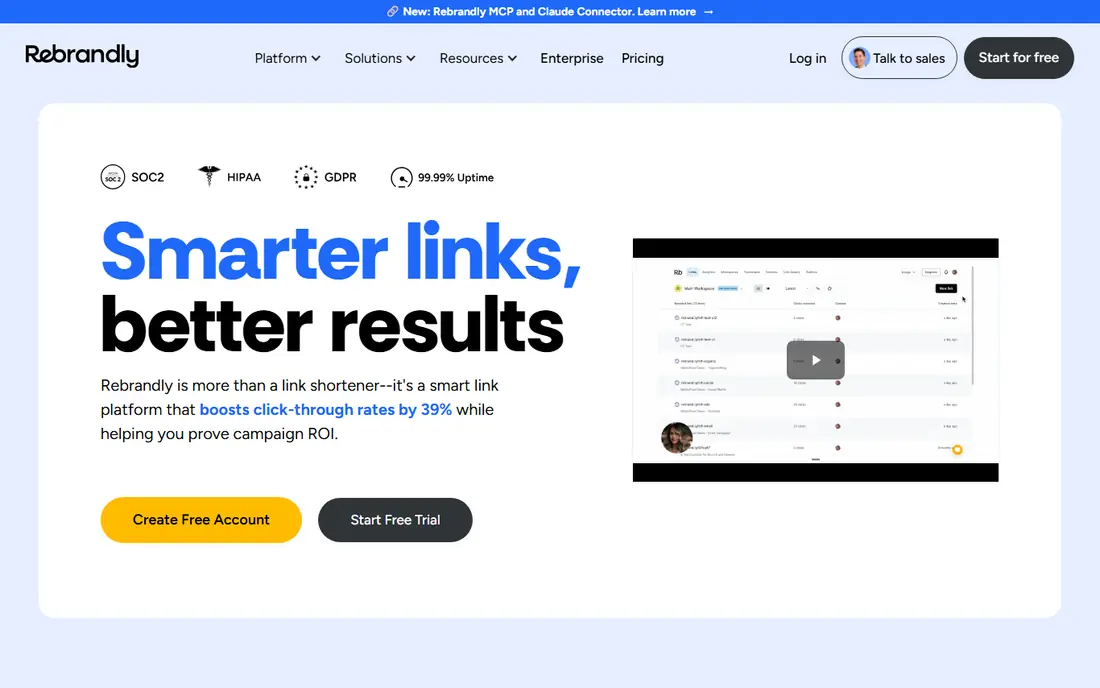
Rebrandly is the classic branded-link tool, and it remains a strong Bitly replacement for marketing teams and agencies. It lets you run multiple custom domains, organize links by workspace, and manage UTM parameters in one place. That structure helps when several clients or campaigns share one account.
The free plan is tight, with only a small number of links per month in recent guides, so it suits testing rather than daily use. Paid plans start around 16 dollars per month in recent comparisons, with annual billing lower. If branded links and campaign organization matter most, Rebrandly is a safe, well-supported pick.
- Strong branded domain support
- UTM and workspace tools
- Deep linking and team features
- Free plan is limited to a small number of links per month
- Higher plans rise quickly
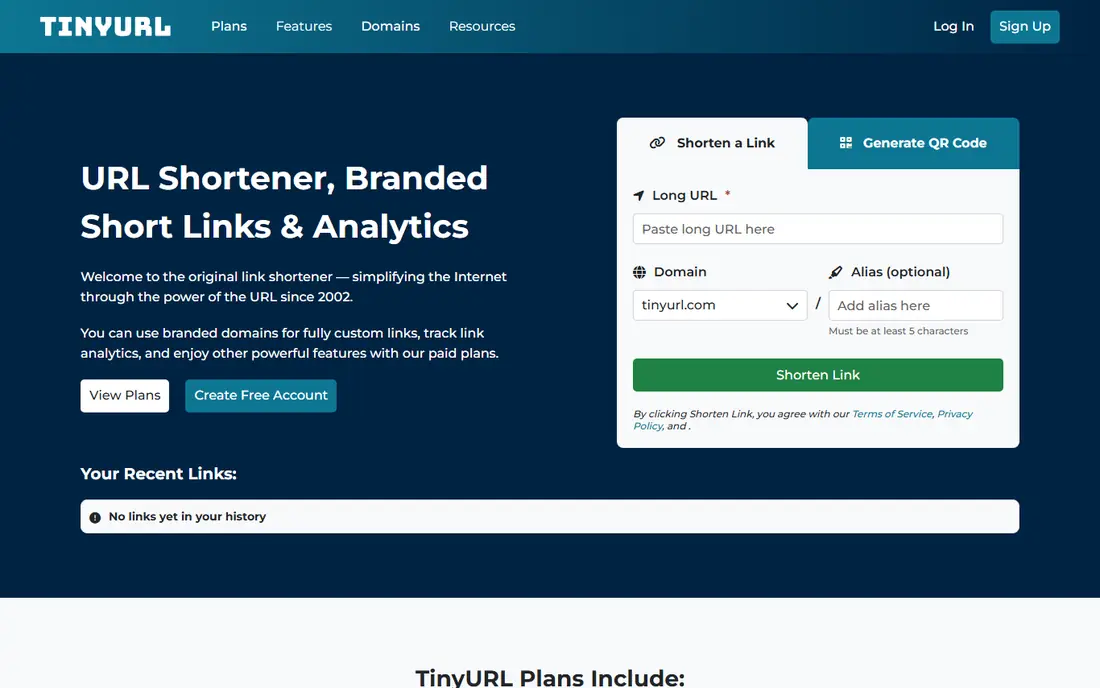
TinyURL is the answer when you just need a short link fast. You can shorten a link without an account, and the free tier covers unlimited basic links in recent guides. That makes it ideal for one-off sharing, social posts, and internal links where tracking is not critical.
The trade-off is analytics. Free links give you little click data, and branded domains start on the paid plan at about 9 dollars per month billed annually. TinyURL is also a good TinyURL alternative in the sense that it is the simplest of the tools here, but it is listed here as a Bitly alternative in its own right. Pick it for simplicity, not for campaign reporting.
- Unlimited basic shortening without signup
- Very simple to use
- QR codes included
- Free analytics are minimal
- Branded domains and deeper features need a paid plan
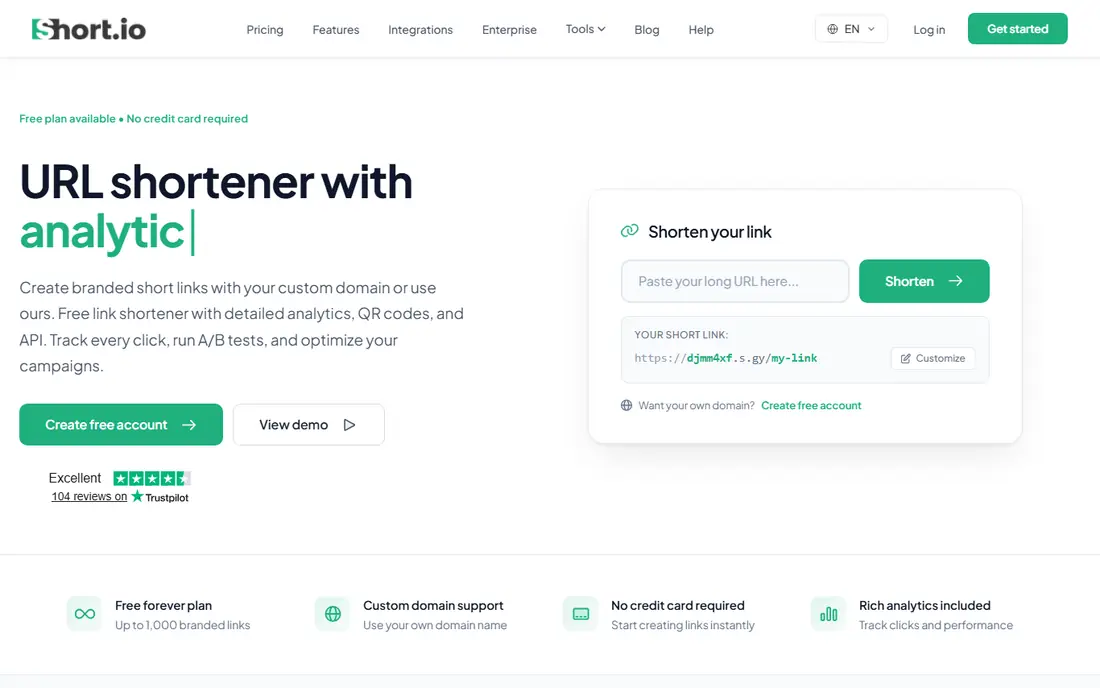
Short.io gives you a lot for a small price. Its free tier includes a large number of branded links and several domains in recent guides, and paid plans start at 5 dollars per month. For creators and small teams that want branded links without paying agency prices, that value is hard to beat.
The tool is developer-friendly too, with API access and deep linking options, though its dashboard is more functional than beautiful. If you create many links per month, Short.io beats per-link pricing models quickly. We would pick it first for most small teams moving away from Bitly.
- Low entry price
- Multiple custom domains
- Generous free tier
- API access
- Interface is less polished than Rebrandly for some teams
- Domain setup needs a little care
Dub, formerly known as Dub.co, is the developer favorite among Bitly alternatives. Its code is open source, so you can inspect how it handles links and data, and you can self-host if you want full control. The hosted service offers a free tier with a small monthly link allowance, plus custom domains and analytics.
Paid plans start around 30 dollars per month in recent guides, which is more than Short.io for a similar branded-link job. The extra cost buys a modern API, attribution features, and a tool built for product teams. If open source and API quality matter, Dub is worth it. If price matters most, Short.io wins.
- Open-source codebase
- Modern API
- Custom domains
- QR codes and analytics
- Paid plan is higher than Short.io
- Self-hosting needs technical skill
T2M suits users who create links in bulk and want a predictable cost. It supports bulk shortening, custom domains, QR codes, and detailed analytics, and it has offered lifetime pricing options alongside monthly plans. That makes it attractive to small businesses that dislike rising subscriptions.
The free tier has a quirk: some guides note a small lifetime verification fee, so read the free plan terms before relying on it. The dashboard also feels less modern than Dub or Rebrandly. For bulk work and long-term link stability, T2M remains a credible, affordable option.
- Bulk shortening
- Lifetime pricing options
- Custom domains and analytics
- Free tier needs a small verification fee in some guides
- Design feels dated next to newer tools
BL.INK is built for larger teams and enterprises that need control over thousands of branded links. It offers deep analytics, team permissions, and domain management at a scale that smaller tools do not match. Recent guides note that BL.INK no longer lists public prices after joining a larger parent company, so enterprise buyers should request a quote.
Solo creators and small teams will find BL.INK too much, both in price and in setup. For regulated or large organizations that need audit trails and access controls, it is one of the few tools in this list built for that job. Shortlist it only when enterprise controls are a real requirement.
- Enterprise-grade link management
- Unlimited custom domains on higher plans
- Strong analytics and access controls
- No public starting price in recent guides
- Overkill for solo creators
Cuttly is a good middle ground between TinyURL simplicity and Rebrandly branding. Its free plan includes link tracking with more depth than TinyURL, plus a custom domain option and QR codes. That makes it useful for creators who want to see where clicks come from without paying from day one.
The free allowance is limited each month, so heavy users will need the paid plan at about 12 dollars per month. Analytics retention and link limits also vary by plan, so check those before a campaign. For a free-first tool with real click data, Cuttly is a strong choice.
- Free plan with analytics
- Custom domain support
- QR codes and link management
- Free link allowance is limited per month
- Advanced features need a paid plan
Sniply does something the other tools here do not: it lets you attach a call-to-action button or message to a link you share, even when the destination page is not yours. That suits marketers and curators who share third-party articles and want readers to come back to their own offer, newsletter, or product page.
It is not the best general shortener. There is no free plan, only a trial, and branded domain depth is less central than in Rebrandly or Short.io. Use Sniply as a specialist tool alongside a main shortener, not as your only link tool. For content curation campaigns, its overlay feature is genuinely useful.
- Adds a call-to-action overlay to shared links
- Useful for curated content
- Link tracking included
- No free plan, only a trial
- Not a general branded-domain tool for large teams
How we picked these
We compared Bitly alternatives using vendor sites and recent 2026 shortener guides that checked pricing and free tiers. We looked for live, actively sold tools with custom domain support, analytics, and a clear free or low-cost entry point. We excluded discontinued shorteners and tools that only offer link-in-bio pages without true shortening. We did not run hands-on click tests, and we wrote See website where a vendor no longer publishes a starting price.
What to check before you switch shorteners
Start with your domain. Buy or connect a short domain you own before you create links that matter, because a generic short domain belongs to the tool, not to you. If the tool closes or changes its free tier, links on its generic domain can break or start showing ads. A custom domain lets you move tools later without breaking published links.
Next, compare limits in the same units. Some tools limit links per month, some limit clicks, and some limit domains. A tool that looks cheap per month can become expensive if you hit a link cap mid-campaign. Check analytics retention too, since some plans shorten how long click history is kept. Finally, test redirects, QR codes, and UTM handling on a few real links before you migrate a full campaign.
Frequently asked questions
What are the best alternatives to Bitly?
Short.io and Rebrandly are the best general alternatives to Bitly for branded links, TinyURL is best for simple free shortening, and Dub is best for developers. The right pick depends on whether you need branded domains, analytics depth, or the lowest price.
Are there TinyURL alternatives that offer more analytics?
Yes. Short.io, Rebrandly, Cuttly, and Dub all offer deeper analytics than TinyURL free links. TinyURL suits quick sharing, while those tools suit campaigns where click source, location, and device data matter.
Is there a free Bitly alternative?
Yes. TinyURL offers unlimited basic free shortening, Short.io offers a generous free tier with branded links, and Dub and Cuttly offer free tiers with monthly limits. Free plans change often, so check the current link and click limits before relying on one for a campaign.
Can I use my own domain with a Bitly alternative?
Most tools here support custom domains on free or paid plans, with Short.io and Rebrandly among the easiest to set up. You will still need to register the domain and point its DNS records to the shortener, a step that usually takes only a few minutes.
Will my short links break if I switch tools?
Links on a custom domain you own can usually be moved to a new tool by updating DNS and re-creating the links. Links on a tool-owned generic domain cannot be moved in the same way. That is why a custom domain is the safest choice for links in articles, packaging, or ads.
Sources
See where you really rank - block by block
ProMapRanker scans Google Maps across a grid of your service area. Simple monthly plans from $19, white-label on every plan.
Start freeKeep reading
 bill.com alternatives
Best Bill.com Alternatives in 2026
Looking for bill.com alternatives? We compared 9 bill pay and AP automation tools on price, approvals, and accounting sync to help you switch with confidence.
Read → betterhelp alternatives
BetterHelp Alternatives in 2026
We compared BetterHelp alternatives for online therapy, covering Talkspace, Grow Therapy, Rula, Brightside and more on price, insurance and format in 2026.
Read → best widget apps
Best Widget Apps in 2026: 8 Apps Compared
Looking for the best widget apps for iPhone and Android? We compare eight apps for custom widgets, themes, photos, and useful home screens in 2026 today.
Read →