 ProMapRanker
Best Bill.com Alternatives in 2026

Key takeaways
- Melio, Ramp, Brex, and Mercury all offer a free starting tier, so small teams can move off per-user billing without losing core bill pay.
- Ramp and Brex bundle bill pay with cards and expense tools, which suits teams that want one finance platform instead of several.
- Tipalti and AvidXchange fit larger or global operations, with deeper PO matching and multi-entity support that small tools do not offer.
- Always price the per-payment fees, not just the subscription, since ACH, check, and wire charges add up at higher volumes.
Quick comparison
| Pick | Great for | Pricing starts at | Free tier | |
|---|---|---|---|---|
 Melio | Small businesses with straightforward bill pay | Free | Yes | Visit |
 Ramp | Teams that want bill pay plus cards and expenses | Free | Yes | Visit |
 Brex | Startups that already use corporate cards | Free | Yes | Visit |
 Tipalti | Global payables and multi-entity companies | $99 per month | No | Visit |
 Stampli | Mid-market teams that live in their ERP | See website | No | Visit |
 AvidXchange | Real estate, construction, and property management | See website | No | Visit |
 Airbase | Companies that want procurement controls with AP | See website | No | Visit |
 Mercury | Startups that bank with Mercury | Free | Yes | Visit |
 QuickBooks Online | Businesses already running QuickBooks accounting | See website | No | Visit |
The best bill.com alternatives
Bill.com is a capable product, but its per-user pricing and payment fees push many small teams to look elsewhere. The nine options below cover free starting points, all-in-one finance platforms, and heavier AP tools for larger operations.
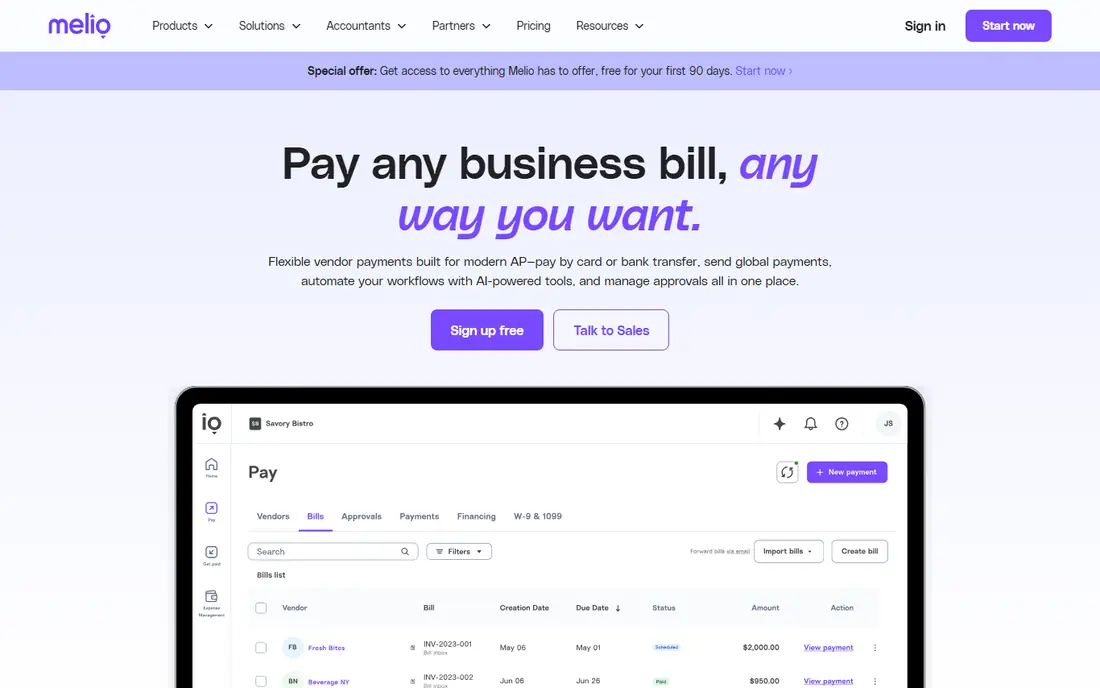
Melio is the closest like-for-like swap for a small business that mainly wants to pay vendors without a large monthly bill. Its Go plan is free for a single user with a small monthly allowance of free ACH payments, and it captures bills with AI, keeps a dedicated bills inbox, and supports international payments. That makes it a sensible first stop for sole operators and very small teams.
The catch is scale. Once a second approver joins or payment volume grows, Melio moves to paid tiers starting at $25 per month, and extra ACH payments cost $0.50 each after the included allowance. Teams that need accounting sync, batch payments, or custom approval workflows should budget for the Core plan or higher rather than assuming the free tier covers everything.
- Free Go tier for light use
- Pay by ACH, card, check, or wire
- Syncs with QuickBooks and Xero on paid plans
- Free tier caps users and free ACH payments
- Card and expedited payment fees apply
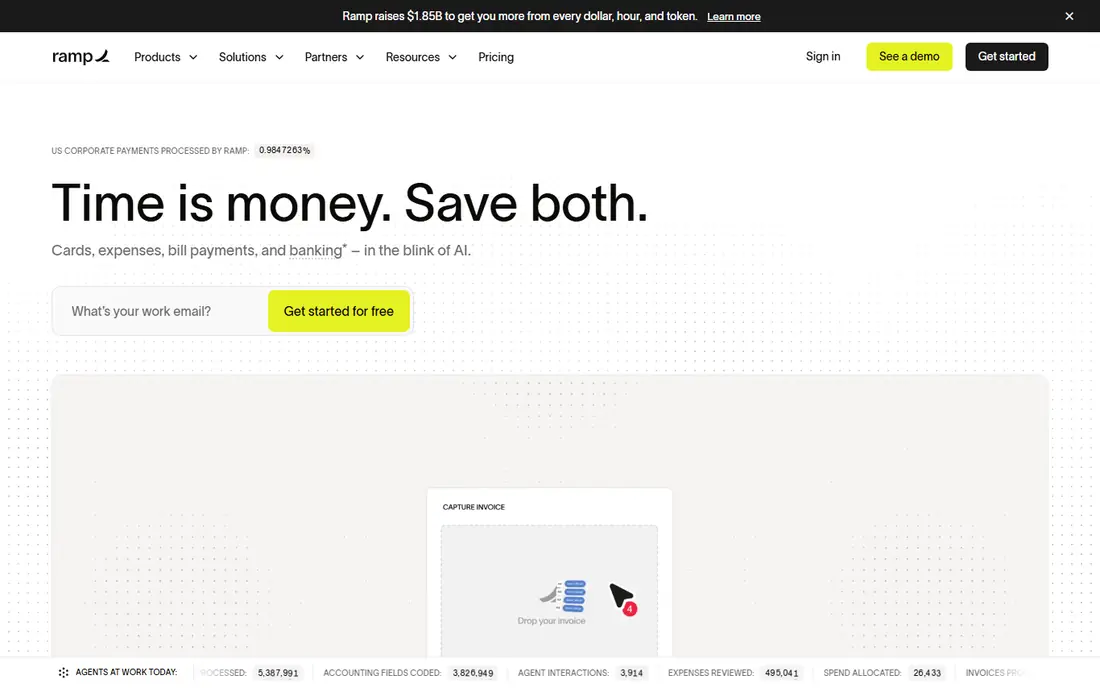
Ramp is our pick for teams that want to replace more than just bill pay. Its free tier covers invoice capture with AI, bill payments by ACH, check, card, and wire, vendor onboarding, and mobile approvals, alongside corporate cards and expense management. That breadth is hard to beat at zero subscription cost.
The honest trade-off is the fee structure. Standard ACH payments cost $0.59 and standard checks cost $1.99 when paid from an outside bank, though those fees are waived when paying from a Ramp Checking account. Ramp Plus, at $15 per user per month plus a platform fee, adds batch payments, two- and three-way matching, and multi-entity support for teams that outgrow the free tier.
- Free core tier with bill pay, cards, and expenses
- QuickBooks and Xero sync on the free tier
- Per-transaction fees waived when paying from Ramp Checking
- Standard ACH and check fees apply when paying from an outside bank
- Plus adds a platform fee on top of the per-user price

Brex combines business banking, corporate cards, expenses, and bill pay in one platform, and its Essentials tier is free. Bill pay on Brex includes AI-drafted bills with line items and multi-level approvals, with wires available to a large number of countries. For a startup already issuing Brex cards, adding bill pay is a natural step.
The main limitation is access. Brex sets qualification criteria that some small businesses will not meet, and features such as two-way PO matching, dynamic approval chains, and deeper ERP integrations sit on Premium at $12 per user per month. Check eligibility early so a promising trial does not stall at application.
- Free Essentials tier includes bill pay
- Multi-level approvals on all plans
- Broad accounting integrations
- Eligibility requirements can exclude very small or unfunded businesses
- Advanced features sit on the paid Premium tier
Tipalti is built for companies that pay many suppliers or payees across borders. Its accounts payable plans start at $99 per month with unlimited users, a self-service supplier portal, and core automation including invoice processing and PO matching. Mass payments plans start at $249 per month for businesses paying large distributed networks.
The price to watch is the transaction layer. Tipalti charges per-invoice and per-payment pricing on top of the platform fee, and those rates are quoted rather than published. That makes Tipalti poor value for a team paying a handful of domestic bills, and a strong fit for finance teams where global tax compliance and multi-entity reconciliation justify the cost.
- Unlimited users on published plans
- Supplier portal and tax compliance built in
- Supports a very large number of countries and currencies
- Transaction pricing is charged on top of the platform fee
- No free tier
- Heavier setup than small-business tools
Stampli centers the invoice itself: approvers, vendors, and finance staff discuss and approve bills in one place, with AI help on coding and duplicate detection. It integrates with more than 70 ERP and accounting systems, which is why mid-market teams with an established ERP often shortlist it. Two- and three-way matching support helps teams that tie payments to purchase orders.
The downside is transparency. Stampli does not publish pricing, so budgeting requires a sales conversation tied to invoice volume and user count. Smaller teams will likely find Melio or Ramp simpler and cheaper, while larger teams get the depth they need from Stampli's approval and audit trail features.
- Strong ERP integrations including NetSuite and Dynamics
- AI-assisted coding and approvals
- Built for high invoice volumes
- Pricing is quote only
- Implementation takes more effort than small-business tools
AvidXchange is a long-established AP automation platform with particular strength in real estate, construction, and property management, where supplier volume and approval chains are heavy. It handles invoice capture, workflow routing, and payments, and its supplier network can reduce the effort of onboarding vendors that other AvidXchange customers already pay.
The trade-off is weight. AvidXchange is an enterprise-style purchase with custom pricing and a longer implementation than the free tools on this list. It earns its place for companies processing hundreds of invoices a month in its core industries, but a small team would be paying for depth it never uses.
- Industry-specific workflows and supplier network
- Purchase order automation
- Strong approval controls
- Pricing is quote only
- Implementation can be complex
- Overkill for simple bill pay
Airbase ties bill pay to the spending decision that came before it. Purchase requests, approvals, vendor onboarding, and payments run through one system, which gives finance teams cleaner control over who can commit money and how bills get coded. That structure appeals to companies that have outgrown ad hoc approvals.
Because Airbase does not publish entry pricing, expect a quote driven by team size and modules. Teams that only need basic bill pay will find cheaper options here, but teams that want procurement discipline alongside AP will get more from Airbase than from a standalone bill pay tool.
- Guided procurement, bill pay, cards, and expenses in one platform
- Strong approval workflows
- Good ERP integrations
- Pricing is quote based
- Best value comes when the whole platform is adopted, not just bill pay
Mercury is a business banking platform, and its bill pay is a genuine bonus for customers that already hold a Mercury account. The free tier includes a bills inbox with OCR capture, amount-based and multi-level approvals, and sync with QuickBooks, Xero, and NetSuite. Paid tiers add features such as expanded reimbursements and invoicing tools.
The limitation is obvious: Mercury bill pay is designed around Mercury accounts, so teams committed to another bank get less from it. For a startup already banking with Mercury, though, it removes the need for a separate bill pay subscription entirely.
- Free tier includes bill pay with OCR capture
- Approvals and accounting automations included
- No per-payment fee on the free tier for standard payments
- Bill pay works best inside Mercury banking
- Limited value for teams that bank elsewhere
QuickBooks Online
Great for: Businesses already running QuickBooks accounting
QuickBooks Online includes bill management as part of its accounting platform, and for many small businesses that is enough. Entering, approving, and paying bills without a separate sync step removes a common source of errors, and most accountants already know the system. It is the lowest-friction option for a team that already runs its books in QuickBooks.
The catch is depth. Approval workflows, PO matching, and payment automation are lighter than in dedicated AP tools, and the exact bill pay features depend on the QuickBooks plan. Teams with complex approvals or high invoice volumes should compare a dedicated tool before settling for the built-in option.
- Bills live inside the accounting system with no separate sync
- Familiar interface for QuickBooks users
- Broad accountant support
- Bill pay features vary by plan
- Full capability may require a higher-tier subscription
- Less AP depth than dedicated tools
How we picked these
We compared official pricing pages, feature documentation, and app store listings for bill pay and AP automation tools that serve US small and mid-sized businesses, and we kept only tools that are live and genuinely handle vendor bill payment. We favored tools with published pricing or a clear free tier, and we noted where pricing is quote only rather than inventing a number. We did not claim hands-on testing; our comparisons rest on vendor documentation and public reviews.
What to check before you switch
Count your real monthly cost
Add the subscription, the per-payment fees for your usual mix of ACH, checks, and wires, and any platform fees. A free tool with per-payment charges can cost more than a flat subscription at high volume, and the reverse is true at low volume.
Confirm your accounting sync
Check that the tool syncs bills, payments, and vendors with your accounting system in both directions, and confirm which plan includes that sync. Some vendors reserve NetSuite or multi-entity sync for higher tiers.
Test approvals with your actual team
Run a real bill through approval, including a second approver and a mobile approval, before migrating. Approval routing is where most bill pay tools either save time or create new bottlenecks.
Plan the vendor migration
Ask how existing vendors, recurring bills, and payment details move over, and how long the transition takes. A tool that cannot import your vendor list cleanly will cost hours no matter how good its monthly price looks.
Frequently asked questions
What is the best free bill.com alternative?
Melio, Ramp, Brex, and Mercury all offer free tiers that include bill pay, and the best choice depends on your setup. Melio suits simple bill pay, Ramp and Brex suit teams that also want cards, and Mercury suits teams that bank with Mercury. Compare per-payment fees on each free tier before choosing.
Are there alternatives to bill.com for small businesses?
Yes. Melio and Ramp are the most popular small-business options, with free starting tiers and QuickBooks and Xero sync. QuickBooks Online also covers basic bill pay for teams already using it, while Brex fits startups that want cards and bill pay together.
What is the best bill pay software for growing companies?
Ramp Plus and Brex Premium suit growing teams that need stronger approvals, multi-entity support, and deeper ERP integrations. For high invoice volumes or complex ERP setups, Stampli and AvidXchange offer deeper AP automation with quote-based pricing.
Can I pay international vendors with these alternatives?
Most of these tools support international payments, but coverage and fees vary widely. Tipalti has the broadest global payment and tax compliance features, while Ramp, Brex, and Melio cover international wires and payments for common corridors. Confirm your destination countries before committing.
Do these tools replace an accountant?
No. They automate bill capture, approvals, and payments, and they sync with accounting software, but they do not replace professional judgment on coding, tax, or month-end close. Most teams still rely on an accountant or bookkeeper alongside the tool.
Sources
See where you really rank - block by block
ProMapRanker scans Google Maps across a grid of your service area. Simple monthly plans from $19, white-label on every plan.
Start freeKeep reading
 bitly alternatives
Bitly Alternatives in 2026: 8 Tools Compared
Compare the best Bitly alternatives for branded short links, with free tiers, custom domains, analytics, and pricing that suits creators and small teams.
Read → betterhelp alternatives
BetterHelp Alternatives in 2026
We compared BetterHelp alternatives for online therapy, covering Talkspace, Grow Therapy, Rula, Brightside and more on price, insurance and format in 2026.
Read → best widget apps
Best Widget Apps in 2026: 8 Apps Compared
Looking for the best widget apps for iPhone and Android? We compare eight apps for custom widgets, themes, photos, and useful home screens in 2026 today.
Read →