 ProMapRanker
Best Vendor Management Software in 2026


Contract renewals and lifecycle · Pricing starts at: See website
Key takeaways
- Gatekeeper is our top pick for contract renewals, while Precoro and Tradogram offer the clearest published pricing for mid-size and small teams.
- Coupa and SAP Ariba suit large enterprises that need full spend visibility, but both are custom-quoted and take months to roll out.
- Tipalti is the specialist for paying many suppliers across borders, and Procurify suits finance teams that need live budget control.
- Vendorful and ProcureDesk cover sourcing and purchasing workflows for teams that want more than a contract repository.
Quick comparison
| Pick | Great for | Pricing starts at | Free tier | |
|---|---|---|---|---|
| Gatekeeper | Contract renewals and lifecycle | See website | No | Visit |
 Precoro | Mid-size purchasing control | $499 per month | Free trial | Visit |
 Tradogram | Small business purchasing | $99 per month | Free trial | Visit |
 Tipalti | Global supplier payments | See website | No | Visit |
 Coupa | Enterprise spend management | See website | No | Visit |
 SAP Ariba | Large SAP enterprises | See website | No | Visit |
 Procurify | Budget control for mid-market teams | See website | No | Visit |
 Vendorful | Sourcing and supplier management | See website | Free trial | Visit |
 ProcureDesk | Mid-market purchasing workflows | See website | No | Visit |
The best vendor management software
We compared these tools on contract management, supplier onboarding, purchasing and approvals, payments, spend visibility, and published pricing. Most enterprise tools in this category are custom-quoted, so we wrote "See website" where no public price exists, and we flagged implementation time where it matters. The right tool depends on your main pain: contracts, purchasing, payments, or supplier risk.

Gatekeeper is our pick for companies whose main problem is contracts expiring unnoticed. It centralizes vendor contracts, tracks renewal dates and obligations, and automates approval workflows so renewals get reviewed before they auto-renew. That focus makes it faster to adopt than a full procurement suite, and finance and legal teams can see vendor spend and contract terms in one place.
The catch is scope and price. Gatekeeper leans commercial rather than risk-focused, so companies that need deep supplier security assessments may need a second tool. Pricing is also custom-quoted, so get the full first-year cost, including implementation, in writing. If missed renewals are your quiet cost leak, Gatekeeper addresses it directly.
- Strong renewal alerts and contract repository
- Workflow automation
- Clear vendor and spend visibility
- Pricing is custom-quoted
- Procurement depth is thinner than full suites
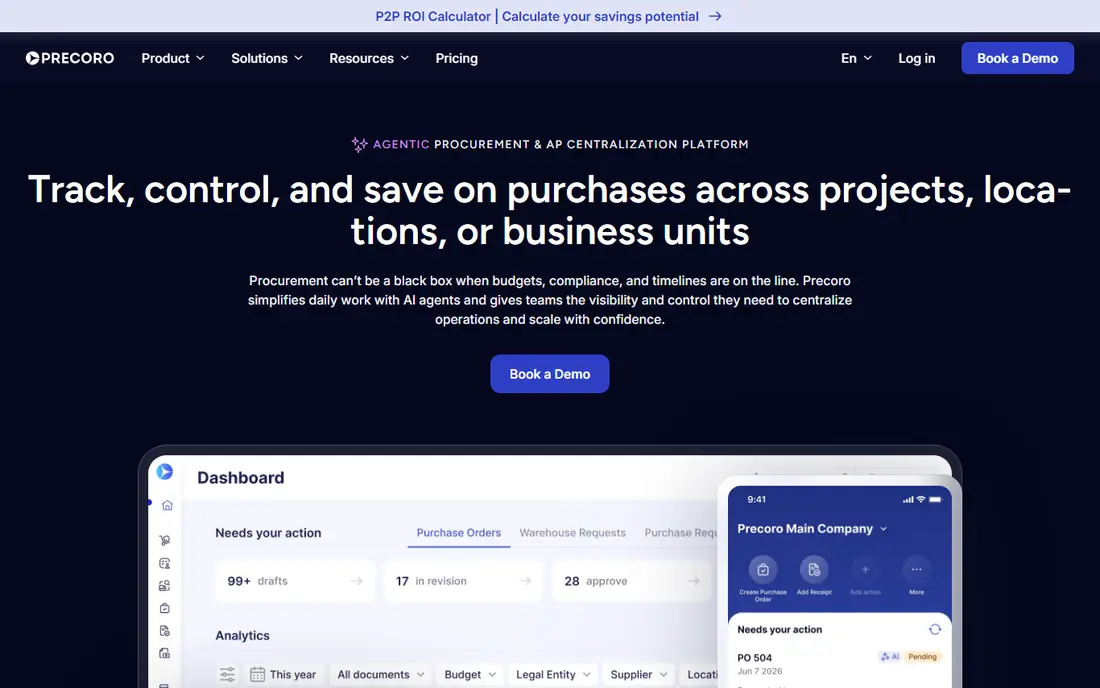
Precoro is the clearest-priced mid-market option on this list, with a Core plan at $499 per month when billed annually. It covers purchase requests, approvals against budgets, purchase orders, receiving, and invoice matching, which stops duplicate orders and surprise invoices without enterprise complexity. That transparency is rare in this category, where most rivals hide pricing behind sales calls.
The limits are scale and free access. There is no free plan, only a trial or demo, and very large enterprises with complex sourcing needs will outgrow it. For a small or mid-size company moving off spreadsheets and email approvals, Precoro offers control at a price you can actually budget for.
- Published pricing
- Purchase requests, approvals, and budgets in one system
- Three-way invoice matching
- No free plan, only a trial
- Enterprise features are thinner than Coupa or SAP Ariba
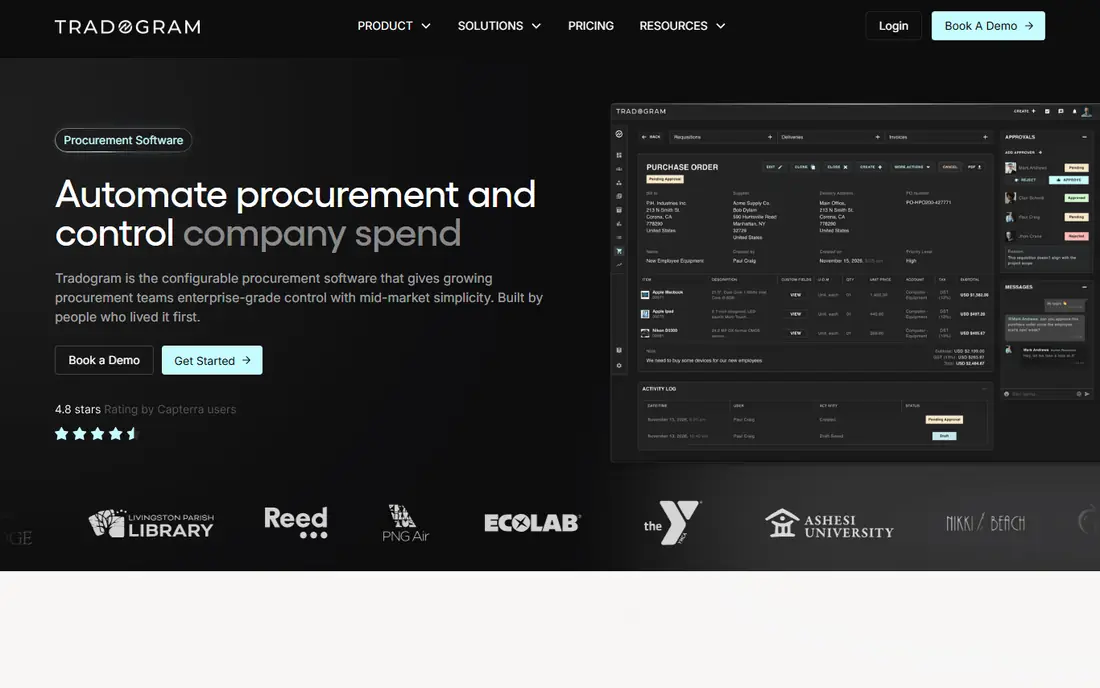
Tradogram is the best entry point for a small business that needs real purchasing control without enterprise cost. At $99 per month, it covers requisitions, approvals, purchase orders, RFQs, supplier onboarding, receiving, invoice matching, budgets, and contracts in one system. That breadth means a growing company may not need to switch platforms as it adds locations or entities.
The trade-off is focus. A very small team may find the feature set broader than it needs at first, and deeper analytics sit on higher plans. Implementation is usually measured in days to weeks rather than months, which is a real advantage over enterprise suites. If your buying still runs on email and spreadsheets, Tradogram is a sensible first system.
- Low entry price
- Full purchasing flow from request to payment
- Supplier onboarding and performance tools
- Interface can feel broad for very small teams
- Advanced analytics need higher plans
Tipalti suits companies that pay large numbers of suppliers, partners, or freelancers across borders. It handles payouts in many currencies and payment methods, collects tax forms, checks compliance details, and gives suppliers a portal to update their own payment information. That removes a large amount of manual finance work and reduces payment errors.
The catch is that Tipalti is payment-focused, not a full procurement suite, so companies that also need deep sourcing and contract tools may pair it with another platform. Pricing is also custom-quoted, so confirm the per-payment and platform fees before committing. If global payouts are your bottleneck, Tipalti is the specialist pick.
- Global payouts in many currencies and methods
- Tax form collection and compliance
- Supplier self-service portal
- Pricing is custom-quoted
- Less of a full procurement suite than Coupa or Precoro
Coupa is a full spend management platform for mid-market to enterprise companies that want visibility across purchasing, invoicing, expenses, and payments. Its analytics help finance leaders see where money goes, which suppliers cost most, and where contracts can be renegotiated. For a large company with complex supply chains, that visibility can pay for the platform.
The downsides are cost, time, and complexity. Pricing is custom, implementation commonly takes months, and a small team will find the suite heavier than it needs. Coupa belongs on the shortlist for larger companies that already feel spreadsheet pain at scale, not for a first purchasing tool.
- Broad procure-to-pay suite
- Strong spend visibility and analytics
- Large enterprise customer base
- Custom pricing and long implementation
- Overkill for small teams
SAP Ariba is the enterprise pick for companies already running SAP, since it connects sourcing, supplier management, contracts, and procurement with SAP systems. Its supplier network and sourcing tools suit organizations with formal tenders, large supplier bases, and strict compliance needs. For a global enterprise with complex procurement, Ariba offers depth few rivals match.
Outside SAP, the case weakens. Implementation is complex and lengthy, pricing is custom, and smaller companies will find the system and the sales process heavy. If your company runs SAP and procurement is a core operation, Ariba is a natural shortlist pick. If not, a mid-market tool will serve you faster and cheaper.
- Deep sourcing and supplier management
- Strong fit for SAP customers
- Large supplier network
- Custom pricing
- Complex implementation
- Weak fit outside SAP environments
Procurify suits mid-size companies where finance needs to see budget impact before approving a purchase, not after it. Requesters see live budget balances as they submit, approvers can act from mobile, and invoices match against purchase orders before payment. That control helps finance close the books faster and reduces overspend surprises.
The main drawback is pricing transparency. Procurify is quote-based, so you cannot budget from a public price page, and some reporting features depend on the plan you buy. Demo it with your real approval chain and budget structure, since that is where Procurify either earns its place or shows its limits.
- Live budget visibility during approvals
- Mobile approvals
- Good QuickBooks and ERP integrations
- Pricing is quote-based
- Reporting depth varies by plan
Vendorful covers the sourcing side of vendor management: finding suppliers, running RFx events, onboarding vendors, and keeping communication in one place. That makes it a good fit for procurement teams that spend more time sourcing and qualifying suppliers than processing purchase orders. It serves both small and mid-size companies and larger enterprises across many industries.
The caution is pricing. Public pricing for Vendorful is not as clear as for Precoro or Tradogram, so request a written quote that covers users, suppliers, and any implementation fees. If sourcing and supplier qualification are your main gaps, Vendorful deserves a demo next to the procurement suites above.
- Sourcing and RFx tools
- Supplier onboarding and communication in one place
- Serves small and large teams
- Pricing is not clearly published
- Smaller brand presence than Coupa or SAP Ariba
ProcureDesk is a mid-market purchasing tool that covers requests, approvals, purchase orders, receiving, and invoice matching, with a focus on QuickBooks users. Its onboarding typically runs two to four weeks, which is faster than enterprise suites and realistic for a team that cannot pause purchasing for months. That pace, plus budget controls, makes it a practical step up from spreadsheets.
The drawback is pricing clarity. Published plan details are thinner than for Precoro or Tradogram, so confirm the monthly cost, user limits, and implementation fee before signing. For a QuickBooks-based company that needs approval control without enterprise weight, ProcureDesk is worth a demo.
- Purchase approvals and three-way matching
- QuickBooks integration
- Onboarding measured in weeks
- Pricing is not published as clearly as rivals
- Smaller ecosystem than Coupa
How we picked these
We compared official product pages, pricing pages, and recent vendor management comparisons, focusing on contracts, purchasing, payments, supplier risk, and published pricing. We kept only tools that are actively sold and that genuinely manage vendors or suppliers, and we wrote "See website" where pricing was custom-quoted or not clearly published. We did not claim hands-on trials we did not run; our findings come from vendor documentation and public reviews.
Choosing the right vendor management tool
Start with your biggest pain, not the longest feature list. A company losing money on auto-renewals needs Gatekeeper. A company drowning in email approvals needs Precoro, Tradogram, or ProcureDesk. A company paying suppliers worldwide needs Tipalti. A large enterprise needing full spend control needs Coupa or SAP Ariba. Buying a suite for a single pain wastes money and slows adoption.
Separate commercial management from risk management
Vendor management covers contracts, renewals, spend, and performance. Third-party risk management covers security posture, financial health, and compliance monitoring. Some platforms cover both, but many lean one way, so check if your regulated work needs the risk side too. If it does, budget for a risk tool alongside a commercial one rather than assuming one platform covers both well.
Get the full first-year cost in writing
Enterprise and mid-market pricing often hides implementation, training, integration, and per-supplier fees. Ask for the total first-year cost, the renewal terms, and what happens to your data if you leave. Mid-market platforms typically go live in one to three months, while enterprise suites take three to nine months, so tie the timeline to your vendor count in the contract.
Pilot with real vendors and real approvals
Run a pilot with a handful of real vendors, real contracts, and your actual approval chain, not a vendor demo dataset. Test renewal alerts, budget checks, invoice matching, and supplier onboarding end to end. A tool that looks good in a demo but frustrates approvers will fail in production, no matter how long its feature list is.
Frequently asked questions
What is the best vendor management software overall?
Gatekeeper is our top pick for contract-focused teams, Precoro for mid-size purchasing with clear pricing, and Coupa or SAP Ariba for large enterprises. The best overall tool depends on your main pain: contracts, purchasing, payments, or supplier risk, so shortlist by pain first and features second.
What is the best vendor management platform for a small business?
Tradogram is the best small business pick on this list, with entry pricing at $99 per month and a full purchasing flow. Precoro suits slightly larger teams that want tighter budget control at $499 per month. Under 50 vendors, even a contract repository with renewal alerts may be enough, so do not buy an enterprise suite too early.
How much does vendor management software cost?
Published pricing runs from $99 per month for Tradogram and $499 per month for Precoro, up to custom enterprise quotes for Coupa and SAP Ariba. Many mid-market platforms are quote-based, and implementation can add a large share to the first-year cost. Get the full first-year figure in writing before comparing.
What is the difference between vendor management and procurement software?
Vendor management focuses on the supplier relationship: contracts, renewals, performance, and risk. Procurement software focuses on buying: requests, approvals, purchase orders, and invoices. Many tools on this list cover both, but they lean one way, so check if your team needs the relationship side, the buying side, or both.
How long does it take to implement vendor management software?
Mid-market tools like Gatekeeper, Precoro, and Tradogram typically go live in weeks to a few months, while enterprise suites like Coupa and SAP Ariba commonly take three to nine months including data migration and workflow design. Ask for a written timeline tied to your vendor count, and plan data cleanup before the project starts.
Sources
- https://www.gatekeeperhq.com
- https://www.precoro.com
- https://www.tradogram.com
- https://www.tipalti.com
- https://www.coupa.com
- https://www.sap.com
- https://www.procurify.com
- https://www.vendorful.com
- https://www.procuredesk.com
- https://rankite.com/blog/best-supplier-management-software
- https://rankite.com/blog/best-purchasing-software-for-small-businesses
See where you really rank - block by block
ProMapRanker scans Google Maps across a grid of your service area. Simple monthly plans from $19, white-label on every plan.
Start freeKeep reading
 best tour operator software
Best Tour Operator Software in 2026
Compare the best tour operator software for bookings, channel management, waivers and payments, with pricing models for day tours and multi-day trips.
Read → best time clock app for small business
Best Time Clock App for Small Business in 2026
We compare the best time clock app for small business options, with free plans, GPS clock ins, scheduling and payroll links for hourly teams and payroll help.
Read → best test automation tools
Best Test Automation Tools in 2026
Compare the best test automation tools, from Playwright and Selenium to Cypress, Katalon and BrowserStack, with prices, languages and best uses explained.
Read →