 ProMapRanker
Best Treasury Management Software in 2026

Key takeaways
- Kyriba and GTreasury are the benchmarks for large multinationals with global cash and complex risk needs.
- Trovata and Agicap suit mid-market teams that want faster setup and clearer pricing.
- SAP Treasury fits enterprises already running SAP, where native ERP integration matters most.
- Most enterprise treasury pricing is quote-based, so plan for a sales process and implementation time.
- Bank connectivity and forecast accuracy matter more than feature count, so test both with your own banks.
Quick comparison
| Pick | Great for | Pricing starts at | Free tier | |
|---|---|---|---|---|
 Kyriba | Large multinationals with global cash | See website | No | Visit |
 GTreasury | Broad enterprise treasury | See website | No | Visit |
 Trovata | Mid-market API-first cash visibility | $24,000 per year | No | Visit |
 SAP Treasury and Risk Management | SAP-centered enterprises | See website | No | Visit |
 FIS Treasury and Risk Manager | High-volume global enterprises | See website | No | Visit |
 Coupa Treasury | Coupa customers adding treasury | See website | No | Visit |
 Agicap | SMBs and mid-market replacing Excel | See website | Free trial | Visit |
 Modern Treasury | API-first payments and reconciliation | See website | No | Visit |
The best treasury management software
Treasury software splits into enterprise suites, ERP modules, and newer API-first platforms. This is not financial advice. Prices vary by company size, bank count, and modules, and implementation costs sit on top of subscription fees for most enterprise tools.
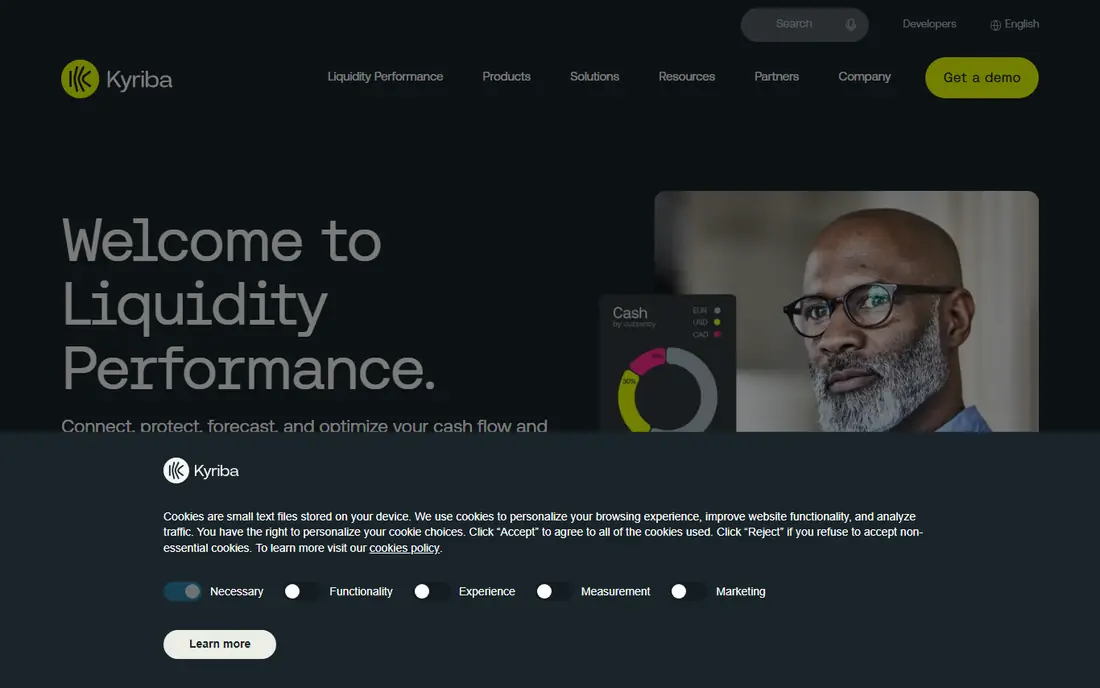
Kyriba is the name that comes up first in most treasury requests for proposals, and for good reason. Its cloud platform brings bank balances, cash positioning, forecasting, payments, FX risk, and working capital into one view, with connectivity to thousands of banks. For a multinational managing cash across dozens of countries and entities, that breadth is the main value.
The cost is time and money. Pricing is quote-based and enterprise-grade, and rollouts often take many months. A treasury team of five or more managing many entities will use that depth. A smaller team will likely find Kyriba more platform than it can staff, and should look at Trovata or Agicap first.
- Very broad bank connectivity
- Full cash, payments, FX risk, and working capital modules
- Strong fraud controls
- Enterprise pricing and long implementation
- More platform than a mid-size team needs
GTreasury is Kyriba's most direct rival, with a modular platform covering cash management, payments, risk, debt, and investments. Teams can start with the modules they need and add more as treasury work grows, which helps a company that wants a full suite without buying every module on day one. Reporting and workflow tools support the daily cash position and longer-range planning.
Like Kyriba, GTreasury is priced by quote and needs a proper implementation. Mid-market buyers should ask for a clear total cost, including implementation and bank onboarding, before comparing it with lighter tools. For a large treasury team that wants broad coverage in one system, GTreasury is a strong and credible choice.
- Broad cash, debt, investment, and risk coverage
- Modular setup
- Strong reporting options
- Quote-based enterprise pricing
- Implementation needs dedicated staff
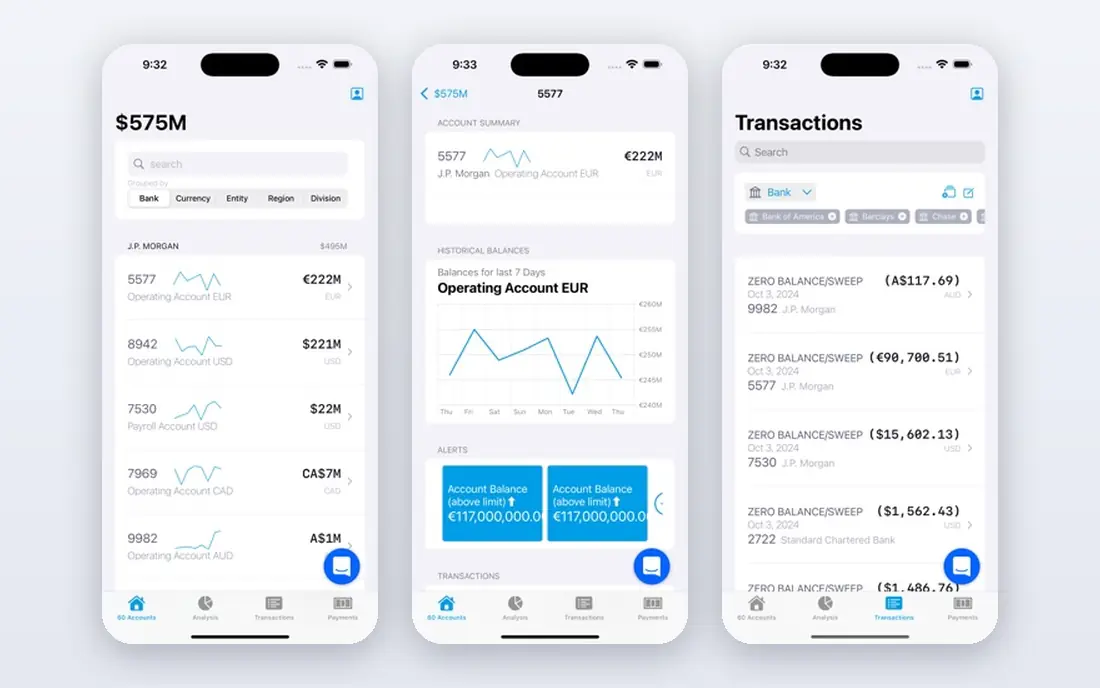
Trovata appeals to mid-market teams that want modern treasury software without a year-long project. Its API-first design connects banks directly, giving a consolidated cash view and forecasting in weeks rather than months in many cases. Published pricing is also a welcome change in a category where most vendors hide prices behind a sales call.
The trade is depth. Trovata covers cash visibility and forecasting well, but a multinational with complex hedge accounting and multi-entity risk work may still need Kyriba or GTreasury. For a mid-market team replacing spreadsheets, Trovata offers a good balance of speed, clarity, and price.
- Published pricing and faster onboarding than enterprise suites
- API-first bank connectivity
- Clean cash visibility and forecasting
- Yearly price still high for small companies
- Narrower risk and hedge depth than Kyriba
For a company already running SAP S/4HANA, SAP Treasury and Risk Management is the natural choice. Cash, payments, risk, and hedge accounting live inside the same ERP that holds the general ledger, which removes reconciliation work and keeps finance data in one place. That native fit is hard for a standalone treasury tool to match.
Outside an SAP estate, that advantage disappears. Implementation follows SAP timelines, and a non-SAP company would be buying an ERP to get a treasury module. If SAP is already your system of record, this module deserves first look. If it is not, a standalone platform will be faster and simpler.
- Native integration with SAP S/4HANA
- Cash, risk, and hedge accounting in the ERP
- Single source for finance data
- Tied to SAP scope and timelines
- Complex and costly outside an SAP estate
FIS Treasury and Risk Manager, formerly Quantum, is a full-suite platform for high-volume global enterprises. It covers cash, payments, risk, debt, and investments, with reporting that can be configured in depth for different entities and regions. That configurability suits large treasuries with varied reporting needs across countries.
The usual enterprise caveats apply. Pricing is by quote, implementation takes months, and the platform rewards a dedicated treasury team. For a large company with high volumes and complex reporting, FIS is a proven option. For a mid-market team, the scale and cost will usually point elsewhere.
- Full-suite treasury with configurable reporting
- Suited to high transaction volumes
- Long enterprise track record
- Quote-based pricing
- Implementation and training take time
Coupa Treasury makes most sense for a company already using Coupa for procurement and spend. Adding treasury gives a unified view of cash, payments, and spend, and forecasting can draw on procurement data that a standalone tool would need to import. That shared data can improve forecast accuracy for companies where supplier payments drive much of the cash flow.
For a non-Coupa company, the suite bonus does not apply, and Kyriba or GTreasury may offer broader treasury depth. If Coupa is already in place, though, adding its treasury module is often simpler than buying and integrating a separate platform, and it keeps vendor management in one place.
- Unified spend and treasury view for Coupa customers
- Cash forecasting tied to procurement data
- Single vendor for spend management
- Best value inside the Coupa system
- Quote-based pricing
Agicap is built for finance teams that still run cash in spreadsheets and want a forecast they can trust. It turns bank and operational data into rolling cash forecasts with scenario views, so a team can see how late payments or a large order change liquidity. Bank connectivity is broad, with particular strength in Europe, and setup is faster than an enterprise suite.
The limit is scale. Agicap suits SMBs and mid-market companies well, but a large multinational with complex hedge and debt work will need a deeper platform. For a finance team moving off Excel, Agicap is one of the most approachable treasury tools here, and the free trial lets you test it with your own banks.
- Forecast-first design with scenario views
- Broad bank connectivity, especially in Europe
- Faster setup than enterprise suites
- Pricing is quote-based
- Less suited to very large multinational treasury operations
Modern Treasury takes a different angle from the classic treasury suite. It focuses on payment operations, bank connectivity, and reconciliation through APIs, which suits companies that move money at scale and need clean, automated reconciliation. Real-time payment support and developer tools make it a good fit for fintech and platform businesses.
The trade is breadth. Modern Treasury is stronger on payments and reconciliation than on the full risk, hedge, and working capital suite of Kyriba or GTreasury. A company that needs payment operations first should look closely at it. A company that needs a full treasury suite should pair it with, or choose, a broader platform.
- API-first payment operations and reconciliation
- Real-time payment support
- Developer-friendly design
- More payment operations than full treasury suite
- Quote-based pricing
How we picked these
We compared official feature and pricing pages, plus public reviews and buyer guides, for software that manages corporate cash, forecasting, payments, and risk. We kept only products that exist and work in October 2026 and that serve treasury teams, not personal finance users. Where pricing was quote-based or could not be verified on the vendor site, we wrote See website. We did not claim hands-on testing we did not do.
How to choose the right treasury platform
Start with your bank footprint and your forecast problem. List every bank, account, and entity you must consolidate, and check which platforms connect to those banks directly. Then define the forecast you need: daily cash position, 13-week rolling forecast, or long-range planning with scenarios. A platform that connects your banks and answers your forecast question is worth more than one with a longer feature list.
Budget for implementation, not just subscription
Enterprise treasury pricing hides the second bill: implementation, bank onboarding, training, and integration with your ERP. Ask each vendor for a realistic timeline and total first-year cost, including those items. A platform with a lower subscription but a nine-month rollout can cost more in staff time than a faster tool with a higher yearly fee. Trovata and Agicap often win on speed, while Kyriba and GTreasury win on depth for large teams.
Test with your own banks before signing
Bank feeds are where treasury projects succeed or stall. Ask for a trial or proof of concept with your largest banks and your real account structure, and check how often balances update, how payment approvals work, and how fraud controls handle exceptions. A demo with sample data will not reveal a slow or incomplete bank feed. That test, plus references from a company of similar size, is the best protection against a long and costly rollout.
Frequently asked questions
What is the best treasury management software for a mid-market company?
Trovata and Agicap are the strongest mid-market picks here. Trovata offers API-first cash visibility with published pricing and faster onboarding, while Agicap is forecast-first and suits teams moving off Excel. Both are simpler to run than Kyriba or GTreasury, though neither matches those suites on complex risk depth.
How much does treasury management software cost?
Most enterprise treasury software is priced by quote, and yearly costs for large suites often run into six figures, plus implementation. Trovata publishes a base package at $24,000 per year. Mid-market tools cost less, but always ask for total first-year cost including implementation, bank onboarding, and training before comparing vendors.
Can treasury software replace Excel for cash forecasting?
Yes, for most teams. Tools such as Agicap and Trovata pull bank data directly, build rolling forecasts, and show scenarios without manual consolidation. Excel still has a role for ad hoc analysis, but a dedicated tool reduces manual work, improves accuracy, and gives a shared view that a spreadsheet passed by email cannot match.
Do I need treasury software if I already use an ERP?
It depends on your ERP and your treasury complexity. SAP users get strong treasury coverage inside S/4HANA. Other ERP users often add a standalone treasury platform for bank connectivity, forecasting, and risk work that the ERP does not cover well. If cash visibility and forecasting take hours each week, a dedicated tool usually pays for itself in time saved.
What is the difference between a TMS and a payment platform?
A treasury management system covers cash visibility, forecasting, payments, risk, and working capital in one suite. A payment platform such as Modern Treasury focuses on moving money and reconciling it cleanly through APIs. Some companies use both: a TMS for treasury planning and a payment platform for high-volume payment operations.
Sources
See where you really rank - block by block
ProMapRanker scans Google Maps across a grid of your service area. Simple monthly plans from $19, white-label on every plan.
Start freeKeep reading
 venmo alternatives
Venmo Alternatives in 2026: 8 Apps Compared
Venmo alternatives compared for sending money to friends, paying businesses and sending abroad, with fees, speed, limits and free plans explained here.
Read → splunk alternatives
Splunk Alternatives in 2026: 8 Tools Compared
Splunk alternatives compared for log search, observability and security analytics, with open source and managed options, free tiers and prices for teams.
Read → microsoft access alternatives
Microsoft Access Alternatives in 2026
Looking for microsoft access alternatives? We compare 8 database tools for teams that need web access, sharing, and apps without old desktop limits in 2026.
Read →