 ProMapRanker
Best Tool for Measuring Visibility in AI Search in 2026

Key takeaways
- Measurement tools differ in what they count: mention rate, citation rate, share of voice, sentiment, and AI traffic are not the same metric.
- Otterly.ai and Kairosy offer the lowest cost entry to prompt level measurement, while Ahrefs Brand Radar adds a large pre collected index.
- Semrush, SE Ranking, Moz Pro, and Nightwatch suit teams that want AI measurement inside a wider SEO or rank tracking suite.
- A stable measurement needs a fixed prompt set, a fixed schedule, and stored answers you can inspect, not only a headline score.
- Compare tools on prompt count, engines, check frequency, and export options, since those four limits decide the real monthly cost.
Quick comparison
| Pick | Great for | Pricing starts at | Free tier | |
|---|---|---|---|---|
 Otterly.ai | Low cost prompt measurement | $29 per month | Free trial | Visit |
 Peec AI | Multi market prompt measurement | $95 per month | No | Visit |
 Profound | Enterprise measurement breadth | See website | Free trial | Visit |
 Semrush AI Visibility Toolkit | AI measurement inside Semrush | $99 per month | Free trial | Visit |
 Ahrefs Brand Radar | Index plus custom prompt measurement | $199 per month | No | Visit |
 SE Ranking | AI measurement beside SEO tracking | See website | Free trial | Visit |
 Moz Pro | AI dashboards beside authority metrics | See website | Free trial | Visit |
 Nightwatch | Rank tracking with AI checks included | See website | Free trial | Visit |
 Kairosy | Small team answer level measurement | $29 per month | No | Visit |
 Keyword.com | Low cost AI visibility checks | $24.50 per month | No | Visit |
The best tools for measuring visibility in ai search
This article focuses on measurement: how often AI assistants mention you, cite you, rank you against rivals, and send traffic, and how to trust those numbers over time.
Otterly.ai is a practical first measurement tool because it keeps the core job simple: run a fixed set of prompts daily, record mentions and citations, and show change over time. Unlimited team members help a small marketing team share the same dashboard without seat math. Recommendations beside the data also help a beginner see why a score moved, rather than staring at a chart alone.
The main limit is sample size. Fifteen prompts can measure a brand and a few core products, but not a wide category, and adding engines raises cost fast. Use Otterly.ai to prove measurement value on your top questions first, then expand prompts or move to a larger tool when the sample clearly limits decisions.
- Low entry price
- Daily prompt tracking
- Unlimited team members
- Clear recommendations beside scores
- Only 15 prompts on Lite
- Gemini and Claude are paid add ons
- API access starts on higher tiers
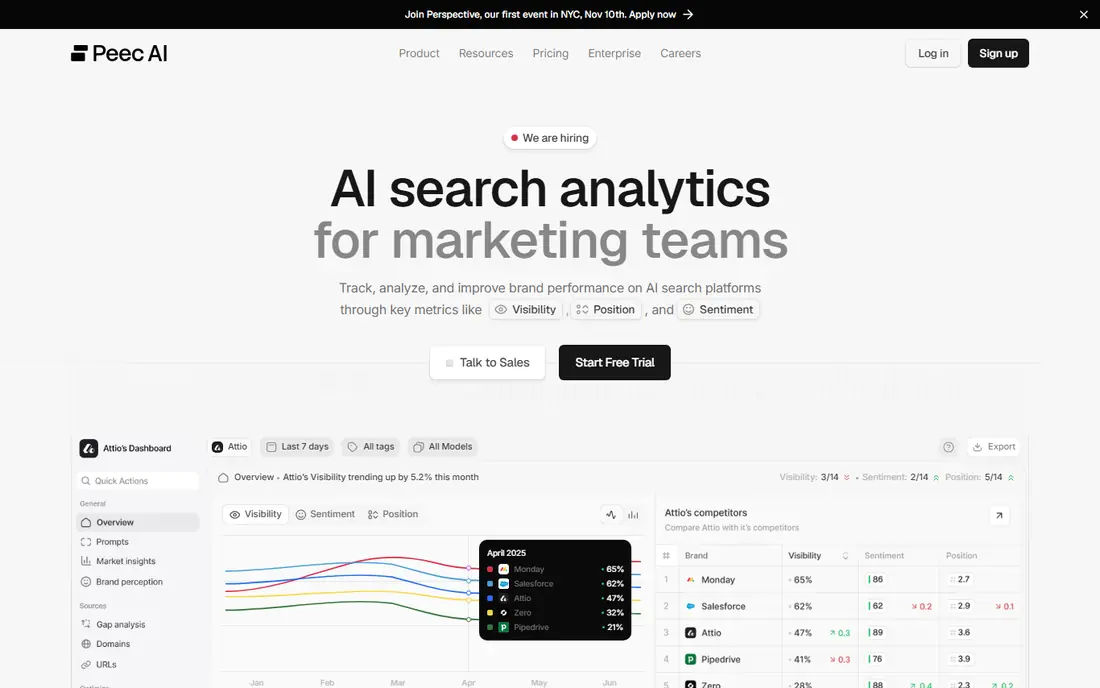
Peec AI measures well for teams with several brands, markets, or clients. You choose engines for each project, track prompts daily, and compare results across markets without buying extra seats. Source analysis adds depth to the headline numbers, since you can see which pages were cited when your mention rate changed.
Measurement buyers should still check engine coverage at the tier they plan to buy, since not every model is included at entry. Prompt count also sets the ceiling for category coverage. For agencies and multi market brands, Peec AI balances measurement depth with manageable pricing.
- Daily tracking across chosen engines
- Multi project and multi market views
- Unlimited users
- Entry engine choice is limited
- Prompt allowance needs planning
- No permanent free plan
Profound offers the broadest measurement footprint in this list for enterprise teams. It tracks answers across many engines, adds prompt volume context, and can connect crawler activity to your analytics where integrations are available. That breadth matters when buyers use several assistants, since a brand can be strong in one engine and invisible in another.
Small teams will find the enterprise model heavy, and the trial covers fewer engines than the full plan. Profound is best when measurement must cover many engines, markets, and stakeholders, and when a team can act on detailed, frequent data.
- Up to nine answer engines on enterprise plans
- Prompt volume data
- Crawler and analytics connections
- Custom enterprise pricing
- Complex setup for small teams
- Trial covers a limited engine set
Semrush AI Visibility Toolkit measures AI visibility in the same place many SEO teams already work. That context helps: you can compare an AI mention gap with keyword rankings, site audit issues, and competitor pages without exporting between tools. Prompt research helps build a measurement set from real search demand, not guesswork.
The entry allowance is modest, and per domain pricing makes multi brand measurement expensive. If you already pay for Semrush, the toolkit is a natural measurement add on. If you only need AI measurement, a specialist tool may give more prompts per dollar.
- AI mention tracking beside SEO data
- Prompt research
- AI readiness site audit
- Competitor comparison
- Per domain price
- 25 tracked prompts at entry
- Extra prompts add cost
Ahrefs Brand Radar measures in two ways, which sets it apart. The index lets you research AI visibility for any brand or category from pre collected responses, while custom prompts track your own questions over time. Citation tracking, competitor benchmarking, and AI traffic data round out a measurement set that goes beyond a single mention score.
Pricing is the part to model carefully. Index access is priced per platform, and custom checks are sold in packages, so cost depends on prompts, platforms, and frequency. For teams that already use Ahrefs, Brand Radar adds market wide measurement that specialist prompt trackers do not offer.
- Pre collected AI response index for market research
- Custom prompt tracking
- Citation and AI traffic reporting
- Index price is per platform
- Check based pricing needs modeling
- Core Ahrefs plan may also be needed for full use
SE Ranking suits SEO teams that want AI measurement without a separate specialist subscription. Its AI results tracker covers major engines, including AI Overviews, AI Mode, ChatGPT, Gemini, and Perplexity, and sits beside rank tracking and site audits. That makes it easier to explain AI changes alongside classic ranking changes in one report.
Check the prompt and keyword allowances on the plan you choose, since AI measurement shares the suite limits. For teams already tracking many keywords, SE Ranking can add AI measurement at a lower extra cost than a standalone tool.
- AI results tracker beside keyword tracking
- Several engines covered
- Familiar SEO reporting
- AI prompt allowance varies by plan
- Full suite may be more than a small team needs
- Pricing varies by billing period
Moz Pro adds AI visibility dashboards to a suite many SEO teams already know. Tracked prompts show how AI assistants handle your brand questions, while authority metrics give context on the pages and domains cited. That pairing helps a team judge whether a citation gap comes from content, authority, or source coverage.
Specialist tools may offer deeper prompt, engine, and source detail than Moz Pro at the same price. Choose Moz Pro when AI measurement is one part of a wider SEO program and you value a single dashboard for rankings, links, and AI answers.
- AI visibility dashboards in a known SEO suite
- Authority metrics for context
- Tracked prompts for brand questions
- AI features are newer than specialist tools
- Plan pricing varies
- Depth varies by tier
Nightwatch is useful for rank tracking teams that want AI checks without a second bill. AI tracking is included at every tier, covering ChatGPT, Claude, Gemini, Perplexity, AI Mode, and AI Overviews in recent plan descriptions. That makes it a low friction way to add AI measurement to daily rank reports.
Keyword volume and plan limits still decide the real cost, so model your tracked keyword and prompt counts together. For teams that already report on rankings daily, Nightwatch adds AI measurement in a familiar workflow.
- AI tracking included at every tier
- Several engines covered
- Strong rank tracking heritage
- Pricing in euros can vary in dollars
- Plan limits depend on keyword volume
- Reporting depth varies by tier
Kairosy stands out for measurement honesty: it shows full answers with sources, so you can check what a score actually means. Sentiment per answer adds context beyond a yes or no mention, which helps brand teams spot negative or inaccurate claims. Daily prompts at a low entry price make it a strong test tool for a small team.
Agency scale and advanced integrations need higher tiers, and the vendor is smaller than the major SEO suites. For a small team that wants to read real answers and track them daily, Kairosy is a strong, low cost measurement choice.
- Low entry price
- Full answers with sources shown
- Sentiment per answer
- Daily prompts
- Smaller vendor record than Semrush or Ahrefs
- Higher tiers needed for agency scale
- Feature set is measurement focused
Keyword.com offers one of the lowest entry prices for AI visibility measurement, with AI checks starting from $24.50 per month in recent published comparisons. API access helps teams pull measurement data into their own dashboards, which suits technical marketers and agencies with custom reporting. Engine coverage includes major assistants, so a small team can measure core visibility without a large budget.
The tool is rank tracking first, so AI reporting may feel less polished than a specialist dashboard. Prompt design also matters more at this price, since a weak prompt set produces weak data. For budget conscious measurement with API needs, Keyword.com is worth testing.
- Low AI visibility entry price
- API access for custom reporting
- Several engines covered
- Interface is rank tracker first
- Setup needs care for prompt design
- Support and depth vary by plan
How we picked these
We compared official feature and pricing pages and recent published pricing checks from October 2026, with a focus on measurement quality rather than content drafting. We favored tools that store answers, state denominators, show sources, and allow export or API access, since those features let you audit a score. Prices marked See website reflect custom, regional, or plan dependent pricing that we could not pin to one stable figure.
Reading AI measurement numbers correctly
A mention rate only means something with a denominator: how many prompts, which engines, how many runs, and over what period. Ask every vendor what counts as a mention, what counts as a citation, and whether a brand in a source link counts the same as a brand named in the answer text. Those definitions differ, so scores from two tools are rarely directly comparable.
Building a measurement set you can trust
Fix your prompt list for at least a month, run it on a fixed schedule, and keep the same engines and regions. Include brand prompts, product prompts, comparison prompts, and problem prompts, and keep a control set of prompts that should not mention you, to catch false positives. Record content changes, PR events, and site changes beside the timeline, so a jump has an explanation beyond the chart.
Share of voice, sentiment, and traffic
Share of voice shows your mentions against rivals in the same prompt set, which is more useful than a solo score. Sentiment shows whether mentions are positive, neutral, or negative, and citation rate shows whether AI assistants link to your pages or only name you. AI traffic, where a tool can measure it, shows whether mentions turn into visits, which is the link between visibility and business results.
Frequently asked questions
What is the best tool for measuring visibility in AI search?
Otterly.ai and Kairosy are the best low cost starts, Peec AI suits multi market measurement, and Ahrefs Brand Radar suits market wide research. Semrush, SE Ranking, Moz Pro, and Nightwatch suit teams that want AI measurement inside a wider SEO suite.
How do tools measure visibility in AI search?
Most tools run a fixed set of prompts through AI assistants on a schedule, then record mentions, citations, sentiment, and rival presence in the answers. Some add a pre collected index, prompt volume data, or AI traffic estimates for extra context.
What is the difference between mention rate and citation rate?
Mention rate counts how often an answer names your brand. Citation rate counts how often an answer links to or cites your pages or sources. A brand can be mentioned without a citation, which is weaker for traffic and trust.
How often should I measure AI visibility?
Daily tracking suits active programs, while weekly tracking suits smaller teams with a stable prompt set. Judge trends over four to eight weeks, since single day answers vary with prompt wording and model behavior.
Can I measure AI visibility for free?
Some tools offer free trials or free checkers, but ongoing prompt measurement is usually paid. Start with a trial on your top prompts, then pay for the smallest plan that covers your prompt, engine, and reporting needs.
Why do two tools give different AI visibility scores?
Scores differ because prompt sets, engines, run timing, and definitions of a mention or citation differ. Compare trends inside one tool over time, rather than treating scores from different tools as the same number.
Sources
See where you really rank - block by block
ProMapRanker scans Google Maps across a grid of your service area. Simple monthly plans from $19, white-label on every plan.
Start freeKeep reading
 peec ai alternatives
Peec AI Alternatives in 2026
Compare the best peec ai alternatives for tracking brand visibility in AI answers, from Profound and Otterly to Scrunch, AthenaHQ, Goodie and more in 2026.
Read → janitor ai alternatives
Janitor AI Alternatives in 2026
Compare the best Janitor AI alternatives for character chat and roleplay, with pricing, safety notes, moderation practices, and honest trade-offs in 2026.
Read → best tools for seo e-commerce
Best Tools for SEO E-Commerce in 2026
We compared the best tools for SEO e-commerce, from keyword research and audits to product page optimization, with current pricing and store trade-offs.
Read →