 ProMapRanker
Best Supply Chain Software in 2026

Key takeaways
- Most top supply chain software is enterprise priced by custom quote, with implementations measured in months rather than days.
- Oracle and SAP win when a company already runs their ERP, while Kinaxis, Blue Yonder and Manhattan lead as specialists.
- NetSuite is the most realistic mid-market option in this list, while the rest target large or complex operations.
- Judge vendors on industry fit and implementation quality, not on feature lists alone, since data quality decides most outcomes.
Quick comparison
| Pick | Great for | Pricing starts at | Free tier | |
|---|---|---|---|---|
 Oracle Fusion Cloud SCM | Oracle ERP users | See website | Free trial | Visit |
 SAP Supply Chain | SAP S/4HANA users | See website | No | Visit |
 Blue Yonder | Retail and manufacturing planning | See website | No | Visit |
 Kinaxis Maestro | Concurrent scenario planning | See website | No | Visit |
 Manhattan Active | Warehouse and omnichannel fulfilment | See website | No | Visit |
 E2open | Multi-tier supplier networks | See website | No | Visit |
 Infor | Industry-specific manufacturing | See website | No | Visit |
 Oracle NetSuite SCM | Mid-market companies | See website | No | Visit |
 o9 Solutions | AI forecasting and digital twins | See website | No | Visit |
The best supply chain software
We compared vendor product pages, planning and execution scope, and published pricing notes for platforms live in October 2026. Almost all pricing is quote based, so we show See website and focus on fit and scope.
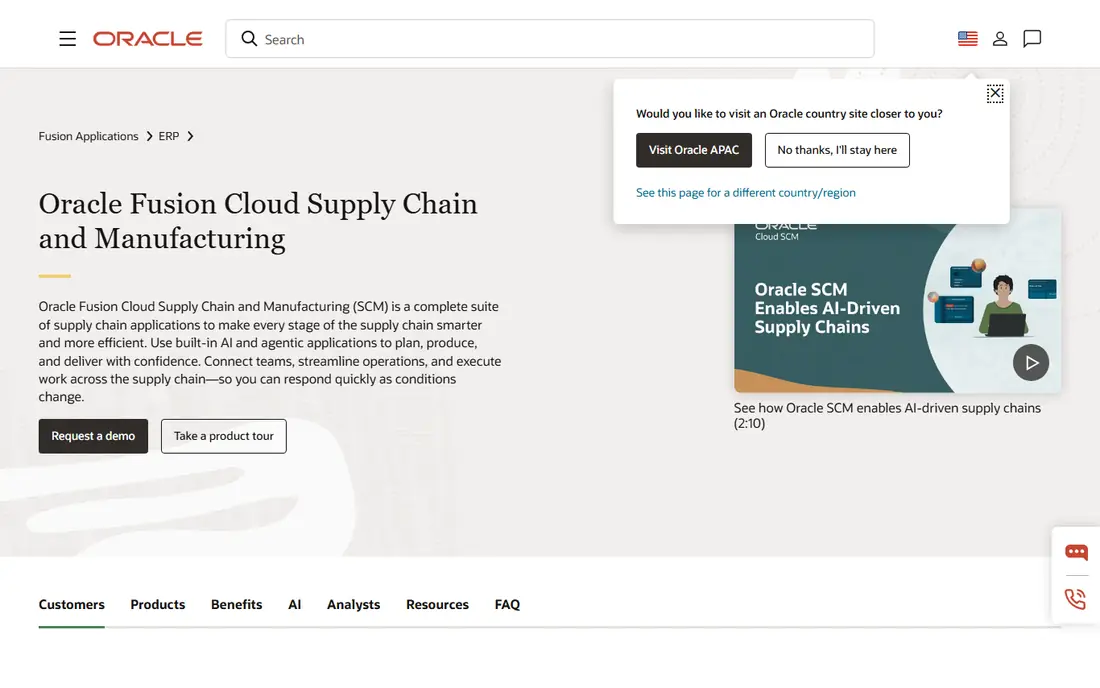
Oracle Fusion Cloud SCM covers planning, inventory, procurement, manufacturing and logistics in one cloud suite. For companies already on Oracle Cloud ERP, the shared data model removes a lot of integration work and gives finance and operations one view of supply and demand. Global companies with complex compliance and multi-currency needs are the core audience.
The cost and project size are the honest catch. This is an enterprise suite, not a quick tool for a small warehouse. Budget for implementation, data cleanup and change management alongside the licence fee.
- End-to-end planning, procurement and logistics
- Strong Oracle ERP connection
- Global scale
- Quote-based pricing
- Implementation is large
- Best value needs Oracle standardisation
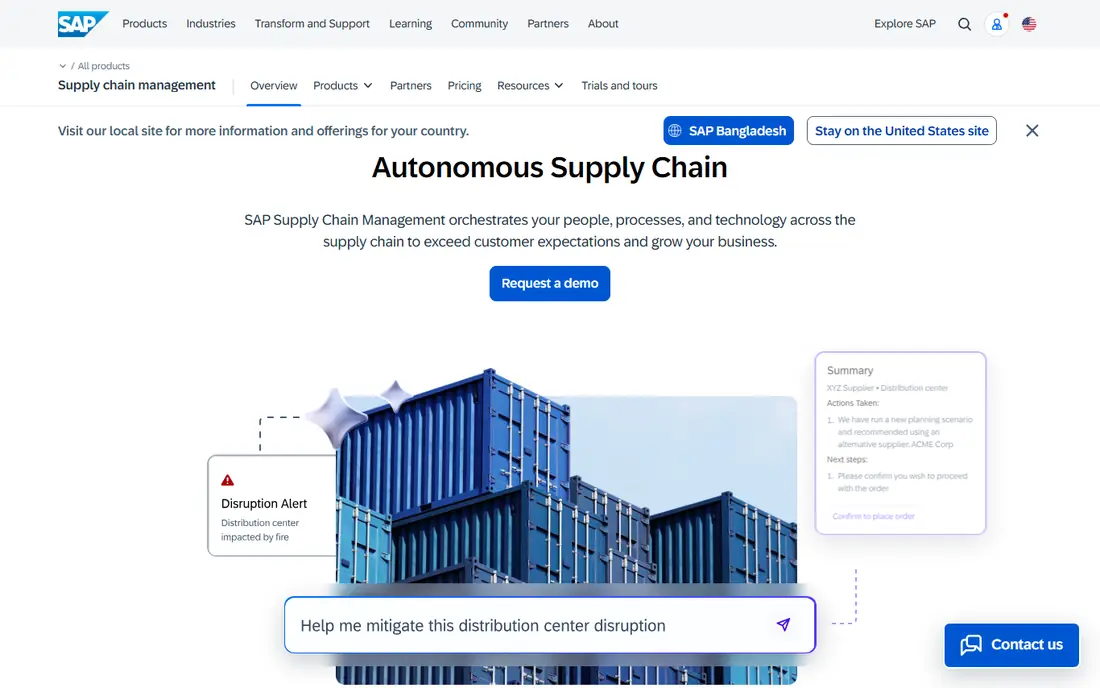
SAP supply chain tools, including Integrated Business Planning, serve global firms standardised on SAP S/4HANA. Planning, production, warehousing and logistics share SAP master data, which helps when plants, suppliers and sales teams must work from one plan. Industry depth in manufacturing, consumer goods and life sciences is a real strength.
Like Oracle, SAP rewards commitment and punishes half-hearted adoption. Companies without SAP already in place should compare specialist tools before accepting a full SAP program.
- Deep SAP integration
- Integrated business planning
- Global manufacturing depth
- Quote-based pricing
- Complex to implement
- Needs SAP skills in-house or from a partner
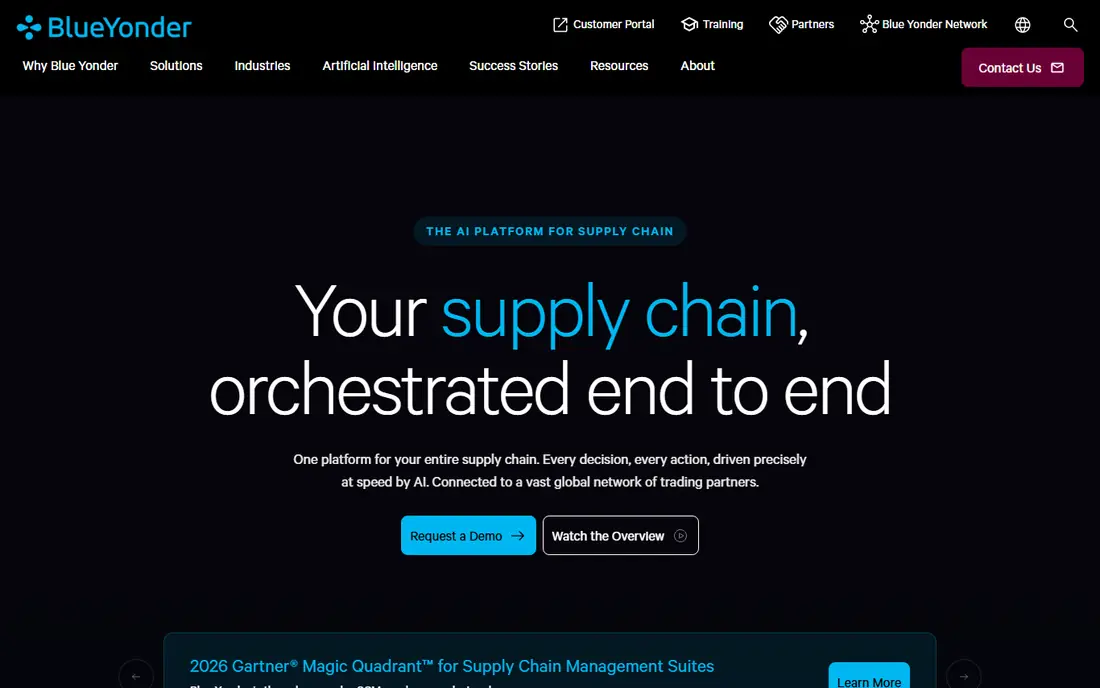
Blue Yonder is best known for demand planning, replenishment and forecasting for retailers, grocers and manufacturers. Its planning models handle promotions, seasonality and store-level demand in ways that generic ERP planning often misses. Execution tools for warehousing and transport can sit alongside planning for a fuller suite.
Scope the project tightly. Blue Yonder sells a broad platform, and buying every module at once can slow the first win. Start with the planning problem that costs the most, such as stockouts or excess inventory.
- Strong demand forecasting
- Retail and grocery expertise
- Planning plus execution options
- Quote-based pricing
- Broad suite needs careful scoping
- Implementation support matters
Kinaxis Maestro lets planners run many what-if scenarios at once and see the effect across sales, production, inventory and finance. That concurrent view suits industries where plans change constantly, such as electronics, pharma and industrial manufacturing. When a supplier fails or demand spikes, teams can compare alternatives quickly instead of rebuilding a plan by hand.
Training and data quality are the limits. Scenario tools only help when the underlying supply data is clean, so expect work on master data and user training before the full benefit appears.
- Fast what-if scenario planning
- Concurrent planning across functions
- Strong in complex industries
- Quote-based pricing
- Training takes effort
- ERP integration needs planning
Manhattan Active is the warehouse and fulfilment specialist in this list. It manages receiving, picking, packing, labour and order allocation across warehouses and stores, with support for ship-from-store and buy-online-pickup models. High-volume retailers and distributors rely on it when order accuracy and speed directly affect customer satisfaction.
It is not a full planning suite on its own. Pair Manhattan with a planning tool, or buy it when warehouse execution is the bottleneck rather than forecasting.
- Warehouse management depth
- Omnichannel order fulfilment
- Scalable for high volume
- Quote-based pricing
- Execution focus rather than full planning
- Implementation is specialist work
E2open connects companies with suppliers, logistics providers and partners across tiers, giving visibility beyond direct suppliers. That network view helps firms spot delays, manage global trade documents and coordinate forecasts with partners. Companies with long, global supply chains gain the most.
The network effect is also the risk. Value depends on partners joining and sharing data, so onboarding plans and partner incentives matter as much as software features.
- Multi-enterprise network visibility
- Supplier and logistics connections
- Global trade support
- Quote-based pricing
- Network onboarding takes time
- Value grows with supplier adoption
Infor offers supply chain tools tuned for specific industries, including food and beverage, fashion, automotive and distribution. That industry focus can shorten implementation, since processes, terms and compliance needs are closer to the buyer out of the box. Infor Nexus also supports multi-tier supplier networks and finance.
The product range can confuse buyers, so confirm exactly which Infor product and edition is being quoted. Ask for reference clients in your industry before signing.
- Industry-specific editions
- Manufacturing and distribution depth
- Cloud suite options
- Quote-based pricing
- Product range is broad and confusing
- Partner quality varies
NetSuite is the practical mid-market pick here. It combines financials, inventory, order management and supply chain in one cloud ERP, which suits companies outgrowing spreadsheets and entry-level systems. The shared system avoids stitching together separate accounting and inventory tools.
Depth is the trade-off. Very large or highly complex supply chains will outgrow NetSuite planning and warehousing sooner than they outgrow Oracle, SAP or Kinaxis. For most mid-market firms, though, that limit is years away.
- ERP plus supply chain in one system
- Realistic mid-market fit
- Inventory and order management included
- Quote-based pricing
- Less depth than enterprise specialists
- Customisation needs care
o9 Solutions builds a digital twin of the supply chain, letting planners test decisions against a model of demand, supply and finance. Its AI forecasting suits companies with large, messy demand signals across channels and regions. Integrated business planning brings sales, operations and finance into one process.
This is an enterprise tool for firms with planning maturity and clean data. Smaller companies should start with NetSuite or a focused planning tool and revisit o9 when complexity justifies it.
- AI-driven forecasting
- Digital twin modelling
- Integrated planning across functions
- Quote-based pricing
- Enterprise focus
- Needs strong data and planning maturity
How we picked these
We compared vendor product pages, planning versus execution scope, and pricing transparency for platforms live in October 2026. We kept suites and specialists that cover real supply chain work, from forecasting to warehousing, and we left out simple inventory apps that lack planning or network features. Prices are quote based for nearly every vendor, so we show See website rather than inventing figures.
How to choose supply chain software
Start with the bottleneck. If forecasts are wrong, buy planning first. If warehouses cannot fulfil orders accurately, buy execution first. If supplier visibility is the gap, buy a network tool. A single suite rarely fixes every problem at once, and phased buying reduces risk.
Implementation, data and total cost
Ask vendors for implementation timelines, data requirements and reference clients in your industry. Supply chain projects fail more often on dirty master data and weak change management than on missing features. Get a total cost that includes licences, implementation, integration and training, and confirm what happens when volumes or users grow. Pilot with one site, one product family or one supplier group first, and measure forecast accuracy, inventory turns and order fulfilment before rolling out wider. That pilot gives a realistic view of data gaps and training needs, and it protects the wider business from a big-bang change that disrupts deliveries.
Frequently asked questions
What is the best supply chain software?
Oracle and SAP lead for firms already on their ERPs, Kinaxis leads for scenario planning, Blue Yonder leads for retail forecasting, and Manhattan leads for warehousing. NetSuite is the best mid-market starting point in this list.
What is the top rated software for supply chain platforms?
Top rated depends on use case, since planning, warehousing and network tools solve different problems. Compare vendors within one category first, then check integration with your ERP and accounting systems.
What are the best supply chain services?
Supply chain services include planning software, warehousing systems, logistics platforms and network tools. This article covers software; logistics providers and consultants are a separate buying decision and should be judged on routes, rates and service levels.
How much does supply chain software cost?
Most enterprise platforms are quote based, with annual contracts that reflect users, modules and volume. Mid-market ERP supply chain tools are lower, but still quote based in most cases. Ask for a full implementation quote before comparing vendors.
Can small businesses use supply chain software?
Yes, but most tools in this list target large firms. Small businesses should start with NetSuite or a focused inventory and planning tool, and move to enterprise suites only when volume and complexity require it.
Sources
See where you really rank - block by block
ProMapRanker scans Google Maps across a grid of your service area. Simple monthly plans from $19, white-label on every plan.
Start freeKeep reading
 whats the best ai app to use
Whats the Best AI App to Use in 2026
Wondering whats the best ai app to use in 2026? We compare ChatGPT, Claude, Gemini, Copilot, and more on price, free plans, and best everyday uses today.
Read → life360 alternatives
Life360 Alternatives in 2026
Life360 alternatives compared: 9 family location apps with live maps, arrival alerts and privacy controls to help your family stay in touch every day.
Read → captcha alternatives
CAPTCHA Alternatives in 2026
CAPTCHA alternatives compared: 9 reCAPTCHA alternatives that block bots with less friction, from free Turnstile to privacy-first proof-of-work tools included.
Read →