 ProMapRanker
Best Supply Chain Management Software in 2026


Planning inside SAP · Pricing starts at: See website
Key takeaways
- SAP and Oracle suit companies that already run those enterprise systems and want planning close to their core records.
- Kinaxis and o9 lead for concurrent planning and scenario work, while Manhattan leads for warehouse and fulfillment execution.
- Blue Yonder is strongest for retail and consumer goods demand planning, and Coupa is strongest for spend and supplier work.
- Every suite here is priced by quote, so budget for implementation and data cleanup on top of the license.
Quick comparison
| Pick | Great for | Pricing starts at | Free tier | |
|---|---|---|---|---|
| SAP Integrated Business Planning | Planning inside SAP | See website | No | Visit |
 Oracle Supply Chain Management Cloud | Planning inside Oracle | See website | No | Visit |
 Blue Yonder | Retail demand planning | See website | No | Visit |
 Kinaxis | Concurrent planning and scenarios | See website | No | Visit |
 Manhattan Associates | Warehouse and fulfillment | See website | No | Visit |
 o9 Solutions | AI planning and digital twin work | See website | No | Visit |
 Coupa | Spend and supplier management | See website | No | Visit |
 Infor Supply Chain Management | Manufacturing and distribution suites | See website | No | Visit |
 E2open | Network visibility and collaboration | See website | No | Visit |
The best supply chain management software
We compared official product pages, documentation, and current vendor descriptions for these suites, looking at planning depth, execution strength, integration, and fit for different company sizes. Most vendors price by quote based on modules, users, and scope, so we use See website for price throughout this article. Implementation often costs as much as, or more than, the first year license, and data quality is the factor that most often decides success.
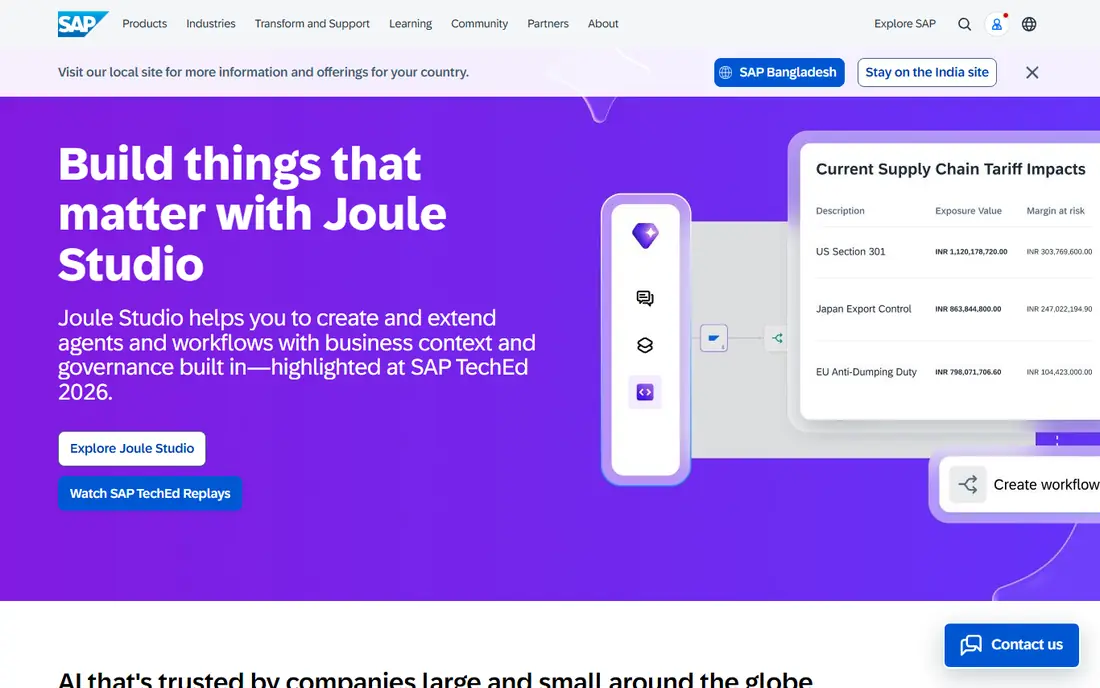
SAP Integrated Business Planning, often called SAP IBP, covers demand planning, supply planning, inventory optimization, and sales and operations planning in one cloud suite. Its strength is the link to SAP ERP records, which reduces the manual data work that weakens many planning projects. Planners can test scenarios, compare outcomes, and align on one plan across functions.
The catch is scope. SAP IBP rewards companies that commit to the SAP data model and to a proper implementation, and smaller teams may find the project heavy. If your company already runs SAP and your planners still live in spreadsheets, SAP IBP is the natural first look. If you run another ERP, a best of breed planner may fit faster.
- Deep demand, supply, and inventory planning
- Close fit with SAP ERP data
- Strong scenario tools
- Complex to implement
- Best value comes with a wider SAP footprint
Oracle Supply Chain Management Cloud covers planning, procurement, manufacturing, inventory, logistics, and order management. Like SAP, its main advantage is working inside the vendor ERP, so orders, inventory, and financial records stay connected. Global companies also benefit from its trade, transportation, and warehouse tools.
The suite is broad, and that breadth can become a long project if you try to adopt every module at once. A phased rollout, starting with planning and one execution area, usually works better. Oracle customers who want one vendor for ERP and supply chain work should put this at the top of the shortlist.
- Broad suite from planning to logistics
- Close fit with Oracle ERP
- Strong global trade and logistics tools
- Large suite with a long implementation
- Pricing and module choices need careful scoping
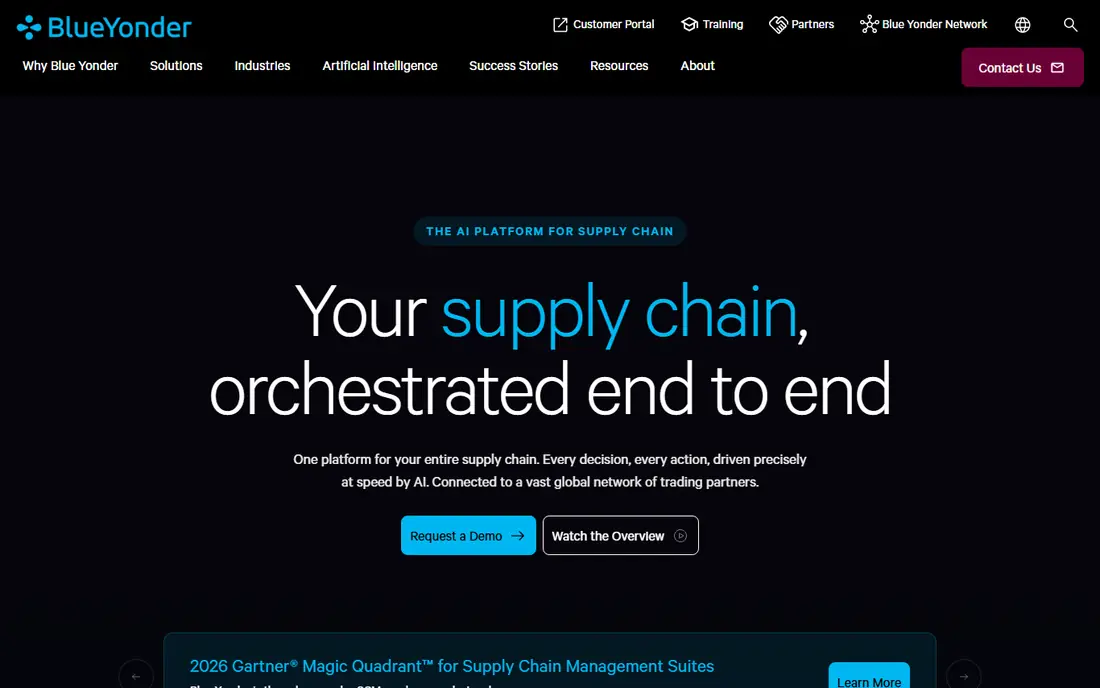
Blue Yonder has long served retailers and consumer goods companies, and that focus shows in its demand forecasting, assortment aware planning, and inventory tools. It handles seasonal swings, promotions, and store level demand better than many general suites, and its fulfillment tools help with buy online and pickup in store orders.
Blue Yonder is an enterprise purchase, with a project to match, and it suits companies with complex retail networks more than small distributors. If your pain is forecast accuracy across stores and channels, Blue Yonder deserves a demo. If your pain is factory scheduling alone, a planning specialist may fit better.
- Strong retail and consumer goods planning
- Demand forecasting and inventory optimization
- Omnichannel fulfillment tools
- Enterprise price and project size
- Retail focus may matter less for pure manufacturers
Kinaxis, built around its Maestro platform and RapidResponse heritage, lets planners work on demand, supply, and inventory at the same time, rather than in separate steps. When a supplier fails or demand jumps, teams can run a scenario and see the effect across the network quickly. That speed is why many large manufacturers use it for sales and operations planning.
The platform rewards good data and trained users. Companies that skip data cleanup or planner training will get less value, no matter how fast the engine runs. For complex, fast changing supply chains, Kinaxis is one of the strongest planning picks on this list.
- Fast concurrent planning across demand, supply, and inventory
- Strong what if scenarios
- Clear exception alerts
- Needs clean data and trained planners
- Enterprise pricing
Manhattan Associates leads on execution, especially warehouse management. Its Manhattan Active platform covers warehouse operations, labor, slotting, transportation, and order management, and it is proven in high volume retail and distribution centers. If your warehouse is the bottleneck, Manhattan is the name most operators mention first.
Manhattan is not primarily a demand forecasting suite, so many customers pair it with a planning tool such as Kinaxis or Blue Yonder. Budget time for warehouse process design, not just software setup, since the gains come from how work flows through the building. For fulfillment quality and speed, it is hard to beat.
- Leading warehouse management
- Strong order management and fulfillment
- Proven at retail scale
- Less of a pure demand planning suite
- Implementation needs warehouse process work
o9 Solutions offers an integrated planning platform that models the full supply chain as a digital twin, letting teams test decisions before they commit. Demand, supply, inventory, and financial planning sit in one model, with AI tools to surface risks and options. Large consumer goods, retail, and industrial companies use it for enterprise planning.
The platform is powerful, but it is not a quick purchase. It needs executive backing, clean data, and planners who can own the model. Companies that meet those conditions often report faster, more consistent planning cycles. Smaller teams should look at a narrower tool first.
- Integrated business planning with AI models
- Digital twin scenarios
- Strong for large, complex networks
- Enterprise scope and price
- Needs senior planning leadership to succeed
Coupa is best known for business spend management, and its supply chain strength sits in procurement, supplier collaboration, invoicing, and spend visibility. It helps companies control what they buy, from whom, and at what terms, and it gives finance a clear view of committed spend. That matters when supplier risk and cost pressure dominate.
Coupa does not replace a warehouse system or a detailed factory planner, so treat it as a complement to execution tools, not as a full suite for every supply chain job. If procurement and supplier risk are your main gaps, Coupa is a strong, focused pick.
- Strong procurement, invoicing, and spend analytics
- Supplier collaboration tools
- Broad business spend coverage
- Not a full factory or warehouse suite
- Planning depth is narrower than Kinaxis or o9
Infor Supply Chain Management covers planning, warehouse management, transportation, and supply chain visibility, with editions tuned for industries such as food and beverage, fashion, automotive, and distribution. That industry focus can shorten implementation, since workflows and terms already match the sector.
The range is broad, so buyers should confirm which modules and editions fit their exact operation, rather than assuming every Infor product covers every need. Companies that run Infor ERP, or that want an industry tuned suite without the largest enterprise price tag, should include Infor in the comparison.
- Industry focused suites for manufacturing and distribution
- Warehouse and planning tools
- Cloud deployment options
- Product breadth varies by industry edition
- Integration work still needed for non Infor systems
E2open focuses on the network between companies, not just inside one firm. Its platform connects suppliers, logistics partners, and customers so that demand signals, inventory, shipments, and trade documents move faster and with fewer errors. That network view helps when delays start with a partner, not in your own warehouse.
The catch is adoption: the network helps most when key partners also use it well. Smaller firms may find the scope larger than they need, while global companies with many partners gain the most. If visibility across partners is your top problem, E2open is a distinct and useful option.
- Multi enterprise network for suppliers and partners
- Demand and supply visibility
- Logistics and trade tools
- Network value depends on partner adoption
- Enterprise scope for smaller firms
How we picked these
We compared official product pages and documentation, and we kept suites that are actively sold and supported in October 2026, that cover planning, execution, or network collaboration at real scale, and that appear in enterprise shortlists. We left out small inventory apps, since the topic is management software and suites, and we left out point tools that cover only one warehouse task. Prices are quote based, so we did not invent figures, and we used See website throughout.
How to choose a suite without a painful project
Start with the gap, not the vendor list. If forecasts are wrong, you need a planning tool. If warehouses miss shipments, you need execution. If suppliers surprise you, you need visibility and procurement. Many failed projects buy a suite for one gap and then try to force it to cover every job.
Suite or best of breed
A suite from your ERP vendor gives cleaner data and fewer integrations, but it may be weaker in one area. A best of breed planner or warehouse tool can be stronger in that area, at the cost of integration work. For most mid size firms, a strong planner plus a strong execution tool beats a weak all in one suite. For large global firms, a suite plus targeted specialists is common.
Implementation, data, and total cost
Ask each vendor for a phased plan, a data cleanup estimate, and a training plan for planners and warehouse staff. Get the license, implementation, integration, and support costs in writing, and ask what happens at renewal. Run a pilot on one product family or one warehouse before a global rollout, and judge the pilot on forecast accuracy, service level, and inventory, not just on whether the software went live.
Frequently asked questions
What is the best supply chain management software for most companies?
There is no single winner, since planning and execution are different jobs. SAP and Oracle suit firms already on those ERPs, Kinaxis and o9 suit complex planning, and Manhattan suits warehouse led operations. Start from your biggest gap, then shortlist two or three vendors for demos.
What is the top supply chain management software for small businesses?
Most suites here target mid size and large firms. Smaller firms should look at the ERP they already use, or at lighter inventory and order tools, before buying an enterprise suite. Buying too large a platform early is a common and costly mistake.
How much does supply chain management software cost?
Almost all enterprise suites price by quote, based on modules, users, sites, and transaction volume. Annual licenses often run from tens of thousands into six or seven figures, plus implementation services. Ask for a written total cost, including support and renewal terms.
What is the difference between planning and execution software?
Planning decides what should happen, including forecasts, inventory targets, and production schedules. Execution makes it happen, including warehouse work, transport, and order fulfillment. Kinaxis, o9, and Blue Yonder lean toward planning, while Manhattan leans toward execution.
How long does implementation take?
Mid size projects often run three to nine months, while enterprise rollouts run nine to eighteen months or longer for global scope. Data migration, ERP integration, and staff training drive the timeline more than software configuration alone.
Do I need supply chain software if I already have an ERP?
You may, if planners still rely on spreadsheets beside the ERP. ERPs handle transactions well, but they plan less well. A planning suite adds forecasting, scenario modeling, and optimization, while an execution suite adds warehouse and transport depth.
Sources
See where you really rank - block by block
ProMapRanker scans Google Maps across a grid of your service area. Simple monthly plans from $19, white-label on every plan.
Start freeKeep reading
 best tour operator software
Best Tour Operator Software in 2026
Compare the best tour operator software for bookings, channel management, waivers and payments, with pricing models for day tours and multi-day trips.
Read → best time clock app for small business
Best Time Clock App for Small Business in 2026
We compare the best time clock app for small business options, with free plans, GPS clock ins, scheduling and payroll links for hourly teams and payroll help.
Read → best test automation tools
Best Test Automation Tools in 2026
Compare the best test automation tools, from Playwright and Selenium to Cypress, Katalon and BrowserStack, with prices, languages and best uses explained.
Read →