 ProMapRanker
Best Sign Language Learning Apps in 2026

Key takeaways
- Lingvano is the best structured starting point, with short lessons, Deaf teachers, and quizzes in one app.
- SignSchool is the best free dictionary-style option, with thousands of signs and slow-motion video.
- ASL Bloom suits learners who want a lesson path plus several sign languages in one subscription.
- Apps build vocabulary and confidence, but real conversation with fluent signers is still needed to reach fluency.
Quick comparison
| Pick | Great for | Pricing starts at | Free tier | |
|---|---|---|---|---|
 Lingvano | Structured ASL lessons | Free | Yes | Visit |
 SignSchool | Free sign dictionary | Free | Yes | Visit |
 ASL Bloom | Lesson path and library | See website | Free trial | Visit |
 The ASL App | Conversational phrases | Free | Yes | Visit |
 Sign It ASL | Course-style learning | See website | No | Visit |
 ASL Kids | Kids and families | Free | Yes | Visit |
 PocketSign | Practice and lookup | Free | Yes | Visit |
 HandSpeak | Deep ASL dictionary | Free | Yes | Visit |
 Ace ASL | Fingerspelling practice | Free | Yes | Visit |
The best sign language learning apps
Learning sign language on a phone works because the language is visual. Good apps show clear video, let you slow it down, and test recall with short quizzes. These nine cover ASL first, with a few options for kids, fingerspelling, and other sign languages.
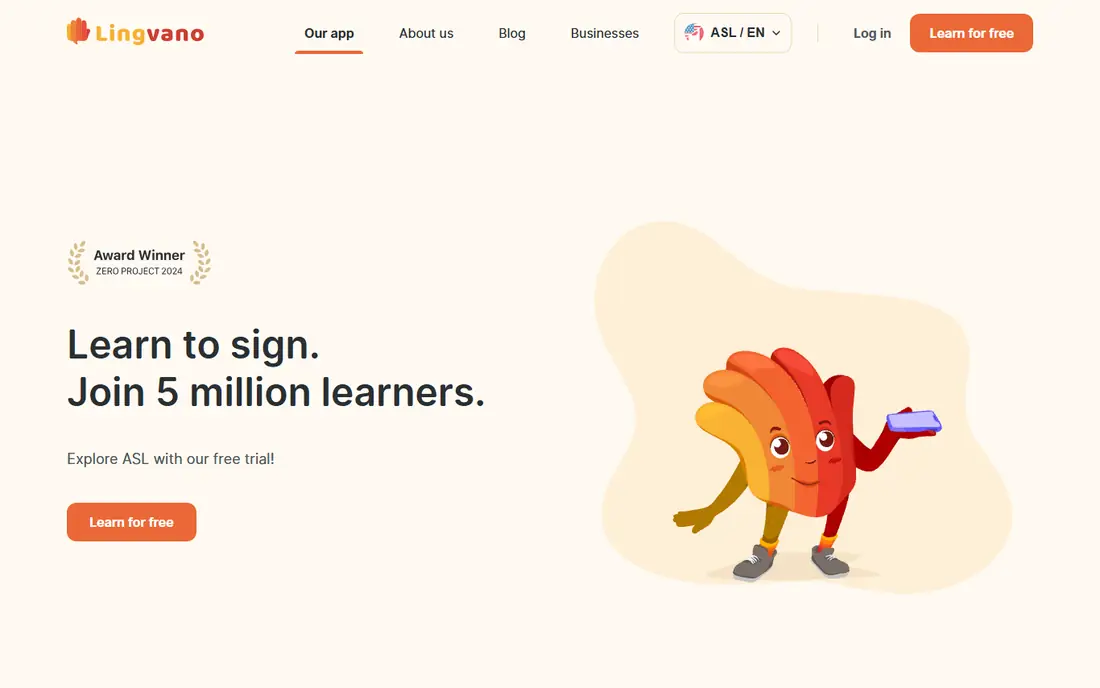
Lingvano is our pick for most adult beginners because it feels like a course, not just a word list. Lessons cover the alphabet, numbers, greetings, and everyday phrases, with video from native signers and short quizzes to check recall. A sign mirror feature, where available, gives visual feedback on form, which helps early learners correct handshape.
The free start is useful, but the full path requires payment, so check the subscription terms for your region before committing. Lingvano fits learners who want a daily lesson habit and a clear order of topics, rather than dipping into a dictionary at random.
- Bite-size lessons with Deaf teachers
- Vocabulary, grammar, and quizzes
- Sign recognition practice
- Full lessons sit behind a subscription
- Advanced conversation needs practice beyond the app
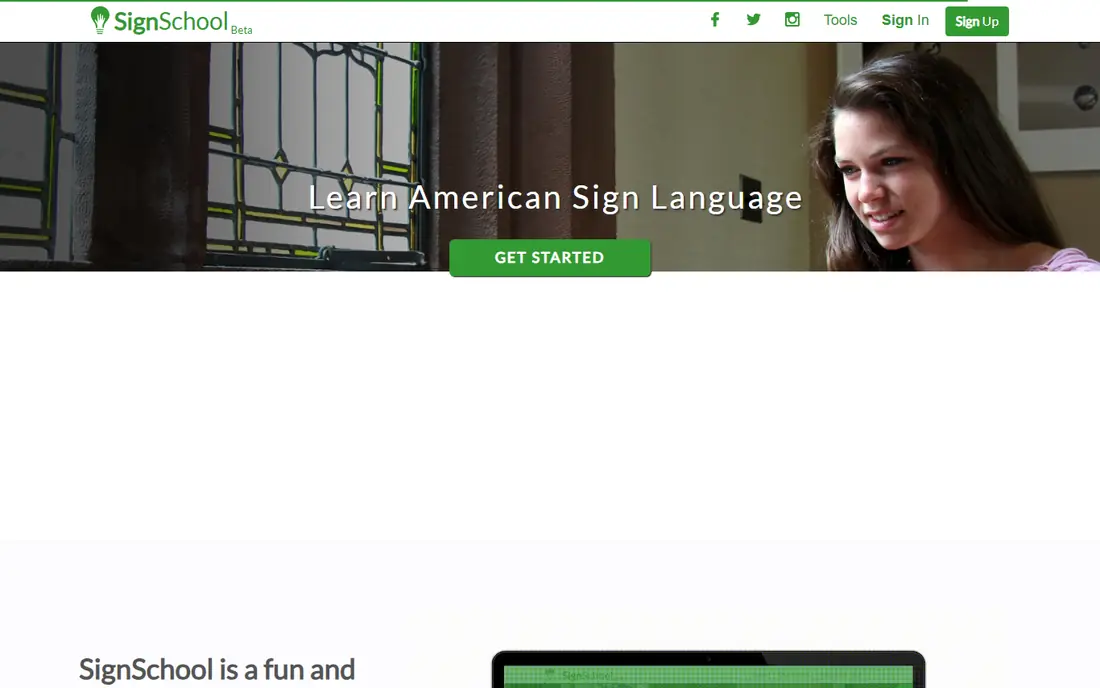
SignSchool suits learners who want to look up signs quickly and practice in short bursts. Its library covers thousands of signs across many subtopics, and slow-motion playback helps with signs that move fast at full speed. A sign of the day and simple games give casual learners a reason to return.
Because it is organized like a dictionary, it does not push you through a full grammar course on its own. SignSchool fits learners who already have a class or a study plan and need a reliable lookup tool, plus families who want free vocabulary practice.
- Large sign library across many topics
- Slow-motion video
- Daily sign and games
- Dictionary style needs self-discipline
- Premium features vary by platform
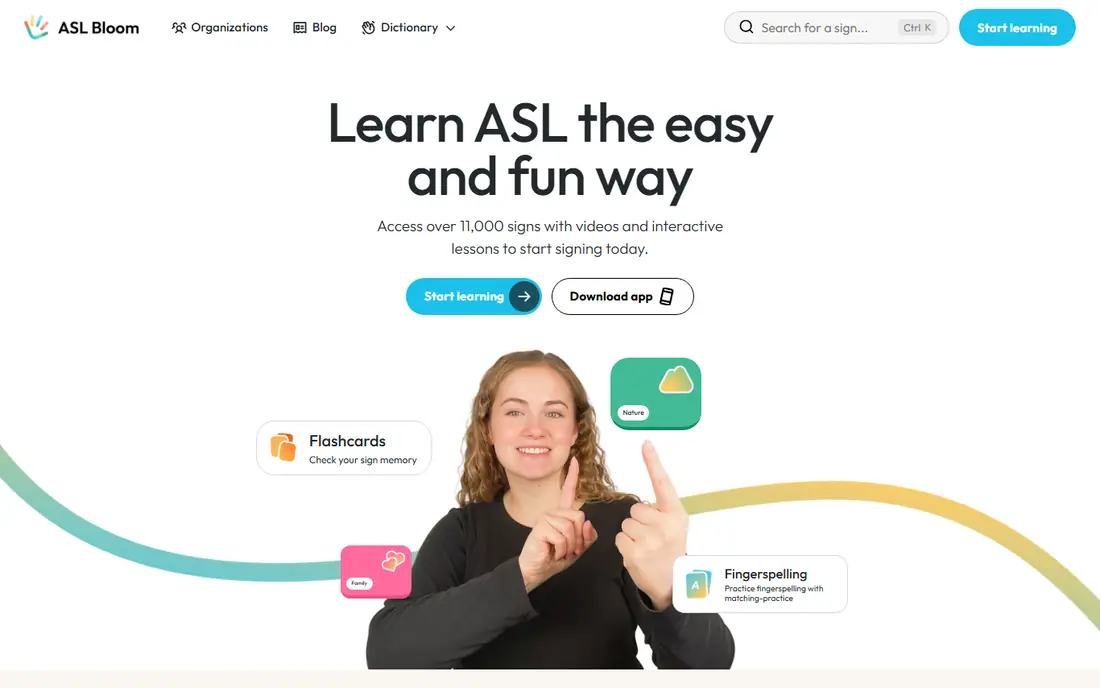
ASL Bloom combines a lesson path with a large sign library, which helps learners who want both structure and lookup in one app. Lessons move in small steps, and spaced repetition features aim to bring signs back just before you forget them. Support for British, Norwegian, Indonesian, and Indian sign languages is a plus for learners outside the US.
The trade-off is that a newer app has fewer years of public reviews to judge. ASL Bloom fits learners who want a modern lesson app and may also want to explore a sign language beyond ASL, provided they use the trial to check lesson style first.
- Structured lessons plus a visual dictionary
- Lessons from native and Deaf instructors
- Several sign languages offered
- Newer than Lingvano, so less long-term track record
- Full access requires subscription
The ASL App focuses on the phrases people actually use in conversation, rather than isolated vocabulary alone. Learners can practice greetings, questions, and common exchanges, slow the video down, and save favorite signs for review. That conversational angle makes it a good second app beside a structured course.
It is not a complete curriculum on its own, and some content sits behind paid packs. The ASL App fits learners who want to speak, in signs, sooner, and who like to practice real phrases they can use with Deaf friends, family, or coworkers.
- Focus on everyday conversation
- Slow mode for study
- Favorites for quick review
- Less of a full curriculum than Lingvano
- Premium packs cost extra
Sign It ASL takes a course approach, with units that build from basic signs toward longer conversations. That order helps learners who get lost in a dictionary, since each unit assumes the last one is understood. Cultural topics beside vocabulary also help learners understand context, not just hand movements.
The paid model means it suits committed learners more than casual browsers. Sign It ASL fits students, workers, or family members who want a classroom-like path on a phone or computer, and who plan to finish units in order rather than jump around.
- Course units with clear progression
- Video lessons from fluent signers
- Vocabulary and culture topics
- Paid course model, not a free app
- Less casual dictionary use than SignSchool
ASL Kids is designed for young learners, babies, families, and early classroom practice. Videos use simple signs, quiz games keep practice playful, and fingerspelling exercises help kids learn the alphabet in a low-pressure way. Parents can use it beside story time or daily routines.
Older learners should not expect a full adult course here, since the pace and content are aimed at children. ASL Kids fits families introducing first signs to kids, and adults who want a gentle, visual starting point before moving to Lingvano or SignSchool.
- Kid-friendly videos and quiz games
- Fingerspelling practice
- Family-friendly pace
- Starting tool, not a full adult curriculum
- Older learners will outgrow it
PocketSign works as a pocket reference for learners who need a sign fast. Its simple layout suits quick checks before a conversation, and practice features help turn a lookup into a short review session. Learners who already study with a course often keep a lookup app like this beside it.
Because it is less widely reviewed than Lingvano or SignSchool, learners should test it with signs they already know before relying on it for new vocabulary. PocketSign fits commuters and students who want a light second app for daily review.
- Quick sign lookup
- Practice tools for learners on the go
- Simple interface
- Smaller public profile than larger apps
- Feature depth varies by platform
HandSpeak is a long-running ASL resource with a deep dictionary, word lists, and learning pages. Serious students value its breadth, especially for signs that smaller apps may not cover. It works well as a reference when a course introduces a word and the learner wants more examples.
The interface feels older than newer apps, and mobile use is less smooth. HandSpeak fits learners who care more about depth and accuracy than design, and who want a trusted reference to check signs found elsewhere.
- Extensive ASL library and word lists
- Long-running Deaf resource
- Useful for study and reference
- Website-first feel
- App experience is less polished than newer apps
Ace ASL focuses on fingerspelling, which is the skill of spelling words letter by letter with handshapes. That narrow focus is useful, since fingerspelling is often the hardest early skill to make fast and clear. Short drills help learners recognize spelled words at speed, not just form each letter slowly.
It does not teach full ASL grammar or conversation, so it works best as a supplement. Ace ASL fits beginners who can form the alphabet but struggle to read fingerspelling, and learners who want a few minutes of focused drill each day.
- Focused fingerspelling drills
- Useful for alphabet fluency
- Free to start
- Narrow scope
- Not a full sign language course
How we picked these
We compared official app pages, app store listings, and recent ASL app summaries, and we kept only apps that are still available in October 2026 with video-based signing. We favored apps with native or Deaf signers, slow-motion playback, and quizzes or spaced review, since those features help visual learning. We noted where a free tier is limited, and we did not present any app as a substitute for classes or conversation with fluent signers.
What to check before you pick
Start with your goal. A structured course suits daily study, a dictionary suits lookup and review, and a fingerspelling drill suits one weak skill. Many learners do best with one course app plus one dictionary app, rather than five apps that all try to do everything.
Next, check the sign language you need. Most apps here teach American Sign Language, but British Sign Language and other national sign languages are different languages, not dialects. If you need BSL or another sign language, confirm the app covers it before paying, and look for local Deaf community classes to practice real conversation.
Frequently asked questions
What is the best app for learning sign language?
Lingvano is the best overall pick for adult ASL beginners, thanks to structured lessons, Deaf teachers, and quizzes. SignSchool is the best free dictionary option, while ASL Bloom suits learners who want a lesson path plus a large sign library.
Can I learn sign language only from an app?
An app can build strong vocabulary and basic grammar, but fluency needs real conversation, feedback on facial expression, and cultural context. Use an app for daily practice, then join a class, Deaf community event, or conversation group when you can.
How long does it take to learn basic ASL?
It varies by study time and practice. Many learners can hold simple conversations after several months of regular short lessons, while fluency takes much longer. Daily practice, even for ten minutes, usually beats occasional long sessions.
Is ASL the same as British Sign Language?
No, ASL and BSL are different languages with different signs and grammar. Learners should pick the sign language used by the community they want to communicate with, and check that their app teaches that language, not just a generic sign list.
Are sign language apps free?
Many apps offer a free start, including Lingvano, SignSchool, The ASL App, and ASL Kids, but full lessons often require a subscription. Use free tiers and trials to test lesson style before paying for a year.
Sources
See where you really rank - block by block
ProMapRanker scans Google Maps across a grid of your service area. Simple monthly plans from $19, white-label on every plan.
Start freeKeep reading
 who has best internet service
Who Has the Best Internet Service in 2026
Who has best internet service for US homes? We compare fiber, cable, fixed wireless and satellite providers on speed, price, availability and terms today.
Read → which survey tool has the best analytics
Which Survey Tool Has the Best Analytics in 2026
Find which survey tool has the best analytics in 2026, comparing Qualtrics, SurveyMonkey, Typeform, Alchemer, and more on reports, text, and stats today.
Read → which streaming service has the best movies
Which Streaming Service Has the Best Movies in 2026
Answering which streaming service has the best movies, with Netflix, Max, Criterion and more compared on libraries, prices and free options in this guide.
Read →