 ProMapRanker
Best Search Visibility Optimization Tools in 2026

Key takeaways
- Semrush and Ahrefs are the most complete suites for keyword research, rank tracking, audits, and competitor analysis.
- Moz Pro and SE Ranking offer a lower-cost entry point for small teams that do not need enterprise scale.
- BrightEdge, Conductor, and seoClarity are enterprise platforms for large sites, with quote-only pricing and longer contracts.
- AI search visibility is now a separate check, so confirm which AI engines and prompts each tool actually tracks before you buy.
Quick comparison
| Pick | Great for | Pricing starts at | Free tier | |
|---|---|---|---|---|
 Semrush | All-in-one visibility | $139 per month | Free trial (7 days) | Visit |
 Ahrefs | Backlinks and research | $129 per month | Yes | Visit |
 Moz Pro | Beginner-friendly suite | $99 per month | Free trial | Visit |
 SE Ranking | Lower-cost all-in-one | $129 per month | Free trial | Visit |
 BrightEdge | Enterprise SEO at scale | See website | No | Visit |
 Conductor | Enterprise content and AI visibility | See website | No | Visit |
 seoClarity | Enterprise content at scale | See website | No | Visit |
 Similarweb | Traffic and market intelligence | See website | Free trial | Visit |
The best search visibility optimization tools
Search visibility now means more than a rank for ten keywords. It covers classic search results, AI answers, local results, and competitor traffic, and the best search visibility optimization tool for a team depends on site size, budget, and how much AI tracking matters. This list covers affordable suites and enterprise platforms, without listing ProMapRanker itself.
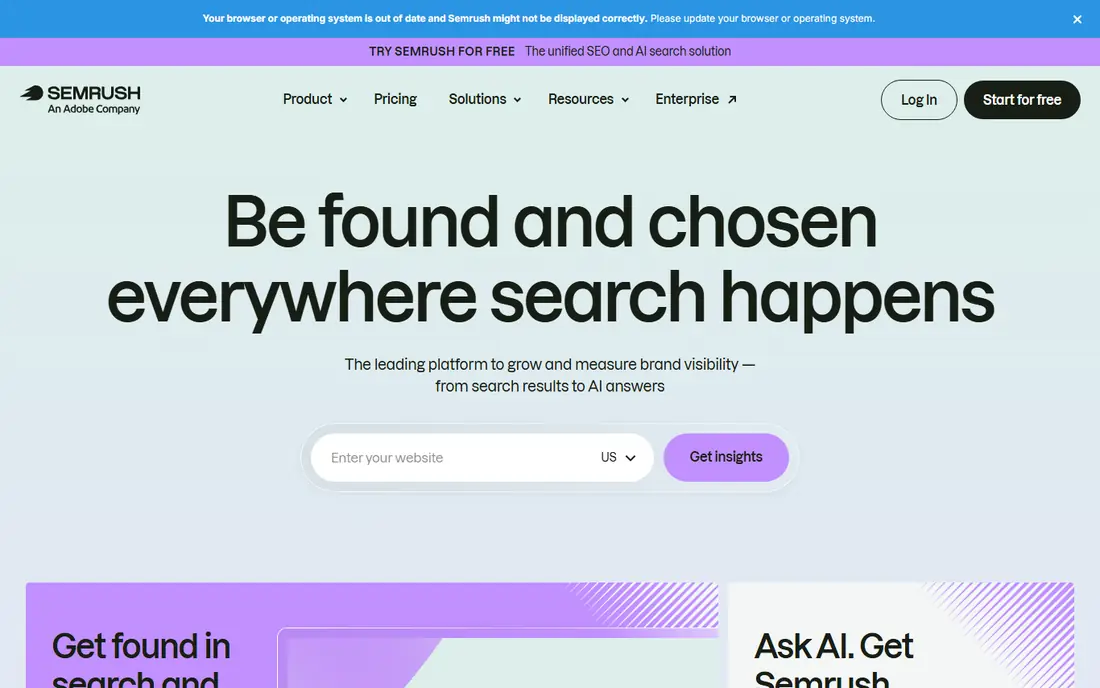
Semrush is the broadest tool on this list, and that breadth is why many marketing teams choose it first. The SEO plan covers keyword research, rank tracking for 500 keywords, site audits, backlink analysis, and competitor research, with separate toolkits for ads, content, and social. That makes it a good single subscription for a team that also buys ads or manages social content.
The cost to watch is not the entry plan alone. Extra users, report add-ons, and AI visibility bundles can raise the bill, and the annual price of $117.33 per month differs from the $139 monthly price. For a team that wants one platform for most marketing intelligence, Semrush is the default pick. For a team that only needs SEO, Ahrefs may be simpler.
- Broad suite for SEO, PPC, content, and social
- Large keyword database
- Daily rank tracking and site audits
- Price rises with extra users and add-ons
- Interface can feel busy
- AI visibility sits in separate bundles for some plans
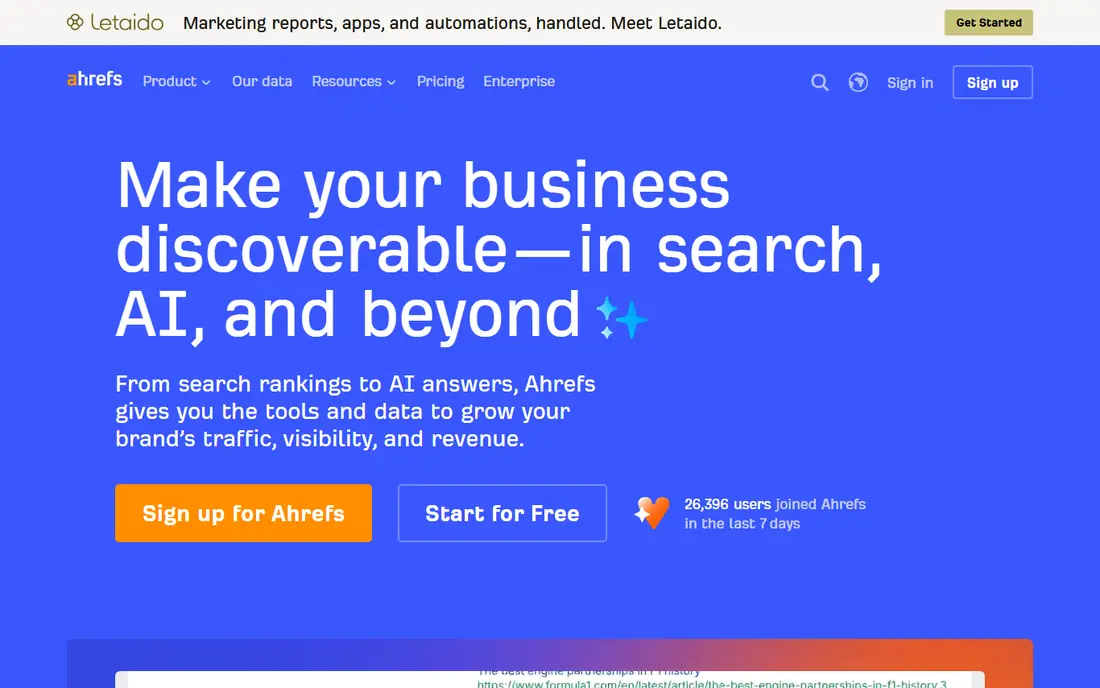
Ahrefs is the tool many SEO professionals open first for research, and its backlink index is a major reason. Keywords Explorer offers click-adjusted volume, difficulty scores, and parent-topic clustering, while Site Explorer shows which pages and links drive a competitor. Lite at $129 per month covers five projects and 750 tracked keywords, with a shared pool of 1,000 research credits per user per month.
The free tier is genuinely useful for site owners. Ahrefs Webmaster Tools gives Site Explorer and site audits free for domains you verify, which is enough for a small site to start. For serious agencies, Standard at $249 per month removes the credit limit and adds more tracked keywords. If backlinks and competitor pages matter most, Ahrefs is the benchmark.
- Deep backlink and keyword research
- Trusted keyword difficulty scores
- Free Webmaster Tools for verified sites
- Lite uses a credit pool for research tools
- Rank tracking is weekly unless you pay for daily
- Extra users cost more
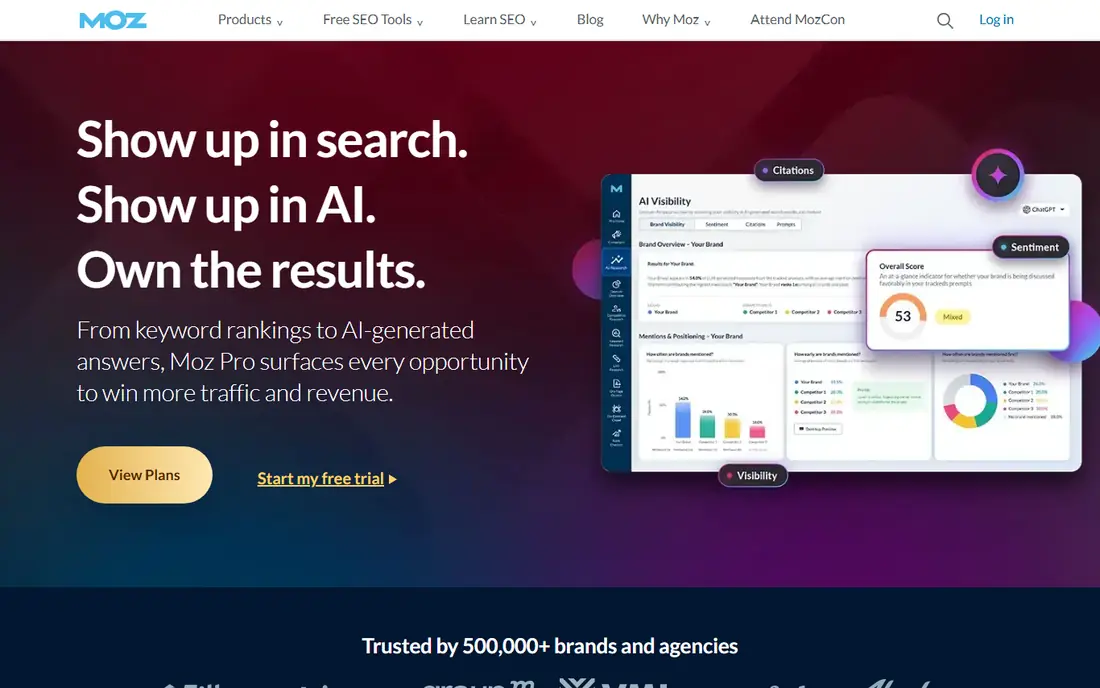
Moz Pro is the easiest suite for a small team that is still learning SEO. Standard at $99 per month, or $79 on annual billing, covers three campaigns, 300 tracked keywords, keyword research, rank tracking, and site audits, with plain language that helps non-specialists act on findings. The learning resources around Moz are also a real advantage for beginners.
The limit is scale. Standard includes only 150 keyword queries per month, so a team doing heavy research will need Medium at $179 or Large at $299. Moz is often outgrown by larger teams, but for a small site or a local business, its simplicity and lower price make it a sensible first suite.
- Friendliest interface for beginners
- Familiar Domain Authority metric
- Clear audits and rank tracking for small campaigns
- Smaller keyword index than Semrush or Ahrefs
- Standard limits keyword queries
- AI tracking is more limited than enterprise tools
SE Ranking is a mid-market all-in-one suite that covers keyword research, rank tracking, site audits, and competitor analysis in one subscription. Core at $129 per month, or $103.20 on annual billing, suits small agencies and in-house teams that want a full suite without enterprise pricing.
The main caution is add-ons. Agency features, extra projects, and report limits can raise the cost, so model the price at your real project count. For a team that wants a complete suite and is willing to learn a less familiar interface, SE Ranking offers strong value. For a team that needs the deepest backlink data, Ahrefs remains stronger.
- All-in-one suite with research, tracking, and audits
- Agency add-ons available
- Competitive price for mid-size teams
- Add-ons can raise the final bill
- Check project, seat, and report limits
- Less brand recognition than Semrush or Ahrefs
BrightEdge is built for large enterprises that track tens of thousands of keywords across many pages and markets. Its Data Cube dataset, technical auditing through ContentIQ, and AI visibility features help big teams connect rankings, content, and revenue. That scale is why it suits Fortune 500-style programmes rather than small sites.
Pricing is the barrier. BrightEdge publishes no list price, and reported enterprise contracts run into tens of thousands of dollars per year, with onboarding and add-on fees on top. Expect a sales cycle and a one to three year contract. For a large site with a dedicated SEO team, BrightEdge is a serious contender. For everyone else, a suite will be cheaper and faster to start.
- Large Data Cube keyword dataset
- Deep technical auditing
- AI visibility and content recommendations for large sites
- Quote-only pricing with long contracts
- Complex interface with a longer learning curve
- Add-ons for API and content tools
Conductor suits content-led organisations that need to show how search and AI answers support editorial work. It tracks rankings, content performance, and AI visibility, with reporting that executives can read without a technical background. Its workflow tools help writers, editors, and SEO staff work from the same data, which is a real advantage in a large content team.
Like BrightEdge, Conductor does not publish list prices, and reported contracts also run into tens of thousands of dollars per year. Onboarding is usually faster than BrightEdge, but a sales cycle is still required. For a content-heavy enterprise, Conductor is often the more usable choice. For a small team, it is far more platform than needed.
- Cleaner reporting for content teams
- AI visibility across major models
- Strong content workflow and market share insights
- Quote-only pricing
- Technical auditing is less granular than BrightEdge
- Seat and feature tiers need careful checking
seoClarity is an enterprise platform for teams that produce a high volume of content and need to optimise it at scale. Research Grid offers a large keyword dataset, Clarity Grid helps with AI writing and content optimisation, and site audit runs at scale with scheduled monitoring and alerts. Dedicated onboarding and customer success are included, which helps large teams adopt the platform.
Pricing is custom, based on keywords, pages, and users, with reported entry costs from around $3,000 to $5,000 per month. Backlink prospecting is not its strength, so link-focused teams should pair it with Ahrefs or Semrush. For an enterprise content operation, seoClarity is a strong, if expensive, pick.
- Large keyword research dataset for B2B
- AI content optimisation and Clarity Grid
- Site audit at scale with alerts
- Quote-only pricing
- Backlink analysis is weaker than Ahrefs
- Interface can feel overwhelming at first
Similarweb answers a different question from Semrush or Ahrefs: how much traffic does a competitor get, and from where. It models traffic from clickstream and other sources, which helps with market sizing, channel mix, and benchmarking. That makes it a useful companion to an SEO suite, rather than a replacement for one.
The limit is precision. Modelled traffic is an estimate, so it should not be treated as exact analytics for a rival site. Full access is also largely quote-based, though a free trial and limited free tools exist. Use Similarweb to understand a market, and use Semrush, Ahrefs, or Moz to optimise your own pages.
- Modelled traffic and market data for competitors
- Useful for market sizing and channel mix
- Broad web and app coverage
- Not a classic all-in-one SEO suite
- Modelled data is an estimate, not a direct measurement
- Pricing is largely quote-based for full access
How we picked these
We compared official pricing pages, product documentation, and public reviews for tools that measure search visibility in October 2026, including classic rankings and AI search visibility. We kept suites for small teams and enterprise platforms for large sites, and we checked keyword research, rank tracking, audits, backlink data, and AI tracking. We did not claim hands-on testing; our comparison is based on vendor pages and published reviews.
Choosing by site size and AI needs
Start with site size. A small site needs a suite with a clear price and a free trial, which points to Moz Pro, SE Ranking, or Semrush. A large site with thousands of pages needs audit scale, workflow, and governance, which points to BrightEdge, Conductor, or seoClarity. Buying an enterprise platform for a ten-page site wastes money and time.
Next, define AI visibility clearly. Ask which AI engines are tracked, which prompts are used, how often they refresh, and whether citations, comparisons, and recommendations are shown separately. A tool that only tracks one model or a handful of prompts will miss much of the AI picture, so test it with your own brand queries before signing a long contract.
Finally, check the total cost, not just the plan. Extra users, report add-ons, API access, and AI bundles can double a suite bill, while enterprise platforms add onboarding and contract length. Run a trial with your real keywords and pages, and compare the cost per tracked keyword and per user at your actual scale.
Frequently asked questions
What is the best search visibility optimization tool for a small business?
Semrush Pro and Moz Pro are the best starting points for most small businesses, with Semrush offering more breadth and Moz offering a simpler start. SE Ranking is also worth a look for a lower-cost all-in-one suite. Start with a free trial and your real keywords, since the best tool is the one your team will actually open each week.
What is the best tool for AI search visibility?
BrightEdge, Conductor, and seoClarity all offer enterprise AI visibility tracking, while Semrush and Ahrefs offer AI tracking on paid tiers. The best choice depends on which AI engines you need to track and how many prompts you need. Test each tool with your own brand and product queries, since coverage and refresh rates differ.
Is Similarweb an SEO tool?
Similarweb is a traffic and market intelligence tool, not a classic all-in-one SEO suite. It estimates competitor traffic and channel mix, which is useful for market research, but it does not replace keyword research, rank tracking, or site audits. Pair it with Semrush, Ahrefs, or Moz for full visibility work.
How much do search visibility tools cost?
Suites start at $99 to $139 per month, with higher tiers from $179 to $249 per month for larger teams. Enterprise platforms are quote-only and often cost tens of thousands of dollars per year. Always add extra users, API access, and AI bundles to the headline price before comparing.
Can I track search visibility for free?
Yes, for basic checks, through Google Search Console, Ahrefs Webmaster Tools for verified sites, and limited free tools from several vendors. Free tools cover your own site well, but competitor research, large keyword sets, and AI tracking usually need a paid plan. Start free, then pay when the limits block your work.
How often should I check rankings?
Daily tracking suits competitive keywords and large sites, while weekly tracking is enough for most small sites. Ahrefs Lite updates weekly unless you pay for daily, while Semrush and other suites offer daily tracking on paid plans. Check more often when you publish, change pages, or see a traffic drop, and less often when nothing has changed.
Sources
See where you really rank - block by block
ProMapRanker scans Google Maps across a grid of your service area. Simple monthly plans from $19, white-label on every plan.
Start freeKeep reading
 bitly alternatives
Bitly Alternatives in 2026: 8 Tools Compared
Compare the best Bitly alternatives for branded short links, with free tiers, custom domains, analytics, and pricing that suits creators and small teams.
Read → bill.com alternatives
Best Bill.com Alternatives in 2026
Looking for bill.com alternatives? We compared 9 bill pay and AP automation tools on price, approvals, and accounting sync to help you switch with confidence.
Read → betterhelp alternatives
BetterHelp Alternatives in 2026
We compared BetterHelp alternatives for online therapy, covering Talkspace, Grow Therapy, Rula, Brightside and more on price, insurance and format in 2026.
Read →