 ProMapRanker
Best S and OP Software in 2026


Global manufacturers needing concurrent planning · Pricing starts at: See website
Key takeaways
- Kinaxis, SAP IBP, o9 Solutions, and Anaplan suit large enterprises with complex, multi-site supply chains.
- RELEX fits retail and consumer goods firms that need inventory and demand planning tied to store and channel data.
- Datup and John Galt Atlas suit mid-market manufacturers that want faster setup or a process they can configure themselves.
- Almost every enterprise S&OP tool in this list is quote-based, so implementation cost matters as much as the license.
- Small firms should start with their ERP planning module or a focused planning tool, not a full enterprise S&OP suite.
Quick comparison
| Pick | Great for | Pricing starts at | Free tier | |
|---|---|---|---|---|
| Kinaxis | Global manufacturers needing concurrent planning | See website | No | Visit |
 SAP IBP | Companies already running SAP | See website | No | Visit |
 o9 Solutions | Large firms linking commercial and supply decisions | See website | No | Visit |
 Anaplan | Flexible connected planning across departments | See website | No | Visit |
 RELEX Solutions | Retail and consumer goods planning | See website | No | Visit |
 John Galt Atlas | Mid-market firms configuring their own process | See website | No | Visit |
 Logility | AI-first supply chain planning and inventory | See website | No | Visit |
 Datup | Mid-market teams wanting faster AI planning setup | See website | No | Visit |
The best s&op software
Sales and operations planning, often written S&OP, is the monthly cycle where sales, operations, finance, and supply agree on one plan. The best s&op software in this list helps teams forecast demand, test supply scenarios, balance inventory, and agree on financial impact in one place. Note that other keywords for this topic include s&op software top lists, which tend to rank the same enterprise vendors.
Kinaxis is built around concurrent planning, which means demand, supply, inventory, and capacity sit on one live model instead of in separate spreadsheets passed between teams. When a supply constraint changes, planners can run scenarios and see the impact across the network quickly, rather than waiting for a weekly rebuild. That speed is why global manufacturers with volatile supply chains keep choosing Kinaxis.
The trade-off is cost and effort. Kinaxis is an enterprise license with implementation and ongoing customization costs, and buyers should expect a structured rollout, often measured in weeks to months. Planners also need to trust the model outputs, or they drift back to spreadsheets and the tool becomes an expensive reporting layer. For large manufacturers where a single planning decision affects many plants and suppliers, Kinaxis is a top pick. For smaller firms, it is more than needed.
- Concurrent planning on a single live data model
- Fast what-if scenarios with financial impact
- Strong fit for volatile supply chains
- Enterprise pricing and implementation cost
- Performance can slow on very large data sets
- Needs planning discipline to keep trust in outputs
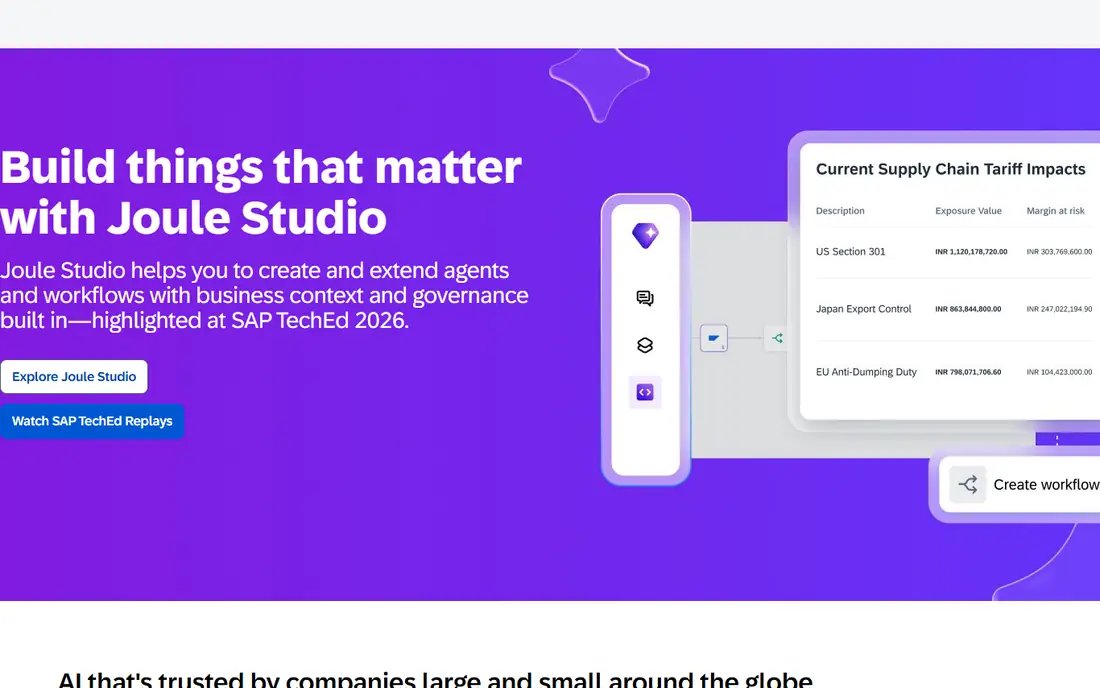
SAP Integrated Business Planning, known as SAP IBP, is the natural S&OP choice for companies already running SAP. It connects sales and operations planning to demand, supply, inventory, and response planning, with native links to S/4HANA that reduce duplicate data entry. A control tower view helps planners spot exceptions and test scenarios without exporting data to separate tools.
The cost is enterprise-grade, and implementation relies on technical teams and training. Teams outside SAP will find less value here, since much of the benefit comes from staying inside one SAP data model. For SAP shops that want S&OP, demand sensing, and supply balancing in the same stack, SAP IBP is a strong, if demanding, choice. Budget for consultants, training, and a phased rollout, and confirm which IBP modules are included in the quote.
- Native integration with SAP S/4HANA
- Real-time supply and demand balancing
- Scenario simulation and control tower views
- Enterprise license and heavy implementation
- Needs technical teams and training
- Weaker fit outside the SAP ecosystem
o9 Solutions positions its platform as a Digital Brain for planning, linking decisions across commercial, supply, and finance teams. It uses a knowledge graph and external variables, such as market and economic signals, to inform forecasts, and it supports revenue growth management alongside supply planning. That breadth suits large multinationals that need one planning view across regions, brands, and channels.
Pricing is modular and enterprise-grade, and rollout is resource-heavy. o9 fits best when a company has the planning maturity to use connected decisions, not just a better forecast. Smaller firms will find the scope and cost hard to justify. For large firms that already run a formal S&OP cycle and want to tie it to financial outcomes, o9 deserves a place on the shortlist alongside Kinaxis and SAP IBP.
- Digital Brain approach linking commercial, operational, and financial decisions
- External data variables in forecasts
- Scenario planning at scale
- Modular enterprise pricing
- Complex rollout for large multinationals
- Needs strong internal ownership
Anaplan is a connected planning platform that many firms use for S&OP because it can model finance, sales, and supply in one place. Its calculation engine handles complex, multidimensional models, and teams can build scenarios, test assumptions, and share a single plan across departments. Predictive tools help planners test demand signals and adjust the plan as conditions change.
The catch is modeling skill. Simple models are fast to build, but complex S&OP models often need certified consultants and ongoing model care. Data integration can add license cost, and training matters for the staff who will maintain the models. Anaplan suits mid-size to large firms that want flexibility and already have, or will hire, planning and finance modelers. Firms that want a ready-made S&OP process with less modeling may prefer RELEX, Kinaxis, or Datup.
- Flexible multidimensional models for finance, sales, and supply
- Fast calculations for complex scenarios
- Connected planning across teams
- Enterprise license with extra costs for data integration
- Needs certified consultants for complex models
- Learning curve for model builders
RELEX Solutions serves retailers, wholesalers, and consumer goods manufacturers with planning tools for demand, inventory, replenishment, and S&OP. Its digital twin approach models stores, channels, suppliers, and products together, so a change in demand or supply shows up across the plan. Firms can start modular, often with inventory, and add planning areas as the process matures.
Pricing is quote-based and priced by module, so buyers should map each module to a planning step before comparing totals. RELEX is less suited to heavy discrete manufacturing with complex plant scheduling, where Kinaxis or SAP IBP fit better. For retail and consumer goods firms, where assortment, promotion, and store-level inventory drive the plan, RELEX is one of the strongest S&OP software top picks. Ask for a retail or consumer goods reference client similar in size to your firm.
- Digital twin approach for retail and consumer goods S&OP
- Modular start with inventory, then scale
- Strong demand and replenishment planning
- Quote-based pricing by module
- Retail focus limits fit for heavy manufacturing
- Comparing modules takes care
John Galt, whose platform is known as Atlas Planning Platform, targets mid-market manufacturers and distributors that want to configure their own integrated business planning process. It offers ensemble forecasting, which blends multiple forecast methods, plus probabilistic planning that shows a range of outcomes rather than a single point forecast. That approach helps planners explain risk to sales and finance in plain terms.
Pricing is quote-based, and setup time depends on how much configuration the firm wants to do itself. Firms with a clear S&OP process and staff to own it will get good value. Firms that want a fully managed, out-of-the-box process may prefer Datup or RELEX. John Galt is a good middle path: more configurable than a retail-focused tool, less enterprise-heavy than Kinaxis, and built for firms that have outgrown spreadsheets but are not yet enterprise-scale.
- Ensemble forecasting and probabilistic planning
- Configurable IBP process for mid-market firms
- Strong forecast accuracy reported by users
- Quote-based pricing
- Setup depends on internal bandwidth and configuration
- Smaller vendor than SAP or Kinaxis
Logility offers a supply chain planning platform that covers demand planning, inventory optimization, supply planning, and order response, with AI tools that give planners recommendations and explanations. Its Decision Intelligence approach aims to turn plan data into decisions, not just reports, which helps S&OP meetings focus on exceptions and trade-offs rather than data reconciliation.
Pricing is quote-based, and the breadth of the platform means scoping matters. Firms should agree which planning steps Logility will own, and which will stay in ERP or finance tools, before signing. Logility suits manufacturers, distributors, and consumer goods firms that want AI-assisted planning without jumping straight to the largest enterprise suites. It also fits firms that want inventory optimization alongside S&OP, since stock levels are often where the plan meets cash.
- AI-first platform covering demand, inventory, and supply
- Decision intelligence tools for planners
- Scalable for mid-size and large firms
- Quote-based pricing
- Breadth needs careful scoping
- Implementation and change management matter
Datup is a mid-market S&OP and supply planning vendor that emphasizes AI forecasting and faster setup than enterprise suites. It offers demand forecasting with external variables, automatic scenarios, and inventory optimization, with implementation measured in weeks rather than many months in vendor materials. The vendor reports a subscription model based on products and locations, not per-user charges, which can simplify budgeting for larger planning teams.
Pricing is still quote-based, and firms should confirm what the subscription covers at their product and location count. Datup fits manufacturing, retail, pharma, and consumer goods firms in the mid-market that want AI planning results without a long enterprise rollout. Very small firms will still find it heavy, and large multinationals with complex plant networks may need Kinaxis or o9. For the mid-market, Datup is a credible, faster alternative worth a demo.
- AI demand forecasting with external variables
- Subscription model without per-user charges reported by the vendor
- Faster implementation than enterprise suites
- Quote-based subscription by products and locations
- Smaller vendor footprint than leaders
- Best for firms with $10M plus revenue scale
How we picked these
We compared vendor product pages, S&OP comparison guides, and public reviews for tools that cover the full S&OP cycle: demand planning, supply planning, inventory, scenarios, and a shared plan with finance. We kept only tools that exist today and serve S&OP or integrated business planning, not single-point forecast tools alone. We marked pricing as See website where vendors do not publish a rate, which is common in this category, and we noted company size fit because that matters more here than a single feature.
What to check before you buy
Start with your current S&OP cycle, not the software demo. Write down who owns demand, who owns supply, how finance signs off, and how often the plan changes. A tool that matches that cycle will get used in meetings. A tool that forces a new cycle on top of an unclear process will become another report no one trusts.
Next, test forecast and scenario quality on your own data. Ask each vendor to run a forecast on a sample of your SKUs and locations, and to show how a supply shock changes the plan. Check data needs too. S&OP tools need clean sales, inventory, lead time, and capacity data, and cleaning that data often takes longer than installing software. Finally, get implementation, training, and renewal terms in writing, and ask which modules are included, since modular pricing is the norm here.
Match the tool to company size
Under $10M in revenue with a few hundred SKUs, your ERP planning module or a focused tool usually beats a full suite. In the $10M to $100M range, Datup, John Galt, or RELEX often fit best. Above $100M with complex portfolios, Kinaxis, SAP IBP, o9, or Anaplan become the realistic shortlist.
Plan the monthly cycle first
Agree on meeting cadence, decision rights, and exception rules before go-live. The software should support that cycle, with one plan, one forecast, and clear ownership for each input. Without that discipline, even the best tool will not fix a broken S&OP process.
Frequently asked questions
What is S&OP software?
S&OP software supports sales and operations planning, the cycle where sales, operations, finance, and supply agree on one demand, supply, and inventory plan. It typically covers forecasting, supply scenarios, inventory balancing, and financial impact in one shared model.
Which s&op software top vendors suit large enterprises?
Kinaxis, SAP IBP, o9 Solutions, and Anaplan suit large enterprises with complex, multi-site operations. They offer scenario planning, connected models, and scale, but they also carry enterprise pricing and longer rollouts.
Is there affordable S&OP software for mid-market firms?
Datup and John Galt Atlas target mid-market firms with faster setup or configurable processes, and RELEX offers a modular start for retail and consumer goods. All are still quote-based, so request a quote at your product and location count.
How long does S&OP software take to implement?
It varies widely. Mid-market tools report setup in weeks, while enterprise suites often take months with consultants and data work. Data quality, scope, and internal ownership affect timing more than the software alone.
Do small companies need S&OP software?
Most small companies do not need a full S&OP suite. An ERP planning module, a focused forecasting tool, or a disciplined spreadsheet process often covers the need until SKU count, locations, and supply complexity grow.
Sources
See where you really rank - block by block
ProMapRanker scans Google Maps across a grid of your service area. Simple monthly plans from $19, white-label on every plan.
Start freeKeep reading
 who has best internet service
Who Has the Best Internet Service in 2026
Who has best internet service for US homes? We compare fiber, cable, fixed wireless and satellite providers on speed, price, availability and terms today.
Read → which survey tool has the best analytics
Which Survey Tool Has the Best Analytics in 2026
Find which survey tool has the best analytics in 2026, comparing Qualtrics, SurveyMonkey, Typeform, Alchemer, and more on reports, text, and stats today.
Read → which streaming service has the best movies
Which Streaming Service Has the Best Movies in 2026
Answering which streaming service has the best movies, with Netflix, Max, Criterion and more compared on libraries, prices and free options in this guide.
Read →