 ProMapRanker
Best Running Training App in 2026

Key takeaways
- Nike Run Club is our pick for free coaching, because its guided runs and training plans cost nothing and suit beginners through half marathoners.
- Runna is the strongest paid plan-first coach, with adaptive plans, watch sync, and strength work, at $19.99 per month or $119.99 per year.
- Garmin Coach is the best free option for Garmin owners, though it does not offer a marathon plan.
- TrainingPeaks suits data-driven runners and coached athletes, while Strava suits runners motivated by community and segments.
- The best plan is one you will follow for sixteen weeks, so pick the interface and watch support that fit your life, not just the longest feature list.
Quick comparison
| Pick | Great for | Pricing starts at | Free tier | |
|---|---|---|---|---|
 Nike Run Club | Best free coaching and guided runs | Free | Yes | Visit |
 Runna | Best paid adaptive training plans | $19.99 per month | Free trial | Visit |
 Strava | Best community and segment motivation | $79.99 per year | Yes | Visit |
 Runkeeper | Best simple tracker with plan options | $9.99 per month | Yes | Visit |
 TrainingPeaks | Best analytics for serious athletes | $19.99 per month | Yes | Visit |
 Garmin Coach | Best free coach for Garmin owners | Free | Yes | Visit |
 Coopah | Best budget coaching alternative | See website | Free trial | Visit |
 MapMyRun | Best mapping and route tools | Free | Yes | Visit |
 adidas Running | Best free tracking with shoe tracking | Free | Yes | Visit |
The best running training app
A training app should do more than record a run: it should tell you what to run tomorrow, at what pace, and why. The apps below differ in coaching style, plan adaptivity, watch support, and price, and the right one depends on your goal race and how much structure you want.
Nike Run Club remains the best free training app in 2026, and the gap is not close. It costs nothing, with no subscription and no in-app purchases, yet it offers audio-guided runs led by Nike coaches and athletes, GPS tracking, and structured training plans. For a beginner or an intermediate runner, hearing a coach talk you through intervals, pacing, and effort is more useful than a static PDF plan, and NRC delivers that for free.
The limits show up in adaptivity. If you miss a session, you adjust the plan by hand rather than having the app reshape the week around you, and there is no strength or cross-training layer to support injury prevention. Social features are also lighter than Strava.
- Completely free with no premium tier
- Hundreds of audio-guided runs from Nike coaches and athletes
- Training plans for 5K through marathon
- Plans adapt less than paid rivals
- No strength or cross-training integration
- Training plan availability varies by country
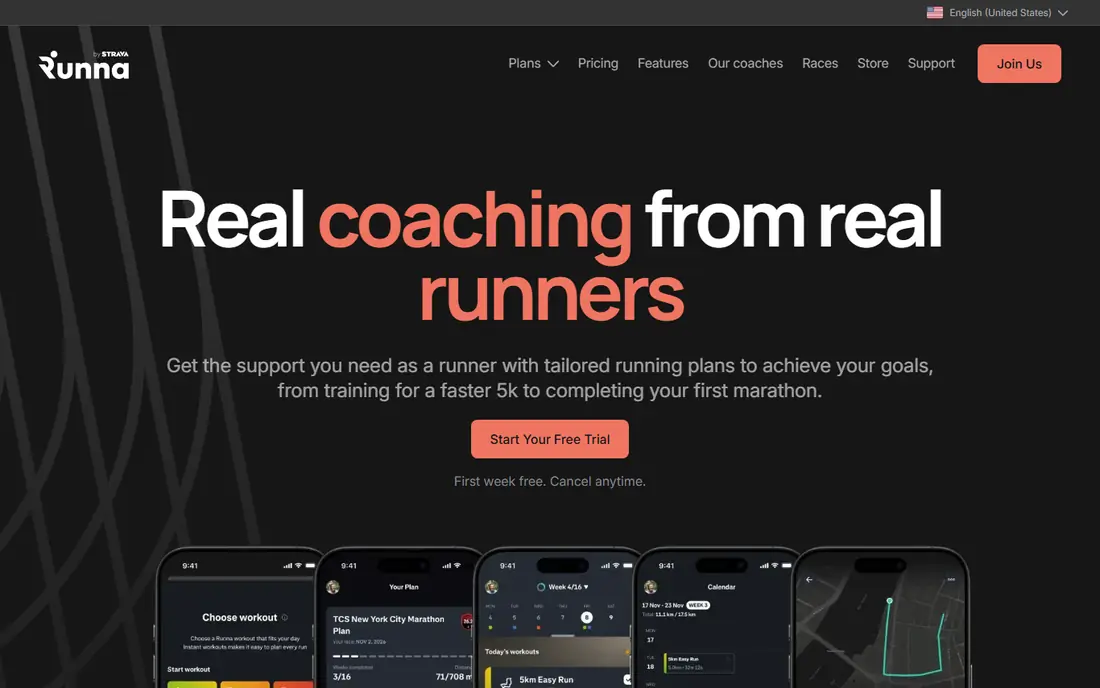
Runna is the strongest paid answer when you want a coach in your pocket rather than a tracker with a plan attached. You set a goal race, enter recent times and weekly availability, and Runna builds a week-by-week plan with individual workouts, target paces, and strength sessions, then syncs those workouts to your watch. Plans cover 5K, 10K, half marathon, marathon, and ultra, plus beginner paths, and the app adjusts paces as you complete sessions.
The price is the honest barrier: $19.99 per month, or $119.99 per year, with a trial of seven days through Runna, longer through some partner offers. Free access without a subscription covers the first week of a plan plus run recording, so a trial is the right way to judge it. Some runners also find the intensity distribution aggressive, so inspect the week and listen to your body rather than following every session blindly. For a goal race with structure, Runna is the benchmark paid pick.
- Adaptive plans for 5K through ultra with target paces
- Syncs workouts to Garmin, Apple Watch, COROS, and Suunto
- Strength and mobility sessions included
- $19.99 per month or $119.99 per year is a real commitment
- Free access covers only the first week plus a trial
- Some runners find plans aggressive
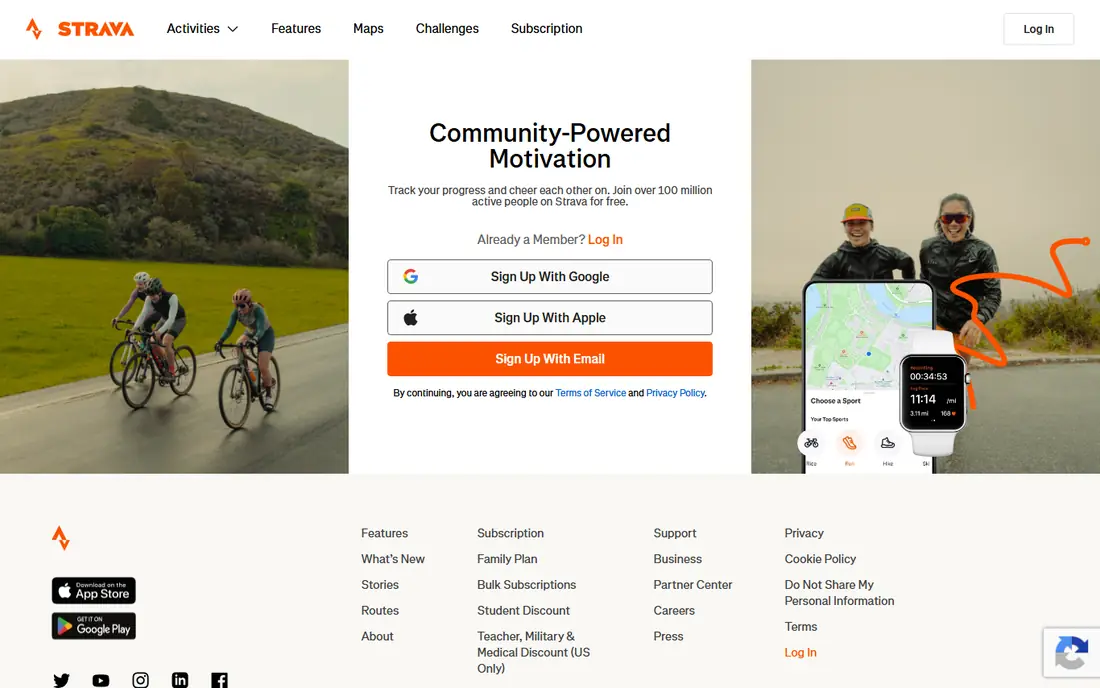
Strava is less a coach and more a training home, and for many runners that community is the motivation that keeps a plan alive. The free tier records unlimited activities, syncs from almost any watch, and gives you the full social feed with kudos and comments. Segment leaderboards, route building, training plans, and deeper analysis sit behind the subscription, priced at $79.99 per year in recent listings.
If your friends are on Strava and a leaderboard or a weekly kudos thread keeps you honest, Strava's social pull is hard to replace. Many runners use both: a coaching app for the plan, Strava for the feed. A combined Strava and Runna subscription is also sold, so check that bundle price if you would pay for both anyway.
- Largest running community with kudos and segments
- Free tier covers unlimited activity logging
- Paid tier adds routes, analysis, and training plans
- Best analysis and training features sit behind the paid tier
- Free tier lacks segment leaderboards and route building
- Social feed can distract from training
Runkeeper, owned by ASICS, is the sensible middle for runners who want a straightforward tracker with the option of plans later. The free tier covers GPS tracking, pace, distance, and basic history on iOS and Android, while Runkeeper Go at $9.99 per month or $39.99 per year adds training plans, advanced analytics, and deeper insights. That two-step structure suits runners who are not ready to pay for coaching yet.
The trade is that Go has become the gate for the features that make Runkeeper a training app rather than a tracker, and the social side never matched Strava. If you own a Garmin, Garmin Coach may already cover your coaching for free, and if you want deep adaptivity, Runna goes further. For a simple, affordable tracker with a plan upgrade path, Runkeeper remains a solid choice.
- Simple GPS tracking on phones and watches
- Runkeeper Go adds training plans and advanced analytics
- Syncs with Garmin and other wearables
- Key plan features sit behind Go at $9.99 per month or $39.99 per year
- Social features are lighter than Strava
- Interface feels dated to some users
TrainingPeaks is the platform serious endurance athletes and their coaches rely on when data matters more than motivation. Its Performance Management Chart tracks chronic training load, acute load, and training stress balance, showing whether you are building fitness, burying yourself, or peaking at the right time. Thousands of structured plans from credentialed coaches are available, and workouts push to Garmin, Wahoo, and Polar devices.
That depth is also the barrier. Beginners will find the metrics confusing, and the Premium price at $19.99 per month or $134.99 per year is hard to justify for a solo runner who does not use coach features. TrainingPeaks shines when a coach lives inside it, or when a self-coached athlete already thinks in training load and wants a calendar that reflects it. For most runners, Runna gives a better plan experience for similar money.
- Performance Management Chart with fitness, fatigue, and form metrics
- Thousands of structured plans from coaches
- Workout delivery to major watches
- Steep learning curve for beginners
- $19.99 per month or $134.99 per year is expensive for solo runners
- Coach plans cost extra
Garmin Coach is the best free coach for anyone who already owns a Garmin watch, because you have technically already paid for it. Inside Garmin Connect, you pick a goal distance, a coach persona, and a schedule, and Garmin builds an adaptive plan with target paces that adjust as you train. Workouts sync to the watch, so you run without a phone, and the whole system lives inside the data you already collect.
The limits are clear: Garmin Coach covers 5K, 10K, and half marathon, but it does not offer a marathon plan, which pushes marathoners toward Runna or a static plan. It also works only on Garmin hardware, and setup sometimes asks you to re-enter information the watch already holds. If you own a Garmin and your goal is a half marathon or shorter, start here before you pay for anything else.
- Free with a compatible Garmin watch
- Adaptive plans for 5K, 10K, and half marathon
- Workouts flow to the watch with no phone needed
- Requires a Garmin device
- No marathon plan
- Setup can ignore existing watch data and ask for manual inputs
Coopah is the budget-conscious alternative that runners mention when Runna feels too expensive. It offers personalized training plans for common race distances, with a coaching focus that suits runners who want structure without a premium price tag. For a runner who needs a plan, pace guidance, and a calendar, but not the full Runna feature set, Coopah covers the core job at a lower cost.
The trade is scale: a smaller app means fewer integrations, a smaller community, and less public detail on pricing and long-term plan support, so check the current plan page and trial terms before you commit. Strength and cross-training features are also lighter than Runna. If budget is the deciding factor and you want real coaching rather than a free static plan, Coopah deserves a trial next to Nike Run Club.
- Personalized training plans at a lower price than Runna in many listings
- Covers common race distances
- Simpler coaching focus for budget runners
- Smaller community and fewer integrations than larger apps
- Pricing and plan details need a live check
- Strength features are lighter
MapMyRun, from Under Armour, is best for runners who think in routes. Its mapping tools, route library, and course creation suit runners exploring a new city, planning a long run, or sharing a favorite loop with friends. Free GPS tracking covers the basics, and the app syncs with many wearables, so it fits into a wider fitness setup without friction.
As a training app, it is lighter than the coaching picks above. Structured plans and advanced analysis sit behind a premium subscription, and the free tier carries ads that some runners find distracting. Choose MapMyRun when routes and mapping matter most, and pair it with Nike Run Club or Runna when you need a coach.
- Strong route creation and mapping tools
- Free GPS tracking with a large route library
- Works with many wearables and apps
- Training plans sit behind a premium tier
- Ads on the free tier
- Coaching is lighter than Runna or Garmin Coach
adidas Running, formerly Runtastic, is a free tracker with a practical extra: shoe mileage tracking. Logging how many miles each pair has covered helps you replace shoes before worn cushioning contributes to aches, and that small feature is genuinely useful for runners who rotate pairs. The app also offers GPS tracking, training plans on higher tiers, live tracking, and social challenges.
Adaptive coaching is not its strength, and the best training features require a premium subscription, so serious plan seekers should look at Runna or Garmin Coach first.
- Free GPS tracking with training plans on some tiers
- Shoe mileage tracking for knowing when to replace shoes
- Social challenges and live tracking
- Best training features sit behind premium
- Community is smaller than Strava
- Interface favors tracking over adaptive coaching
How we picked these
We compared official feature pages, pricing pages, and app store listings, plus public reviews, for apps still available in October 2026. We favored apps with a real training plan or coaching feature, not just tracking, and with an official homepage we could verify. We included free, paid, and watch-based options so beginners, marathoners, and data-driven athletes all have a relevant pick.
We did not claim hands-on lab testing over a full training block. Our comparisons rest on published plan types, watch support, pricing, and coaching features, and we recommend a trial week with your real schedule before you pay for a sixteen-week plan.
How to pick a plan that you will actually finish
Start with your goal race and your honest weekly time. A marathon plan that assumes six days a week will fail if you have four, and a 5K plan will bore a runner who already runs thirty miles a week. Pick a plan that matches your current mileage, not your wishful mileage, and check whether it includes rest days, cutback weeks, and strength work.
Next, check watch support before you pay. A plan that lives only on your phone is easy to ignore mid-interval, while a plan that syncs to your watch keeps paces and cues where you can see them. Confirm your watch model is supported, test one workout sync during the trial, and make sure the app handles a missed session in a way you can live with.
Finally, listen to your body over the app. No plan, however adaptive, knows about a sore calf, a bad night of sleep, or a work trip unless you tell it, and some plans progress faster than is comfortable. If a week feels too hard, slow down, repeat a week, or talk to a coach or clinician about pain that persists. A finished plan at a slightly slower pace beats an abandoned plan at an ambitious one.
Frequently asked questions
What is the best running app for training for a marathon?
Runna is the strongest paid marathon training app, with adaptive plans, watch sync, and strength sessions for $19.99 per month or $119.99 per year. Nike Run Club offers a free marathon plan for runners on a budget, while TrainingPeaks suits data-driven marathoners working with a coach.
What is the best running coach app that is free?
Nike Run Club is the best free running coach app overall, with guided runs and plans at no cost. Garmin Coach is the best free coach for Garmin owners, though it covers 5K, 10K, and half marathon only, with no marathon plan.
What is the best app for running training plans for beginners?
Nike Run Club suits beginners best, because its guided runs explain pace and effort in real time and its plans start gently. Runna also offers beginner paths, including Couch to 5K style plans, but it requires a subscription after the first week and trial.
Is Runna worth the price?
Runna is worth it if you want an adaptive plan, watch-synced workouts, and strength sessions for a goal race, and you will follow the plan for a full training block. At $19.99 per month, it is expensive for casual running, and Nike Run Club or Garmin Coach cover many runners for free.
Do running training apps work with Apple Watch and Garmin?
Most do, but support varies. Runna syncs with Garmin, Apple Watch, COROS, Suunto, and other watches, while Garmin Coach works only with Garmin devices. Check your exact watch model on the app's support page and test one workout sync during the trial before you commit.
What is the best running plan app for half marathon training?
Nike Run Club, Runna, and Garmin Coach all offer strong half marathon plans. Nike Run Club is free, Garmin Coach is free for Garmin owners, and Runna adds the most adaptive pacing and strength work for runners who want a paid coach. Pick based on your watch and your budget, not on the longest feature list.
Sources
See where you really rank - block by block
ProMapRanker scans Google Maps across a grid of your service area. Simple monthly plans from $19, white-label on every plan.
Start freeKeep reading
 top custom software development company
Top Custom Software Development Company in 2026
Looking for a top custom software development company? We compare 9 firms for web, mobile, and enterprise software, covering strengths and fit for 2026.
Read → tableau alternatives
Tableau Alternatives in 2026
Compare the best Tableau alternatives for 2026, from Power BI to Metabase, with prices, hosting options, and picks for small teams and enterprises today.
Read → microsoft teams alternatives
Best Microsoft Teams Alternatives in 2026
Looking for microsoft teams alternatives? We compare 9 chat and video tools for 2026, covering free plans, pricing, meetings, and integrations for teams.
Read →