 ProMapRanker
Best Risk Management Software in 2026

Key takeaways
- Most enterprise risk platforms are quote-only, so budget for a sales process and a demo rather than a published price.
- LogicGate and Onspring suit mid-market teams that want to shape workflows themselves without heavy coding.
- AuditBoard and MetricStream fit larger, regulated organisations with complex control libraries and audit needs.
- Drata is the compliance-led pick for firms that need SOC 2, ISO 27001 or HIPAA evidence without building a full risk programme from scratch.
- Resolver and Riskonnect cover wider operational risk, including claims and safety, not just cyber and compliance risk.
Quick comparison
| Pick | Great for | Pricing starts at | Free tier | |
|---|---|---|---|---|
 LogicGate Risk Cloud | No-code risk workflows | See website | No | Visit |
 Resolver | Mid to large risk and security teams | See website | No | Visit |
 Riskonnect | Integrated risk plus claims | See website | No | Visit |
 AuditBoard | Audit, risk and compliance in one place | See website | No | Visit |
 MetricStream | Large regulated programmes | See website | No | Visit |
 ServiceNow Integrated Risk Management | Firms already on ServiceNow | See website | No | Visit |
 Drata | Automated compliance evidence | See website | No | Visit |
 Onspring | Flexible mid-market governance | See website | No | Visit |
The best risk management software
Risk management software covers a wide range, from a simple risk register to a full governance, risk and compliance platform. The eight tools below are all in active use in 2026, and each one fits a different size and type of organisation.
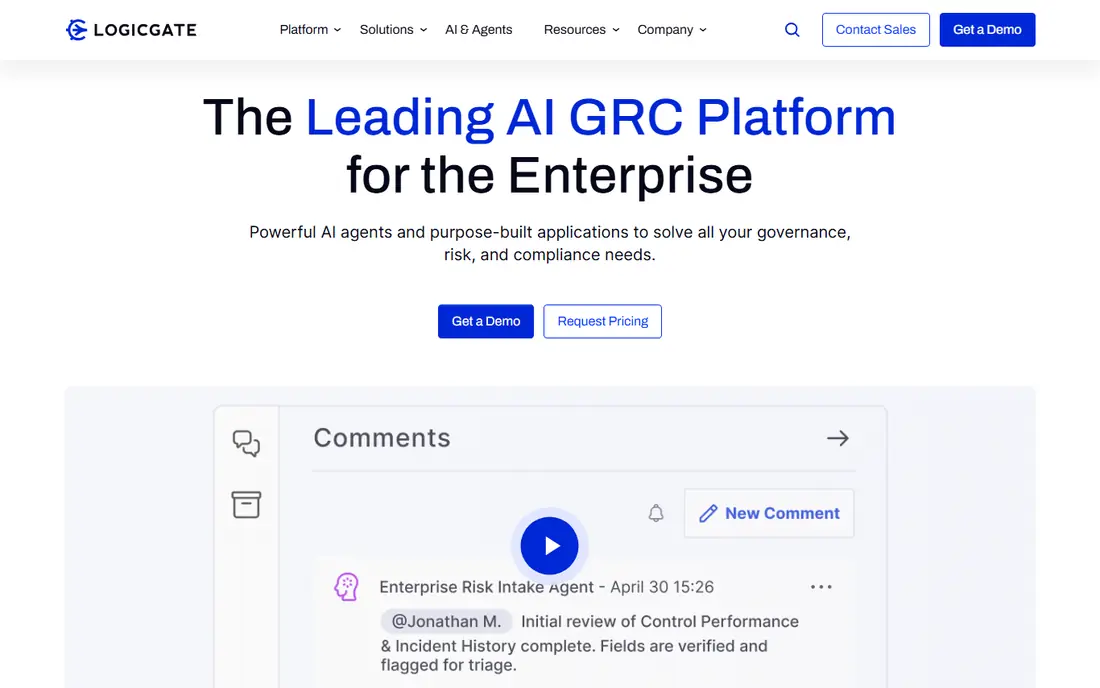
LogicGate is our pick for teams that want to build their own risk processes without waiting on developers. Its Risk Cloud uses a no-code builder, so business users can create workflows, questionnaires and assessments, and link risks to controls and owners. Prebuilt apps cover enterprise risk, third-party risk, audit and compliance, which gives a new programme a faster start than a blank system. Published guidance also notes that standard and external users are included without extra per-user licence fees, which helps when many staff need to complete assessments.
The catch is that pricing is custom, so you will need a demo and a quote to get a real number, and published third-party estimates vary widely. Reporting is also a weaker spot than the workflow builder, so teams that live in dashboards should test that part hard in the trial. If your team wants control over its own processes and can run a proper evaluation, LogicGate is a strong starting point.
- Drag-and-drop builder for risk apps
- Prebuilt apps for risk, third-party risk and compliance
- Standard and external users included without extra per-user fees on published terms
- Pricing is quote-only
- Reporting can feel thin on its own
- Setup still needs clear ownership

Resolver brings corporate security, governance, risk and investigations under one roof, which suits organisations where those teams currently work in separate spreadsheets. Users praise the interface and the custom reports once the system is live, and the platform handles risk registers, assessments and incident workflows in a connected way. That breadth makes it useful for firms that need risk intelligence to turn into action, not just a list of risks.
Setup is the main hurdle. Resolver works best with a team that has time and technical help for implementation, and smaller firms may find the effort heavy for a first risk tool. Pricing is quote-based, so shortlist it alongside LogicGate and compare implementation timelines, not just feature lists. For mid to large firms with a real risk function, Resolver is a credible, flexible choice.
- Covers risk, security and investigations in one platform
- Customisable reports
- Intuitive day-to-day interface once set up
- Setup is complex and suits larger teams
- Third-party integrations could be wider
- Pricing is not published
Riskonnect is different from the cyber-led tools on this list, because it grew up around operational and insurable risk. Its platform covers enterprise risk, claims management, internal audit, third-party risk and healthcare, which fits companies where risk means physical operations, insurance costs and regulatory exposure as well as security controls. Customer stories on its site include hotels, food and public sector organisations, which shows how broad the use cases are.
That breadth comes with enterprise weight. Implementation takes time, the learning curve is steep, and pricing is quote-only at a level that suits larger firms. If your risk register is mostly cyber controls, a tool like Drata or AuditBoard will be simpler. If it includes claims, safety and continuity, Riskonnect covers ground few others match.
- Combines enterprise risk, claims, audit and business continuity
- Strong fit for insurance and healthcare
- Active training and customer stories
- Enterprise scale and cost
- Steep learning curve
- Pricing is not published
AuditBoard connects audit management, risk management and compliance in one platform, so findings, risks and controls stay linked instead of living in separate files. That connection matters at audit time, when you need to show how a control test relates to a risk and to a regulation. Reporting is built for leadership and audit committees, which helps risk teams get attention and funding. It is widely used by larger firms, so auditors and advisers are often already familiar with it.
The platform is more than most small teams need, and the price reflects that, with quotes rather than published plans. Smaller firms should be honest about whether they will use the audit modules or only the risk register. If audit and compliance sit alongside risk in your organisation, AuditBoard keeps those three jobs in one system.
- Connected audit, risk and compliance modules
- Strong reporting for boards and auditors
- Widely used by larger firms
- Quote-only pricing
- Can be more than a small team needs
- Implementation needs planning
MetricStream is the heavyweight option for large, regulated organisations with complex control libraries and many business units. It covers enterprise risk, compliance, audit, third-party risk and policy management in depth, and its platform includes AI features for risk analysis. For banks, insurers and other regulated firms, that depth is the point, since a simpler tool would force workarounds as soon as the programme grows.
For everyone else, MetricStream is likely too much. Implementation is long, pricing is quote-only, and a small team would spend more time managing the system than managing risk. Shortlist it only if you have a large programme, a dedicated risk function and regulatory pressure that justifies the investment. In that setting, it is one of the most complete platforms available.
- Deep governance, risk and compliance coverage
- Strong control libraries
- AI-led platform features
- Enterprise implementation times
- Quote-only pricing
- Overkill for small teams
ServiceNow Integrated Risk Management makes most sense if your organisation already runs ServiceNow for IT service management or operations. In that case, risk, compliance and audit workflows can sit on the same platform, share the same data model and trigger the same automation as service tickets and change requests. That link between risk and day-to-day operations is genuinely useful, since a risk is often discovered through an incident or a change.
If you do not already use ServiceNow, the case is weaker. Licensing is complex, implementation is a project in itself, and a standalone risk tool will be faster to adopt. For ServiceNow shops, though, adding risk management to a platform staff already know is often smarter than buying a separate system and integrating the two.
- Sits inside the ServiceNow platform many firms already run
- Links risk to IT service and operations
- Strong workflow automation
- Best value only if you already use ServiceNow
- Licensing is complex
- Smaller firms will find it heavy
Drata is the pick for companies that need to prove compliance quickly, especially software firms selling to larger customers. It automates evidence collection from cloud systems and tools, monitors controls continuously, and maps them to frameworks such as SOC 2, ISO 27001 and HIPAA. That automation cuts the manual work of screenshots and spreadsheets before an audit, and it keeps evidence fresh between audits rather than piling up at year end.
Drata is not a full enterprise risk platform in the MetricStream sense, so firms with wide operational risk, claims and safety needs will still need other tools. Pricing is also quote-based, so expect a sales conversation. If your main goal is audit readiness and customer trust, and your risk work is mostly cyber and compliance, Drata is the most direct route on this list.
- Automates evidence collection for SOC 2, ISO 27001 and HIPAA
- Continuous monitoring
- Faster path to audit readiness than a full GRC build
- Compliance-led, not a full enterprise risk platform
- Quote-only pricing
- Best for tech and SaaS firms
Onspring suits mid-market teams that want a configurable platform without enterprise cost or complexity. It covers governance, risk and compliance workflows, and lets teams shape forms, reports and workflows to match how they actually work. That flexibility helps firms that have outgrown spreadsheets but do not want to adopt a rigid enterprise system. Support and implementation help are often cited as strengths for smaller teams.
The trade-off is brand familiarity. Onspring is less widely known than AuditBoard or MetricStream, so auditors may need a short introduction, and the community of users is smaller. Pricing is quote-based, so compare it directly with LogicGate on total cost and implementation time. For a mid-market firm that wants control without a large project, Onspring is a practical, often overlooked choice.
- Configurable without heavy coding
- Suits mid-market teams
- Covers risk, audit and compliance in one place
- Less well known than larger rivals
- Quote-only pricing
- Needs clear process design to get value
How we picked these
We compared official product pages, published feature lists and public reviews for risk platforms that are actively sold in 2026. We favoured tools with a clear risk register, workflow and reporting capability, a working vendor site, and a real customer base, and we left out tools that had closed, tools that only do project risk, and single-purpose spreadsheets. Because most vendors do not publish prices, we marked pricing as See website rather than inventing numbers, and we urge readers to get quotes on the same scope for a fair comparison.
How to choose the right risk tool for your firm
Start with the risks you actually manage. A cyber-led firm needs controls, frameworks and evidence, while a firm with sites, vehicles or claims needs operational and insurance risk too, and those needs point to different tools. Next, count who will use the system. If hundreds of staff need to complete assessments, per-user pricing and included user types matter more than a headline feature. Then test reporting in the demo with your own risk register, not the vendor sample data, since a dashboard that looks good on sample data can disappoint on real data.
Also ask about implementation time, data migration from spreadsheets, and who owns the system after go-live. A tool that needs a consultant for every change will slow you down, while a no-code tool needs a clear internal owner to stay tidy. Finally, get at least two quotes on the same scope, including implementation and training, since the subscription is only part of the total cost.
Frequently asked questions
Which risk management software is the best?
There is no single best tool, because the right choice depends on your size and risk type. LogicGate suits mid-market teams that want no-code workflows, AuditBoard suits firms that combine audit and risk, and Drata suits tech firms focused on compliance. Shortlist two or three, run demos with your real risk register, and compare implementation time as well as features.
What is the best risk management platform for small businesses?
Small firms should start with the simplest tool they will actually use, and often that means Drata for compliance-led firms or Onspring or LogicGate for a first risk register. Enterprise platforms such as MetricStream and Riskonnect are usually too heavy and too costly for a small team. If your risks are few and simple, a well-run register in a configurable tool beats an enterprise system nobody maintains.
What is the best risk management tool for enterprise risk?
For large, regulated firms, MetricStream and AuditBoard offer the deepest control libraries and reporting, while Riskonnect adds claims and operational risk. ServiceNow is the natural choice for firms already on that platform. Expect a longer implementation and a quote-based price, and plan for dedicated staff to run the programme.
Do risk management tools offer a free plan?
In general, no. None of the enterprise tools on this list publish a free plan, and most offer demos rather than trials. Drata and others may offer a guided demo and a pilot, so ask the vendor what evaluation options exist before you commit. That is why a careful demo matters more here than in consumer software.
What are the top 10 risk management software options?
Beyond the eight tools here, firms also consider Archer, NAVEX, LogicManager and OneTrust, depending on their sector and existing systems. The right top 10 for you depends on whether your risks are cyber, operational, financial or third-party, so use this list as a starting shortlist and add sector specialists where they fit.
Sources
See where you really rank - block by block
ProMapRanker scans Google Maps across a grid of your service area. Simple monthly plans from $19, white-label on every plan.
Start freeKeep reading
 free chatgpt alternatives hong kong
Free ChatGPT Alternatives Hong Kong in 2026
Find free ChatGPT alternatives Hong Kong users can access in 2026, from Gemini and Perplexity to DeepSeek and Copilot, with free tiers compared today.
Read → best work management software
Best Work Management Software in 2026
We compared the best work management software for teams, agencies, and small businesses, covering boards, timelines, automation, and current pricing today.
Read → best wiki app paid
Best Wiki App Paid in 2026: 10 Apps Compared
Compare the best wiki app paid options in 2026, with Confluence, Notion, Nuclino, Slab, Guru, and more for teams needing a real knowledge base Plus buying tips.
Read →