 ProMapRanker
Best Risk Assessment Software in 2026


Configurable mid-market risk · Pricing starts at: See website
Key takeaways
- LogicGate and Onspring suit mid-market teams that want configurable risk workflows without heavy coding.
- Archer, MetricStream, and ServiceNow suit large, regulated programs with complex control libraries.
- The best risk assessment tools keep one risk register, with scoring, owners, controls, and evidence linked together.
- Most enterprise risk platforms are quote based, so demo with your real risk register before comparing prices.
Quick comparison
| Pick | Great for | Pricing starts at | Free tier | |
|---|---|---|---|---|
| LogicGate Risk Cloud | Configurable mid-market risk | See website | No | Visit |
 Resolver | Flexible GRC and risk | See website | No | Visit |
 OneTrust | Privacy and third-party risk | See website | Free trial | Visit |
 Riskonnect | Enterprise risk and claims | See website | No | Visit |
 MetricStream | Large regulated programs | See website | No | Visit |
 Archer | Complex control frameworks | See website | No | Visit |
 ServiceNow GRC | IT and enterprise GRC | See website | No | Visit |
 Onspring | Configurable risk workflows | See website | No | Visit |
 LogicManager | Mid-market risk and compliance | See website | Free trial | Visit |
The best risk assessment software
Risk assessment software helps a team list risks, score them, assign owners, link controls, and report on what changed. It replaces scattered spreadsheets with one register that auditors and managers can trust. We compared official product pages, pricing information, and documentation, and we kept tools that are live and focused on risk assessment, GRC, or enterprise risk management. This article is not financial or legal advice, and risk scores should be checked against your own policies.
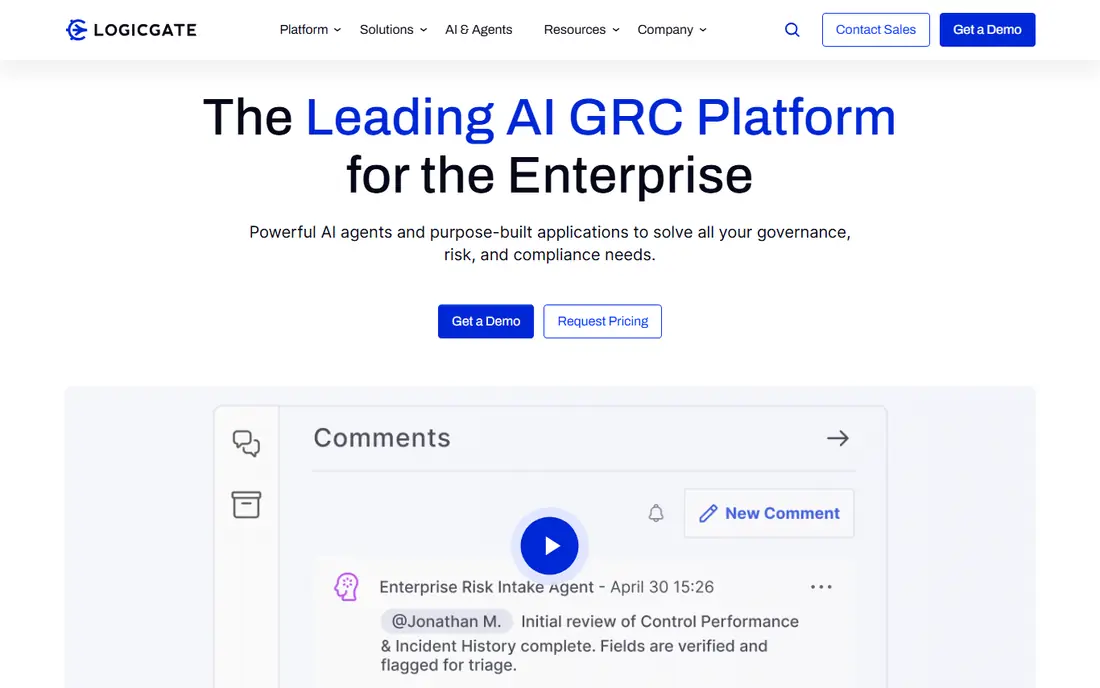
LogicGate Risk Cloud lets business users build risk assessments, questionnaires, and workflows without writing code. Prebuilt apps cover enterprise risk, third-party risk, audit, and compliance, which helps a mid-market team start with a working structure instead of a blank register. Standard and external users are often included without extra per-user fees, which helps when many staff must complete assessments.
Pricing is based on applications and power user licenses, so you will need a quote. Some users also note that standalone reporting feels lighter than the workflow builder. For a mid-market team that wants to shape its own risk process, LogicGate is a strong pick.
- No-code workflow builder
- Prebuilt risk, audit, and compliance apps
- Standard users included without extra per-user fees on many plans
- Pricing is quote based
- Reporting depth can feel thin for some advanced users

Resolver covers corporate security, GRC, and investigations in one platform, with risk assessment workflows that teams can shape to their own frameworks. Users praise its interface and customizable reports, which help day-to-day risk work feel manageable once setup is done. It suits mid-size to larger companies that want one system for risk, compliance, and incidents.
Initial setup can be complex, and integration breadth is a common limitation in public reviews. Pricing is quote based. Resolver is a good fit when flexibility and a manageable entry point matter more than the deepest enterprise control library.
- Flexible risk, compliance, and incident workflows
- Clear reporting
- Approachable entry point for mid-size teams
- Setup can be complex for larger programs
- Third-party integrations are narrower than some rivals
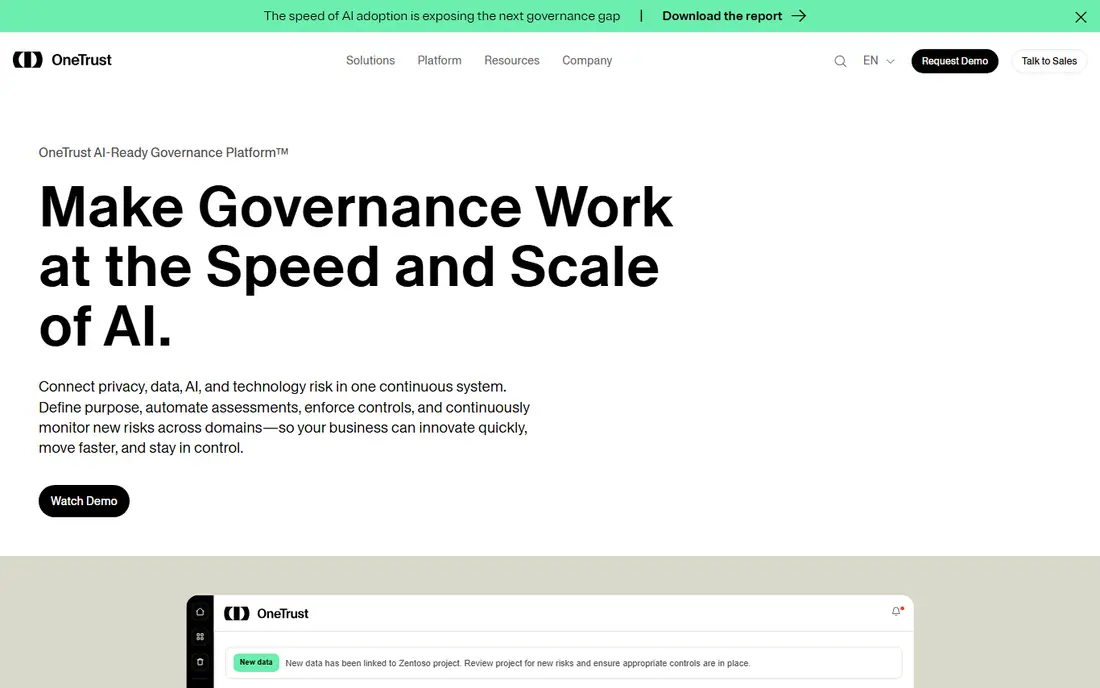
OneTrust started in privacy and has grown into a broad trust and risk platform, with modules for privacy, third-party risk, ethics, and tech risk. That breadth helps data-heavy organizations that must assess vendors, data flows, and regulatory duties together. Its regulatory content and templates also help teams that operate across many jurisdictions.
Pricing is modular and quote based, so a full program can cost more than a single risk module suggests. Implementation for a large program needs planning. For a team where privacy and third-party risk drive the risk agenda, OneTrust is a leading choice.
- Strong privacy, data, and third-party risk modules
- Broad regulatory content
- Large enterprise customer base
- Modular pricing can add up
- Implementation needs planning for large programs
Riskonnect pulls together enterprise risk, claims administration, internal audit, third-party risk, and healthcare risk in one platform. That breadth suits large organizations whose risk picture spans many departments and regulated areas. Integrated views help a risk team see how claims, audits, and incidents connect, rather than treating each as a separate file.
Pricing is enterprise-level and quote based, and users flag a steep learning curve. For a large enterprise with complex risk and claims needs, Riskonnect is a strong, if costly, pick. Smaller teams should shortlist a mid-market tool first.
- Broad enterprise risk, claims, and healthcare coverage
- Integrated risk and audit views
- Strong for large programs
- Enterprise pricing
- Steep learning curve for new users
MetricStream is a long-standing GRC platform for large, regulated organizations with complex control libraries and audit needs. It covers risk assessment, compliance, audit, and third-party risk, with workflows that can handle many frameworks and business units. That depth helps a global company keep one risk method across regions and regulators.
The trade-off is cost and implementation effort. MetricStream suits enterprises with dedicated GRC staff, not a small team that needs a simple register. For a large regulated program, it is one of the most complete options in this list.
- Deep GRC and risk capabilities
- Strong for regulated industries
- Broad control and audit features
- Enterprise pricing and implementation
- More than a small team needs
Archer, from RSA, is a mature GRC platform known for customizable regulatory frameworks and control libraries. It suits finance, healthcare, and other highly regulated sectors where risk assessments must map to many rules and controls. Teams can build assessments, track issues, and report across business units from one system.
Customization needs skilled administrators, and pricing is enterprise-level. For a large organization with complex framework needs, Archer is a strong pick. For a mid-market team, a simpler tool will likely deliver value faster.
- Highly customizable risk and control frameworks
- Strong for finance and healthcare
- Mature GRC platform
- Enterprise pricing
- Customization needs skilled admins
ServiceNow GRC brings risk, policy, audit, and compliance into the ServiceNow platform, which many IT teams already use for service management. That integration helps link IT risks, incidents, and controls to the same workflows as IT operations. It suits large enterprises that want risk data close to IT service data.
Pricing is enterprise-level, and the strongest value comes for existing ServiceNow customers. A team without ServiceNow may find a standalone risk tool simpler and cheaper. For a ServiceNow shop, GRC is a natural extension.
- Integrates with ServiceNow IT workflows
- Strong for IT risk and compliance
- Broad enterprise platform
- Enterprise pricing
- Best value for existing ServiceNow customers
Onspring is a configurable GRC platform that lets teams build risk assessments, audits, and compliance workflows without heavy coding. It suits mid-market teams that want to shape forms, scoring, and reporting to their own method, rather than adopting a rigid vendor template. Its support reputation is a plus for teams without a large GRC staff.
Pricing is quote based, and it is less well known than Archer or MetricStream. For a mid-market team that values configurability and support, Onspring is worth demoing alongside LogicGate.
- Configurable no-code workflows
- Good fit for mid-market risk, audit, and compliance
- Responsive support reputation
- Pricing is quote based
- Brand recognition is lower than the largest GRC vendors
LogicManager offers integrated risk management, compliance, and governance tools for mid-market organizations. Its taxonomy and framework libraries help a team structure risks consistently, and its workflows cover assessments, controls, incidents, and reporting. That structure helps a growing team move from spreadsheets to a governed register without an enterprise budget.
Pricing is quote based, and its depth for very large, complex programs is lighter than the enterprise leaders. For a mid-market team that needs a structured, all-in-one risk tool, LogicManager is a practical pick.
- Integrated risk, compliance, and governance tools
- Taxonomy and framework libraries
- Mid-market focus
- Pricing is quote based
- Enterprise depth is lighter than Archer or MetricStream
How we picked these
We compared official product pages, pricing information, and documentation, and we kept tools that support risk registers, scoring, controls, and reporting. We weighed configurability, framework depth, industry fit, and pricing transparency. We left out pure audit tools and pure compliance checklists without a risk assessment core, since the topic is risk assessment software specifically.
What to check before you pay
Start with your real risk register, not a vendor demo register. Bring a sample of your risks, scoring method, controls, and reporting needs to each demo, and ask the vendor to build one assessment live. That test reveals whether scoring, ownership, and evidence linking work the way your team needs.
Next, check framework and taxonomy support: can the tool handle your industry rules, internal policies, and third-party assessments in one method? Also confirm user licensing: some tools charge only for power users, while others charge for every user, which changes the total fast. Finally, ask about implementation time and data migration, since moving a spreadsheet register into a governed system often takes longer than the software demo suggests.
Frequently asked questions
What is the best risk assessment software for a small team?
For a small team, LogicGate Risk Cloud, Onspring, and LogicManager are good starting points, because they offer configurable workflows without enterprise complexity. Start with a trial or demo using your real risks, and choose the tool your risk owners find easiest to update. A tool that staff avoid using will not improve risk visibility.
What are the best risk assessment tools for large enterprises?
Archer, MetricStream, ServiceNow GRC, and Riskonnect suit large enterprises, with different strengths. Archer and MetricStream lead on control frameworks, ServiceNow suits IT-centered estates, and Riskonnect adds claims and healthcare depth. Demo at least two with your real register before committing.
How is risk scoring usually done in these tools?
Most tools use likelihood and impact scores, often on a simple scale, to rank risks, then add controls, owners, and residual scores after mitigation. The exact scales and formulas vary by tool and should match your internal policy. A tool should let you change scoring without rebuilding the whole system.
Can risk software replace spreadsheets completely?
Yes, for most teams, once the register, scoring, and reporting are set up. Spreadsheets often remain for quick analysis, but the system of record should be the risk platform, so ownership, history, and evidence stay in one place. Plan a migration step, rather than running both systems in parallel for long.
Do these tools include third-party risk assessment?
Many do, but depth varies. OneTrust and LogicGate have strong third-party risk apps, while other tools treat vendors as one risk type among many. If vendor risk is a main need, test vendor questionnaires, scoring, and remediation workflows specifically in the demo.
How much does risk assessment software cost?
Most enterprise risk platforms in this list are quote based, so cost depends on modules, users, and program size. Mid-market tools often start in the tens of thousands per year, while enterprise platforms can cost far more. Get a written quote that includes implementation, users, and support, not just a license figure.
Sources
See where you really rank - block by block
ProMapRanker scans Google Maps across a grid of your service area. Simple monthly plans from $19, white-label on every plan.
Start freeKeep reading
 who has best internet service
Who Has the Best Internet Service in 2026
Who has best internet service for US homes? We compare fiber, cable, fixed wireless and satellite providers on speed, price, availability and terms today.
Read → which survey tool has the best analytics
Which Survey Tool Has the Best Analytics in 2026
Find which survey tool has the best analytics in 2026, comparing Qualtrics, SurveyMonkey, Typeform, Alchemer, and more on reports, text, and stats today.
Read → which streaming service has the best movies
Which Streaming Service Has the Best Movies in 2026
Answering which streaming service has the best movies, with Netflix, Max, Criterion and more compared on libraries, prices and free options in this guide.
Read →