 ProMapRanker
Best Review Request Software for Farmers Markets in 2026
Direct answer
Grade.us is my top pick for farmers markets because it is built around sending review requests by email and SMS and routing feedback before it reaches Google. It has no free plan stated, so check its pricing page. Trustmary suits markets that want to collect feedback and show it on a website, and Broadly fits vendors who want review requests tied to customer conversations.
I compared these tools from vendor documentation and public sources, not from hands-on tests. I looked at how each one handles review requests, contact imports, multiple locations and Google's review policies, then matched that to how farmers markets actually operate.
Key takeaways
- Farmers markets usually deal with many small vendors and a rotating customer base, so a tool that sends requests in bulk and tracks who was asked matters more than a heavy CRM.
- Google does not allow review gating, so any software you pick should send every customer to the same review page rather than filtering out unhappy ones.
- SMS requests tend to fit market shoppers better than email because most people check a text the same day they bought something.
- A review request tool only helps if you can import contacts from vendor lists, loyalty signups or newsletter forms without manual work.
- Check how each tool handles multiple locations, because a market with several sites or seasonal stalls needs separate request streams.
Quick comparison
| Pick | Great for | Pricing starts at | Free tier | |
|---|---|---|---|---|
 Grade.us | Email and SMS review request campaigns | See website | Not stated | Visit |
 Trustmary | Collecting feedback and displaying reviews | See website | Free plan | Visit |
 Broadly | Review requests tied to customer conversations | See website | Not stated | Visit |
 Localo | Google Business Profile and review management | See website | Free trial | Visit |
 Synup | Listing management across many vendors | See website | Not stated | Visit |
 SE Ranking | Local rank tracking with review tools | See website | Free trial | Visit |
 CallTrackingMetrics | Phone call tracking and follow-up | See website | Free trial | Visit |
The best review request software for farmers markets compared
Grade.us is a review management tool built around campaigns. You add contacts, choose a request template and the software sends the ask on a schedule. For a farmers market that collects shopper emails at a welcome stall or through a newsletter, that means you can load a list after each market day and let the requests go out.
The workflow fits markets because it handles volume. A Saturday market might see hundreds of shoppers, and manually asking each one for a review is not realistic. Grade.us lets you segment by vendor, stall or event, so a request can mention the specific stall the shopper visited. It also supports multiple locations, which helps a market that runs in more than one town.
The limits are practical. There is no free plan stated, and the setup asks you to think through templates and schedules before anything sends. A single-stall vendor with a short contact list will find it heavier than needed.
- Sends requests by email and SMS
- supports multiple locations
- tracks who was asked and who replied
- Setup takes planning
- interface feels dated in places
Trustmary is a feedback and review collection tool with a free plan, which makes it a low-risk starting point for a market that has never asked for reviews before. It collects responses through forms and then lets you show positive reviews on a website or landing page.
For a farmers market, the useful part is the feedback form. You can ask shoppers what they bought, which stall they visited and how the market could improve, then invite happy respondents to leave a Google review. That keeps the ask personal rather than generic, which tends to get better responses from people who just spent a morning at the market.
The widget side is where it gets technical. Embedding reviews on a market website usually needs someone comfortable with a CMS or a developer. Markets without that help should treat the widgets as optional and focus on the collection side.
- Free plan to start
- review widgets for websites
- forms for collecting feedback
- Widgets can need developer help
- less focused on bulk SMS
Broadly combines review requests with messaging and web chat. The idea is that a customer conversation, whether by text or chat, becomes the moment you ask for a review. For a market with a stallholder who takes orders or a market manager answering shopper questions, that link is useful.
Farmers markets are not typical Broadly customers, though. The product is designed around service businesses that talk to the same customer repeatedly, like home services or auto shops. A market that mostly sells produce and crafts has shorter relationships, so the conversation-led approach fits less well than a simple bulk request.
If your market runs a pre-order scheme or a community-supported agriculture box, the messaging side may earn its place. Otherwise, a simpler request tool will do the job with less setup.
- Requests linked to messages and interactions
- web chat included
- review monitoring
- Built for service businesses
- pricing needs a quote
Localo is a local marketing tool aimed at small businesses, with a focus on Google Business Profile. It shows reviews, tracks local visibility and helps keep listing details consistent. A farmers market with a single Google listing can use it to watch what shoppers say and reply in one place.
The review request side is lighter than the dedicated tools here. You get prompts and monitoring rather than deep campaign automation. That suits a market committee that wants to see reviews and respond, but does not want to run scheduled SMS campaigns to hundreds of shoppers.
Skip it if your main goal is bulk requests. It earns its place when the bigger problem is an unmanaged Google listing with unanswered reviews and wrong opening hours.
- Free trial to test
- review monitoring in one place
- helps with local listings
- Review requests are basic
- smaller than full suites
Synup is a listings and reputation platform built for businesses with many locations. It keeps names, addresses and hours consistent across directories and pulls reviews into one dashboard. A large market with several sites, or a market authority overseeing a group of markets, could use that structure.
For a single weekend market, it is more than you need. The value shows up when you have multiple listings to keep straight and several people replying to reviews. Review requests exist in the product, but the core strength is listing accuracy rather than campaign sending.
Small markets should look at it only if listing management is the real headache. If your problem is getting shoppers to leave reviews in the first place, a request-focused tool is a better fit.
- Handles many locations
- review monitoring included
- listing consistency tools
- Priced for larger operations
- more than a small market needs
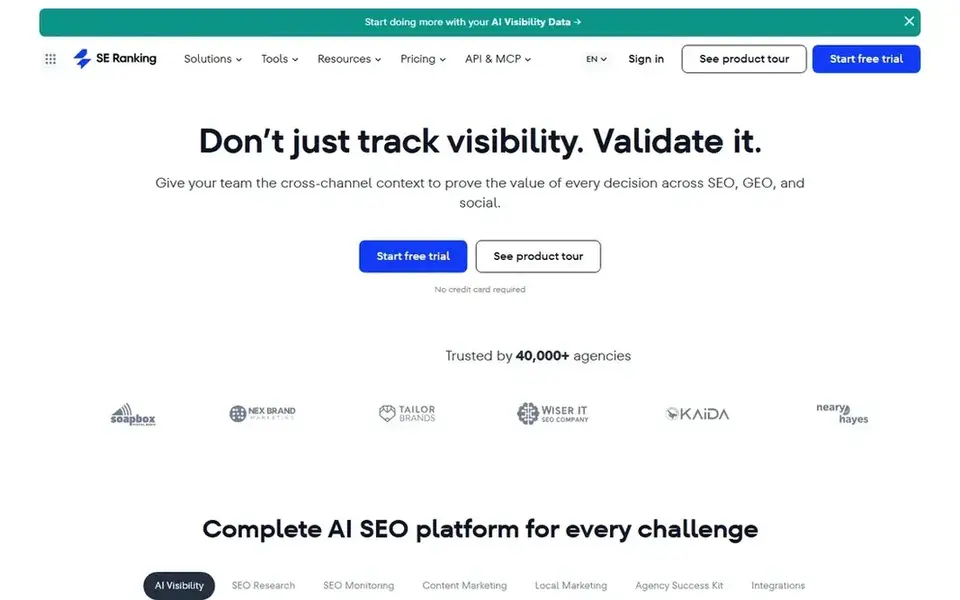
SE Ranking is an SEO platform with local rank tracking and a review management section. A market that wants to know whether it shows up when people search for farmers markets in its town can use the rank tracking, then check reviews in the same place.
The review request features are not the main event. They help you monitor and respond, but they do not replace a dedicated campaign tool for sending asks to a shopper list. Think of it as the place you measure results, not the place you run outreach.
It suits a market with someone who already does SEO work and wants reviews in the same dashboard. Markets that just want to send requests should start elsewhere and add analytics later.
- Free trial available
- strong local rank tracking
- review monitoring alongside
- Review requests are secondary
- more analytics than outreach
CallTrackingMetrics tracks phone calls and ties them to marketing sources. It can trigger a follow-up message after a call, which is a form of review request. A market that runs a phone line for stallholder enquiries or a seasonal information line could use it to see where calls come from.
Most farmers markets do not get enough calls for this to pay off. Shoppers walk up, buy and leave. If your market does take bookings by phone, such as stall reservations or workshop signups, the tracking has a purpose, and the follow-up can include a review ask.
For a market with no phone line to speak of, skip it. The setup and cost only make sense when calls are a real channel.
- Free trial
- tracks calls from ads and listings
- follow-up automation
- Needs phone enquiries to matter
- complex for a small market
How I chose
I started with vendor documentation for each tool, then checked public sources for how the products are positioned and what they include. I did not run hands-on tests, so everything here comes from what the vendors publish and what is publicly known about each product. Where a vendor does not state a free plan, I have said so rather than guessing.
The second filter was fit for farmers markets. I asked whether a tool could handle a rotating shopper list, whether it sends requests by SMS as well as email, and whether it supports more than one location. I also dropped anything that encourages review gating, because Google's guidelines do not allow it. Tools that only monitor reviews, without a way to ask for them, were ranked lower for this topic.
What to check before you buy
- Confirm the tool sends every customer to the same Google review page, with no filtering of unhappy respondents, because review gating breaks Google's rules.
- Check whether SMS is included or costs extra, since market shoppers respond better to texts than email.
- Ask how contact imports work, so you can load a CSV from a newsletter signup or loyalty list without retyping.
- Confirm the tool supports multiple locations if your market runs in more than one town or has seasonal sites.
- Read the cancellation terms and whether your contact data can be exported if you leave.
- Test the request template with your market's name and a specific stall, because generic asks get ignored.
Frequently asked questions
Do farmers markets need review request software?
Not strictly, but it helps. A market with a shopper email list or a loyalty signup can send requests in bulk after each market day, which is faster than asking people in person. Software also tracks who was asked, so you do not pester the same shoppers every week.
Is it allowed to ask customers for Google reviews?
Yes, as long as you ask everyone and do not offer incentives or filter out unhappy customers. Google's guidelines prohibit review gating and paid reviews. A simple ask after a purchase, sent to your whole list, is fine.
Should I use SMS or email for review requests?
SMS usually gets faster responses because shoppers see it the same day. Email works better for a longer newsletter list and costs less per message. Many tools let you use both, so start with SMS for recent shoppers and email for the wider list.
Can one tool handle several market locations?
Some can. Grade.us, Synup and Localo all support multiple locations to different degrees. If your markets share a brand but sit in different towns, check that each location gets its own review link and request stream before you commit.
What about vendors who want their own reviews?
Stallholders usually have their own Google listings, and a market-wide tool will not manage those. Point vendors to a simple request process of their own, or use a platform with per-location links if the market wants to help them collect reviews separately.
Sources
See where you really rank - block by block
ProMapRanker scans Google Maps across a grid of your service area. Simple monthly plans from $19, white-label on every plan.
Start freeBrowse all guides
← Best Review Request Software for Chimney Repair Companies in 2026Best Review Request Software for Home Theater Installers in 2026 →
 best review request software for cheese shops
Best Review Request Software for Cheese Shops in 2026
A practical guide to review request software for cheese shops in 2026, comparing tools for SMS and email asks, QR codes, follow-ups and review monitoring.
Read → best review request software for archery ranges
Best Review Request Software for Archery Ranges (2026)
A practical guide to the best review request software for archery ranges in 2026, compared from vendor documentation and public sources.
Read → best review management software for record stores
Best Review Management Software for Record Stores in 2026
A practical guide to the best review management software for record stores in 2026, covering review requests, reputation tools and local listing control.
Read → free geo grid scan
How to Get a Free Geo-Grid Scan of Your Business
How to get a free geo-grid scan of your business and see exactly where you rank.
Read → local citation finder
Local Citation Finder: A Complete Guide
Everything you need to know about local citation finder: what it is, why it matters for local SEO, and exactly how to act on it.
Read → geo grid heatmap seo
How to Read a Local Search Grid: A Beginner's Heatmap Tutorial
New to geo-grid heatmaps? This beginner tutorial walks you through reading every color, number, and pattern.
Read →More in Local SEO & Google Maps · All guides A to Z by date · Latest guides