 ProMapRanker
Best Review Management Software for Record Stores in 2026
Direct answer
Grade.us is my top pick for record stores because it focuses on getting reviews from customers after a sale or a special-order pickup, which is the moment a record shop earns goodwill. It has no free plan stated, so check its pricing page. Trustmary suits shops that want to collect and display testimonials, and Synup fits stores that need review management tied to accurate Google Business Profile listings.
I compared these tools from vendor documentation and public sources, and I did not run hands-on tests. My focus was on how each one fits the daily rhythm of a record store: a customer digs through a crate, buys a sealed reissue or a used pressing, and either leaves happy or has a question about condition. The tools below cover review requests, replies, listings and the local rank checks that tell you whether people find the shop on Maps.
Key takeaways
- Record stores get reviews at the counter, so software that sends a request right after a sale or a hold pickup works better than a general reputation suite.
- Review replies matter for a shop that sells collectible and used records, because a calm public answer to a grading complaint protects trust with other buyers.
- Listing accuracy on Google Maps and Apple Maps decides whether a customer finds your store before a weekend drop, so review tools that also manage listings save you work.
- Testimonial tools help you show customer quotes on a store website, but they do not replace Google reviews, which is where most local discovery happens.
- Skip any tool that offers review gating or asks you to filter out unhappy customers, because Google's guidelines forbid it and it can cost you your profile.
Quick comparison
| Pick | Great for | Pricing starts at | Free tier | |
|---|---|---|---|---|
 Grade.us | Review requests after a sale or pickup | See website | Not stated | Visit |
 Trustmary | Collecting and displaying customer testimonials | See website | Free plan | Visit |
 Synup | Reviews plus accurate local listings | See website | Not stated | Visit |
 Broadly | Review requests and customer messages in one inbox | See website | Not stated | Visit |
 SE Ranking | Local rank tracking next to review checks | See website | Free trial | Visit |
 Places Scout | Grid-based local rank checks | See website | Free trial | Visit |
 CallTrackingMetrics | Tracking calls from review and ad traffic | See website | Free trial | Visit |
The best review management software for record stores compared
Grade.us is a review management platform aimed at getting customers to leave reviews on Google and other sites. For a record store it fits the counter moment: when someone buys a rare pressing or picks up a special order, that is when they are most willing to write a few lines. You can set up a request that goes out after the sale and keep the message short.
The workflow is straightforward. You add a customer, choose the review site, and send a request by email or text. Replies to reviews can be handled in one place, which helps when someone complains that a used LP was graded too generously. You answer once, publicly, and move on. You can also route happy customers toward Google while still asking everyone, which stays within Google's guidelines.
The limits are practical. There is no free plan stated, so a small shop should check the pricing page before committing. If you only want to reply to reviews and do not plan to ask for them, a simpler tool may be enough.
- Built around review request campaigns
- supports multiple review sites
- simple reply workflow
- No free plan stated
- interface is plain compared with newer tools
Trustmary is a testimonial and review collection tool. It suits a record store that wants to show customer quotes on its own site, for example on a page about buying and selling used vinyl. You collect a quote through a form, then display it in a widget that updates as new quotes come in.
For a shop, the useful part is turning a happy customer's comment into something you can show on the website without copying and pasting by hand. It also supports review collection, so you can ask for a Google review at the same time. Keep the ask simple and never offer anything in exchange, since that breaks Google's rules.
The limit is scope. Trustmary is not built to manage your Google Business Profile or check Maps rankings, and its review request flow is lighter than a dedicated reputation tool. If your main goal is a steady flow of Google reviews, look at Grade.us first.
- Free plan to start
- testimonial widgets for a store website
- forms for collecting quotes
- Not a full Google review request system
- fewer listing features
Synup is a local marketing platform that combines review management with listing management. It fits a record store that has moved or changed opening hours and found stale details on directories. You fix the address and hours once, and the platform pushes the update to the listings it supports.
On the review side, you can monitor incoming reviews, reply from a single inbox and track how ratings move over time. For a shop that runs Record Store Day events or late-night listening sessions, keeping hours accurate across Maps and directories matters as much as the reviews themselves, because a customer who finds a closed door rarely comes back.
The trade-off is size. Synup is built for multi-location businesses, and a single shop will pay for features it may not use. Check the pricing page and decide whether listing accuracy is worth the broader platform.
- Review monitoring and replies
- listing management across directories
- location data in one place
- No free plan stated
- more platform than a single shop may need
Broadly is a customer interaction tool built around review requests and messaging. A record store can use it to text a customer after a purchase and ask for a review, then handle the reply in the same place. The web chat option helps when someone asks whether a specific pressing is in stock before making the trip.
The service-business background shows in the templates, which lean toward appointments and jobs rather than retail. You will need to rewrite the messages so they sound like a record shop and not a plumber. Still, the request-and-reply loop is easy to follow for staff who are not marketers.
Skip it if you want deep listing management or local rank tracking. Broadly is a messaging and review tool, and it does that job without pretending to be a full SEO suite.
- Review requests by text and email
- one inbox for replies and messages
- simple web chat
- Aimed at service businesses
- no free plan stated
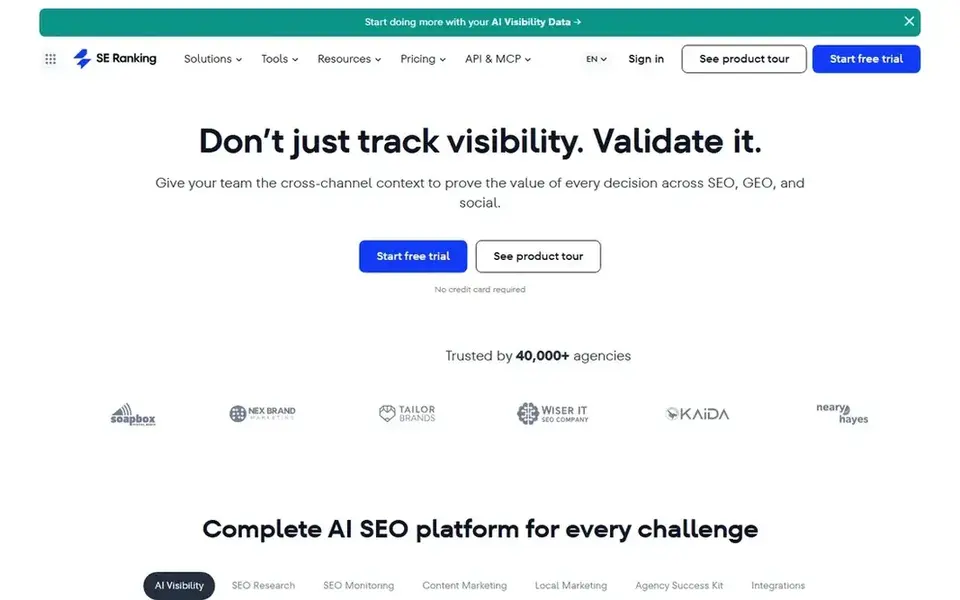
SE Ranking is an SEO platform with local rank tracking and review monitoring. It fits a store owner who wants to know where the shop shows up when someone searches for a record store in the neighborhood, and also wants a simple view of new reviews.
The local rank checks are the main draw. You can track terms like used vinyl near me or record store plus your neighborhood and see movement over time. Review monitoring sits alongside, so you can spot a new Google review and reply without opening another tab. Reports are readable enough to share with a partner who does not live in SEO dashboards.
The limit is that reviews are a side feature, not the core. If your only goal is review requests and replies, a dedicated tool is leaner. The free trial lets you check the interface before deciding.
- Local rank tracking by keyword and location
- review monitoring features
- clear reports
- Review tools sit inside a larger SEO suite
- free trial only
Places Scout is a desktop tool for local rank tracking and competitor research. It suits a record store that wants to see how it ranks across a grid of points around the shop, which is useful when a competitor opens a few blocks away or when a new pressing draws search traffic.
The grid view shows where you appear on Maps from different spots in the neighborhood, not just from one central point. That matters for a store near a transit stop or a busy retail street, where customers search from several directions. You can compare against nearby shops and export reports.
It is not a review management tool in the usual sense, so pair it with something that sends requests and handles replies. The desktop setup and data-heavy screens will put off staff who just want a simple inbox.
- Grid rank tracking around a location
- competitor comparison
- desktop reporting
- Desktop software with a learning curve
- not a review request tool
CallTrackingMetrics
Great for: Tracking calls from review and ad traffic
CallTrackingMetrics is a call tracking and conversation analytics platform. A record store that runs ads or relies on phone calls to ask about stock can use it to see which channel produced the call. If a review or a Maps listing sends someone to call, you can connect that call back to the source.
The fit for review management is indirect. It tells you whether your reputation work is producing calls, which is useful when you want to justify the time spent asking for reviews. You can also track form fills and chats in the same place.
It does not send review requests or manage replies, so it is a companion tool rather than a replacement. The setup takes some planning, and a small shop should decide whether call data is worth the extra work.
- Call tracking with source data
- form and chat tracking
- reporting by channel
- Not a review request tool
- setup takes planning
How I chose
I built this list from vendor documentation and public sources, not from hands-on tests. I read each product's feature pages, help docs and public descriptions, then matched them to how a record store actually earns reviews: at the counter, after a special order, or during an event. Tools that only fit appointment-based service businesses ranked lower.
I also weighed limits. A single shop does not need a multi-location platform, and a store that mainly wants replies does not need a full SEO suite. I left out any tool that promotes review gating or filtering unhappy customers, because that conflicts with Google's guidelines. Where a free plan or trial was not clearly stated, I said so rather than guess.
What to check before you buy
- Confirm the tool sends review requests by text as well as email, since many record buyers prefer a quick text after a purchase.
- Check that replies to Google reviews can be handled in one inbox, so staff do not juggle logins during a busy Saturday.
- Ask whether the tool touches Google Business Profile listings, because wrong hours hurt a shop more than a missing review.
- Make sure the request flow asks every customer, with no filtering or gating, so you stay within Google's review policies.
- Check if the tool can track local rank terms like record store near me, which tells you whether reviews are turning into discovery.
- Read the pricing page for limits on locations, users and review sites before you commit, since a single shop can outgrow a starter tier quickly.
Frequently asked questions
Do record stores really need review management software?
A record store can reply to reviews by hand, but software helps when you want a steady request flow after sales and events. It saves time on replies and keeps requests consistent. If you get only a handful of reviews a month, a simple tool or manual replies may be enough.
Should I ask every customer for a review?
Yes, ask every customer in the same way and never filter out unhappy ones. Google's guidelines forbid review gating, and selective asking can damage trust. A short request after a sale, sent to everyone, is the safe approach.
Can I offer a discount for a review?
No. Offering money, discounts or free records in exchange for reviews breaks Google's policies and can lead to removed reviews or profile penalties. Ask for honest feedback and leave the choice to the customer.
What should I do about a bad review of a used record?
Reply once, calmly, and explain your grading policy and what you can do to fix the issue. Do not argue about condition in public. A clear, polite reply shows other buyers that you stand behind your stock.
Do I need listing management as well as review software?
It helps if your hours or address change often, or if you run events. Stale details on Maps send customers away, and a tool like Synup handles both reviews and listings. If your details are stable, a review-only tool is fine.
Sources
See where you really rank - block by block
ProMapRanker scans Google Maps across a grid of your service area. Simple monthly plans from $19, white-label on every plan.
Start freeBrowse all guides
← Best Review Management Software for Pumpkin Patches in 2026Best Review Request Software for Archery Ranges (2026) →
 best review management software for maid services
Best Review Management Software for Maid Services in 2026
A practical guide to the best review management software for maid services in 2026, covering review requests, replies, listings and reputation tools.
Read → best review management software for kayak rentals
Best Review Management Software for Kayak Rentals in 2026
A practical guide to the best review management software for kayak rentals, comparing tools for review requests, replies, and reputation in 2026.
Read → best review management software for horse trainers
Best Review Management Software for Horse Trainers in 2026
A horse trainer's guide to review management software in 2026: how each tool handles review requests, replies and listings, with limits and fit.
Read → promorepublic alternatives
Best PromoRepublic Alternatives in 2026
Compare 9 PromoRepublic alternatives for scheduling, content ideas, reviews, and local marketing in 2026, from Buffer to Sprout Social and Planable today.
Read → local seo for car dealerships
Local SEO for Car Dealerships
A local SEO guide for car dealerships: Google Business Profile setup, reviews, and inventory-driven local SEO for auto dealers.
Read → local seo for tree service
Local SEO for Tree Service Companies
How tree service companies can rank higher for emergency and seasonal local searches.
Read →More in Local SEO & Google Maps · All guides A to Z by date · Latest guides