 ProMapRanker
Best Retail Pricing Software Compared


enterprise B2B and B2C price optimization · Pricing starts at: quote only
Key takeaways
- Prisync is the most transparent pick for small and mid-size shops, with URL plans from $99 a month and a 14-day trial.
- Pricefy is the cheapest entry point, with a free plan for 50 SKUs and Starter at $49 a month.
- Omnia Retail is the only mid-market tool with a published price in euros, from 399 euros a month on the SMB plan.
- Competera, Pricefx and Revionics are quote-only enterprise suites, so budget for a demo and a sales conversation.
- The real cost driver is catalog size and update frequency, not the headline price, so compare the cost at your real SKU count.
Quick comparison
| Pick | Great for | Pricing starts at | Free tier | |
|---|---|---|---|---|
| Pricefx | enterprise B2B and B2C price optimization | quote only | No | Visit |
 Competera | mid-size and large retailers needing AI price recommendations | quote only | No | Visit |
 Prisync | small and mid-size shops under 5,000 products | $99 per month (Professional, 100 products) | Free trial (14 days) | Visit |
 Price2Spy | small catalogs that need price history and MAP monitoring | quote only | Free trial | Visit |
 Omnia Retail | European online stores that want automated repricing | €399 per month (SMB plan) | No (demo available) | Visit |
 Intelligence Node | large retailers needing price intelligence at scale | quote only | No | Visit |
 Wiser | enterprise brands and retailers tracking prices and MAP | quote only | No | Visit |
 Pricefy | online stores that want repricing from a low entry price | $49 per month (Starter, 100 SKUs) | Yes | Visit |
 Revionics | large retailers optimizing prices, promotions and markdowns | quote only | No | Visit |
The best retail pricing software

Pricefx is the broadest pricing platform on this list, covering B2B and B2C companies with price management, optimization, quoting, CPQ and analytics as cloud-native software. Its PricingAI engine runs optimization at the deal level, not just the price list level, so sales reps get real-time guidance on every quote, and the 2025 launch of Pricefx Copilot added conversational AI for pricing questions.
The subscription is quoted, and services add up. Pricefx's own 2026 customer price list shows project training such as UAT and adoption training from $11,000, and solution adoption tiers from $11,500. The vendor claims an average 8.4% margin improvement, which is a vendor claim rather than a measured result, so pilot with your own data before you trust it.
- Broadest pricing platform, price setting, optimization, quoting and analytics in one cloud suite
- AI agents automate routine pricing tasks
- Modular suite with 50 plus pre-built use cases
- No published subscription price
- Services add up, training from $11,000
- Advanced features have a steep learning curve
Competera
Great for: mid-size and large retailers needing AI price recommendations
Competera is the strongest AI pricing option for retailers in this list. It blends competitive data with demand elasticity modelling across 20 plus factors, then issues price recommendations and executes them across large assortments. The Competitive Data, Adaptive AI and Contextual AI editions cover monitoring, recommendation and automated execution in stages.
There are no published prices, and the product sells through a demo and a quote. Third-party guides put typical pricing at $50,000 plus a year, which fits mid-size and large retailers but not small shops. The vendor claims 95% prediction accuracy, which is a vendor claim rather than a measured result, so ask for a pilot on your own assortment before signing.
- AI price recommendations based on demand elasticity
- Competitive data plus adaptive AI editions
- Strong fit for large assortments
- No published prices, sells through a demo
- Typically $50,000 plus a year
- Needs good data to work well
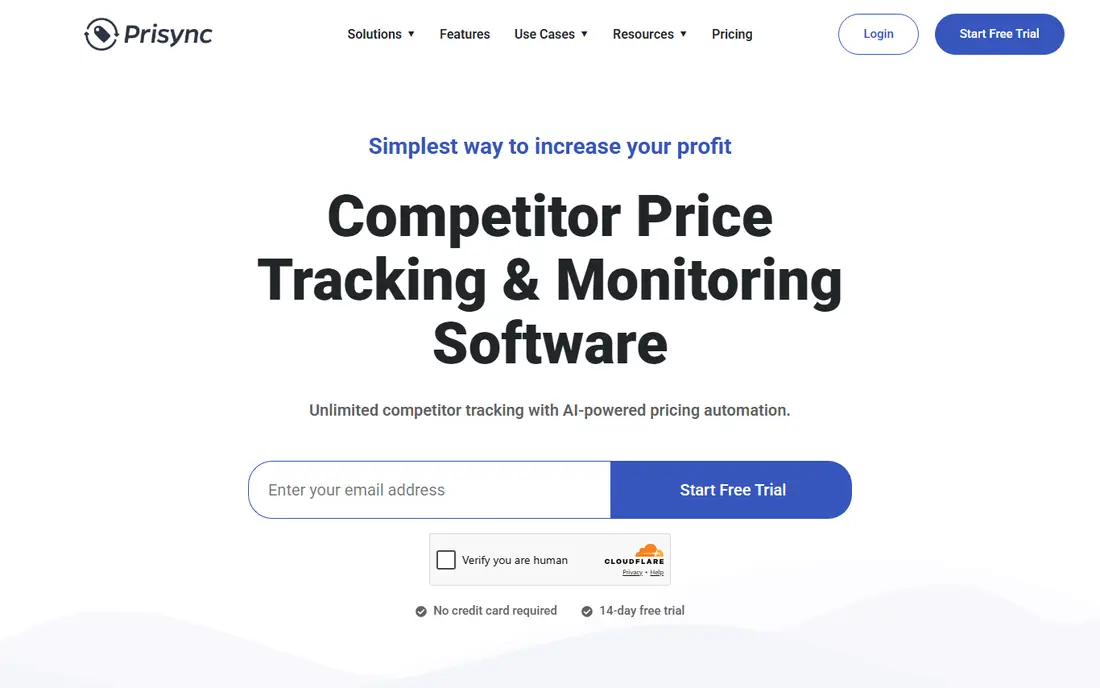
Prisync is the most transparent tool on this list, and it stays a good fit for small and mid-size shops under 5,000 products. URL-based plans run $99 a month for 100 products, $199 for 1,000 and $399 for 5,000, with updates 3 times a day and unlimited competitors. Channel-based plans for marketplaces start at $199 a month, and hybrid plans that mix URLs and channels start at $299.
Dynamic repricing is built in, so the tool can adjust your prices when a competitor moves, within the floors and rules you set. The catches are API access at 20% extra on every plan, marketplace channels that cost more than URL tracking, and update frequency that is 3 times a day rather than instant on the entry plans. A 14-day free trial needs no card.
- Published prices from $99 a month
- Dynamic repricing built in
- Unlimited competitors on URL plans
- API access costs 20% extra on every plan
- Marketplace channels cost more than URL tracking
- Price updates 3 times a day on URL plans, not instant
Price2Spy is the closest like-for-like alternative to Prisync. It monitors competitor prices, sends alerts and sells repricing as a separate module. Its standout is MAP monitoring and enforcement, which brands choose when resellers undercut the minimum advertised price. Premium allows up to 8 price checks a day, with instant alerts from the Basic plan up.
The catch for budgeting is that the pricing page we checked did not show a dollar figure for Starter or Basic, and Premium is on request. Third-party figures of $24 to $39.95 a month circulate online, but they are not on the vendor page, so treat them as unverified and ask for a written quote. A free trial is offered, though the length is not stated on the pricing page.
- Monitoring with optional repricing
- MAP monitoring and enforcement features
- Premium allows up to 8 price checks a day
- Pricing page shows no Starter or Basic prices
- Repricing is a separate module
- Marketplace tracking starts on Basic
Omnia Retail is the transparent mid-market pick for European online stores. The SMB dynamic pricing plan starts at 399 euros a month, and the platform automates repricing across the assortment, with Omnia Agent agentic AI that automates pricing decisions. It integrates with Shopify, Shopware and Plentymarkets, which covers the main European ecommerce stacks.
The limits are currency and access. Prices are in euros, so US buyers face conversion on top of the subscription, and there is no free plan, only a demo after an introductory call. Enterprise plans are custom, so larger retailers still need a sales conversation. For a European store that wants published pricing and automated repricing, it is the clearest option here.
- Transparent pricing from €399 a month
- Dynamic pricing with automated execution
- Agent AI that automates pricing decisions
- Priced in euros, so US buyers face conversion
- No free plan, demo after an introductory call
- Enterprise plans are custom
Intelligence Node
Great for: large retailers needing price intelligence at scale
Intelligence Node is an enterprise price intelligence platform for large retailers and brands. It tracks competitor prices across retailers and marketplaces, pairs that with assortment analytics, and feeds pricing decisions for catalogs far larger than the small-shop tools handle. The platform is built around data volume: matching, monitoring and reporting across thousands of SKUs in several markets.
There are no public prices, and buying starts with a demo. That puts it in the same enterprise bracket as Competera and Pricefx, where the quote depends on catalog size, markets and data feeds. Small and mid-size shops will find the onboarding too heavy, but a large retailer with a pricing team and a big assortment gets a purpose-built tool.
- Price intelligence across retailers and marketplaces
- Assortment and pricing analytics in one platform
- Built for large catalogs
- No public prices, demo first
- Enterprise-only fit
- Implementation takes time and data work
Wiser sells price and MAP intelligence to enterprise brands and retailers. It crawls competitor and marketplace prices, flags MAP violations, and gives pricing teams the data to defend margins. Access runs through the web, an API, a Chrome extension and CSV, so the data can feed other systems. Wiser also offers a free competitor price snapshot on request, which is a useful way to test the data quality before a sales call.
The limits are price transparency and fit. There are no published prices, and the quote depends on catalog size and scope, so budgeting starts with a conversation. The enterprise focus makes it too heavy for a small shop, and teams that only need basic monitoring will find Prisync or Pricefy cheaper and faster to start.
- Price and MAP intelligence for brands and retailers
- Free competitor price snapshot on request
- Chrome extension and API access
- No published prices, contact sales
- Enterprise focus, too heavy for small shops
- Quote depends on catalog size
Pricefy is the cheapest entry point on this list for a store that wants repricing. The free plan covers 50 SKUs with 5 competitors, and Starter costs $49 a month for 100 SKUs, Pro $99 for 2,000, Business $189 for 15,000 and Enterprise $499 for 25,000, with about 25% less on annual billing. AI product matching pairs your catalog with competitor listings, and repricing starts on Pro.
The limits are update frequency and scale. Subscription plans update twice a day, which is slower than Prisync at 3 times a day and far slower than Price2Spy Premium at 8 checks a day. Large catalogs need the higher tiers, and Pricefy is a smaller vendor than Prisync or Competera, so support and integrations are thinner. For a small store, the free plan is a genuine way to test the category.
- Free plan for 50 SKUs
- AI product matching
- Repricing from the Pro plan
- Two updates a day on subscription plans
- Higher tiers needed for large catalogs
- Smaller vendor than Prisync or Competera
Revionics, by Aptos, is a retail price, promotion and markdown optimization suite for large retailers. It covers the full pricing cycle: base prices, promotions and markdowns, with analytics that show where money is left on the table and guide better pricing decisions across the assortment. Its customer list includes large retailers and Fortune 500 names, which is the scale it is built for.
There are no published prices, and third-party guides put typical pricing at $200,000 plus a year, which fits enterprise retailers only. The platform needs a pricing team to run well, with clean data and a testing routine, so a small retailer gets little from it. For a large chain, it is one of the few tools that treats pricing, promotions and markdowns as one problem.
- Price, promotion and markdown optimization in one suite
- Used by large retailers including Fortune 500 names
- Strong analytics for assortment decisions
- No published prices, enterprise quote
- Typically $200,000 plus a year
- Needs a pricing team to run well
How we chose
We compared vendor pricing pages, help documentation and feature lists, and we checked every price in November 2026. Prices are in US dollars on monthly billing unless the entry says billed annually or shows euros. We did not test the products hands-on and we did not use review scores. A tool made this list only if it helps a retailer set, track or optimize the prices it charges, and only if its pricing page or help pages confirm the price shown. Where a vendor hides its price, we say quote only and we do not invent a figure.
What to check before you buy
Check the cost at your real catalog size, not the headline price, because most tools price by products tracked. Check update frequency, since a price checked 3 times a day can miss a flash sale. Check whether repricing is included or a separate module, and check whether marketplace channels cost extra. Set a hard minimum margin per SKU before you turn on any automation, so an algorithm cannot discount you into a loss.
| Catalog size | Best fit | What you get | Monthly cost | | 50 SKUs | Pricefy free plan | 50 SKUs, 5 competitors, daily updates | $0 | | 100 products | Prisync Professional | 100 products, 3 updates a day, unlimited competitors | $99 | | 100 SKUs | Pricefy Starter | 100 SKUs, AI matching, 2 updates a day | $49 | | 1,000 products | Prisync Premium | 1,000 products, daily updates, marketplace channels | $199 | | 2,000 SKUs | Pricefy Pro | 2,000 SKUs, AI matching, repricing | $99 | | 5,000 products | Prisync Platinum | 5,000 products, instant alerts, hybrid tracking | $399 | | Large assortment | Omnia Retail SMB | Dynamic pricing, automated execution | €399 | | Enterprise assortment | Competera, Pricefx, Revionics | AI optimization, full suite | Quote only |
Before you buy, run this checklist. First, pilot on a slice of the catalog, such as your top 100 sellers, and measure the margin change before you roll out. Second, confirm product matching accuracy, because bad matches produce bad prices. Third, check which competitors and marketplaces are covered in your country, since coverage varies by region. Fourth, set price floors and approval rules before you enable automatic repricing.
Frequently asked questions
What is retail pricing software?
Retail pricing software helps a retailer set, track and optimize the prices it charges. It monitors competitor and marketplace prices, recommends prices based on demand, cost and margin, and can reprice products automatically within rules the retailer sets. Some tools focus on monitoring, others on optimization, and the enterprise suites cover pricing, promotions and markdowns together.
How much does retail pricing software cost?
Entry prices run from $49 a month for Pricefy Starter to $99 a month for Prisync Professional, with free plans from Pricefy. Omnia Retail starts at 399 euros a month. Enterprise tools such as Competera, Pricefx and Revionics are quote-only, with third-party guides putting Competera around $50,000 a year and Revionics around $200,000 a year. The quote depends on catalog size and scope.
What is dynamic pricing?
Dynamic pricing means prices change automatically in response to signals such as competitor prices, stock levels, demand and time of day. The software watches those signals and adjusts prices within floors and ceilings the retailer sets. It is common in ecommerce and travel, and it works best with a hard minimum margin per SKU so an algorithm cannot discount you into a loss.
How often should retail prices update?
It depends on the category. Fast-moving ecommerce categories benefit from several checks a day, which is why Prisync updates 3 times a day and Price2Spy Premium allows 8 checks a day. Slower categories can update daily. The cost of stale prices is lost margin when a competitor undercuts you, and the cost of instant updates is a higher subscription, so match frequency to how fast your market moves.
Is competitor price tracking legal?
Tracking prices that competitors publish on public web pages is a normal business practice, and every tool on this list is built for it. The limits are the terms of the sites being tracked and the law in your country, so check both before you start. MAP monitoring is different: it tracks whether resellers respect the minimum advertised price your brand sets, which is a contract matter between you and your resellers.
Sources
See where you really rank - block by block
ProMapRanker scans Google Maps across a grid of your service area. Simple monthly plans from $19, white-label on every plan.
Start freeKeep reading
 best scheduling software for med spas
Best Scheduling Software for Med Spas in 2026
Compare the best scheduling software for med spas, with real prices and calendar features, so you can run staff schedules and waitlists without double bookings.
Read → best scheduling software for law firms
Best Scheduling Software for Law Firms
Compare the best scheduling software for law firms, with real 2026 prices, intake forms, and calendar sync, so clients can book easily without phone tag.
Read → best scheduling software for gyms
Best Scheduling Software for Gyms in 2026
Compare the best scheduling software for gyms, with real prices and timetable features, so you can run classes, coaches and waitlists without double bookings.
Read →