 ProMapRanker
Best Reservation Software for Restaurants 2026


Restaurants that want the biggest diner network · Pricing starts at: $149/month
Key takeaways
- OpenTable is the only tool with widely published pricing, at $149 a month for Basic, but per-cover fees of $1 to $1.50 make it the most expensive option for busy rooms.
- Resy and Tock charge flat monthly rates with no per-cover fees, starting around $289 a month, which suits upscale restaurants that seat many covers.
- Eat App is the budget pick, with a free plan for 100 covers a month and Lite at $69 a month billed annually, plus a full guest CRM.
- SevenRooms, Yelp Guest Manager, ResDiary and Toast Tables do not publish a flat price, so budget them only after a sales quote.
- Quandoo is shutting down globally, with new bookings ended on 30 September 2026, so its restaurants need a new system now.
Quick comparison
| Pick | Great for | Pricing starts at | Free tier | |
|---|---|---|---|---|
| OpenTable | Restaurants that want the biggest diner network | $149/month | No | Visit |
 Resy | Upscale city restaurants that want flat rate pricing | $289/month | No | Visit |
 Tock | Wineries, tasting rooms and experience led venues | $289/month | No | Visit |
 SevenRooms | Guest experience and CRM for hospitality groups | quote only | No | Visit |
 Eat App | Independents and groups that want a free start and full guest CRM | $69/month (billed annually) | Yes | Visit |
 Yelp Guest Manager | Restaurants that get real traffic from Yelp | quote only | No | Visit |
 ResDiary | Small to mid size restaurants that want control of bookings | quote only | No | Visit |
 Toast Tables | Restaurants already running Toast POS | quote only | No | Visit |
The best reservation software for restaurants
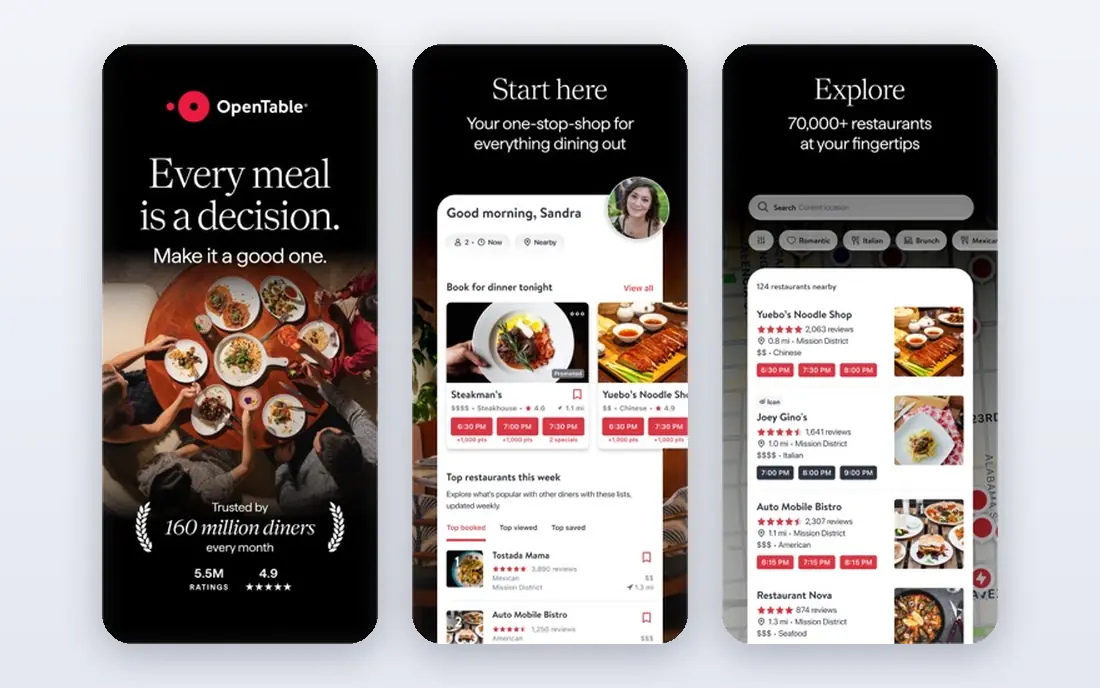
OpenTable has taken restaurant reservations since 1998 and remains the default discovery platform for diners. Its published plans run Basic at $149 a month, Core at $299 and Pro at $499, plus per-cover fees of $1 to $1.50 for diners who find you through the network, and a 2 percent service fee on advance payment experiences added in early 2026. Phone and walk-in reservations carry no fees on any plan. Basic charges $1.50 per network cover and 25 cents per website cover, while Core and Pro cut the network fee to $1 per cover. The math decides whether OpenTable fits. A restaurant with 1,000 network covers a month pays about $1,500 a month in cover fees on Basic, on top of the $149 subscription, which works out near $19,800 a year. A quieter room that mostly fills from its own website and regulars pays far less. The guest CRM on Core and Pro tracks diner history, tags and notes, while Basic covers the booking flow only. The one year auto renewing contract locks you in, so ask for the cancellation window and any early termination fee before signing.
- Largest diner discovery network
- Diners can book from Google, maps and the OpenTable app
- Per-cover fees add up fast for busy rooms
- One year auto renewing contract
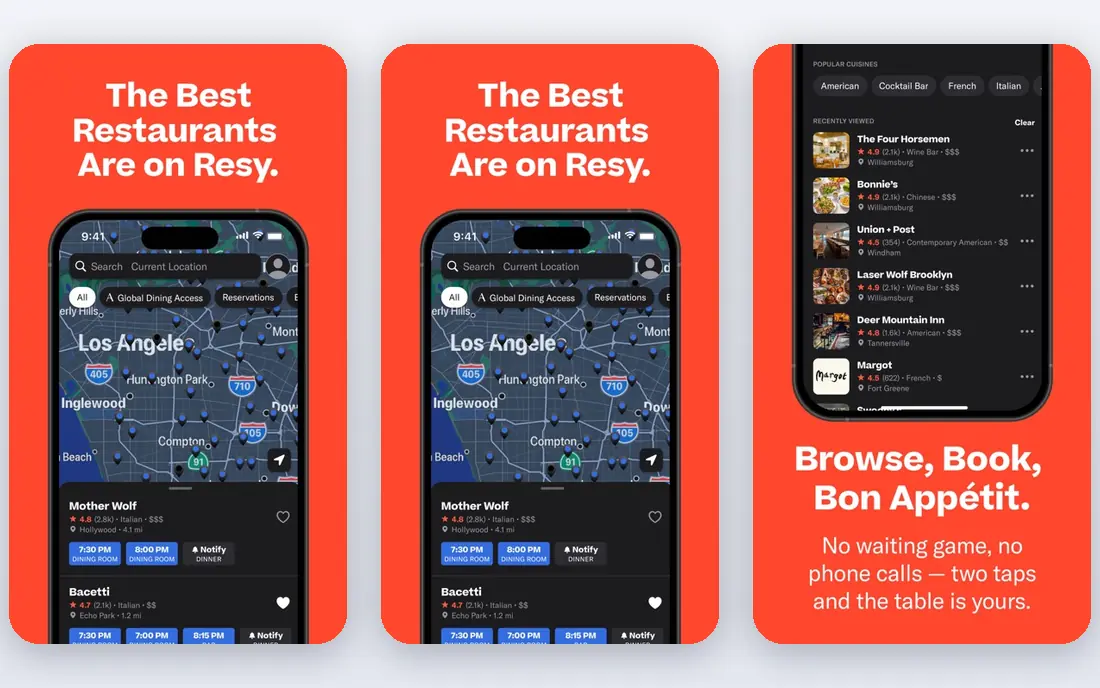
Resy, owned by American Express, suits upscale and fine dining restaurants in major cities that want flat rate pricing with no per-cover meter. Reporting puts the Platform tier around $289 a month and Platform 360 around $459 a month, with no per-cover fees on bookings. That flat structure is the main reason to choose Resy over OpenTable: a restaurant that seats 1,000 covers a month pays about $289, not $289 plus $1,000 or more in cover fees. The waitlist is strong, with SMS notifications that let guests join a line from their phone. Resy handles standard reservations, waitlists, table management and guest notes, and it connects with the American Express network for cardholder perks and exclusive bookings. The Tock product now sits inside Resy, so advance payment and ticketed dining is handled through the same company. The drawback is transparency: Resy does not publish its prices plainly, so the $289 figure comes from 2026 reporting rather than a vendor page, and the exact quote depends on the restaurant.
- Flat monthly rate with no per-cover fees
- Strong waitlist and table management
- Pricing is not published on its own page
- Suits city restaurants more than rural rooms
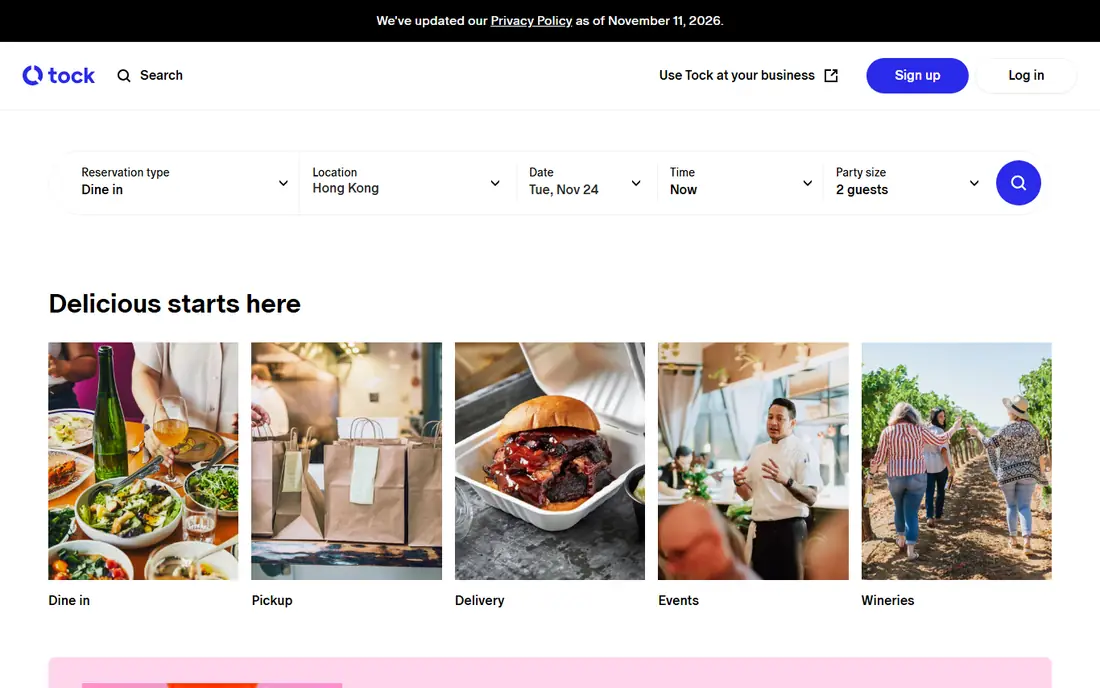
Tock carved out the experience led corner of reservations: wineries, tasting rooms, chef counters and advance payment events, where the booking is really a ticket sale. The Essential tier starts around $289 a month, with a 3 percent fee on prepayments, while Premium at about $459 a month lowers that fee to 2 percent. Vendor supplied data also lists tiers at Base $79, Essential $199, Premium $339 and Premium Unlimited $769 a month, though Tock own site does not publish these plainly, so confirm the current tiers on a demo. Tock is now part of Resy, and the Tock app is being retired, with venues moving into the Resy network. That change matters for a venue choosing today: the product, pricing and support will follow Resy terms over time, so ask how the migration works before you sign. The advance payment model cuts no-shows, because guests pay before they arrive, and the system handles deposits, ticketed seatings and tasting menus without workarounds. Tock fits best for a venue where the meal is an event with a set price, not a walk-in table that turns several times a night.
- Built for advance payment reservations, ticketed events and tasting menus
- No per-cover fees
- Pricing is not published plainly on its own site
- Now part of Resy, and the Tock app is being retired
SevenRooms is less a booking widget and more a guest system. It builds a single profile for each diner across every venue in a group, with visit history, spend, preferences, tags and notes, so a hotel group can greet a returning guest by name at any of its restaurants. The platform covers reservations, waitlists, table management, guest messaging and marketing, with more than 100 integrations into POS, loyalty and hotel systems. Pricing is quote only through sales, and SevenRooms is now a DoorDash company. Operator reports cluster around $300 to $700 or more a month per location, often with a $5,000 to $25,000 setup fee, though those figures are unverified and vary by group size. One comparison lists entry from about $499 a month. There is no free plan and no published price, so budgeting needs a sales conversation and a written quote. SevenRooms fits best for a group or hotel with several venues that wants one guest record everywhere. A single independent restaurant will usually get more value from Eat App or OpenTable Basic.
- Deepest guest data in this list, with one view of diners across venues
- Strong integrations
- Quote only pricing aimed at groups
- Operator reports put entry near $300 to $500 a month or more
Eat App is the best overall pick for most independent restaurants and groups: it has a real free plan, flat monthly pricing on direct bookings, and a full guest CRM. The free plan covers 100 covers a month, and Lite costs $69 a month billed annually, or $99 month to month. Higher tiers run to $389 a month. There are no per-cover fees and no commission on bookings, and the restaurant owns its guest data, which is the opposite of the network model where the platform keeps its marketplace users. The trade off is discovery. Eat App has no diner marketplace, so a new restaurant gets no bookings from searchers browsing a network, and must drive traffic from its own website, social pages and Google listing. POS integration costs $39 a month extra on Lite and Core, and is included on Pro. For a restaurant with a loyal base and its own marketing, that trade is good: the monthly cost stays flat while cover volume grows, and the guest list stays in house. Eat App fits best for independents and small groups that value data ownership and a predictable bill over network reach.
- Real free plan for 100 covers a month
- Flat pricing with no per-cover fees
- Guest data stays with the restaurant
- No diner discovery network, so the restaurant must drive its own bookings
- POS integration costs extra on lower tiers
Yelp Guest Manager turns a Yelp business page into a booking channel. Diners who find the restaurant on Yelp can book a table or join the waitlist without leaving the app, and the waitlist sends SMS updates as tables free up. The system covers reservations, waitlists, table management and guest notes, with reporting on where bookings come from. Pricing is quote only through Yelp sales, with no published starting price and no free plan. The value depends entirely on Yelp traffic: a restaurant with a strong Yelp presence and many reviews will see bookings, while one with a thin listing will pay for a channel that brings little. Ask for a quote that covers the monthly fee, any setup charge and the waitlist messaging cost, and compare it with Eat App Lite at $69 a month, which covers the same booking and waitlist job without a marketplace. Yelp Guest Manager fits best for restaurants whose Yelp page already brings diners every week.
- Bookings flow straight from the Yelp listing diners already use
- Waitlist with SMS updates
- Quote only pricing
- The value depends on how much Yelp traffic the restaurant already gets
ResDiary is a reservation system popular with independent restaurants and small groups, built around control of the book rather than discovery. It covers online bookings, table planning, waitlists, deposits, pre-orders, event management and gift vouchers, with booking rules that limit party size, sitting length and time slots per service. The restaurant owns its guest data, and there are no per-cover fees on direct bookings. Pricing is quote only for US restaurants. UK tiers are reported at Connect £109 a month for up to 150 bookings, Express £139 for 450, Pro £209 for 1,000 and Ultimate £315 for unlimited, according to a Capterra listing. SMS, pre-orders, event management and gift vouchers are charged separately, so the headline tier price is not the full cost. There is no free plan. ResDiary fits best for a restaurant that wants detailed control of sittings and deposits, and that books mostly from its own website rather than a discovery network.
- Strong booking rules, deposits and table planning
- No per-cover fees on direct bookings
- US pricing is not published
- Some features such as SMS and gift vouchers cost extra
Toast Tables is the reservation and waitlist product inside the Toast platform, and it only makes sense for a restaurant that already runs Toast POS. Tables, waitlists and guest status live in the same screens the staff already use, so there is no second login, no second guest list and no integration to maintain. A table that books online shows up on the floor plan, and the check closes in the same system. Pricing is not published separately, since Toast Tables is sold as part of a Toast package, and a restaurant without Toast POS cannot buy it on its own. That limits the audience to existing Toast customers, and the cost sits inside the wider Toast bill rather than as a line item you can compare. It fits best for a Toast restaurant that wants bookings without adding another vendor. A restaurant on another POS should shortlist OpenTable, Resy or Eat App instead.
- Reservations, waitlist and table status live inside the Toast POS the staff already use
- No separate login
- Needs Toast POS, so it is not a standalone choice
- Pricing is not published separately
How we chose
We compared vendor pricing pages, product documentation and feature lists for each tool, checking prices against October and November 2026 sources that read the vendor pages directly. We looked at monthly prices, per-cover fees, contract terms, guest data ownership and whether the price is published or quote only. We did not run hands-on tests, and we did not count review site scores as evidence. Where sources disagreed on a price, we used the figure most often tied to a vendor page or to 2026 reporting, and noted the conflict.
What to check before you buy
- Work out your real monthly cover volume and split it between network bookings and your own website, since OpenTable per-cover fees depend on that split.
- Ask who owns the guest data. Network tools keep their marketplace users, while Eat App and ResDiary give the restaurant its own list.
- Check the contract term and the cancellation window. OpenTable runs a one year auto renewing contract, so ask about the early termination fee.
- Confirm whether deposits, prepayments and no-show tools are included, and what percentage the platform takes on advance payment bookings.
- Test the waitlist SMS flow on a phone before you sign, since guests will use it on a busy night and a slow message creates a queue at the door.
Decision table by restaurant type and budget
| Restaurant type | Monthly budget | Best fit | Why | | Independent, under 100 covers a month | $0 to $69 | Eat App | Free plan, flat pricing, full CRM | | Upscale city restaurant, high volume | $289 | Resy | Flat rate, no per-cover meter | | Winery or ticketed venue | $289 | Tock | Advance payment bookings, no per-cover fees | | Restaurant that needs discovery | $149 plus cover fees | OpenTable | Largest diner network | | Hotel or multi venue group | Quote based | SevenRooms | One guest record across venues | | Toast POS restaurant | Part of Toast package | Toast Tables | Bookings inside the POS staff already use |
Frequently asked questions
What is the cheapest reservation software for restaurants?
Eat App is the cheapest, with a free plan for 100 covers a month and Lite at $69 a month billed annually. It charges no per-cover fees and no commission, and the guest CRM is included. OpenTable Basic at $149 a month looks close, but per-cover fees of $1 to $1.50 can push the real monthly cost well above $500 for a busy room. For a small independent restaurant, Eat App is the lowest total cost in this list.
How much does OpenTable cost per month?
OpenTable Basic costs $149 a month, Core costs $299 and Pro costs $499, plus per-cover fees. Basic charges $1.50 per diner who books through the network and 25 cents per website booking, or a $49 monthly flat fee for website covers. Core and Pro cut the network fee to $1 per cover. A restaurant with 1,000 network covers a month pays about $1,500 in cover fees on Basic, on top of the subscription, plus a 2 percent fee on advance payment experiences.
Does Resy charge per cover?
No. Resy charges a flat monthly rate with no per-cover fees. Reporting puts the Platform tier around $289 a month and Platform 360 around $459 a month, though Resy does not publish these prices on its own page. That flat structure suits restaurants with high cover volume, since the bill stays the same while covers grow. Confirm the current quote with Resy sales before you budget, since the figures come from 2026 reporting rather than a vendor pricing page.
Which reservation software is best for no-shows?
Tock is best for no-shows, because guests pay in advance for their booking, so a missed table still brings revenue. OpenTable and SevenRooms offer deposits and advance payment experiences, with OpenTable charging a 2 percent fee on advance payment bookings. Eat App and ResDiary support deposits and booking rules that limit party size and sitting length. The strongest no-show defence is an advance payment or deposit policy, not a reminder message alone.
Is SevenRooms worth the price?
SevenRooms suits hotel and multi venue groups that want one guest record across every venue, with visit history, spend and preferences in a single profile. Pricing is quote only, and operator reports put entry near $300 to $500 a month or more, often with a setup fee. A single independent restaurant will usually get more value from Eat App at $69 a month or OpenTable Basic at $149 a month, since it does not need cross venue guest records.
Sources
See where you really rank - block by block
ProMapRanker scans Google Maps across a grid of your service area. Simple monthly plans from $19, white-label on every plan.
Start freeKeep reading
 best scheduling software for med spas
Best Scheduling Software for Med Spas in 2026
Compare the best scheduling software for med spas, with real prices and calendar features, so you can run staff schedules and waitlists without double bookings.
Read → best scheduling software for law firms
Best Scheduling Software for Law Firms
Compare the best scheduling software for law firms, with real 2026 prices, intake forms, and calendar sync, so clients can book easily without phone tag.
Read → best scheduling software for gyms
Best Scheduling Software for Gyms in 2026
Compare the best scheduling software for gyms, with real prices and timetable features, so you can run classes, coaches and waitlists without double bookings.
Read →