 ProMapRanker
Best Reputation Management Software for Furniture Stores in 2026

Text-first review invites for big-ticket sales · Pricing starts at: See website
Direct answer
Podium is my top pick for furniture stores because its review invites and text messaging fit how big-ticket buyers actually behave: they ask questions before the sale and go quiet after delivery. Podium has no free plan stated, so check its pricing page. If you want a lower-cost review-focused tool, look at NiceJob, and if your main problem is listings and location data across several showrooms, look at Uberall.
I put this list together by reading vendor documentation and public sources, and I did not run hands-on tests of any of these tools. My focus was on how each one handles the long furniture sales cycle, delivery complaints and multi-showroom setups.
Key takeaways
- Furniture reviews usually arrive after delivery and assembly, so software that sends timed requests by text fits the buying cycle better than email-only tools.
- Showroom staff who never log in will not send review requests, so pick a tool that sends them automatically from your point-of-sale or delivery data.
- Stores with more than one location need listing management and review management in the same place, or the two sets of data drift apart.
- A public reply to a delivery complaint is read by future buyers, so reply workflows and saved templates matter as much as the review request itself.
- Review gating, buying reviews and offering discounts for positive reviews break Google's rules and put your profile at risk.
Quick comparison
| Pick | Great for | Pricing starts at | Free tier | |
|---|---|---|---|---|
| Podium | Text-first review invites for big-ticket sales | See website | No free plan stated | Visit |
 NiceJob | Straightforward automated review requests | See website | No free plan stated | Visit |
 Birdeye | Reviews plus messaging across several channels | See website | No free plan stated | Visit |
 GatherUp | Budget review collection and replies | See website | Free plan | Visit |
 Grade.us | Agencies running reviews for store clients | See website | No free plan stated | Visit |
 Uberall | Listings and reviews for multiple showrooms | See website | No free plan stated | Visit |
 Local Falcon | Checking map visibility around each showroom | See website | No free plan stated | Visit |
The best reputation management software for furniture stores compared
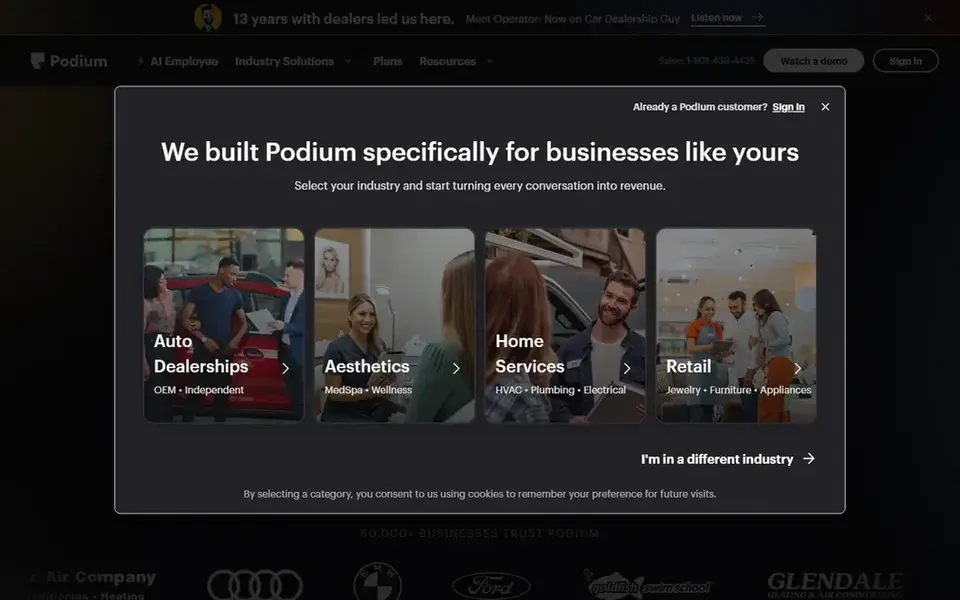
Podium is a customer messaging platform with review collection built in. For a furniture store it fits the gap between the showroom visit and the delivery date, because most buyers will not answer a phone call but will read a text. It suits stores with a sales team that already talks to customers by phone and wants one place to keep those threads.
In practice, you connect your order or delivery records and set a request to go out after delivery is confirmed. A customer who texts back about a scratched table leg lands in the same inbox, so staff can fix the issue before it becomes a one-star review. Review invites go to Google and other sites from the same flow.
The limit is fit. A single small store with a handful of reviews a month may find the platform larger than the job, and pricing is quote-based, so ask for a demo and a written quote before committing.
- Text messaging built around the review request
- inbox that keeps customer conversations in one place
- payments and follow-up in the same thread
- Pricing is quote-based
- more features than a single small store needs
NiceJob is a review and reputation tool aimed at local service and retail businesses. It is a reasonable fit for a furniture store that wants review requests to go out automatically after a sale or delivery without learning a big platform. The interface is plain, which helps when the person running it is a store manager rather than a marketer.
You set up a campaign, connect it to your customer list or point-of-sale export, and choose when the request fires. For furniture, a delay after the delivery date works better than a request at the till, because the customer has lived with the piece for a few days. Positive reviews can be shared to your social profiles from the same dashboard.
Skip it if you need a full messaging inbox, a website chat widget or detailed reporting across several showrooms. It does the review request job well and stops there.
- Simple campaign setup
- review requests by text and email
- social sharing of positive reviews
- Fewer messaging features than Podium
- less useful for complex multi-location reporting
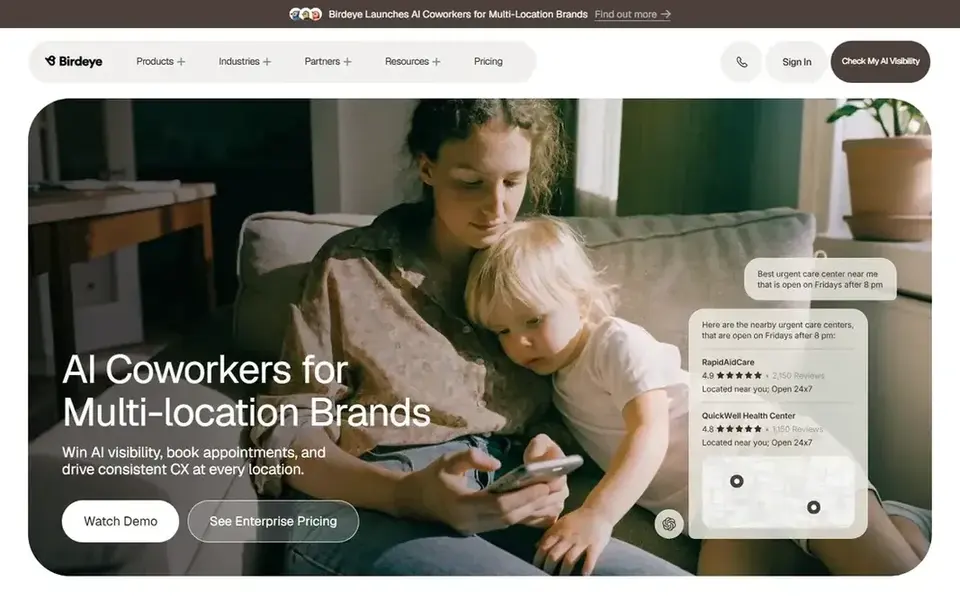
Birdeye is a broad reputation and customer experience platform used by multi-location businesses. A furniture retailer with two or more showrooms and a central marketing person is the natural fit, because the tool can roll up reviews by location while still letting each store reply to its own customers.
For furniture specifically, the survey feature is useful after delivery: a short satisfaction question can catch a problem before the customer posts publicly. Review requests, web chat and listings sit in the same account, so a change to your opening hours does not have to be made twice.
The trade-off is setup time. Expect to spend a few sessions mapping locations, users and request rules, and expect quote-based pricing that reflects the number of locations.
- Reviews, messaging, surveys and listings in one platform
- good multi-location reporting
- automated replies and templates
- Setup takes real effort
- quote-based pricing
GatherUp is a review management tool with a free entry plan, which makes it easy for an independent furniture store to test the habit of asking for reviews before paying for anything. It collects reviews from Google and other sites and puts them in one dashboard for replies.
For a store, the useful part is the request flow: you import customer emails or phone numbers after a delivery and send a request with a direct link to your Google profile. Staff can reply from the dashboard, and you can set alerts so a negative review reaches the manager the same day.
It is not a full customer messaging platform, and its listings tools are lighter than Uberall or Yext. A store that mainly needs reviews and replies will be fine; one that needs chat, payments and listings in one place should look elsewhere.
- Free plan to start
- review requests by email and SMS
- simple reply workflow
- Listings and messaging features are lighter
- advanced reporting sits on paid tiers
Grade.us is a review management tool built with agencies in mind. If a furniture store works with a local marketing agency, or an agency is reading this on behalf of a store client, Grade.us lets the agency run review campaigns and send branded reports without the store logging into a separate system.
For a furniture client, the agency can set a request that fires after delivery, monitor new reviews across Google and other sites, and reply on the store's behalf with approval. Monthly reports show review volume and response rates in plain language the store owner can read.
A store buying directly will find it workable but plain compared with Podium or Birdeye. It is the strongest fit when an agency sits in the middle.
- White-label reporting for agencies
- campaign builder for review requests
- reply management
- Less brand recognition among store owners
- not a messaging platform
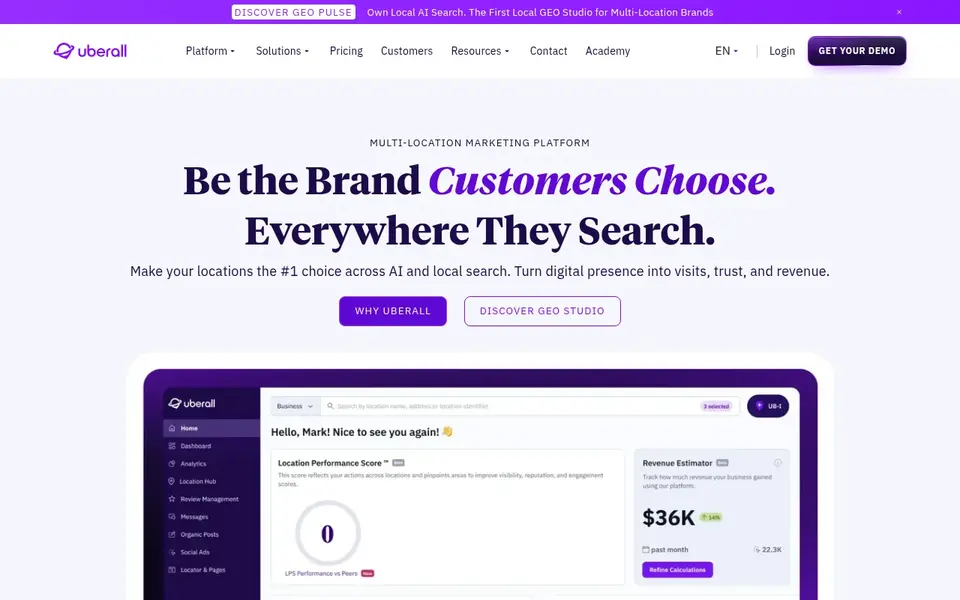
Uberall handles location data and reviews for businesses with several physical sites. A furniture retailer with showrooms in different towns is the target user: each location needs its own hours, photos and review stream, and the head office needs to see all of it in one view.
For reputation work, Uberall pulls reviews from Google and other platforms per location and lets you reply from a central inbox. Because listings and reviews share the same location records, a corrected address or holiday hours change shows up everywhere at once, which reduces the mismatched data that confuses map shoppers.
A single independent store will pay for capacity it does not use. Look at it when you have three or more locations or a franchise network.
- Listing sync across many directories
- review management by location
- consistent store data
- Priced for multi-location businesses
- overkill for one store
Local Falcon is a local search visibility tool rather than a reputation platform. I include it because furniture shoppers often start with a map search like "sofa store near me", and a store can rank well at its own address but disappear a few miles away.
The tool runs grid scans around a location and shows where your Google Business Profile appears in map results. For a furniture store, that helps you see whether people in nearby suburbs find you, and whether review growth or profile changes move that visibility over time.
It does not send review requests or manage replies. Pair it with one of the review tools above rather than using it alone.
- Grid-based map rank scans
- shows where a store is visible
- useful for tracking changes over time
- Not a review request tool
- needs a separate review workflow
How I chose
I compared these tools from vendor documentation and public sources, not from hands-on testing. I read each vendor's own product pages and help documentation to understand what the software actually does, then checked how those features map to a furniture store's workflow: a long consideration period, a delivery date that matters more than the purchase date, and complaints that often involve damage, delays or assembly.
I also weighed limits. A tool that is excellent for a restaurant with hundreds of visits a week may be oversized for a store that sells a few dozen sofas a month. I favored tools that send requests automatically after delivery, keep replies in one place, and handle more than one showroom without extra spreadsheets. Where a tool is really built for agencies or multi-location chains, I said so rather than pretending it fits a single store.
What to check before you buy
- Confirm the tool can trigger a review request from a delivery date, not just a purchase date, since furniture buyers need time to receive and assemble the item.
- Ask whether review requests go by text as well as email, because many furniture customers ignore email after a large purchase.
- Check how replies work when several staff members need access, and whether you can save templates for common delivery and damage complaints.
- If you have more than one showroom, confirm that reviews and listings are separated by location and that head office can see all of them in one report.
- Make sure the tool does not offer review gating or incentives for positive reviews, because those practices break Google's review policies.
- Ask for a written quote that covers the number of locations and users you actually have, and check whether onboarding help is included.
Frequently asked questions
Do furniture stores really need reputation software?
A furniture store gets fewer reviews per customer than a cafe, so each one carries more weight in local search. Software helps by sending requests at the right moment after delivery and by making sure someone replies to complaints quickly. A store can do this by hand, but it is easy to forget once the showroom gets busy.
When should a review request go out after a furniture sale?
After delivery is confirmed and the customer has had a few days with the item is usually better than at the point of sale. A request sent the same day as purchase often arrives before the customer has anything to say. Many stores split it: a short check-in message after delivery, then a review request a few days later.
How should a store reply to a negative delivery review?
Reply publicly, stay factual and keep it short. Acknowledge the problem, say what you are doing about it and move the details to a private channel. Future shoppers read these replies to judge how the store handles problems, so a calm, specific answer does more good than a defensive one. Never argue about the customer's account in public.
Can I ask customers for reviews in the showroom?
Yes, you can ask, but do not offer discounts, gifts or entries into a draw in exchange for a review, and do not filter out unhappy customers before asking. Google's policies prohibit incentivized reviews and review gating. A simple ask at the end of a good delivery experience, followed by an emailed or texted link, is within the rules.
Is one tool enough for reviews and local listings?
For a single store, a review tool plus a well-maintained Google Business Profile is often enough. Once you have several showrooms, keeping hours, addresses and photos correct across directories by hand gets messy, and a platform that handles both listings and reviews saves time. Decide based on the number of locations, not on feature lists.
Sources
See where you really rank - block by block
ProMapRanker scans Google Maps across a grid of your service area. Simple monthly plans from $19, white-label on every plan.
Start freeBrowse all guides
← Best Reputation Management Software for Florists in 2026Best Reputation Management Software for Painting Contractors (2026) →
 best reputation management software for flooring companies
Best Reputation Management Software for Flooring Companies in 2026
A practical guide to the best reputation management software for flooring companies in 2026, compared from vendor documentation and public sources.
Read → best reputation management software for dermatologists
Best Reputation Management Software for Dermatologists in 2026
A practical guide to the best reputation management software for dermatologists in 2026, compared from vendor docs and public sources.
Read → best reputation management software for daycares
Best Reputation Management Software for Daycares in 2026
A guide to the best reputation management software for daycares in 2026, comparing review requests, parent feedback and listing tools from vendor docs.
Read → how to make a google business page
How To Make A Google Business Page?
Everything you need to know about how to make a google business page: what it is, why it matters for local SEO, and exactly how to act on it.
Read → local falcon vs brightlocal
Local Falcon vs BrightLocal vs ProMapRanker: Honest 2026 Comparison
A head-to-head comparison of Local Falcon, BrightLocal, and ProMapRanker on geo-grid, AI tracking, and price.
Read → best ai keyword rank tracker software
7 Strong AI Keyword Rank Tracker Software Options in 2026
Best AI keyword rank tracker software: 7 tools compared on price, free plans and fit. The weak spots sit next to the strengths. Current for November 2026.
Read →More in Local SEO & Google Maps · All guides A to Z by date · Latest guides