 ProMapRanker
Best Real Estate Syndication Companies


Accredited investors who want large manager funds · Pricing starts at: $5,000 minimum investment
Key takeaways
- The best real estate syndication companies range from Fundrise at a $10 minimum to Origin Investments at a $100,000 minimum, so budget and accreditation status narrow the list fast.
- Most private syndication deals accept accredited investors only, which usually means $200,000 in annual income or $1 million in net worth excluding a primary home.
- Fundrise and RealtyMogul REITs accept non-accredited investors, while CrowdStreet, EquityMultiple, Ashcroft Capital, Origin Investments and DLP Capital do not.
- Syndication capital is usually locked for three to seven years or longer, with no secondary market, so only use money you can leave untouched for the full hold period.
- Read the offering memorandum, fee schedule and distribution history before you commit, because fees, capital calls and paused distributions change the result.
Quick comparison
| Pick | Great for | Pricing starts at | Free tier | |
|---|---|---|---|---|
| CrowdStreet | Accredited investors who want large manager funds | $5,000 minimum investment | No | Visit |
 RealtyMogul | Non-accredited investors who want REIT access | $5,000 minimum investment | No | Visit |
 EquityMultiple | Accredited investors who want notes and deals | $25,000 minimum investment | No | Visit |
 Fundrise | Beginners who want a low minimum | $10 minimum investment | No | Visit |
 Ashcroft Capital | Accredited investors who want multifamily value-add deals | $25,000 minimum investment | No | Visit |
 Origin Investments | Accredited investors who want a diversified private REIT | $100,000 minimum investment | No | Visit |
 DLP Capital | Accredited investors who want housing focused funds | $100,000 minimum investment | No | Visit |
 Arrived Homes | Non-accredited investors who want single rental homes | $100 minimum investment | No | Visit |
The best real estate syndication companies
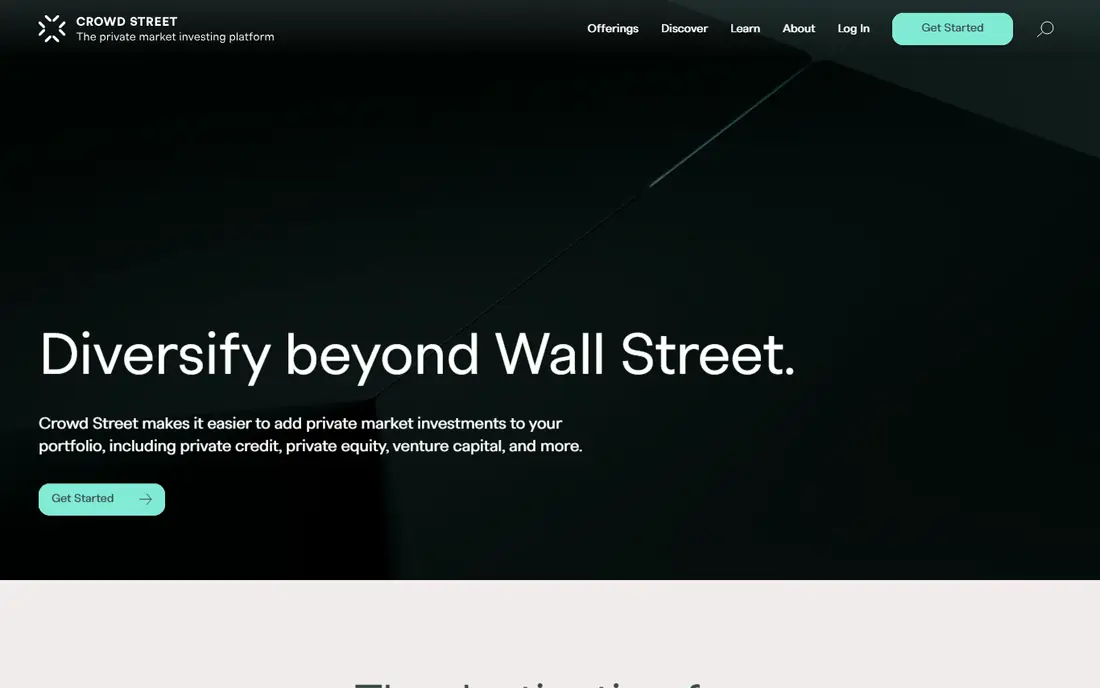
CrowdStreet, now shown as Crowd Street, is a private markets platform for accredited investors. Its Form CRS dated May 18, 2026 states that there is no account minimum and that offerings typically have an investment minimum starting at $5,000, with minimums varying by offering. The marketplace changed in 2025, and it now lists funds from outside managers such as Nuveen, PGIM and StepStone rather than the single sponsor deals that used to start at $25,000.
Investors on CrowdStreet buy into funds and REITs through CrowdStreet Capital LLC, a broker dealer registered with the SEC and a member of FINRA and SIPC. Sales loads typically run 1.5 percent to 3.5 percent up front, plus fund fees that vary by offering. Each fund sets its own fees, hold period and distribution terms. Accreditation is checked at signup, and investors must live in the United States. Company disclosures describe these investments as speculative, with a risk of losing the full amount invested.
- Access to funds from large managers
- Typical minimum lower than the old $25,000 deal minimum
- Accredited investors only, and holdings are illiquid for years with no early exit

RealtyMogul is an online real estate investment platform founded in 2012. Its FAQ states a $5,000 minimum for its REITs, with $1,000 add ons, and typically $25,000 or $35,000 for individual private placements. The REITs, MogulREIT I and MogulREIT II, are Regulation A offerings that accept non-accredited investors, with a general limit of 10 percent of the greater of annual income or net worth. Private placements are for accredited investors only.
Note a material change in 2026. Checks in October 2026 found both REITs closed to new money, with share repurchases suspended as of April 21, 2026, and neither REIT had accepted new cash since July 11, 2025. The Income REIT withdrew a new offering statement on September 10, 2026. On October 27, 2026, the site listed one open equity offering, a flex industrial property with a $35,000 minimum. RealtyMogul was acquired by The Wideman Company in November 2025. Confirm the current status of each REIT first.
- Two REITs open to non-accredited investors under Regulation A
- Long operating history since 2012
- Both REITs were paused for new investors in 2026, and private placements need $25,000 to $35,000

EquityMultiple is an online platform for private commercial real estate investments, open to accredited investors only. Its FAQ states a $25,000 minimum per standard offering and a $5,000 minimum for Alpine Notes. Alpine Notes are short term notes issued by EM Alpine, LLC, with terms of 3, 6 or 9 months. The Ascent Income Fund carries a $20,000 minimum in some listings, so the entry point depends on the product. Every investor must self certify accredited status at signup.
Effective August 1, 2026, Equity Multiple, Inc. licensed the platform and brand to a subsidiary of Larson Financial Holdings, and Larson Capital Management now runs it day to day. Most new offerings are expected to come from Larson, its operator, rather than from outside sponsors. Fees on single deals run 1 percent to 2 percent a year under the Form ADV, plus sponsor and vehicle fees that vary by offering.
- Alpine Notes start at $5,000 with 3, 6 or 9 month terms
- No fees on Alpine Notes
- Accredited investors only, and standard deals are locked for at least five to seven years
Fundrise is the most accessible name here. Its minimum is $10 for a taxable brokerage account, while an IRA requires a $1,000 minimum. The $10 entry buys fractional shares of the Flagship Real Estate Fund, the Income Fund or the Innovation Fund, depending on how you allocate. Fundrise charges a 0.15 percent advisory fee plus a 0.85 percent management fee a year, about 1 percent in total, plus fund expenses. Total annual fund operating expenses were 1.78 percent for the Flagship fund and 2.13 percent for the Income fund in the prospectuses dated May 1, 2026.
Fundrise sells its own funds, so one manager picks, runs and values every property in the portfolio. That keeps the process simple, but you cannot pick a single building or sponsor. The portfolios hold multifamily, industrial and single family rental property. Products are designed for holds of five years or longer, and redemptions are quarterly, capped and not guaranteed. Early redemption can carry a penalty, so the low minimum does not make the money liquid.
- Lowest minimum in this guide at $10
- Open to non-accredited investors
- You buy into pooled funds, not single properties, and redemptions are quarterly and capped
Ashcroft Capital
Great for: Accredited investors who want multifamily value-add deals
Ashcroft Capital is a private multifamily investment firm co-founded by Joe Fairless and Frank Roessler, based in New York. It focuses on value-add apartment communities in Sun Belt markets such as Texas, Florida and Georgia, buying properties, running renovation programs, and seeking rent growth over a planned hold. Its target hold period is five years for single assets and seven years for funds. The Form D for Ashcroft Value-Add Fund II, LP, filed May 4, 2022, states a $25,000 minimum investment, with $1,000 increments after that. Offerings are made under Regulation D for accredited investors only.
The firm states that its general partners co-invest as limited partners in every deal, with at least $100,000 from the general partners in each deal, and that asset management fees are not collected until investors have received their full preferred coupon. That alignment is a real feature, but it does not remove the risks in the sector. Public reports in 2025 and 2026 describe paused distributions in some Ashcroft funds and a capital call of about 19.7 percent of invested capital on one asset, Elliot Roswell, with investors asked to fund the call to support a refinance or sale within 24 months. Those reports show why reserves matter in syndication.
- Focus on value-add multifamily in Sun Belt markets
- General partners co-invest in each deal
- Accredited investors only, and some funds paused distributions in 2023 with capital calls in later years
Origin Investments
Great for: Accredited investors who want a diversified private REIT
Origin Investments is a Chicago based private real estate fund manager focused on multifamily property. Its flagship IncomePlus Fund is a diversified private REIT, converted from partnership tax treatment effective January 1, 2025, so investors now receive 1099 tax forms instead of K-1 forms. The fund minimum is $100,000, and it is for accredited investors only under SEC Rule 506(c), which requires verification of accredited status. Origin reports $3.8 billion in assets under management as of March 31, 2026, and the IncomePlus Fund held about 33 properties and about 7,300 multifamily units in 2026 comparisons. Other Origin products carry different minimums, including $50,000 for some opportunity zone funds and $250,000 for DST offerings.
The IncomePlus fee stack is stated as 1.25 percent plus 10 percent over a 6 percent preferred return in 2026 comparisons, and redemptions are quarterly but discretionary, not guaranteed. The hold period is five years or longer. To verify accreditation, Origin accepts a letter signed by a CPA, attorney or financial adviser within 90 days before subscription. The fund filed its latest amended Form D on September 22, 2026, under Rule 506(c).
- Diversified private REIT with about 33 properties
- 1099 tax forms since the January 2025 conversion
- $100,000 minimum and accredited investors only, with a hold of five years or longer
DLP Capital is a St. Augustine, Florida based sponsor of private real estate funds focused on housing and real estate credit. Its FAQ page states the minimums as follows: $500,000 for the DLP Housing Fund and DLP Lending Fund, $200,000 for the DLP Preferred Credit Fund, DLP Building Communities Fund and DLP Lending Fund Series A Note Offering, and $100,000 for the DLP Living Fully Community Fund. That makes $100,000 the lowest entry point across the DLP fund family. Only accredited investors may invest in DLP Capital funds.
DLP does not offer investments in single real estate deals. Each fund gives diversified exposure to a basket of deals across different sponsors and markets with a single investment. The Preferred Credit Fund is described as a REIT providing mezzanine loans and other subordinate financing for attainable rental housing, with a $200,000 minimum, an evergreen term and a 90 day redemption notice period in current summaries. Fund terms, fees and distribution rates vary by fund.
- Lowest DLP fund minimum is $100,000
- Funds focus on attainable housing and real estate credit
- Accredited investors only, and most DLP funds need $200,000 to $500,000
Arrived Homes, usually called Arrived, lets investors buy shares in individual single family rental homes and, in some offerings, short term rentals. The minimum is $100 in every offering, based on the company help center as checked in October 2026. Arrived is open to any United States resident aged 18 or older, with no income or net worth test, which makes it one of the few names in this guide that a non-accredited investor can use for single property exposure. Investors receive rental income as dividends when the property is occupied.
The single property model is both the appeal and the limit. A $100 share in one home is more concentrated than a $100 share in a diversified fund, because a vacancy, a repair or a local market change hits that one property directly. Arrived reports an average dividend yield of about 3.6 percent on long term rentals in the first quarter of 2026, and results on exited properties vary by home and hold period. Hold periods run for years, and shares are not traded on a public exchange, so liquidity is limited.
- $100 minimum per property
- Open to non-accredited investors
- You own shares in single homes, so one vacancy or repair can affect that property
How we chose
We compared vendor pricing pages, FAQ pages, fund pages and SEC filings dated in 2026, and we checked accreditation rules, minimums, hold periods and fee disclosures for each company. We gave weight to a published minimum, a clear accredited or non-accredited rule, and a current product menu. We did not claim hands-on testing, and we did not use advertised past returns to rank the companies, because past results do not predict future results. We left out Arbor Crowd, which was in the first draft list, because reviews in November 2026 state that it has posted no new deals in years and appears to have shut down. We added Arrived Homes in its place, because it is active, publishes a $100 minimum, and accepts non-accredited investors. Confirm each figure on the company site and in the offering documents before you invest.
What to check before you buy
Read the private placement memorandum or offering circular first, not the marketing page. It states the fees, the hold period, the distribution policy, the capital call provisions, the sponsor compensation and the risks in full. Ask for the distribution history for the specific fund or deal, including any pauses, and ask whether investors have faced capital calls in the past three years. Confirm your accreditation status and how the company verifies it. Confirm the minimum for the exact product, not the platform, because RealtyMogul, EquityMultiple, Origin and DLP each set different minimums by product. Keep cash reserves outside the investment.
Use this decision table to match your budget and status to a shortlist.
| Investor type and budget | Start here | Why | | Non-accredited, under $500 | Fundrise at $10, Arrived Homes at $100 | Lowest minimums, no accreditation test | | Non-accredited, $5,000 or more | RealtyMogul REITs at $5,000 when open | REIT access under Regulation A, check paused status first | | Accredited, $5,000 to $25,000 | CrowdStreet funds at $5,000, EquityMultiple notes at $5,000 | Short term notes or manager funds at a lower entry point | | Accredited, $25,000 to $50,000 | EquityMultiple standard deals at $25,000, Ashcroft Capital at $25,000 | Single deal or fund access at a standard syndication minimum | | Accredited, $100,000 or more | Origin Investments at $100,000, DLP Capital at $100,000 | Diversified private funds with a five year or longer hold |
Frequently asked questions
What is a real estate syndication company?
A real estate syndication company pools money from many investors to buy, operate or develop a property that would be hard for one investor to buy alone. A sponsor, also called a general partner, finds the property, arranges the purchase and manages the business plan. Limited partners supply most of the capital, receive distributions when the property earns income, and share in the sale proceeds at exit.
Do I need to be an accredited investor to invest in a syndication?
Most private syndications accept accredited investors only, under SEC Regulation D. The common tests are $200,000 in annual income, or $300,000 jointly with a spouse, in each of the past two years, or $1 million in net worth excluding a primary home. Fundrise, Arrived Homes and RealtyMogul REITs accept non-accredited investors under different rules, with limits on how much they can commit.
What is the minimum investment for a real estate syndication?
Minimums in this guide run from $10 at Fundrise and $100 at Arrived Homes to $100,000 at Origin Investments and DLP Capital. Most private deals for accredited investors start at $5,000 to $25,000 per offering, and some funds need $50,000 to $500,000. The minimum always depends on the exact product, so confirm the figure on the offering page and in the Form D or offering memorandum before you commit.
How long is money locked in a real estate syndication?
Most syndications lock capital for three to seven years, and some funds run for ten years. Alpine Notes from EquityMultiple are an exception, with terms of 3, 6 or 9 months. Fundrise and RealtyMogul REITs offer quarterly redemptions, but those redemptions are capped, can carry a penalty, and can be suspended. There is no public market for most syndication shares, so plan to hold to the end of the term.
Can I lose money in a real estate syndication?
Yes. Syndication investments are private, illiquid and speculative, and you can lose part or all of the amount you invest. Property values can fall, rents can drop, interest costs can rise, distributions can pause, and a sponsor can ask investors for extra capital through a capital call. Read the risk section in the offering documents and keep reserves outside the investment.
How do syndication companies charge fees?
Fees vary by company and by offering, and they are stated in the offering documents. Common charges include an acquisition fee, an annual asset management fee, a disposition fee on sale, and a share of profit above a preferred return. Fundrise charges about 1 percent a year in advisory and management fees, plus fund expenses. CrowdStreet funds carry sales loads of 1.5 percent to 3.5 percent up front, plus fund fees.
Sources
See where you really rank - block by block
ProMapRanker scans Google Maps across a grid of your service area. Simple monthly plans from $19, white-label on every plan.
Start freeKeep reading
 best scheduling software for med spas
Best Scheduling Software for Med Spas in 2026
Compare the best scheduling software for med spas, with real prices and calendar features, so you can run staff schedules and waitlists without double bookings.
Read → best scheduling software for law firms
Best Scheduling Software for Law Firms
Compare the best scheduling software for law firms, with real 2026 prices, intake forms, and calendar sync, so clients can book easily without phone tag.
Read → best scheduling software for gyms
Best Scheduling Software for Gyms in 2026
Compare the best scheduling software for gyms, with real prices and timetable features, so you can run classes, coaches and waitlists without double bookings.
Read →