 ProMapRanker
Best RASP Tools in 2026: 8 Tools Compared


Dedicated runtime protection · Pricing starts at: See website
Key takeaways
- Contrast Security is the most focused dedicated RASP choice, while Datadog and Dynatrace suit teams that already run those observability agents.
- Language coverage decides most shortlists fast, since Java, .NET, Node.js, Python, and mobile runtimes are not covered equally by every vendor.
- Blocking mode, monitor mode, and virtual patching are different promises, so check what each product actually stops in production, not just what it detects.
- Mobile apps need a different kind of runtime protection from server apps, which is why Zimperium and Jscrambler sit beside server-focused tools here.
- Pricing is almost always quote-based in this category, so plan for a proof of concept and a clear performance test before signing.
Quick comparison
| Pick | Great for | Pricing starts at | Free tier | |
|---|---|---|---|---|
| Contrast Security | Dedicated runtime protection | See website | Free trial | Visit |
 Imperva Application Security | Web app protection with RASP | See website | No | Visit |
 Datadog Application Security Management | Teams already using Datadog | See website | Free trial | Visit |
 Dynatrace Application Security | Teams already using Dynatrace OneAgent | See website | Free trial | Visit |
 Waratek | Virtual patching for Java apps | See website | No | Visit |
 Jscrambler | JavaScript runtime protection | See website | Free trial | Visit |
 Zimperium | Mobile runtime protection | See website | No | Visit |
 OpenText Core Application Security | Enterprise app security suites | See website | No | Visit |
The best RASP tools
Runtime application self-protection, or RASP, runs inside an application and watches what the code actually does, rather than only inspecting traffic at the edge. That inside view helps it block injection attacks, tampering, and some zero-day exploits with more context than a firewall alone. We compared dedicated RASP products and platform features that provide real runtime protection, and we focused on language support, blocking behaviour, and deployment effort.
Contrast is the closest thing in this list to a pure RASP specialist. Its agent instruments the application, so it can see a suspicious input travel through code to a database query or a file operation, rather than guessing from a request alone. That context helps reduce false blocks and gives developers a clearer path to a fix.
The trade-off is rollout work. Every service needs the agent, and teams should run in monitor mode first to tune rules before turning on blocking. For organisations that want runtime protection as a core control, rather than a toggle inside another platform, Contrast is a strong starting point.
- Runtime agent with deep code context
- Assessment and protection in one platform
- Java, .NET, and Node.js coverage
- Quote-based pricing
- Needs agent rollout and tuning for each app
Imperva suits teams that want runtime protection beside edge controls from the same vendor. Its RASP component adds in-app blocking to the web application firewall and bot defences that already sit in front of many sites. That combination can be useful when an attack slips past the edge or targets logic inside the app.
The catch is scope. If you only need RASP for a few internal services, a full Imperva suite may be more than you need. It makes most sense for public web applications where edge and runtime protection are managed together.
- Combines web application firewall, bot, and runtime protection
- Pre-built policies
- Broad web app coverage
- Quote-based pricing
- Best as part of a wider Imperva deployment
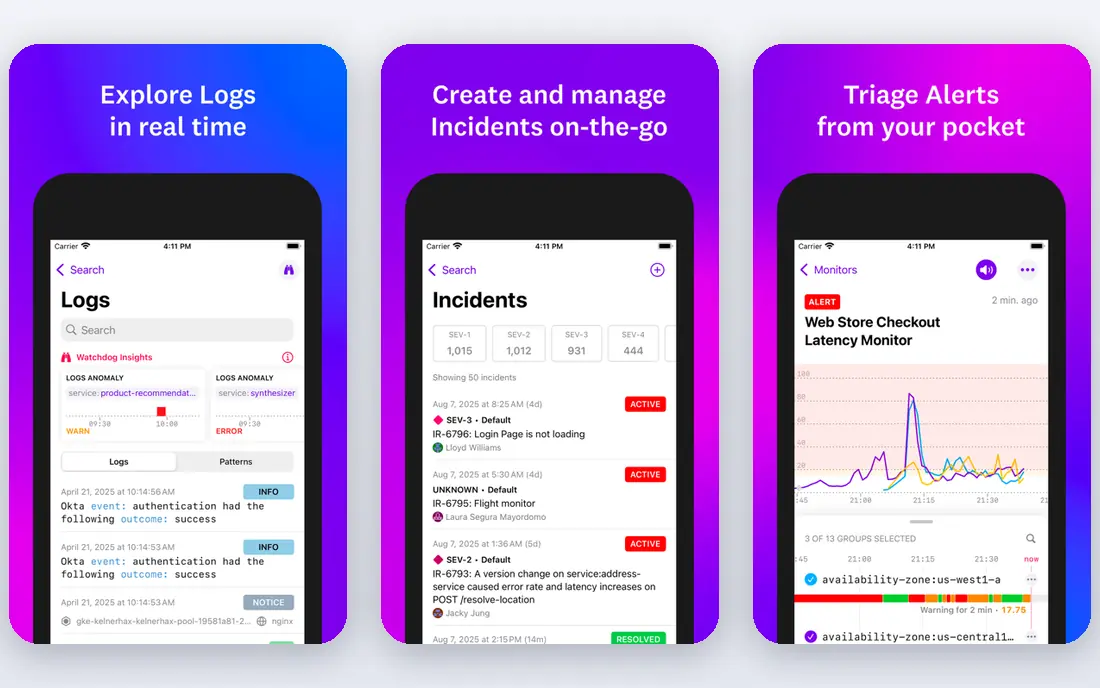
Datadog is an easy shortlist pick for teams that already trace applications with Datadog. Its application security features build on those agents, so there is often no new agent to deploy, and security findings can be linked to the same traces developers already use. That link between an attack and a code path is genuinely useful during incident review.
The limit is that it is a platform feature, not a standalone RASP specialist. Language and framework coverage should be checked service by service. For Datadog shops, though, the low deployment friction is hard to beat.
- Uses existing Datadog tracing agents
- Ties attacks to traces and code context
- Usage-based pricing model
- Depth varies by language and framework
- Works best inside the Datadog platform
Dynatrace follows a similar logic to Datadog. If OneAgent is already running, application security can often be switched on without a separate rollout, and runtime blocking sits beside vulnerability and observability data in the same console. That shared context helps teams prioritise a vulnerable, internet-facing service over a low-risk internal one.
The downside is platform gravity. Teams that do not already use Dynatrace will face a larger purchase and rollout than a point RASP tool. For existing Dynatrace customers, it is worth testing before buying anything else.
- OneAgent delivery with no extra agent for many apps
- Runtime blocking
- Vulnerability and exposure context
- Strongest inside Dynatrace
- Pricing is tied to the wider platform
Waratek answers a specific, painful problem: a critical Java vulnerability in an app that cannot be redeployed quickly. Its JVM-level rules can change how vulnerable code behaves at runtime, giving teams time to plan a proper fix. For legacy systems and regulated estates, that breathing room can be the difference between a rushed change and a safe one.
The scope is narrower than a general RASP platform. Teams with mixed languages will still need other controls for non-Java services. Within Java, however, Waratek is one of the clearest virtual patching options.
- Patches vulnerable Java behaviour without redeploying
- Strong fit for legacy Java estates
- Runtime rules at the JVM level
- Java-focused scope
- Quote-based pricing
Jscrambler protects the client side, where many RASP tools for servers do not reach. It hardens JavaScript code and adds runtime defences that react to tampering and debugging attempts in the browser. That matters for web apps that handle sensitive logic or data on the client, and for teams worried about code theft or manipulation.
The limit is focus. Jscrambler does not replace server-side runtime protection, and it should be judged as part of a client-side strategy. For JavaScript-heavy products, it fills a gap that server tools leave open.
- Code protection and runtime defences for JavaScript
- Anti-tamper and anti-debugging features
- Fits web and hybrid apps
- JavaScript-focused
- Pricing is quote-based for many plans
Zimperium is built for mobile, where the app runs on a device you do not control. Its in-app protection can detect compromised environments, tampering, and hostile conditions, and respond inside the app. Paired with its mobile threat defence signals, it gives mobile teams a runtime view that server tools cannot provide.
The catch is that it is not a general web app RASP tool. Mobile teams should shortlist it, while server teams should look elsewhere. For banking, health, and other sensitive mobile apps, that specialisation is a strength, not a weakness.
- In-app runtime protection for mobile apps
- Device and environment threat signals
- Threat intelligence context
- Enterprise pricing
- Mobile-only scope in this comparison
OpenText Core Application Security, which grew out of the Fortify line, suits enterprises that want runtime protection inside a wider application security programme. Testing, monitoring, and runtime controls sit under one vendor, which can simplify procurement and reporting for large teams.
Smaller teams may find the suite heavier than a focused RASP agent, and setup takes care. For organisations already standardising on OpenText for application security, adding runtime protection there is often simpler than introducing another vendor.
- Runtime protection beside static and dynamic testing
- Enterprise reporting
- Broad application security coverage
- Interface and setup can feel heavy
- Pricing is quote-based
How we picked these
We compared official vendor pages and documentation for products that provide protection inside a running application, not just scanning before release or filtering at the edge. We included server, JavaScript, and mobile runtime protection because the best RASP tool solutions for one team may be the wrong fit for another. Where pricing is not published, we wrote See website rather than inventing a figure.
What to check before you choose
Start with language and runtime coverage for every service you actually run, not just your main web app. A tool that covers Java well may not cover Python, Go, or mobile code at all. Then test performance under load, because a RASP agent that slows responses will be switched off in production, no matter how good its detection is.
Run in monitor mode first, review false positives with developers, and only then enable blocking for high-confidence rules. Also confirm what happens when the agent fails: does the app keep running, and does anyone get alerted? A runtime control should fail safely and loudly, not silently.
Frequently asked questions
What are the best RASP tools?
The best RASP tools include Contrast Security for dedicated runtime protection, Datadog and Dynatrace for teams already using those platforms, and Waratek, Jscrambler, and Zimperium for Java, JavaScript, and mobile special cases. The right pick depends on your languages and existing tooling.
What is the best RASP tool solution for a small team?
A small team usually does best with a platform feature it already runs, such as Datadog or Dynatrace application security, because deployment is lighter. A dedicated tool such as Contrast can still fit if runtime protection is a core requirement and the team can manage agent rollout.
How is RASP different from a web application firewall?
A web application firewall inspects traffic before it reaches the app, while RASP runs inside the app and sees how inputs move through code. That inside view gives better context for blocking, but it also means you must deploy and maintain an agent in each application.
Does RASP replace code scanning?
No. RASP protects a running app, while static and dynamic scanning find flaws before release. The strongest setups use both, so flaws are fixed early and runtime protection covers what remains, including new vulnerabilities in third-party code.
Should RASP block attacks right away?
Not on day one. Start in monitor mode, tune rules with developers, and check for false positives on real traffic. Enable blocking gradually for rules you trust, and keep a fast rollback path if a rule breaks a legitimate workflow.
Sources
See where you really rank - block by block
ProMapRanker scans Google Maps across a grid of your service area. Simple monthly plans from $19, white-label on every plan.
Start freeKeep reading
 who has best internet service
Who Has the Best Internet Service in 2026
Who has best internet service for US homes? We compare fiber, cable, fixed wireless and satellite providers on speed, price, availability and terms today.
Read → which survey tool has the best analytics
Which Survey Tool Has the Best Analytics in 2026
Find which survey tool has the best analytics in 2026, comparing Qualtrics, SurveyMonkey, Typeform, Alchemer, and more on reports, text, and stats today.
Read → which streaming service has the best movies
Which Streaming Service Has the Best Movies in 2026
Answering which streaming service has the best movies, with Netflix, Max, Criterion and more compared on libraries, prices and free options in this guide.
Read →