 ProMapRanker
Best Quiz Funnel Software in 2026

Key takeaways
- Octane AI and Quiz Kit lead for Shopify product quizzes, while Typeform and involve.me suit broader lead quizzes.
- The best quiz funnel software tools connect quiz answers to a product, email list, or CRM, not just to a score.
- Quiz take limits drive cost, so forecast monthly traffic before comparing plans.
- Test the quiz on mobile first, since most shoppers will answer on a phone.
Quick comparison
| Pick | Great for | Pricing starts at | Free tier | |
|---|---|---|---|---|
 Octane AI | Shopify product quizzes | $50 per month | No | Visit |
 Quiz Kit | Shopify quizzes at lower cost | $19 per month | Free trial | Visit |
 RevenueHunt | Budget Shopify quizzes | See website | Free trial | Visit |
 Prehook | Shopify quiz funnels | See website | Free trial | Visit |
 Typeform | Beautiful general quizzes | See website | Yes | Visit |
 Interact | Lead generation quizzes | See website | Free trial | Visit |
 involve.me | Funnels, forms, and quizzes | See website | Yes | Visit |
 ScoreApp | Scorecard lead quizzes | See website | Free trial | Visit |
 Bucket.io | Segmenting quiz funnels | See website | Free trial | Visit |
The best quiz funnel software
A quiz funnel asks a visitor a short set of questions, then recommends a product, captures an email, or segments the lead for follow-up. It works best when a catalog is large or a service needs qualification, because it replaces browsing with guided choice. We compared official product pages, pricing pages, and app listings, and we kept tools that are live and focused on quiz funnels, product recommendations, or lead quizzes.
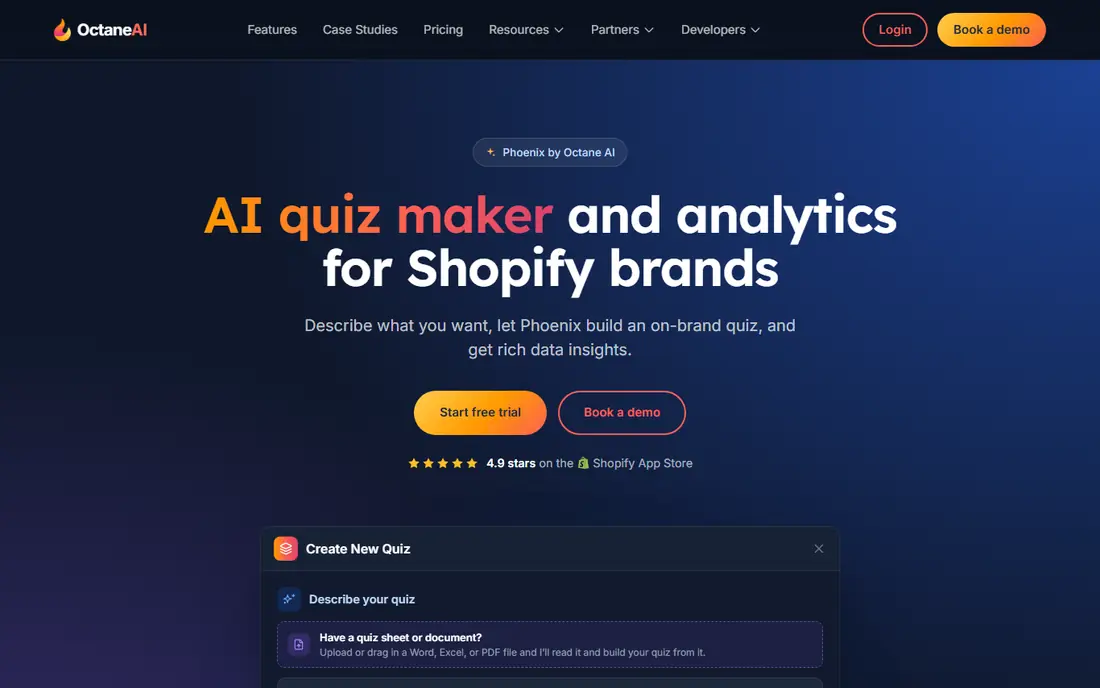
Octane AI is the most Shopify-focused quiz tool in this list. A store can build a product finder quiz, recommend items based on answers, capture emails with preferences attached, and sync that data to Klaviyo and other marketing tools. That preference data makes welcome emails and product suggestions more relevant than a generic signup form.
The entry plan covers a limited number of quiz takes per month, so a store with heavy traffic will need the higher plan. Setup also takes thought: questions must map cleanly to products, or recommendations will feel random. For a Shopify store with a complex catalog, Octane AI is the strongest pick.
- Deep Shopify integration
- Product recommendations from answers
- Klaviyo and email sync
- Entry plan limits quiz takes
- Higher plan needed for larger traffic and advanced tests
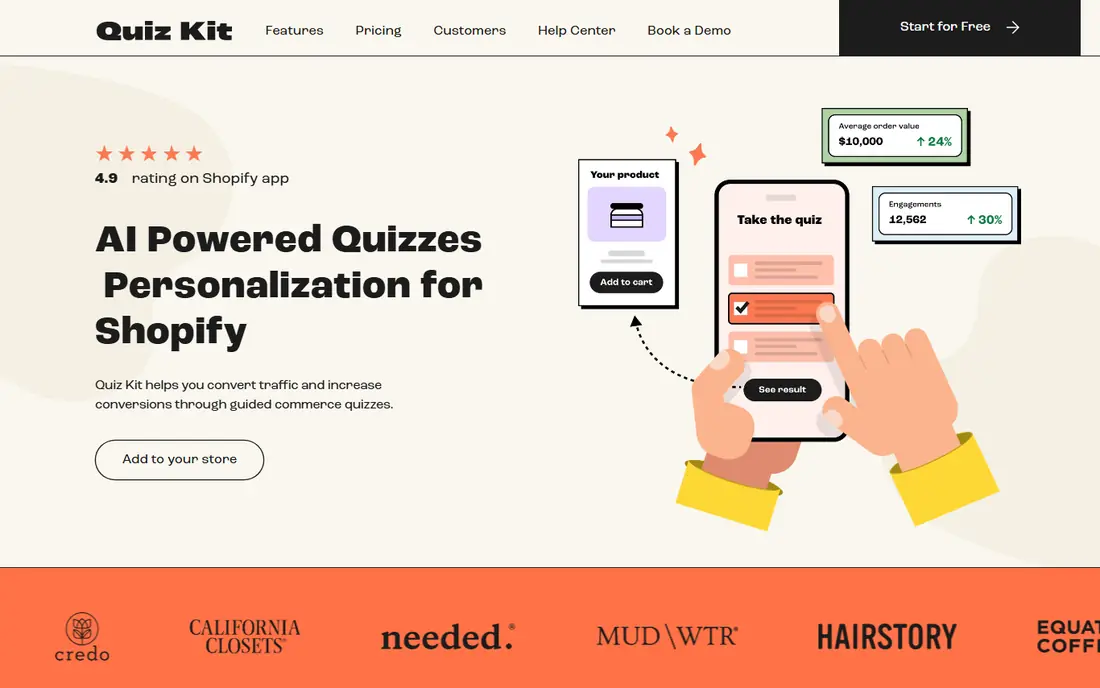
Quiz Kit, from Presidio, offers Shopify quiz building at a lower entry price than Octane AI. It includes templates, no-code logic, email capture, analytics, and product recommendations, with higher plans adding CRM integrations, A/B testing, and more. That makes it a good fit for a smaller Shopify store that wants a product quiz without a large monthly fee.
It does not match Octane AI on depth for very large stores, and it is mainly a Shopify tool, so non-Shopify sellers should look elsewhere. For a budget-conscious Shopify store, Quiz Kit is a strong, lower-cost alternative.
- Lower entry price for Shopify
- No-code templates
- Quiz logic and email capture
- Smaller feature depth than Octane AI at the top end
- Mainly a Shopify tool
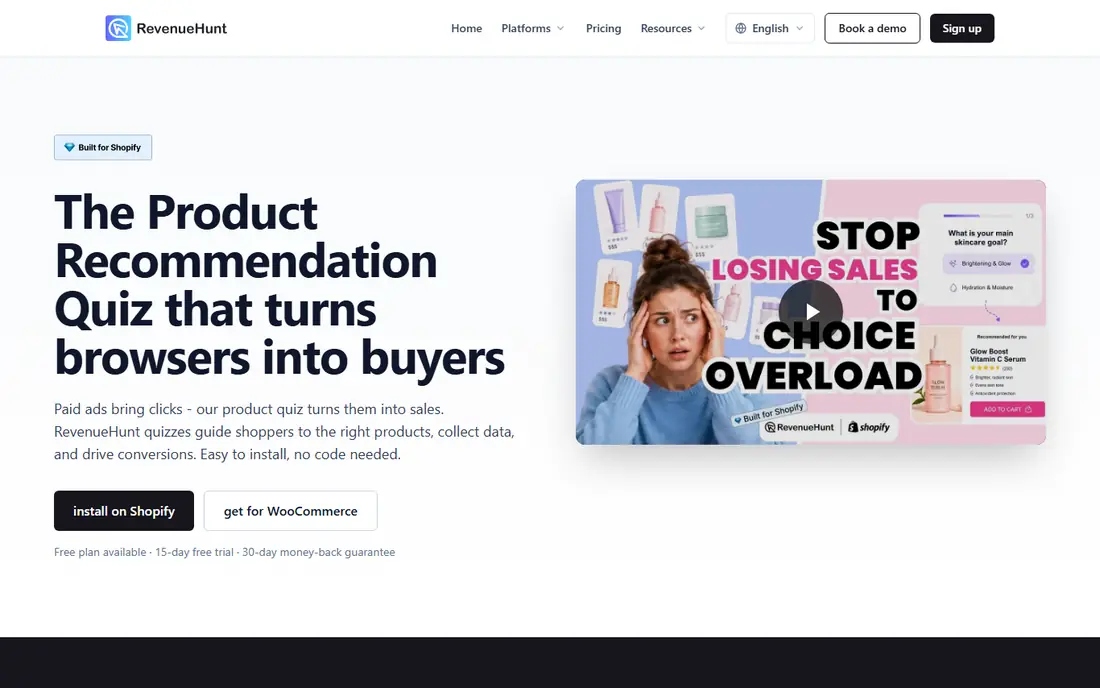
RevenueHunt is a budget-friendly Shopify quiz app that helps small stores build product finder quizzes. It offers recommendation logic, templates, and integrations with common marketing tools, at a price point aimed at newer stores. Setup is straightforward, which suits a solo founder who wants a quiz live quickly.
Advanced features, such as deep segmentation or complex testing, are lighter than Octane AI or Quiz Kit at higher tiers. Pricing should be confirmed on the vendor page, since app pricing can change. For a small Shopify store testing whether quizzes lift sales, RevenueHunt is a low-risk start.
- Low-cost Shopify quiz option
- Product recommendation logic
- Simple setup for small stores
- Fewer advanced marketing integrations than larger rivals
- Pricing needs a check on the vendor page
Prehook builds quiz funnels for Shopify stores, with product matching, email and SMS capture, and funnel analytics. A store can see where shoppers drop off in a quiz and adjust questions or recommendations to improve completion. That funnel view helps a team treat a quiz as a sales step, not just a form.
It is mainly a Shopify product, so sellers on other platforms should shortlist a general tool instead. Pricing varies by plan and should be checked on the vendor page. For a Shopify store that wants funnel analytics alongside recommendations, Prehook is worth testing.
- Shopify quiz funnels with product matching
- Email and SMS capture
- Analytics for funnel performance
- Mainly a Shopify tool
- Pricing is plan based and needs a vendor check
Typeform is a general form and quiz builder known for clean, one-question-at-a-time design. It suits lead quizzes, assessments, and surveys where design and completion rate matter, and logic jumps can route respondents down different paths. Integrations with email tools, CRMs, and sheets make it easy to send results onward.
It is not a dedicated Shopify product recommender, so a store that needs automatic product matching should pick a Shopify tool instead. Response limits and advanced logic sit on paid plans. For a marketer who needs a polished quiz on any platform, Typeform is a strong pick.
- Clean, conversational quiz design
- Strong logic jumps
- Wide integrations
- Not built for Shopify product matching
- Higher plans needed for larger response volumes
Interact focuses on lead generation quizzes, such as personality quizzes, assessments, and find-your-fit quizzes that end with an email signup. Templates for common niches help a marketer launch quickly, and branching logic can segment leads by answer. Integrations send leads to email platforms and CRMs for follow-up.
It is less focused on Shopify product matching than Octane AI or Quiz Kit, so ecommerce stores should compare carefully. Pricing varies by plan. For a content or service business that wants leads from quizzes, Interact is a practical choice.
- Templates for lead quizzes
- Branching logic
- Email and CRM integrations
- Product recommendation depth is lighter than Shopify tools
- Pricing needs a vendor check
involve.me is a broader funnel builder that includes quizzes alongside forms, calculators, surveys, and landing pages. That breadth helps a marketer who wants one tool for several lead capture formats, with consistent design and reporting. The visual builder and templates make it accessible to non-technical users.
Because it covers many formats, it is not as deep on Shopify product matching as a dedicated quiz app. Free use is limited, and larger volumes need paid plans. For a marketer who needs quizzes plus other funnel formats, involve.me is a flexible pick.
- Combines quizzes, forms, calculators, and funnels
- Visual builder
- Many integrations
- Breadth can make setup slower than a single-purpose quiz tool
- Higher volumes need paid plans
ScoreApp builds scorecard quizzes that grade a respondent and deliver a personalized report. That format suits coaches, consultants, agencies, and service businesses that want to qualify leads and show value before a sales call. Automated reports and follow-up integrations help turn a quiz result into a booked call or a nurture sequence.
It is less suited to a store that needs to recommend a specific product from a catalog. Pricing varies by plan and should be checked on the vendor page. For a service business that sells expertise, ScoreApp is a strong, focused option.
- Scorecard format for lead qualification
- Automated reports
- CRM and email integrations
- Scorecard focus may not suit product recommendation
- Pricing needs a vendor check
Bucket.io builds quiz funnels that segment respondents and send them to tailored follow-up, such as a specific offer, email sequence, or booking page. That segmentation focus suits marketers running campaigns where different answers should lead to different next steps. Integrations with email and CRM tools support that workflow.
Its pricing and feature details are less transparent at a glance than Typeform or involve.me, so a trial and a vendor check are wise before committing. For a marketer whose main goal is segmentation, Bucket.io is a focused option to test alongside Interact or ScoreApp.
- Segmentation-focused quiz funnels
- Marketing integrations
- Built for lead capture campaigns
- Interface and pricing are less transparent than some rivals
- Mainly a marketing tool
How we picked these
We compared official product pages, pricing pages, and app listings, and we kept tools that build quiz funnels with logic, outcomes, and integrations. We weighed Shopify product matching, lead capture, design quality, analytics, and pricing transparency. We left out simple survey tools without funnel outcomes, and single-purpose poll tools, since the topic is quiz funnels specifically.
What to check before you pay
Start with the outcome, not the quiz design. Decide whether the quiz should recommend a product, capture an email, qualify a lead, or segment a campaign, because that choice points to a different tool. Then map questions to outcomes on paper: every question should change the result, or it should be cut.
Next, forecast quiz takes. Plans often limit monthly takes, and a viral post or ad campaign can push you over a limit fast. Test on mobile, check load time, and confirm that email and CRM syncs carry answer data, not just an email address. Finally, run the quiz with real users and watch drop-off: a quiz that is too long will lose more leads than a shorter, clearer version.
Frequently asked questions
What is the best quiz funnel software for Shopify?
Octane AI is the strongest Shopify pick for larger stores, while Quiz Kit and RevenueHunt offer lower-cost Shopify options. Octane AI has deeper product matching and marketing sync, while Quiz Kit balances price and features. Test all three on your real catalog before choosing, since product mapping quality matters more than templates.
What are the best quiz funnel software tools for lead generation?
Interact, ScoreApp, and Bucket.io suit lead generation, with different angles. Interact covers general lead quizzes, ScoreApp suits scorecard qualification, and Bucket.io focuses on segmentation. Typeform and involve.me also work for leads when design and general funnel formats matter more than a scorecard.
How many questions should a quiz funnel have?
Most effective quiz funnels use five to ten questions, with a clear outcome at the end. Shorter quizzes complete more often, while longer quizzes can qualify better but lose more respondents. Test a short version first, and add questions only when each one changes the recommendation or segment.
Do quiz funnels work for small stores?
Yes, when the catalog is confusing or the product choice depends on personal needs. A small store with a few products may not need a quiz, but a store with many variants, sizes, or use cases can benefit. Start with a low-cost tool, measure completion and sales, and keep the quiz only if it improves results.
Can quiz answers sync to my email tool?
Most tools here sync to email platforms or CRMs, but the depth varies. Shopify tools often sync product preferences to Klaviyo, while general tools sync to a wider range of CRMs. Confirm that answer data, not just contact details, flows through, since that data drives relevant follow-up.
How do I measure whether a quiz funnel works?
Track completion rate, email capture rate, and sales or bookings from quiz takers, compared with non-takers. Also check drop-off by question, since one confusing question can hurt the whole funnel. A quiz that captures many emails but never leads to sales needs a better outcome or follow-up, not more traffic.
Sources
See where you really rank - block by block
ProMapRanker scans Google Maps across a grid of your service area. Simple monthly plans from $19, white-label on every plan.
Start freeKeep reading
 who has best internet service
Who Has the Best Internet Service in 2026
Who has best internet service for US homes? We compare fiber, cable, fixed wireless and satellite providers on speed, price, availability and terms today.
Read → which survey tool has the best analytics
Which Survey Tool Has the Best Analytics in 2026
Find which survey tool has the best analytics in 2026, comparing Qualtrics, SurveyMonkey, Typeform, Alchemer, and more on reports, text, and stats today.
Read → which streaming service has the best movies
Which Streaming Service Has the Best Movies in 2026
Answering which streaming service has the best movies, with Netflix, Max, Criterion and more compared on libraries, prices and free options in this guide.
Read →