 ProMapRanker
Best QA Outsourcing for Healthcare Software


Large regulated healthcare programs · Pricing starts at: quote only
Key takeaways
- Healthcare QA outsourcing is a separate discipline from general software testing, because HIPAA, FDA rules and FHIR interoperability shape every test case.
- All eight firms in this list price by engagement, so expect a custom quote after a scoping call, not a published list price.
- Qualitest and ScienceSoft suit large regulated programs, while QASource and TestingXperts suit mid-size teams that need a dedicated QA team.
- Ask every vendor for a signed business associate agreement, synthetic test data practices and validation documents before you sign anything.
Quick comparison
| Pick | Great for | Pricing starts at | Free tier | |
|---|---|---|---|---|
| Qualitest | Large regulated healthcare programs | quote only | No | Visit |
 ScienceSoft | Medical device and SaMD validation | quote only | No | Visit |
 QASource | Dedicated QA teams for mid-size firms | quote only | No | Visit |
 Testlio | Flexible crowd and managed testing | quote only | No | Visit |
 Cigniti | Enterprise digital assurance programs | quote only | No | Visit |
 iBeta Quality Assurance | Validation and biometrics testing | quote only | No | Visit |
 TestingXperts | EHR and healthcare app testing | quote only | No | Visit |
 QA Mentor | On-demand QA for small teams | quote only | No | Visit |
The best QA outsourcing firms for healthcare software
Qualitest is the largest independent QA and software testing firm in this list, founded in 1997 and staffed by more than 7,000 engineers serving over 400 customers. Its healthcare practice covers functional testing, performance testing, security testing and regulatory compliance testing for patient-facing software, with explicit FDA and HIPAA experience. The firm has run turnkey remediation programs for healthcare companies after FDA warnings, which shows it can handle validation work under real regulatory pressure.
For a buyer, the managed testing model is the main draw. Qualitest can run a dedicated team on site, near site or offshore, and it produces the validation documents auditors ask for, including traceability from requirements to tests. The trade-off is scale. Small teams often find the minimum engagement size too large, and the absence of a published price list means every comparison starts with a sales conversation. Ask for a fixed-scope pilot with clear pass criteria before you commit to a long program.
- Largest independent QA firm with healthcare depth
- FDA and HIPAA testing experience
- Managed testing services
- Enterprise-scale engagements suit large teams better than small startups
- No public rate card to compare against rivals
ScienceSoft has worked in healthcare IT since 2005 and holds an ISO 13485 certified quality management system for medical device software and software as a medical device. Its engineers test EHR and EMR systems, hospital information systems, medical imaging, lab software, telemedicine apps and SaMD, and they work with HIPAA, HITECH, FDA and ONC requirements plus data standards such as HL7, ICD-10, CPT and FHIR. The firm reports that 65 percent of its test engineers have more than 10 years of experience, and its test documentation follows ISO 13485 and IEC 62304.
The firm suits teams that need validation evidence, not just bug reports. ScienceSoft writes validation plans, builds traceability matrices and produces test summary reports that fit FDA submissions and CE marking. Its HIPAA compliance testing checks technical safeguards such as access control, audit logs and encryption, and it works with synthetic data rather than real patient records. The main limits are breadth and price transparency. Healthcare sits beside many other practices, so confirm the named engineers on your account have healthcare backgrounds, and budget time for a scoping call because no list price exists.
- ISO 13485 certified quality system
- Deep HL7 and FHIR experience
- Healthcare IT practice since 2005
- Healthcare is one practice among many in a broad services catalog
- Quote-only pricing slows comparison shopping
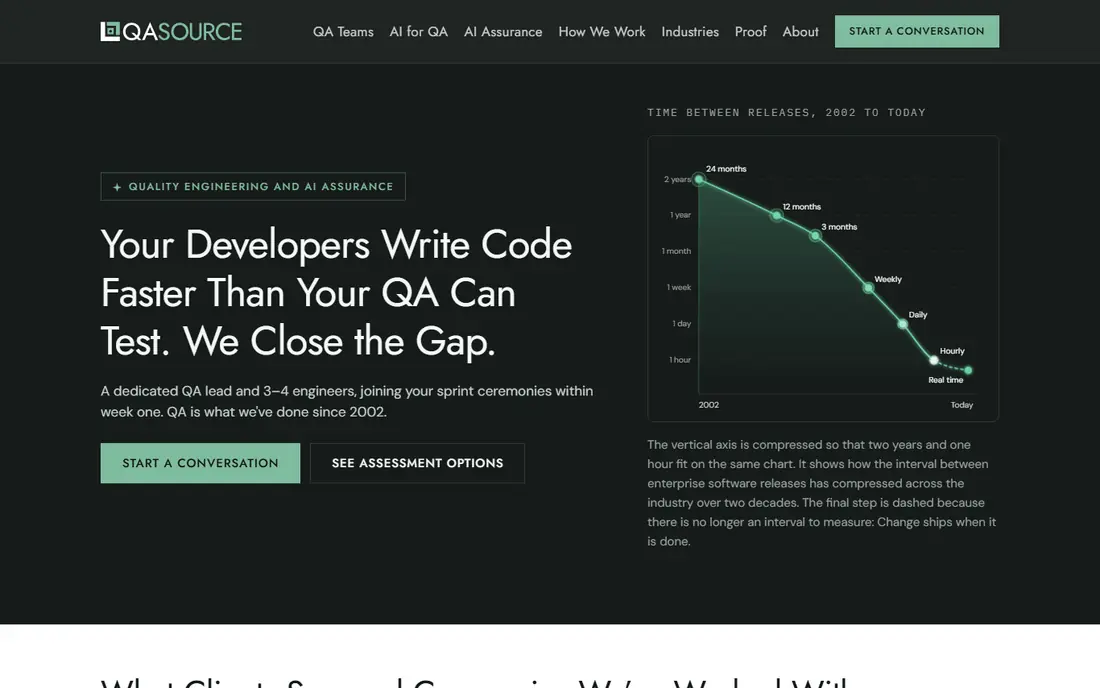
QASource was founded in 2002 and runs dedicated QA teams from the United States, Mexico and India, with healthcare listed among its core industries alongside financial services, manufacturing and higher education. Its service list covers manual testing, test automation, API testing, mobile app testing and load testing, plus newer AI assurance work such as human validation of AI agents. For a healthcare software team, the dedicated team model is the practical fit. You get named engineers who learn your product, your release cycle and your compliance constraints, rather than a rotating pool.
The onshore and offshore mix keeps rates lower than a purely domestic team, but it needs clear handoff routines and a shared definition of done. QASource does not publish team rates, so pricing comes from a scoping conversation about headcount, skill mix and duration. Before you sign, ask how test data is handled, whether the firm will sign a business associate agreement, and how it documents test evidence for HIPAA and FDA reviews. Those three answers tell you more than any rate card.
- Dedicated QA teams with healthcare clients
- Onshore and offshore delivery mix
- AI-assisted testing services
- Time zone spread across US, Mexico and India needs active coordination
- No public pricing for team rates
Testlio runs a network of vetted freelance testers on real devices and pairs them with managed testing services, which suits healthcare teams that need broad device coverage without hiring a full QA staff. A typical engagement covers functional testing, usability checks and regression runs across phones, tablets and browsers, with results delivered through a managed workflow rather than a raw bug dump. That model fits patient-facing apps, portals and telehealth products where the experience changes across devices and operating systems.
The limit to watch is domain depth. Crowd testers are strong on device and usability coverage but vary in healthcare knowledge, so regulated validation work still needs named specialists who understand HIPAA safeguards and clinical workflows. Use Testlio for breadth and release coverage, and keep validation and compliance evidence with a specialist firm or your own QA lead. Pricing is quote only, so define the device matrix and test scope first, then ask for a fixed price per release cycle.
- Large network of vetted testers on real devices
- Managed testing with fast ramp up
- Flexible engagement sizes
- Crowd testers vary in healthcare domain depth
- Quote-only pricing means rates depend on scope
Cigniti is a digital assurance and software testing firm that now sits inside Coforge, which gives it enterprise delivery capacity across functional testing, test automation, performance testing and security testing. Healthcare is one of its served industries, and its AI-led testing approach targets large programs where automation coverage and continuous testing matter more than one-off manual passes. For a hospital system or a large health IT vendor, that scale is useful. The firm can staff a multi-team program, run automation frameworks and report quality metrics across releases.
The trade-off is fit for smaller buyers. Enterprise vendors bring onboarding overhead, account management layers and minimum engagement sizes that suit large programs better than a single product team. Pricing is quote only and depends on scope, team size and duration. If your program is large and regulated, ask for healthcare references with named clients and validation deliverables. If your team is small, a smaller specialist firm will usually move faster and cost less.
- Large enterprise delivery capacity
- AI-led testing approach
- Healthcare among its served industries
- Enterprise focus brings onboarding overhead for small teams
- No public pricing for healthcare engagements
iBeta Quality Assurance is a US-based software testing firm with a long history in quality assurance, known for biometrics testing alongside functional, performance and security testing. Its healthcare work covers software validation, including the documentation and evidence that FDA-regulated programs need, and its biometrics strength suits patient identity, access control and authentication testing. For a healthcare team building login, identity proofing or device authentication, that combination is practical.
The firm is smaller than the global vendors in this list, which cuts both ways. You get closer access to senior testers and faster decisions, but a very large program may need more staff than iBeta can field alone. Pricing is quote only. Ask for a validation sample, a traceability matrix example and a clear statement of how test data is protected. Those documents show whether the firm treats healthcare validation as a core service or as a side practice.
- Long testing history with validation expertise
- Biometrics and identity testing strength
- US-based delivery
- Smaller headcount than the global firms, so very large programs may need extra staff
- No public pricing
TestingXperts is a specialist testing firm with a dedicated healthcare practice covering EHR validation, patient portals, telehealth apps and medical device software. Its services include functional testing, test automation, performance testing, security testing and HIPAA-focused compliance checks, delivered from the US, the UK and India. The automation-first approach suits teams that release often and want regression coverage that grows with each sprint, rather than manual passes that repeat the same checks.
The catch is maintenance. Automated suites need owners, updates and triage, so confirm who maintains the scripts when requirements change and how flaky tests are handled. TestingXperts does not publish rates, so pricing comes from a scoping call about team size, automation depth and release cadence. Ask for an EHR reference, a sample automation report and a written statement of how patient data is kept out of test environments. Those three items separate a healthcare specialist from a generalist.
- Dedicated healthcare testing practice
- EHR validation experience
- Test automation and performance testing
- Automation-first approach needs your team to maintain scripts over time
- No public pricing for team rates
QA Mentor is a QA outsourcing firm that supplies on-demand testers and dedicated QA teams, with healthcare QA among its service lines. The model suits small healthcare software teams that need testing help without hiring full-time staff. You can start with a small engagement, such as a release regression pass or a usability review, and grow into a dedicated team as releases get busier. The firm covers functional testing, mobile testing, API testing and test automation, and it works with HIPAA-aware test data practices.
The limit is breadth. A smaller firm may not cover every niche, such as specialized medical device testing or large-scale performance work, so confirm the exact scope before you sign. Pricing is quote only and scales with team size and duration. For a small team, the right questions are simple. Ask who your testers are, how they are vetted, what healthcare experience they hold, and how test evidence is documented. Clear answers on those four points matter more than a low hourly rate.
- On-demand QA staffing that scales up and down
- Healthcare QA among its services
- Lower minimum engagement than global firms
- Smaller firm, so niche device testing may need a partner
- No public pricing
How we chose
We compared vendor service pages, healthcare practice pages, compliance statements and public case studies for firms that list healthcare software testing as a service, checked on November 12, 2026. We kept only firms with a live healthcare practice and a real client record in the sector. We did not claim hands-on testing, and we did not invent prices. All eight firms price by engagement, so every starting price here is quote only, which is the honest figure for this market.
What to check before you buy
Match the engagement model to your team size before you ask for a quote. A project-based engagement suits a single release or a validation push, a dedicated team suits a product with regular releases, and a managed service suits a program that needs full QA ownership. Typical healthcare testing projects run 4 to 16 weeks and cost between 10,000 and 100,000 dollars or more, depending on system complexity, so a fixed-scope pilot with clear pass criteria protects both sides.
| Engagement model | Team size | Typical duration | Best for | | Project-based testing | 2 to 5 testers | 4 to 16 weeks | One release, one validation push, one audit | | Dedicated QA team | 3 to 10 testers | 6 to 12 months | Products with regular releases | | Managed testing service | 5 or more testers | 12 months or more | Full QA ownership across a program | | Crowd and device testing | Variable | Per release cycle | Device coverage for patient apps |
Use this compliance checklist in every vendor call. First, will the vendor sign a business associate agreement before any data is shared. Second, does the vendor use synthetic test data and keep real patient records out of test tools. Third, can the vendor produce a validation plan, a traceability matrix and a test summary report. Fourth, does the vendor test HL7 and FHIR interfaces, not just screens. Fifth, does the vendor document 21 CFR Part 11 controls such as audit trails and electronic signatures where FDA rules apply. A vendor that answers all five clearly is ready for healthcare work.
Frequently asked questions
What does healthcare QA outsourcing cost?
Most healthcare testing projects run 4 to 16 weeks and cost between 10,000 and 100,000 dollars or more, depending on system complexity, team size and validation depth. All eight firms in this list price by engagement, so the real figure comes from a scoping call. Ask for a fixed-scope pilot with clear pass criteria before you commit to a long program.
Do QA outsourcing firms sign a business associate agreement?
A serious healthcare QA vendor will sign a business associate agreement before any protected health information is shared. Ask for the agreement early, and confirm it covers subcontractors, test environments and data retention. If a vendor hesitates on a BAA, treat that as a reason to look elsewhere.
What is the difference between validation and verification for FDA software?
Verification checks that the software was built correctly against its requirements, while validation checks that it meets user needs and its intended use. FDA programs need both, with documented evidence. Ask your vendor for a validation plan, a traceability matrix and a summary report, and confirm who approves each document.
Can an outsourced team test with real patient data?
No, an outsourced team should not test with real patient data. Good vendors use synthetic patient records built to match your edge cases, and they de-identify any production-derived data under HIPAA before it enters a test tool. Ask how test data is created, where it lives and when it is deleted.
How do I check a vendor's healthcare experience?
Ask for three things. First, named healthcare references with the type of software tested. Second, sample validation documents such as a traceability matrix. Third, the names and backgrounds of the engineers who would work on your account. A firm with real healthcare depth will answer all three without delay.
Sources
See where you really rank - block by block
ProMapRanker scans Google Maps across a grid of your service area. Simple monthly plans from $19, white-label on every plan.
Start freeKeep reading
 best scheduling software for med spas
Best Scheduling Software for Med Spas in 2026
Compare the best scheduling software for med spas, with real prices and calendar features, so you can run staff schedules and waitlists without double bookings.
Read → best scheduling software for law firms
Best Scheduling Software for Law Firms
Compare the best scheduling software for law firms, with real 2026 prices, intake forms, and calendar sync, so clients can book easily without phone tag.
Read → best scheduling software for gyms
Best Scheduling Software for Gyms in 2026
Compare the best scheduling software for gyms, with real prices and timetable features, so you can run classes, coaches and waitlists without double bookings.
Read →