 ProMapRanker
Best Product Demo Software for SaaS Companies in 2026


All-round screenshot, video, and HTML demos · Pricing starts at: $40 per month
Key takeaways
- Storylane is the broadest self-serve pick, with screenshot, video, and HTML demos plus a free plan.
- Supademo and Guideflow suit smaller teams that want low entry prices and fast setup.
- Navattic and Walnut suit marketing and sales teams that need polished, personalized demos at scale.
- Demostack is for enterprise presales teams that need full product clones, not simple click-through tours.
Quick comparison
| Pick | Great for | Pricing starts at | Free tier | |
|---|---|---|---|---|
| Storylane | All-round screenshot, video, and HTML demos | $40 per month | Yes | Visit |
 Supademo | Budget-friendly tours and enablement | $38 per creator per month | Yes | Visit |
 Navattic | HTML demos for marketing and sales | $500 per month | Yes | Visit |
 Arcade | Polished, story-style demos | See website | Yes | Visit |
 Guideflow | Guided product tours on a budget | $35 per month | Yes | Visit |
 HowdyGo | Flat-rate HTML demos for growing teams | $159 per month | Yes | Visit |
 Walnut | Personalized sales demos and deal rooms | $575 per month | No | Visit |
 Demostack | Enterprise clones and sandbox demos | See website | No | Visit |
The best product demo software for SaaS companies
Interactive demo software lets prospects click through a guided version of your product without signing up, booking a call, or installing anything. The tools below differ in capture method, from screenshots to full HTML clones, and in price, from free plans to enterprise contracts.
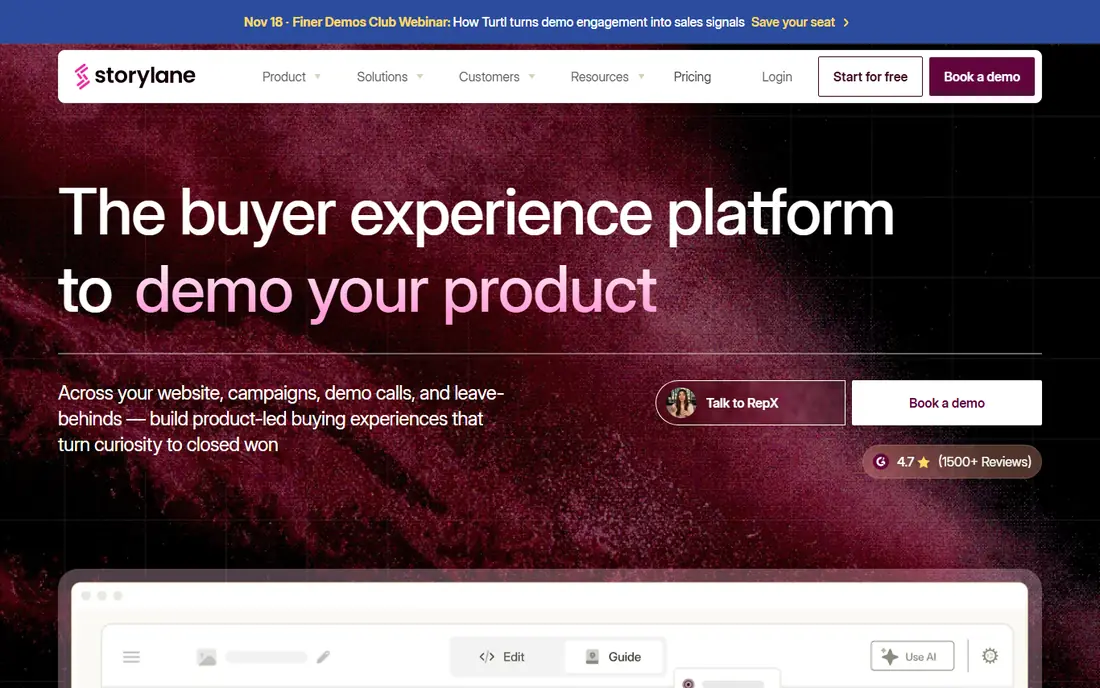
Storylane is the broadest self-serve choice for SaaS teams. You capture your product with a browser extension, build a guided tour, add voiceover or text steps, and embed the demo on a website or share it in sales outreach. The free plan includes one published demo with unlimited views, which is enough to test whether interactive demos help your signup or demo request rate.
Paid plans start at $40 per user per month billed annually for Starter, with Growth at $500 per month for five seats and Premium at $1,200 per month for ten seats. The full HTML editor starts on Growth, so screenshot-only teams can start cheap, while teams that need realistic HTML interaction should price Growth from the start. For most SaaS companies, Storylane covers marketing, sales, and onboarding demos in one tool.
- Screenshot, video, and HTML formats in one platform
- Free plan with one published demo
- Hubs and lead capture
- Full HTML editor sits on Growth
- Sandbox demos are an add-on
- Higher tiers rise fast for larger teams
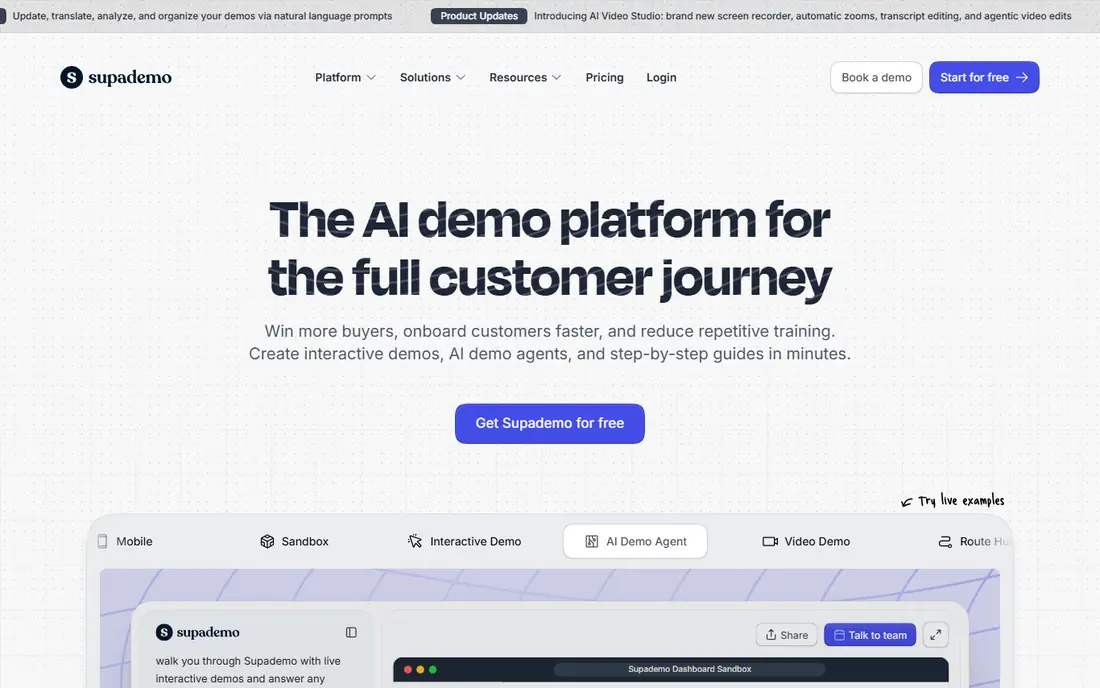
Supademo suits small teams that want a low-cost, multi-format demo tool. The free plan includes one creator and five demos, and the paid Scale plan starts at $38 per creator per month billed annually. You can build screenshot tours, HTML demos, mobile demos, and in-app overlays, then share them through showcases and demo hubs with routing by persona or behavior.
The tier gates matter. HTML demos, unlimited sandbox demos, and the full AI workspace sit on Growth and higher plans, so the entry price does not buy every format. For a startup that mainly needs website tours and sales leave-behinds, Supademo is good value. Larger teams should compare total creator cost with Storylane Growth and Guideflow Growth before committing.
- Screenshot, video, HTML, and mobile demos
- Free plan with five demos
- AI voiceover and translation on paid plans
- HTML and sandbox features sit on higher tiers
- Per-creator pricing adds up for large teams
- Advanced analytics need higher plans
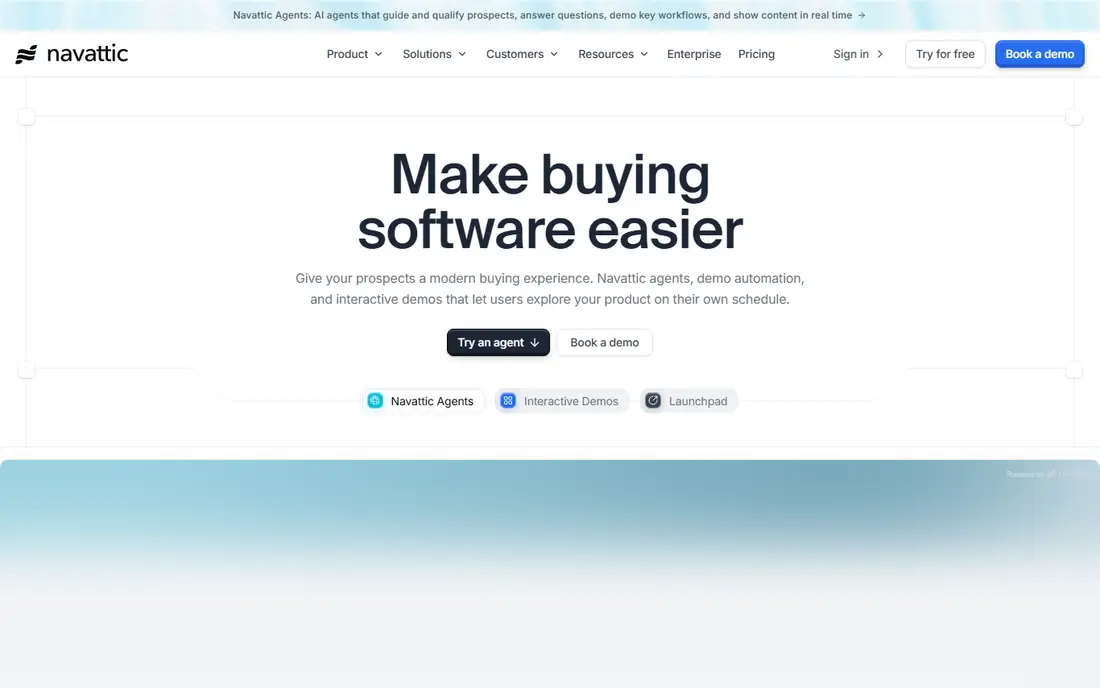
Navattic is built around HTML demos, which replicate your product interface with hover states and dynamic elements rather than static screenshots. That realism helps marketing pages and sales outreach, where a prospect should feel they are using the product, not reading a slideshow. Launchpads let you group demos by persona, use case, or campaign, and analytics show where prospects drop off.
The free plan includes one HTML demo with unlimited views, which is a fair test. Paid plans start at $500 per month billed annually for Base, with Growth at $1,000 per month on the same basis. Small teams may find that steep for a first demo tool, but marketing-led SaaS companies that embed demos on high-traffic pages often justify it with lead quality. Check sandbox and SSO availability on your tier before buying.
- HTML capture feels close to the real product
- Launchpads for sharing demo collections
- Analytics and CRM integrations
- Paid plans start high for small teams
- Sandbox demos sit on higher tiers
- Pricing details for some features are not public
Arcade appeals to design-led marketing teams that want demos to look as polished as their website. Demos present as a guided story with clear steps, and the free plan lets a team test the format before paying. HTML capture is available on Growth and above, which brings Arcade closer to HTML-first rivals than it was in earlier years.
Pricing changed in 2026, with Growth moving to a flat monthly rate that includes five seats, so small teams should check the current page rather than relying on older per-user figures. SSO and custom domains sit on enterprise tiers. If visual polish and story flow matter most, Arcade is a strong pick; if enterprise controls matter most, compare Walnut and Demostack first.
- Clean, design-led demo presentation
- Free plan for experimentation
- HTML capture on Growth and above
- Growth pricing changed in 2026 to a flat monthly rate
- SSO and custom domain sit on enterprise
- Fewer enterprise controls than rivals
Guideflow is the budget pick for product and onboarding teams that mainly need guided tours. The free plan includes one seat, and Solo costs $35 per month with unlimited demos, GIF and video export, and advanced analytics. That price makes it easy for a small SaaS team to publish tours for signup, onboarding, and support without a large contract.
The limits are format and scale. Screenshot capture is the core of the lower plans, while HTML capture and live sandbox demos sit on Growth at $499 per month. Pro at $149 per month adds multi-flow demos, lead capture, and custom branding. If your demos are mainly guided tours rather than full product clones, Guideflow gives the best entry value here.
- Lowest paid entry price on this list
- Unlimited demos on Solo
- Lead capture and analytics
- Free plan covers screenshot capture only
- HTML capture sits on Growth
- Advanced integrations need higher tiers
HowdyGo suits teams that dislike per-seat pricing. Paid tiers are flat monthly rates with unlimited users and unlimited HTML demos, so adding teammates does not raise the bill. Starter costs $159 per month, with annual billing lowering the effective rate, and Pro costs $399 per month with unlimited collections, CRM integrations, offline demos, and password protection.
The trade-off is tier scope. Starter covers one collection and core sharing, while Pro adds analytics, custom domains, and sandbox add-ons. Enterprise adds SSO, role-based access, and custom components by quote. For a growing SaaS team that wants HTML demos for everyone without counting seats, HowdyGo is a clear and predictable option.
- Unlimited users and unlimited HTML demos on paid tiers
- Flat monthly pricing, not per seat
- AI editing and demo analytics on Pro
- Starter limits collections and integrations
- Sandboxes are an add-on on Pro
- Enterprise controls need a custom plan
Walnut is built for sales teams that personalize demos for each prospect rather than sending one generic tour. Capture the product once, then use AI tools to draft tailored versions, adjust text and charts, and track how buyers engage inside deal rooms. Integrations with Salesforce and Slack help sales operations follow up on drop-off points and stakeholder activity.
Pricing is annual and published: Ignite at $575 per month and Accelerate at $1,550 per month, both billed annually, with Scale by quote. There is no free plan, so the entry cost is real. Demo upkeep also takes work, since product changes mean refreshing affected flows. For mid-market and larger SaaS sales teams, Walnut is a strong personalization pick; for small teams, a self-serve tool costs far less.
- AI-assisted personalization for each prospect
- Deal rooms and engagement analytics
- Sandbox demos on higher tiers
- No free plan
- Annual plans only on published tiers
- Upkeep of demo flows takes ongoing effort
Demostack is the enterprise end of this list. It clones your web application into a live sandbox, simulates backend responses, and lets presales teams build tailored proof-of-concept environments with realistic data and governance controls. That fidelity matters for complex products where a screenshot tour cannot show real workflows, integrations, or data handling.
The cost and setup reflect that power. Pricing is quote-based, with annual contracts reported in the tens of thousands of dollars, and setup typically takes weeks rather than hours. Demostack itself notes that it costs more than many other demo solutions. Choose it only when presales needs clones and sandboxes; for website tours and sales leave-behinds, Storylane, Supademo, or Guideflow will do the job faster and cheaper.
- Full product clones with realistic data
- Sandbox environments for proof-of-concept work
- Governance and analytics for presales
- Quote-only pricing with a high entry cost
- Setup takes longer than self-serve tools
- Overkill for simple website tours
How we picked these
We compared official pricing pages, vendor comparisons checked in October 2026, and product documentation, and we favored tools that SaaS teams actually use for website demos, sales demos, and onboarding tours. We included a range of prices, from free plans to enterprise clones, and we noted where HTML capture, sandbox demos, and SSO sit on higher tiers. Where pricing had changed during 2026, we used the latest published figure or marked it as See website.
How to choose a demo tool for your stage
Match the tool to the demo job, not to the longest feature list. Early-stage teams need a free or low-cost tour on the website. Growth-stage teams need HTML demos, analytics, and CRM routing. Enterprise presales teams need clones, sandboxes, and governance. Buying the enterprise tool too early wastes money and slows setup.
Test with one real demo
Build one demo for your most common use case, embed it on a real page or send it to real prospects, and watch completion and drop-off points for two weeks. That test shows whether prospects finish the tour, where they stop, and whether demo viewers convert better than other visitors. Price the plan that covers that demo, not the plan that covers every possible format.
Frequently asked questions
What is product demo software?
It creates clickable, guided versions of your product that prospects can explore without signing up or booking a call. Screenshot tours show captured screens in sequence, HTML demos replicate the live interface, and sandbox demos let prospects use a cloned product with sample data. Most SaaS teams start with screenshot or HTML tours.
What is the best software for product demos for a small SaaS company?
Storylane, Supademo, and Guideflow are the best starting points, since all offer free plans and paid plans from $35 to $40 per month. Storylane is the broadest, Supademo is strong on multi-format tours, and Guideflow has the lowest paid entry price. Test one demo on each free plan before paying.
How much does interactive demo software cost?
Free plans exist from Storylane, Navattic, Guideflow, Arcade, Supademo, and HowdyGo. Paid self-serve plans start around $35 to $40 per month, mid-market plans run roughly $500 to $1,550 per month, and enterprise platforms such as Demostack are quote-based. Price the tier that includes the capture format and features you actually need.
Are interactive demos better than video demos?
They serve different jobs. Interactive demos let prospects click through the product at their own pace, which suits evaluation and onboarding. Video demos suit storytelling and social sharing, where a presenter guides the viewer. Many teams use both: video for awareness, interactive demos for evaluation and sales follow-up.
Do demo tools integrate with a CRM?
Most mid-market and enterprise tools do. Storylane, Navattic, Supademo, Guideflow on higher tiers, Walnut, and Demostack all offer CRM or analytics integrations, with exact coverage varying by plan. Check that lead capture, demo engagement, and account data flow into your CRM before committing to a higher tier.
Sources
- https://www.storylane.io
- https://supademo.com
- https://www.navattic.com
- https://www.arcade.software
- https://www.guideflow.com
- https://www.howdygo.com
- https://www.walnut.io
- https://www.demostack.com
- https://www.storylane.io/blog/interactive-demo-software
- https://supademo.com/blog/navattic-vs-storylane-vs-supademo
See where you really rank - block by block
ProMapRanker scans Google Maps across a grid of your service area. Simple monthly plans from $19, white-label on every plan.
Start freeKeep reading
 twitch alternatives
Twitch Alternatives in 2026
Explore the best Twitch alternatives in 2026 for live streaming, with free platforms, monetisation options, audiences, chat tools, and tips for new streamers.
Read → firebase alternatives
Best Firebase Alternatives in 2026
Looking for Firebase alternatives? We compare 9 backend platforms for auth, databases, realtime, storage, functions, self-hosting, and pricing for your app.
Read → companies with best work life balance
Companies With Best Work Life Balance in 2026
See companies with best work life balance in 2026, ranked by employee ratings, with flexible work options, benefits, and what to check before applying.
Read →