 ProMapRanker
Best Predictive Analytics Software in 2026


Business teams without data scientists · Pricing starts at: See website
Key takeaways
- Predictive analytics turns past data into forecasts for churn, demand, lead scores, and risk, but the value depends on data quality and a clear business question.
- Teams without data scientists should start with AutoML tools such as DataRobot and H2O.ai, while analysts should start with Alteryx or KNIME for data prep plus modeling.
- Dataiku suits organizations where analysts, data scientists, and business users work on the same platform with shared governance.
- Most enterprise tools are quote-based, so budget for usage, deployment, and support, not only a headline seat price.
- A governed, explainable model matters in regulated work, which is where SAS Viya and IBM SPSS Statistics earn their place despite higher cost and complexity.
Quick comparison
| Pick | Great for | Pricing starts at | Free tier | |
|---|---|---|---|---|
| DataRobot | Business teams without data scientists | See website | No | Visit |
 H2O.ai | Technical teams wanting AutoML depth | See website | No | Visit |
 Dataiku | Collaborative data science teams | See website | Free trial | Visit |
 Alteryx | Analysts needing prep plus predictive work | $250 per user per month | Free trial | Visit |
 KNIME | Free visual analytics and modeling | Free | Yes | Visit |
 SAS Viya | Regulated and governed modeling | See website | No | Visit |
 IBM SPSS Statistics | Traditional statistical modeling | See website | Free trial | Visit |
 SAP Analytics Cloud | Predictive planning inside SAP | See website | Free trial | Visit |
The best predictive analytics software
The tools below fall into three groups: AutoML platforms, visual workbenches, and governed enterprise platforms. Pick by team skill, data location, and how much explanation and audit control your forecasts need.
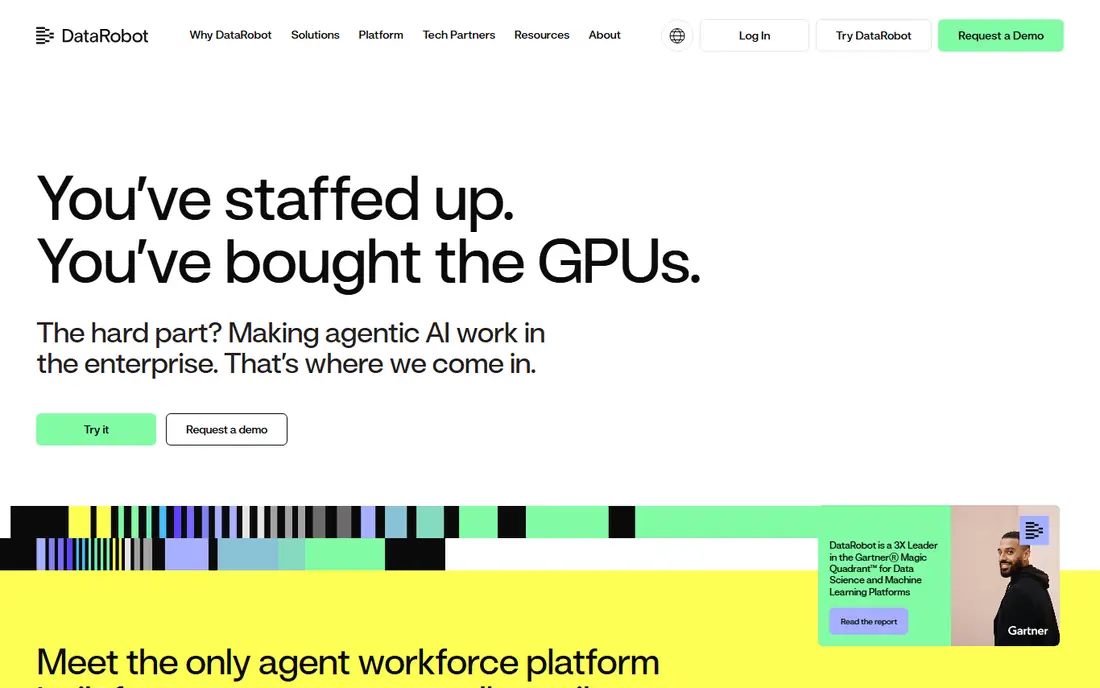
DataRobot is built for a business team that wants a forecast without hiring a data science team first. You upload data, define the target, and the platform builds, compares, and deploys models automatically, with monitoring for drift and retraining once models are live. That MLOps layer covers the production step many teams forget: a model that is not monitored will decay as customer behavior changes.
Pricing is quote-based and scales with usage, which means the bill grows with successful deployment, and there is no free tier. For a company that needs predictions in production, such as churn scores or lead scores, DataRobot is a strong enterprise AutoML choice. For a small team with one model and a tight budget, a free workbench may be a better first step.
- Automated model building and deployment
- Strong monitoring
- Business-friendly interface
- Quote-only pricing
- Costs scale with usage
- No free tier
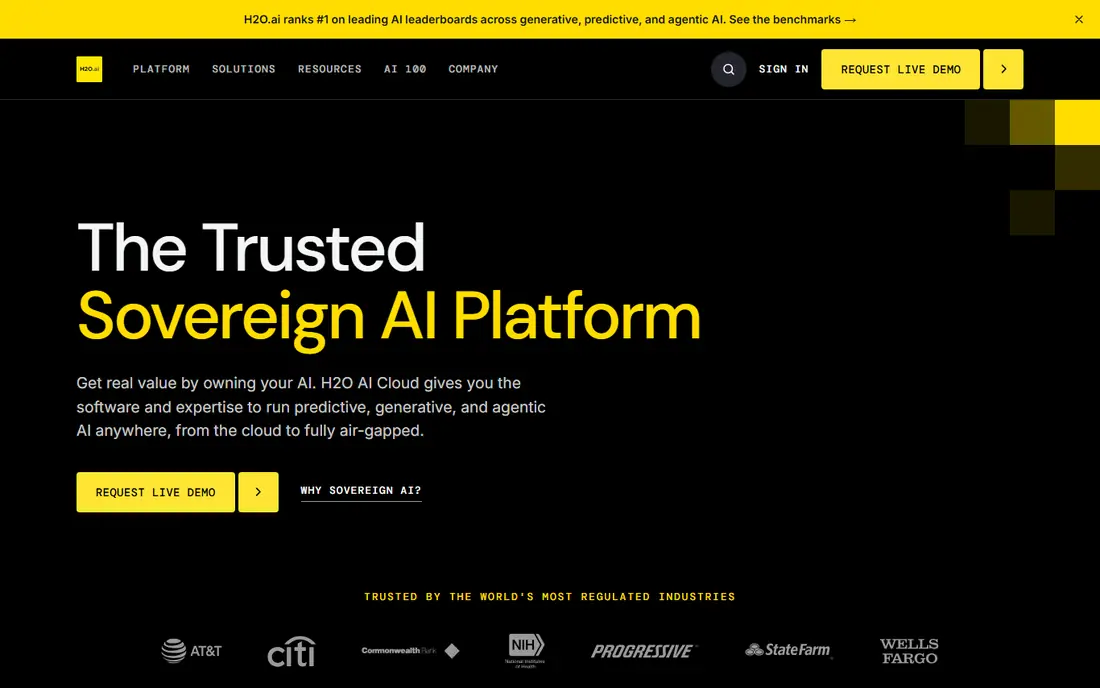
H2O.ai grew from open-source machine learning, and its platform offers AutoML, model training, and deployment for technical teams that want power without building every model by hand. It suits data scientists and engineers who understand model types, feature engineering, and validation, and who want to run many models fast. The open-source roots also help teams that want to test ideas before buying an enterprise plan.
The trade-off is skill and pricing. H2O.ai is less business-friendly than DataRobot out of the box, and enterprise pricing is quote-based, so small teams should test the open-source tools first and get a written quote for production use. Choose H2O.ai when your team is technical, your data is large, and AutoML speed matters more than a simple business interface.
- Strong AutoML roots
- Open-source components
- Scalable model training
- Quote-based enterprise pricing
- Needs technical skill for best results
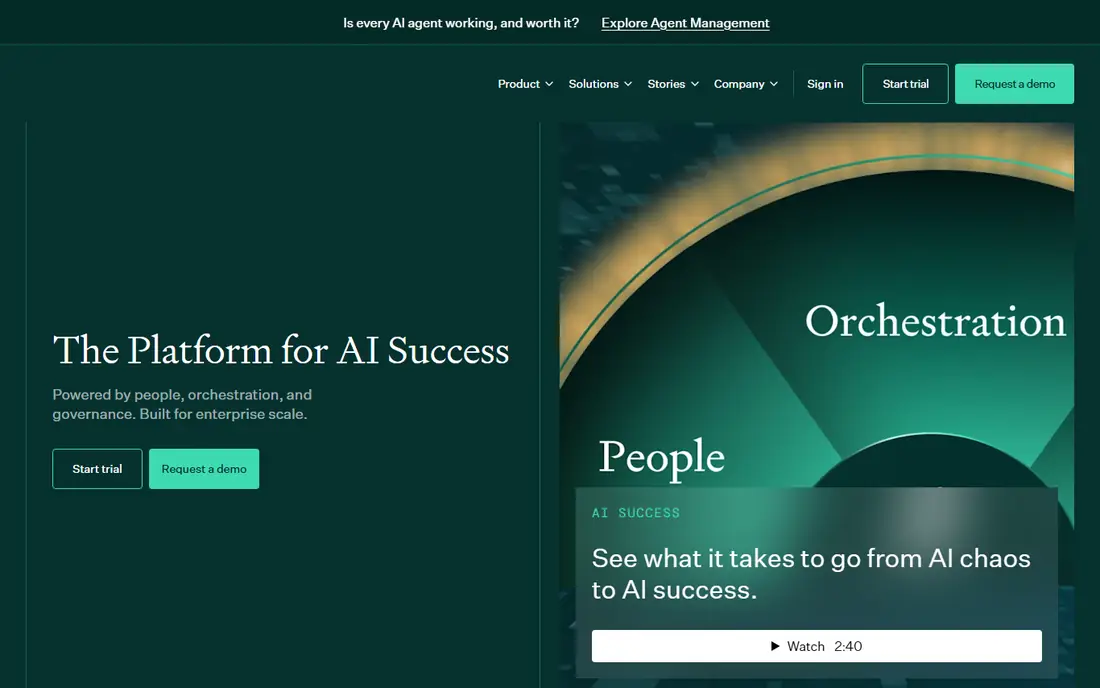
Dataiku brings data prep, visual machine learning, AutoML, and governance into one system where analysts, data scientists, and business users can work on the same flow. Analysts can use visual recipes, data scientists can write Python, R, or SQL, and managers can review models and approvals in one place. That shared workspace helps organizations where a model must pass review before it reaches production.
Pricing is quote-based, with a fourteen-day free trial that includes most features except Govern and advanced LLM controls in published summaries, plus a self-hosted Free Edition for testing. The platform is large, so a team that only needs prep and one forecast may find it heavy. Choose Dataiku when collaboration and governance are central, not when you need a single quick model.
- Visual recipes plus code
- Shared governance
- AutoML in one platform
- Quote-only pricing
- Large platform for a single-model need
Alteryx One bundles data prep, blending, spatial analysis, predictive tools, and reporting on a visual canvas that analysts can use without writing code for many tasks. The Starter edition is $250 per user per month billed annually, cloud-only, with flat-file sources and no automation runs in published October 2026 summaries. Professional and Enterprise add desktop Designer, more sources, scheduling, and AI tools, with a thirty-day trial available.
The limits matter for budgeting. AI assistance and Agent Studio start at Professional, so the published Starter price does not include the AI features that draw many buyers. Desktop Designer also needs Windows, with Mac users needing a virtual machine. Choose Alteryx when your team thinks in workflows, needs heavy prep before modeling, and can justify the edition step for scheduling and AI.
- Visual drag-and-drop workflows
- Strong data prep
- Predictive tools on one canvas
- Entry price is high
- Desktop needs Windows
- AI tools sit on higher tiers
KNIME Analytics Platform is a free, open-source-rooted visual tool where you build data flows by connecting nodes for blending, statistics, and machine learning. It covers the full cycle from data access to model training and scoring, without requiring code for many tasks. For a student, a small team, or a company testing predictive work, the free desktop version is a strong place to start.
The free version is local-only, with no scheduling, data apps, or private sharing, so teams that need collaboration and automation must move to KNIME Hub, with Pro listed at $19 per month and Team at $99 per month in recent guides. Setup can also feel dense at first, since the node library is large. For serious analytics at zero software cost, KNIME is the best entry point in this list.
- Free desktop platform
- Visual nodes for prep and modeling
- Large community
- No scheduling or sharing on free desktop
- Paid Hub needed for team features
SAS Viya is an enterprise analytics platform for organizations that need governed, explainable, and auditable models, such as banks, insurers, and health care teams. It offers data prep, modeling, deployment, and monitoring with controls for model risk, lineage, and approval, which matter when a forecast affects credit, pricing, or clinical decisions. SAS also has a long history in regulated analytics, which helps with audit and compliance reviews.
The trade-offs are cost and complexity. Pricing is quote-based, implementation needs skilled staff, and smaller teams may find the platform heavy for a single forecast. SAS Viya is not a quick AutoML trial tool, but a platform for organizations where a wrong or unexplained model carries real legal or financial risk. Choose it when governance matters as much as accuracy.
- Explainable and auditable models
- Strong governance
- Trusted in regulated industries
- Quote-only pricing
- Steep learning curve
- Enterprise implementation effort
IBM SPSS Statistics is a long-standing statistical tool for researchers, analysts, and students who need regression, forecasting, and survey analysis with a point-and-click interface. It suits academic work, market research, and business analysis where traditional statistical methods, clear tables, and charts matter more than deep learning pipelines. Many analysts already know its menus, which cuts training time.
The limit is modern machine learning workflow. SPSS Statistics is less built for AutoML, large-scale deployment, and cloud pipelines than DataRobot, H2O.ai, or Dataiku, and pricing varies by edition, license type, and term, so check the current IBM page. Choose SPSS Statistics when your work is statistical research and forecasting, not when you need production ML at scale.
- Familiar point-and-click statistics
- Strong for research and surveys
- Clear output
- Less suited to modern ML pipelines
- Pricing varies by edition and license
SAP Analytics Cloud combines business intelligence, planning, and predictive features, which suits SAP customers who want forecasts inside the system that already holds their finance, sales, and operations data. Predictive planning can use past actuals to forecast demand, revenue, or costs, with scenarios and what-if analysis for managers. That SAP link avoids moving data to a separate tool for many planning tasks.
The catch is ecosystem fit. Outside SAP, the value drops, and a standalone predictive tool may be simpler and cheaper. Pricing is quote-based, with a trial available in published summaries, and the tool needs SAP data knowledge to set up well. Choose SAP Analytics Cloud when your company already runs SAP and wants predictive planning close to its core data.
- Predictive planning tied to SAP data
- BI plus forecasting in one tool
- Enterprise controls
- Best only inside SAP
- Quote-based pricing
- Needs SAP data knowledge
How we picked these
We compared official pricing pages, product pages, and recent predictive analytics guides, and we kept only tools that are live in October 2026 and can build, validate, and deploy a forecast, not only chart past data. We favored a mix of AutoML, visual workbenches, and governed enterprise platforms, and we marked quote-based pricing as such. We also checked free and trial options, since a team should test a model on its own data before buying an enterprise platform.
How to test a predictive tool before you buy
Start with one business question, such as which customers will churn in the next ninety days, and one clean dataset with a clear target and date field. Split the data by time, not at random, since a random split can leak future information into training and flatter results. Compare at least two tools on the same split, and check not only accuracy, but also how well the model explains its top drivers.
Next, test deployment. Score new data, monitor for drift, and confirm who can approve a model change and how a bad model is rolled back. Finally, price the full path: data prep, training, deployment, monitoring, and support, at your expected data volume. A tool that wins on a demo dataset but fails on deployment, governance, or cost will not survive in production.
Frequently asked questions
What is the best predictive analytics software?
For business teams without data scientists, DataRobot is a strong AutoML pick. For technical teams, H2O.ai offers deep AutoML power. For analysts, KNIME is the best free start and Alteryx is the best paid workbench. For governed enterprise work, SAS Viya leads, while Dataiku leads for collaborative teams. Match team skill and governance needs first.
What are the best predictive analytics tools for small businesses?
KNIME is the best free tool for a small business, since the desktop platform covers prep and modeling at no software cost. Alteryx Starter at $250 per user per month suits analysts who need a visual workbench and can justify the price. For a business team with no data scientists, a trial of DataRobot or Dataiku can show whether AutoML fits before a quote.
What are the best tools for predictive analytics in Excel or BI?
BI tools with forecasting, such as Power BI, Tableau, and SAP Analytics Cloud, can handle trend and demand forecasts inside dashboards. For a true predictive model with churn or risk scoring, a dedicated tool such as DataRobot, H2O.ai, KNIME, or Alteryx will give better validation and deployment. Use BI forecasting for trends, and a predictive platform for scored predictions.
What is the best predictive analytics platform for regulated industries?
SAS Viya is a strong pick for regulated work, with explainable models, governance, and audit controls. IBM SPSS Statistics also suits research and regulated analysis where traditional statistics and clear output matter. In both cases, document data sources, model drivers, and approval steps, since regulators and auditors will ask for that record.
Is predictive analytics software worth the cost?
It can be, when a forecast changes a costly decision, such as which customers to retain, how much stock to hold, or which leads to prioritize. Start with a free tool such as KNIME to prove value on one question, then compare the lift against the platform cost. If the model does not change a decision, a simpler BI forecast may be enough.
How do I choose between AutoML and a visual workbench?
Choose AutoML when you need a model fast and lack data science staff, since DataRobot and H2O.ai handle model selection and deployment. Choose a visual workbench such as Alteryx or KNIME when data prep is the main work, or when analysts need to see and control each step. Many teams use both: a workbench for prep, and AutoML for model building.
Sources
- https://www.datarobot.com
- https://h2o.ai
- https://www.dataiku.com
- https://www.alteryx.com
- https://www.knime.com
- https://www.sas.com/en_us/software/viya.html
- https://www.ibm.com/products/spss-statistics
- https://www.sap.com/products/technology-platform/cloud-analytics.html
- https://rankite.com/blog/best-predictive-analytics-tools
See where you really rank - block by block
ProMapRanker scans Google Maps across a grid of your service area. Simple monthly plans from $19, white-label on every plan.
Start freeKeep reading
 best subscription manager app
Best Subscription Manager App in 2026
Find the best subscription manager app for your budget with our 2026 comparison of 8 apps, covering automatic detection, renewal alerts and free plans.
Read → best stock picking service
Best Stock Picking Service in 2026
Compare the best stock picking service options for 2026, with 8 stock recommendation services for long-term, dividend, quant, growth and income investors.
Read → best software wallet
Best Software Wallet in 2026
Compare the best software wallet options for 2026, with 8 crypto wallets for desktop and mobile, covering self-custody, supported chains, fees and security.
Read →