 ProMapRanker
Best Platforms to Sell Digital Products in 2026

Key takeaways
- Fee structure matters more than the headline monthly price, because a percentage on every sale can beat a subscription at low volume and lose at high volume.
- Merchant-of-record platforms such as Gumroad and Lemon Squeezy remove much of the global tax work for solo sellers.
- Course sellers should compare student tools, not just fees, while download sellers should compare checkout simplicity and delivery.
- Marketplaces bring traffic but take a larger cut and give you less control over branding and customer data.
Quick comparison
| Pick | Great for | Pricing starts at | Free tier | |
|---|---|---|---|---|
 Gumroad | First product launch with no upfront cost | Free | Yes | Visit |
 Payhip | Budget sellers who want VAT help | Free | Yes | Visit |
 Sellfy | Storefront with no per-sale platform fee | $29 per month | Free trial | Visit |
 Podia | Courses, downloads, and community in one place | See website | Free trial | Visit |
 Teachable | Structured online courses | $39 per month | Free trial | Visit |
 Shopify | Full store for digital and physical products | $39 per month | Free trial | Visit |
 Lemon Squeezy | Software and global sales with tax handled | Free | Yes | Visit |
 Etsy | Templates and printables with built-in search traffic | Free | Yes | Visit |
 Ko-fi | Small creators starting with tips and a shop | Free | Yes | Visit |
The best platforms to sell digital products
Selling a download, a template, or a course is not the same job as running a full retail store. Some platforms give you a checkout link in minutes, some give you a storefront with discovery built in, and some give you a complete course school. Fees matter here more than features alone, because a high percentage on every sale can quietly eat a small product business.
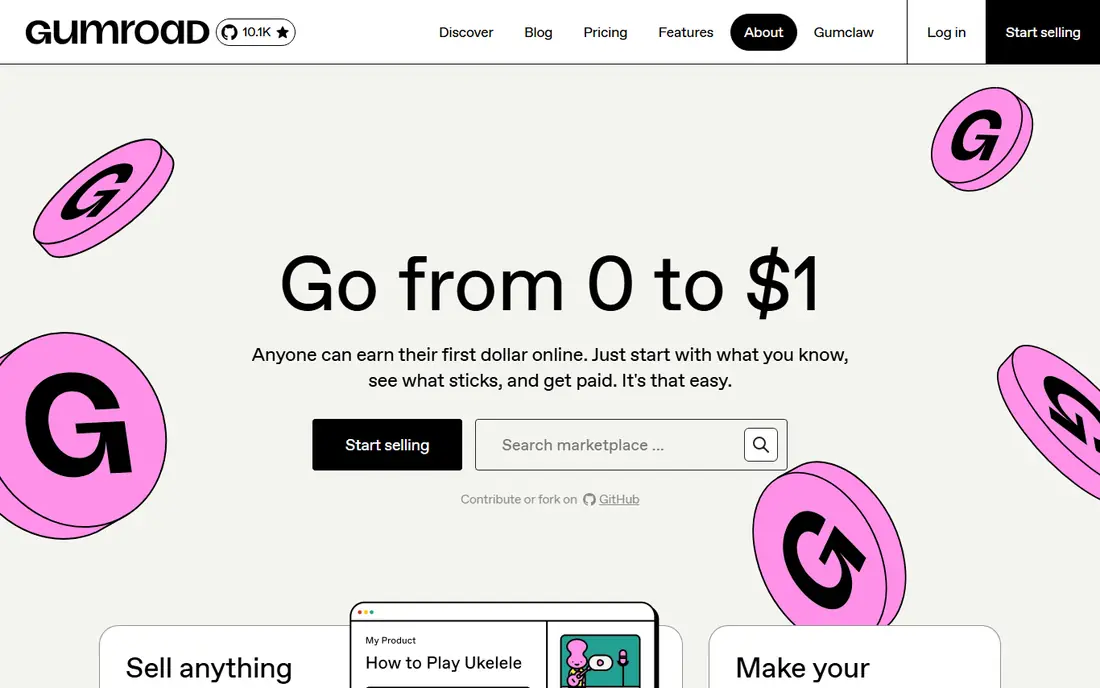
Gumroad is the fastest way to test a digital product. You upload a file, set a price, and share a link, with no monthly fee and no store to build first. It also acts as merchant of record, which means it handles sales tax and related tax work that many solo sellers would rather avoid.
The price of that simplicity is the per-sale fee: 10 percent plus 50 cents on direct sales, plus card processing, and 30 percent on sales through its Discover marketplace. For a first launch or a low-priced product, that is a fair trade. As volume grows, a flat monthly platform usually works out cheaper.
- No monthly fee
- Acts as merchant of record for tax handling
- Simple checkout links and memberships
- 10 percent plus 50 cents per direct sale, plus processing
- 30 percent via Discover
- Costs rise fast at scale
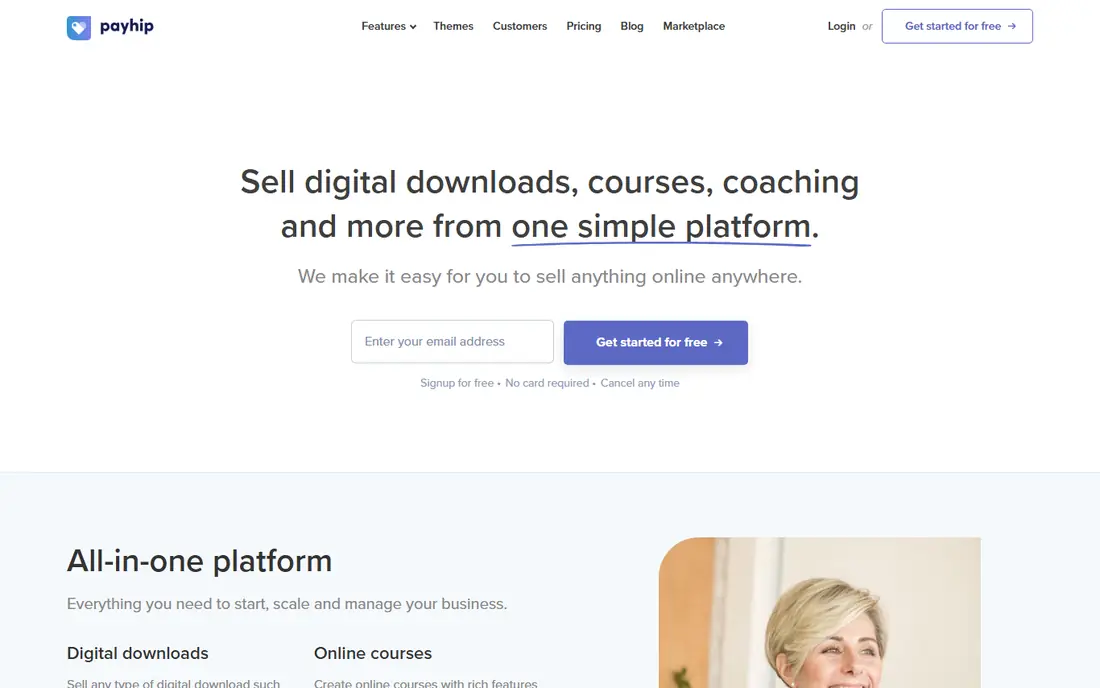
Payhip gives small sellers a lot for no monthly fee. The free plan includes the same features as paid plans, and it handles digital VAT and sales tax in many regions, which removes a common headache for sellers outside their home country.
The catch is the 5 percent platform fee on the free plan, on top of payment processing. Paid plans cut that fee to 2 percent or zero, so the maths changes as sales grow. Discovery is also weaker than a marketplace, so you still need your own audience or traffic source.
- Free plan includes full features
- Handles EU and UK VAT and US sales tax on the free plan
- Supports courses and memberships
- 5 percent fee on the free plan, plus processing
- Marketplace discovery is limited compared with Etsy
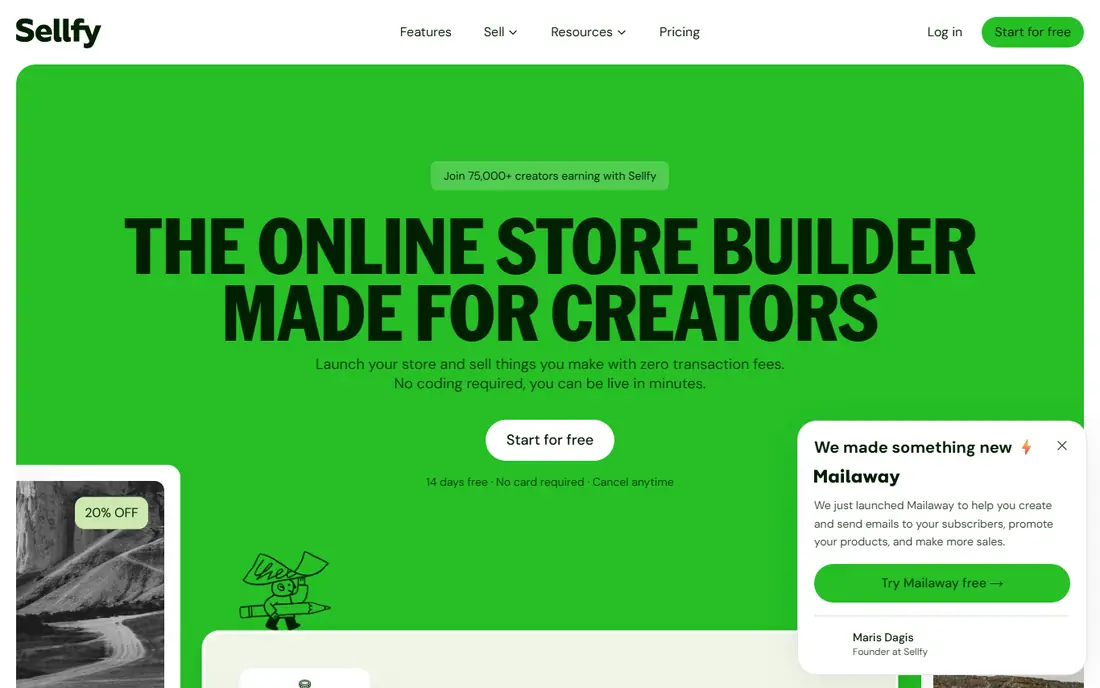
Sellfy suits sellers who want a predictable monthly bill instead of a percentage on every sale. It charges no platform transaction fee, so a higher-priced product keeps more of its price, and it also handles print-on-demand if you want physical items beside downloads.
The trade-off is that you pay from day one, and lower plans carry annual sales caps, so check those caps against your expected revenue. It is a storefront first, not a full course school, so course creators who need quizzes, drip content, and certificates may prefer Podia or Teachable.
- 0 percent platform transaction fee
- Print-on-demand alongside digital products
- Built-in marketing tools
- Monthly fee from the start
- Annual sales caps on lower plans
- Limited course depth compared with course platforms
Podia is built for creators who sell a mix of downloads, courses, and memberships and do not want to stitch several tools together. You get a website, a store, course hosting, and a community space in one place, which keeps support and billing in a single account.
That breadth comes with a monthly cost, and the free option is limited, so it suits sellers who already have an audience or a product ready to sell. If you only sell one small download, a fee-based platform will cost less at first. If you sell courses and memberships together, Podia saves time and tool sprawl.
- Website, store, courses, and community under one login
- No separate course plugin needed
- Email marketing included
- Paid plans only for full selling
- Course tools are simpler than specialist course platforms in some areas
Teachable is the pick when the product is a structured course rather than a single file. Its builder handles lessons, quizzes, certificates, and student progress in a way that a simple checkout link cannot, and it supports bundles and coaching products beside courses.
The entry paid plan starts at 39 dollars per month in recent listings, and the lowest tier carries a transaction fee, so read the current pricing page before you choose. Downloads-only sellers will find it heavier than they need. Course sellers who care about student experience will find the structure worth it.
- Strong course builder with quizzes and certificates
- Student progress tracking
- Coaching and bundle options
- Starter plan takes a transaction fee
- Less suited to downloads-only selling
- Monthly cost adds up for small catalogues
Shopify is the right choice when digital products are part of a larger store. You get full theme control, a large app store, discount and bundle tools, and a checkout that customers already trust. It also handles physical products beside downloads, which few creator platforms do as well.
The Basic plan is 39 dollars per month billed monthly in recent listings, with lower pricing on annual billing, plus payment processing. For a single five-dollar download, that fixed cost is hard to justify. For a growing catalogue with bundles, upsells, and repeat buyers, the control and scale repay the fee.
- Full theme and app ecosystem
- Strong checkout and discount tools
- Scales from one product to a large catalogue
- Monthly fee plus processing
- Digital delivery needs its free app or a paid app
- Overkill for a single download
Lemon Squeezy is built for software and digital sellers who sell worldwide and do not want to register for tax in many countries. As merchant of record, it handles sales tax and VAT, and it supports licence keys, subscriptions, and checkout flows that software sellers need.
The fee is 5 percent plus 50 cents per sale, which is cheaper than Gumroad at volume but still a percentage on every order. It is not a course school, so creators who need a full student experience should look elsewhere. For a plugin, template pack, or app sold across borders, it is a clean fit.
- Merchant of record handling global tax
- Licence keys for software
- Checkout and subscription support
- 5 percent plus 50 cents per sale
- Less of a course platform than Podia or Teachable
- Checkout customisation is limited
Etsy is the only option here where buyers are already searching for digital planners, templates, and printables. That discovery can bring first sales without an existing audience, and instant downloads make fulfilment simple once a shop is set up.
The fees add up on low-priced items: a 20-cent listing fee, a 6.5 percent transaction fee, and payment processing. Competition is heavy in popular niches, and branding control is limited compared with your own store. If your product fits what Etsy shoppers already search for, the traffic is worth it. If it does not, a checkout platform will serve you better.
- Huge built-in search traffic for planners and templates
- Simple instant downloads
- Low barrier to open a shop
- Listing fee plus 6.5 percent transaction fee plus processing
- Heavy competition
- Limited branding and store control
Ko-fi starts as a tip page and grows into a small shop. Fans can support you with a donation at no platform fee, and you can also sell downloads and memberships from the same page, which keeps everything in one place for a small audience.
Shop sales on the free plan carry a 5 percent fee, and the Gold plan at 12 dollars per month in recent listings removes that fee. It is not a replacement for a full course platform or a large store, but for a creator with a modest following who wants a simple first shop, it is one of the lowest-pressure ways to start.
- No platform fee on donations
- Shop and memberships in one page
- Gold plan removes the shop fee
- 5 percent fee on shop sales on the free plan
- Less powerful as a full course or large store platform
How we picked these
We compared official feature pages, pricing pages, and app store listings, and we checked public reviews for recurring complaints. We kept only tools that are available in October 2026 and that fit the topic directly, and we left out tools that only partly match the job. Where a price could not be confirmed on the vendor site during our checks, we wrote See website rather than guessing a figure.
Our pick for most people is the option that covers the common case well without forcing a paid plan for basic use. That does not mean it suits every group, budget, or workflow, so use the comparison table to match the best fit to your own needs before you sign up.
How to pick by product type and sales volume
First, name your product type. A single PDF or template needs a checkout link and secure delivery, nothing more. A course needs lessons, progress tracking, and student support. A software product needs licence keys and subscription billing. Choosing by product type narrows the list faster than comparing feature tables.
Second, run the fee maths on your real price and volume. Take your average sale price, multiply the platform percentage, add any flat fee and processing, and compare that total with a monthly subscription over three months. Many sellers find that a free, fee-based plan wins below a few hundred dollars a month, while a subscription wins once sales are steady.
Third, check tax and delivery before launch. Confirm who handles VAT and sales tax, how buyers receive files, whether licence keys or download limits apply, and what happens on refunds. Those answers affect your workload every week, not just on launch day.
Frequently asked questions
What is the best platform to sell digital products for beginners?
Gumroad and Payhip are the easiest starting points, because both let you list a product with no monthly fee. Gumroad is simpler for a first launch, while Payhip gives stronger tax handling for sellers in Europe and the UK. Ko-fi is another low-pressure start if you already have a small following.
What is the best platform for digital products like courses?
Podia and Teachable lead for courses, because they include course hosting, student tools, and community features in one account. Teachable suits structured courses with quizzes and certificates, while Podia suits creators who also sell downloads and memberships. Compare their current plans, since both change pricing and transaction fees over time.
What is the best platform to sell digital downloads with no monthly fee?
Gumroad, Payhip, Lemon Squeezy, and Ko-fi all let you start with no monthly fee, taking a percentage instead. Lemon Squeezy suits software and global sales, Payhip suits EU and UK tax handling, and Gumroad suits a fast first launch. Check the per-sale fee at your price point, since a flat fee hurts low-priced products most.
Should I sell on Etsy or on my own platform?
Etsy suits planners, templates, and printables that shoppers already search for, because it brings traffic you do not have to build. Your own platform suits products that need branding, bundles, or customer data you control. Many sellers start on Etsy for discovery and later add their own store for repeat buyers.
How do I sell digital products online without handling global tax myself?
Use a merchant-of-record platform such as Gumroad or Lemon Squeezy, which handles sales tax and VAT for you. Payhip also handles EU and UK VAT and US sales tax in many cases. On other platforms, you remain responsible for tax, so check the vendor tax page and get local advice if you sell across borders.
Sources
See where you really rank - block by block
ProMapRanker scans Google Maps across a grid of your service area. Simple monthly plans from $19, white-label on every plan.
Start freeKeep reading
 top custom software development company
Top Custom Software Development Company in 2026
Looking for a top custom software development company? We compare 9 firms for web, mobile, and enterprise software, covering strengths and fit for 2026.
Read → tableau alternatives
Tableau Alternatives in 2026
Compare the best Tableau alternatives for 2026, from Power BI to Metabase, with prices, hosting options, and picks for small teams and enterprises today.
Read → microsoft teams alternatives
Best Microsoft Teams Alternatives in 2026
Looking for microsoft teams alternatives? We compare 9 chat and video tools for 2026, covering free plans, pricing, meetings, and integrations for teams.
Read →