 ProMapRanker
Best Platforms to Build Trading App in 2026

Key takeaways
- Alpaca is the cleanest starting point for a first trading app, with a free paper-trading sandbox and commission-free US stock and ETF trading for eligible retail accounts.
- Interactive Brokers suits apps that need global markets, futures, forex, and bonds, while Tradier suits options-heavy apps with simple monthly plans.
- Polygon.io and Finnhub cover market data, which is a separate cost from execution, and both offer free tiers for getting started.
- Trading carries risk, and this guide is not financial advice: test every strategy in paper trading first, and confirm fees, data terms, and regulations before launch.
- The cheapest API is not always the cheapest app, since data subscriptions, regulatory fees, and engineering time often cost more than commissions.
Quick comparison
| Pick | Great for | Pricing starts at | Free tier | |
|---|---|---|---|---|
 Alpaca | First trading app with paper trading | Free | Yes | Visit |
 Interactive Brokers | Global multi-asset apps | See website | No | Visit |
 Tradier | Options-focused apps | $0 per month | Yes | Visit |
 DriveWealth | Embedded investing apps | See website | No | Visit |
 Charles Schwab API | US brokerage apps | See website | No | Visit |
 tastytrade | Options trading apps | See website | No | Visit |
 TradeStation | Active trader apps | See website | Free trial | Visit |
 Polygon.io | Market data for trading apps | Free | Yes | Visit |
 Finnhub | Market data and fundamentals | Free | Yes | Visit |
The best platforms to build trading app
Building a trading app means joining two pieces: execution through a broker, and data through a market-data provider. Some platforms below cover both, while others cover one side well. This guide is not financial advice, and trading carries risk, including the risk of losing money. Test in paper trading, and get compliance advice before offering trading to real users.
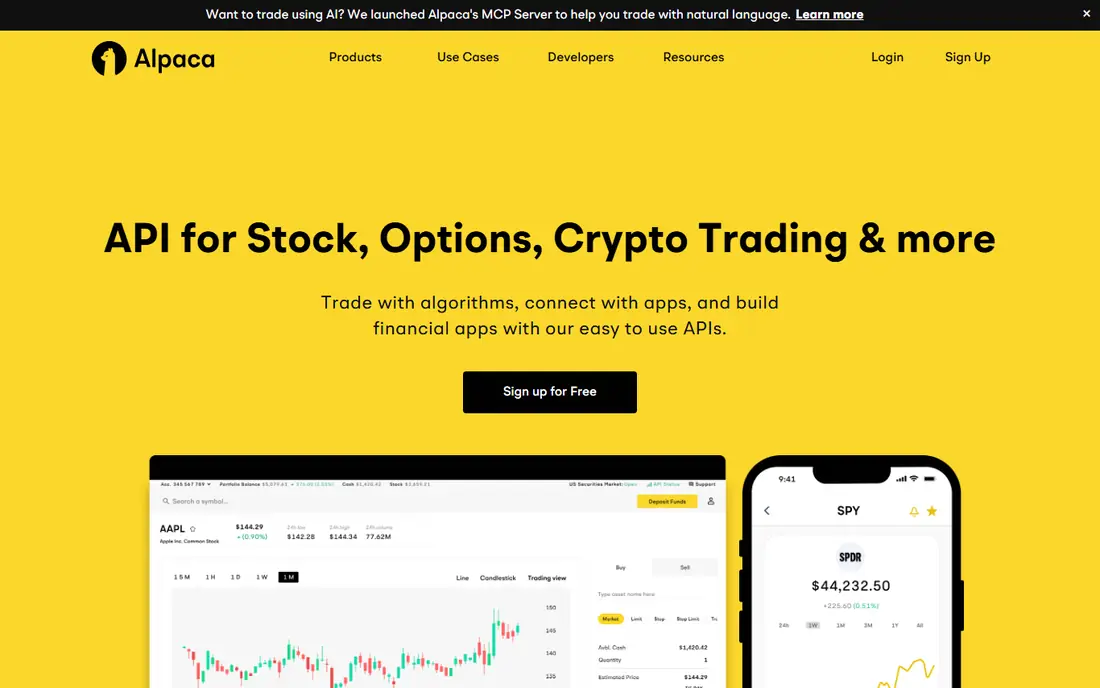
Alpaca is our pick for most developers building a first trading app, because it was built API-first. There is no desktop platform to install, just REST endpoints and WebSocket streams for orders, positions, and market data, plus SDKs in Python, JavaScript, Go, and C#. Paper trading mirrors the production API, so moving from test to live is mostly a change of keys.
The limits are coverage and data cost. Alpaca focuses on US stocks, ETFs, options, and crypto, rather than global futures or forex, and full exchange data requires the $99 per month Algo Trader Plus plan, while the free plan carries IEX quotes and an indicative options feed. For a US equities app, that trade is usually worth it.
- API-first design with REST and WebSocket
- Free paper trading
- Commission-free US stocks, ETFs, and options for eligible retail accounts
- US-focused asset coverage
- Full SIP and OPRA market data costs $99 per month on Algo Trader Plus
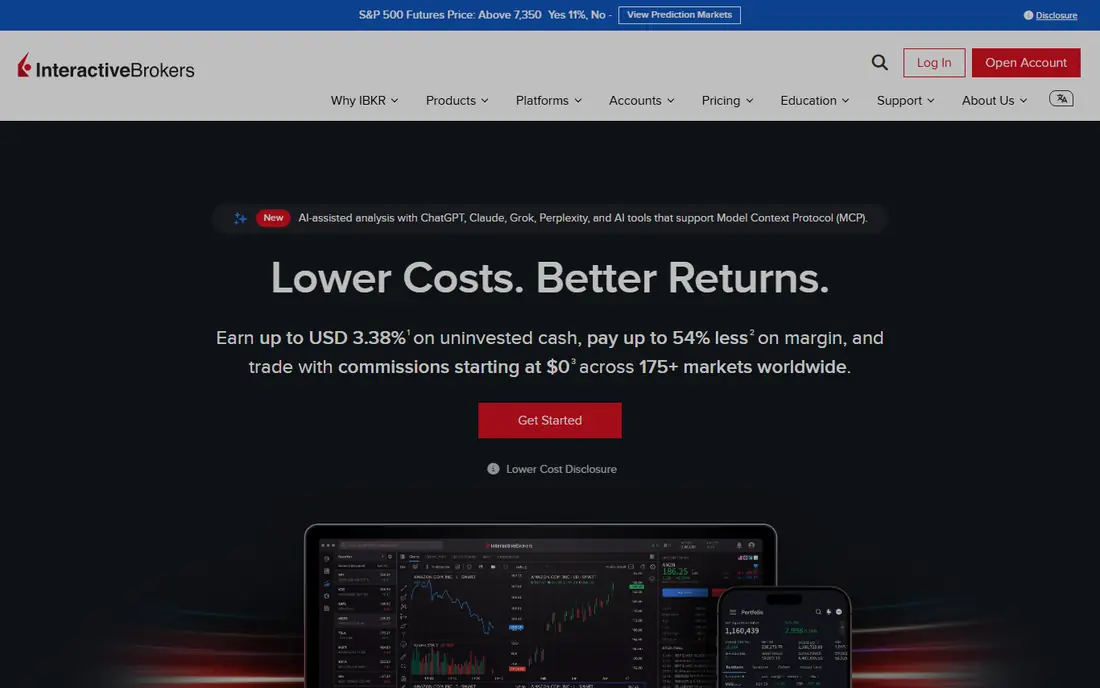
Interactive Brokers, often called IBKR, is the choice when a trading app needs more than US stocks. Its APIs cover stocks, options, futures, currencies, bonds, and funds across many countries, and it offers the TWS API, Client Portal Web API, IBKR Web API, and FIX for institutional clients. That breadth suits professional and quantitative apps that consolidate many asset classes in one broker.
The cost is complexity. The API takes longer to learn, market data is sold by exchange subscription, and live account setup needs more steps than a simple API-first broker. For a global, multi-asset app, IBKR's coverage justifies that effort. For a simple US stock app, it may be more than you need.
- Stocks, options, futures, forex, bonds, and funds across many markets
- Several API options including TWS API and Web API
- Strong for professional apps
- Steeper learning curve
- Market data sold by subscription per exchange
- Account setup is more involved
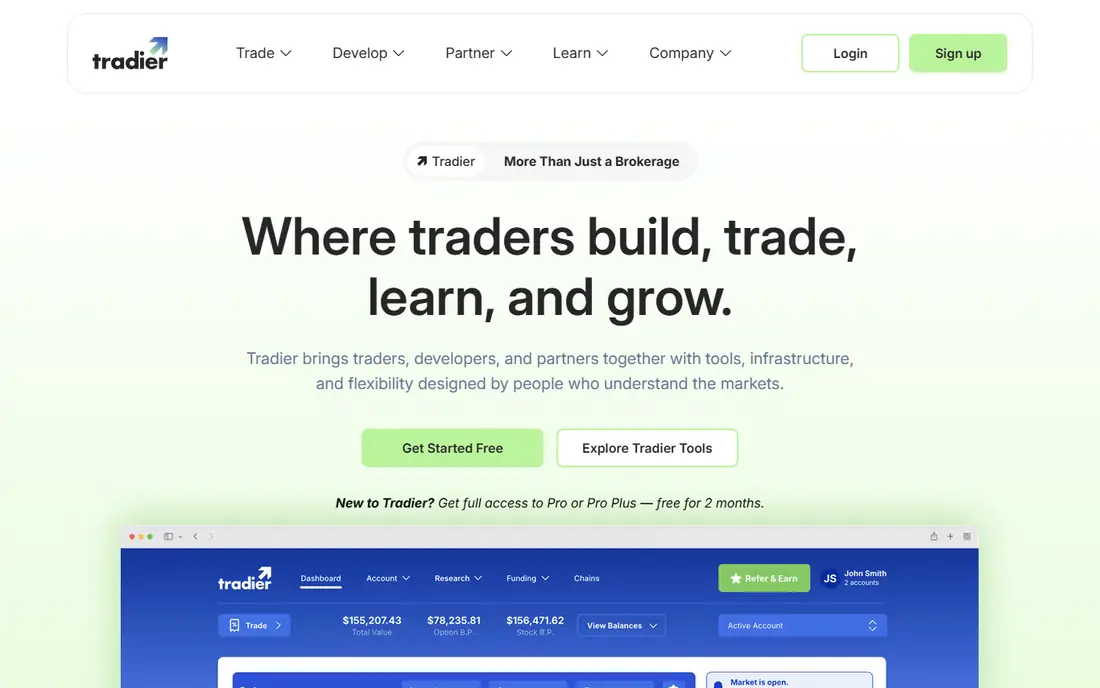
Tradier is a strong pick for options-heavy trading apps, because its API access is included on every plan and its pricing is simple to model. Lite costs $0 per month with $0.35 per stock trade and per option contract, Pro costs $10 per month with $0 stock trades and $0 equity and ETF options, and Pro Plus costs $35 per month with lower index option costs. A sandbox environment lets you test before going live.
Tradier's focus is US equities and options, so apps that need global futures or forex will need another broker. Its token model is also simpler than some rivals, since per-account tokens do not expire in the same way. For an options app with predictable monthly costs, Tradier is easy to recommend.
- API access on every plan
- Sandbox environment for testing
- Simple Lite, Pro, and Pro Plus pricing
- US equities and options focus
- Futures coverage is narrower than IBKR
DriveWealth powers investing features inside other companies' apps, rather than serving solo developers directly. Its platform supports fractional shares and partner integrations, which suits fintech apps that want to add investing without building a brokerage from scratch. If your product is an app with investing as one feature, DriveWealth is designed for that job.
The trade-off is access. Onboarding is partner-led and quoted, so an individual developer cannot simply sign up and start paper trading in an afternoon. For a funded fintech team building an embedded investing product, that partner model is normal. For a personal trading bot, Alpaca or Tradier will be faster.
- Built for embedding investing inside other apps
- Fractional shares support
- Partner-focused APIs
- Partner and sales-led onboarding
- Not aimed at solo developers building a personal bot
The Charles Schwab API lets developers build apps on top of Schwab brokerage accounts, with support for US stocks, ETFs, and options, including index options. For users who already hold Schwab accounts, that familiarity can help trust, and the brokerage's range of account types suits longer-term investing apps as well as trading apps.
Two limits matter for developers. Schwab offers no sandbox, so testing must use real orders with care, and refresh tokens expire every seven days, which means an automated app must re-authorise weekly. If your users are already Schwab customers and you can handle that maintenance, it is a credible platform. If you need a sandbox, look elsewhere first.
- Established US brokerage with broad account types
- Supports stocks, ETFs, and options including index options
- Well-known brand for users
- No sandbox, so testing uses real orders
- Refresh tokens expire every seven days, adding maintenance
tastytrade is an options-focused brokerage whose API suits apps built around options strategies. Its pricing is simple to explain: $1 per contract to open, nothing to close, capped at $10 per leg, which helps apps that trade many contracts. Refresh tokens do not expire, which reduces the login maintenance that Schwab developers face.
API access is not automatic: developers must apply, complete certification steps, and receive approval before production use. That gate keeps quality high but slows a first prototype. For an options app where per-contract costs and stable login matter, tastytrade deserves a place on the shortlist.
- Options-focused brokerage with API access
- $1 per contract to open, $0 to close, capped at $10 per leg
- Refresh tokens do not expire
- API access needs approval and certification steps
- Narrower asset range than IBKR
TradeStation offers a trading API alongside a long history in active trading tools, charting, and strategy analysis. Its SIM environment lets developers test against simulated trading, and standard pricing offers $0 for stocks and ETFs, with tiered per-contract commissions for options. That combination suits apps aimed at active traders who value analysis tools.
TradeStation is less suited to a simple, casual investing app, since its platform and pricing assume an active-trading audience. Options costs also need modelling, since they are tiered rather than flat. For an active-trader app with strategy testing, it is a solid platform.
- Trading API with SIM environment for testing
- $0 stocks and ETFs under standard pricing
- Strong charting and analysis heritage
- Tiered per-contract options commissions
- Platform is geared toward active traders rather than casual investors
Polygon.io is a market-data provider, not a broker, so it does not execute trades. It supplies real-time and historical data for stocks, options, forex, and crypto through REST and WebSocket APIs, which makes it a common data layer for trading apps built on Alpaca, Tradier, or another broker. A free tier lets developers prototype, with paid plans for full real-time coverage.
Pairing Polygon.io with a broker means two vendors and two bills, but it also means you can choose the best data and the best execution separately. If your app needs fast, reliable market data and you already have a broker, Polygon.io is one of the first data providers to test.
- Real-time and historical stock, options, forex, and crypto data
- WebSocket streams
- Free tier for getting started
- Data only, no execution
- Full real-time data needs a paid plan
Finnhub is another data provider for trading apps, with a strength in fundamentals, news, earnings, and company data alongside price data. That mix suits apps that show research, news, and financials next to a chart, not just a price feed. Its free tier supports development and small projects, with paid plans for higher limits and real-time depth.
As with Polygon.io, Finnhub does not execute trades, so it must pair with a broker. Real-time coverage also varies by plan, so check the exchanges and data types your app needs before committing. For a research-led trading app, Finnhub's fundamentals and news coverage is a useful complement to a price feed.
- Stock, forex, and crypto data plus fundamentals, news, and earnings
- Free tier for development
- Simple REST and WebSocket APIs
- Data only, no execution
- Real-time data depth varies by plan and exchange
How we picked these
We compared official developer pages, pricing pages, and documentation for broker APIs and market-data providers that support building trading apps, and we kept only platforms that exist and work today. We weighed API design, paper trading or sandbox availability, asset coverage, data quality, pricing transparency, and SDK support. We did not claim hands-on testing we did not do, and this comparison reflects published features and pricing. Remember, this is not financial advice, and trading carries risk.
What to build first, and what to check before launch
Start with paper trading, even if your strategy looks simple. Build order placement, position tracking, error handling, and a kill switch before you touch real money, and test edge cases such as partial fills, rejected orders, and market halts. A paper account that mirrors production, like Alpaca's, makes that testing far safer.
Before launch, confirm the full cost stack: commissions, exchange and regulatory fees, market-data subscriptions, and any partner fees. Check data redistribution terms if you show data to end users, since that is often a separate licence from personal use. Finally, get compliance advice on licensing, disclosures, and user protections in every country you serve, since trading apps face rules that a normal consumer app does not.
For a first prototype
Alpaca or Tradier will get you trading in a sandbox fastest, with Polygon.io or Finnhub for data if you need more than the broker's free feed.
For a professional or global app
Interactive Brokers covers the widest asset range, with TradeStation as an active-trader alternative and DriveWealth for embedded investing inside a larger product.
For an options-focused app
Tradier and tastytrade offer the clearest options pricing and testing paths, with Schwab as an option if your users already hold Schwab accounts.
Frequently asked questions
What is the best platform to build a trading app?
Alpaca is the best starting point for most developers, thanks to its API-first design and free paper trading. Interactive Brokers is better for global, multi-asset apps, and Tradier is better for options-heavy apps with simple monthly pricing.
Do I need a broker API and a market-data API?
Often, yes, since many brokers offer basic data while dedicated providers offer deeper real-time data, fundamentals, and news. You can start with a broker's data feed, then add Polygon.io or Finnhub when your app needs faster or richer data.
Can I test a trading app without real money?
Yes, if you choose a platform with paper trading or a sandbox, such as Alpaca, Tradier, or TradeStation's SIM environment. Schwab has no sandbox, so testing there needs extra care with real orders.
Is building a trading app the same as giving financial advice?
No, and the distinction matters. Building execution software is different from recommending trades, and offering trading to the public brings licensing, disclosure, and compliance duties. Get legal and compliance advice before launch, and include clear risk disclosures in the app.
How much does it cost to build a trading app?
Execution itself can start free on some platforms, but data subscriptions, compliance, design, and engineering time usually cost far more than commissions. Budget for a data plan such as Alpaca's $99 per month Algo Trader Plus if you need full exchange data, plus ongoing maintenance.
Which platform is best for options trading apps?
Tradier and tastytrade are the strongest options-focused picks here, with simple per-contract or monthly pricing and testing environments. Schwab also supports index options through its API, but its weekly token expiry and lack of a sandbox add maintenance.
Sources
See where you really rank - block by block
ProMapRanker scans Google Maps across a grid of your service area. Simple monthly plans from $19, white-label on every plan.
Start freeKeep reading
 top custom software development company
Top Custom Software Development Company in 2026
Looking for a top custom software development company? We compare 9 firms for web, mobile, and enterprise software, covering strengths and fit for 2026.
Read → tableau alternatives
Tableau Alternatives in 2026
Compare the best Tableau alternatives for 2026, from Power BI to Metabase, with prices, hosting options, and picks for small teams and enterprises today.
Read → microsoft teams alternatives
Best Microsoft Teams Alternatives in 2026
Looking for microsoft teams alternatives? We compare 9 chat and video tools for 2026, covering free plans, pricing, meetings, and integrations for teams.
Read →