 ProMapRanker
Best Platforms for Testing Large Language Models in 2026

Teams aligned with the Anthropic ecosystem · Pricing starts at: See website
Direct answer
For teams aligned with the Anthropic ecosystem, Humanloop is where this list starts. Listed starting prices: Braintrust from $249 a month, LangSmith from $39 per seat a month and Galileo from $6 per month, per CPU core, billed yearly. Look at Braintrust for catching regressions before release, and at LangSmith for tracing and debugging agents in production. The full list of 5 tools follows, with prices and free plan facts.
This ProMapRanker guide covers 5 platforms for testing large language models. Each profile lists a starting price, free plan details, strengths and drawbacks, so you can drop poor fits quickly.
Key takeaways
- Humanloop sits first on this list: teams aligned with the Anthropic ecosystem.
- Braintrust, LangSmith, Galileo, PromptLayer: these are the 4 tools out of 5 that offer a free plan.
- PromptLayer suits prompt versioning with evals and logs.
- The cheapest monthly starting price in the list is $6 per month, per CPU core, billed annually, offered by Galileo.
- A fair warning about Braintrust: less emphasis on prompt versioning as a standalone feature.
Quick comparison
| Pick | Great for | Pricing starts at | Free tier | |
|---|---|---|---|---|
| Humanloop | Teams aligned with the Anthropic ecosystem | See website | Free trial | Visit |
 Braintrust | Catching regressions before release | $249 a month | Yes | Visit |
 LangSmith | Tracing and debugging agents in production | $39 per seat a month | Yes | Visit |
 Galileo | Observability and guardrails with Splunk | $6 per month, per CPU core, billed yearly | Yes | Visit |
 PromptLayer | Prompt versioning with evals and logs | $49 a month | Yes | Visit |
Our 5 platforms for testing large language models
Humanloop serves teams aligned with the Anthropic ecosystem. That makes it most relevant to teams already working closely with Anthropic models or looking for evaluation practices aligned with that ecosystem.
Honest limits: Product direction is tied to the Anthropic acquisition.
On top of that, since the company is joining Anthropic, buyers should confirm the current product status and long-term roadmap straight with the vendor before committing. Pricing for Humanloop is not stated here, so ask the vendor for current figures. Free options: Free trial.
- Positioned around safe AI adoption
- Handy for teams standardizing workflows
- Roadmap certainty may concern some buyers
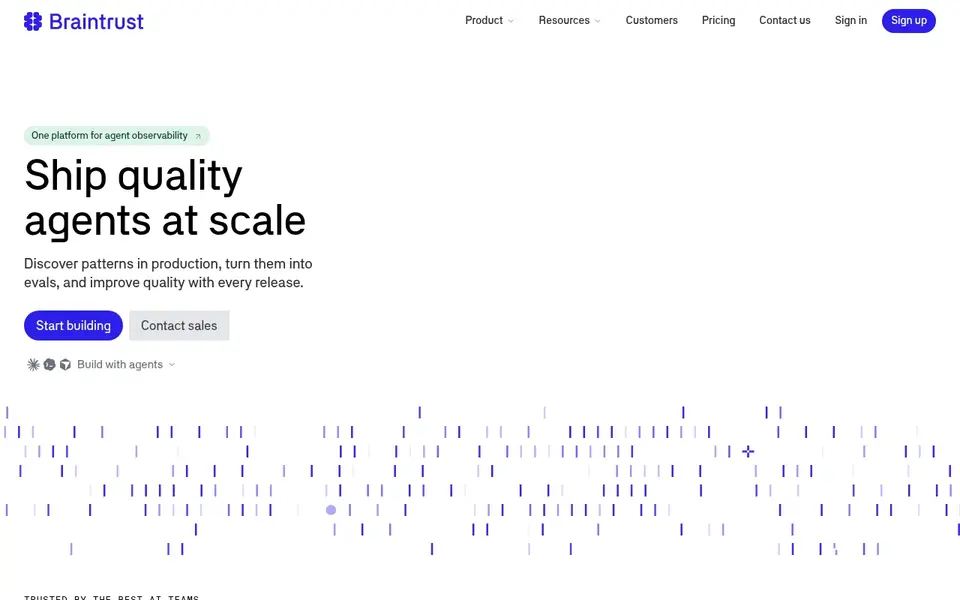
Braintrust targets catching regressions before release. It merges tracing production traffic, running evaluations and catching regressions before they reach users. Its focus is observability and evaluation instead of serving as a general prompt library.
So teams wanting prompt management as the centerpiece may look elsewhere. Beyond that, pick Braintrust when regression prevention across releases is the central goal. Organizations with an established tracing stack should check for overlap. Starting cost for Braintrust: $249 per month. Braintrust has a free plan.
Reasons to shortlist it: Evals built into the workflow. Limits to weigh: Less emphasis on prompt versioning as a standalone feature.
- Tracing of production traffic
- Regression catching before users are affected
- May overlap with existing observability stacks
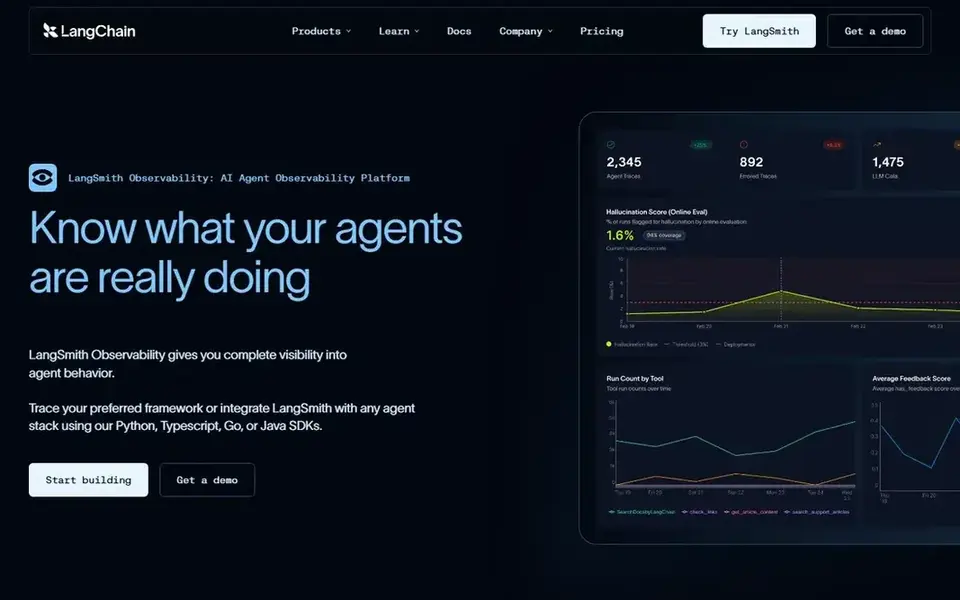
LangSmith is designed for tracing and debugging agents in production. LangSmith is described as a complete AI agent and LLM observability system built around tracing and live monitoring. Groups committed to open source infrastructure frequently prefer a self-managed option.
On top of that, teams use it to debug agents, locate failures rapidly and watch cost and latency as applications run. Consider LangSmith when production visibility and quick failure diagnosis are the priority. Entry price for LangSmith: $39 per seat per month. LangSmith has a free plan.
Where it is weaker: Less suited to teams wanting a completely open source stack.
- Tracks cost and latency
- Tracing and live monitoring in one system
- Concentrated on the LangChain ecosystem
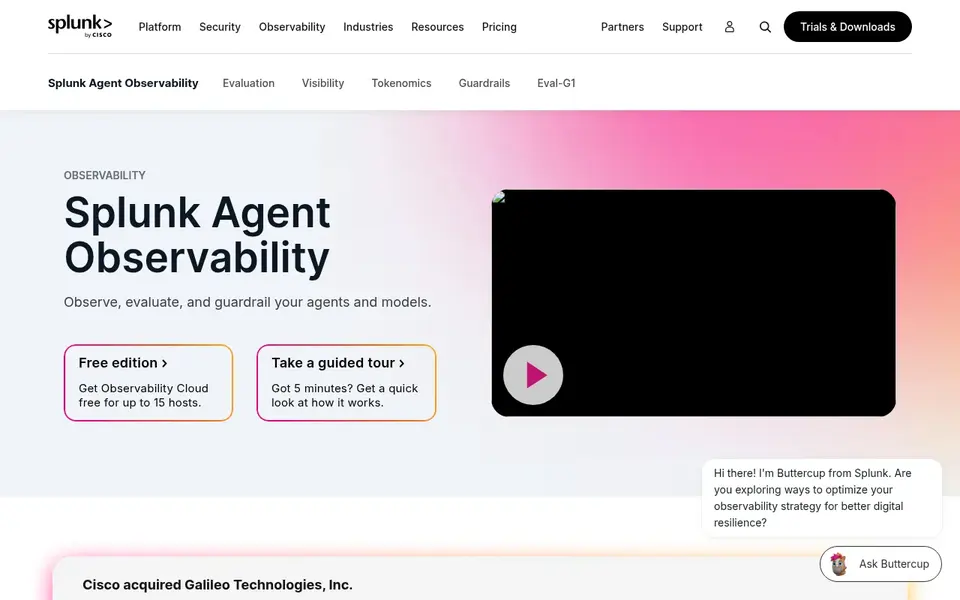
Galileo was built for observability and guardrails with Splunk. Galileo is presented under Splunk Agent Observability, with a focus on observing, evaluating and guardrailing AI agents.
Points against: May be heavier than small teams need.
Best features of Galileo: Backed by Splunk Agent Observability.
It fits enterprises that already depend on Splunk for monitoring and want agent quality signals in a familiar operational context. The starting price for Galileo: $6 per month, per CPU core, billed annually. A free plan is available with Galileo.
- Guardrails alongside evaluation
- Observe
- Tied to the Splunk product family
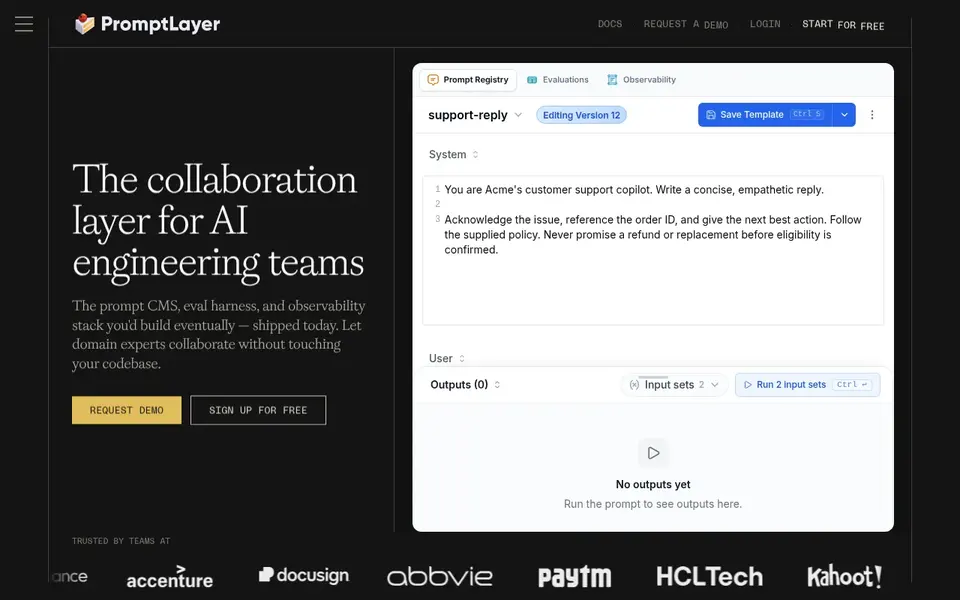
Think of PromptLayer for prompt versioning with evals and logs. PromptLayer is a prompt management product for AI teams. It lets teams version prompts, run LLM evaluations and monitor agents in production with tracing, logs and regression sets.
Downsides: Evaluation depth may trail dedicated eval systems.
Teams whose primary challenge is deep offline evaluation or large-scale experiment comparison may find a dedicated evaluation system better suited. Those needing wide model lifecycle management should consider an open source product instead. What you pay to start with PromptLayer: $49 per month. PromptLayer includes a free tier.
- Evals plus production tracing and logs
- Regression sets for monitoring agents
- Best value for prompt-centric workflows
Before you commit
- Confirm the entry price on the vendor page. For Humanloop that means a quote rather than a fixed price.
- Check what the free option really includes: Braintrust, LangSmith, Galileo and PromptLayer offer a free plan, and usage caps differ.
- Use real work to test the free trial from Humanloop, rather than a demo project.
- Read the limits listed for Humanloop first: product direction is tied to the Anthropic acquisition.
- Before rolling out PromptLayer, verify the integrations your workflow depends on.
- Add up seats, add-ons and usage charges for Galileo before comparing it with cheaper entries.
Frequently asked questions
Which options for platforms for testing large language models have a free plan?
On this list, Braintrust, LangSmith, Galileo and PromptLayer include a free plan. Caps on seats, usage or features are common, so test the free plan against your real workload. One other tool offers a trial instead.
How do evaluation and observability differ?
Evaluation measures quality against defined criteria, frequently before release, whereas observability watches live behavior for example traces, latency and failures. Decide which side matters more for your current stage.
What is the cheapest option for platforms for testing large language models in this list?
On published monthly entry prices, Galileo is the lowest here at $6 per month, per CPU core, billed annually. Entry price is only part of the cost, because seats, add-ons and billing terms can change the total.
Do these tools publish their prices?
Not all of them. Humanloop publishes no starting price, so expect a quote request for it. The rest, Braintrust included, show a starting price, though seats and billing terms still change the final cost. Prices, free plan details and limits for all 5 tools in this platforms for testing large language models roundup sit on the individual cards above.
How are the tools for platforms for testing large language models ordered?
Humanloop sits first and PromptLayer last because the order follows typical fit for platforms for testing large language models, then price clarity and free access. It is a judgement call, so read each profile for fit and limits.
What should I look for in a LLM testing system?
Prioritize the capabilities your team will use daily, for example tracing, offline evaluation, prompt versioning or guardrails. For everyday use, check that the system supports your model providers and suits your existing observability stack.
Sources
See where you really rank - block by block
ProMapRanker scans Google Maps across a grid of your service area. Simple monthly plans from $19, white-label on every plan.
Start freeBrowse all guides
← Platform for Testing AI Prompts in 2026: Top 6 Compared2026 Guide to the Best Real-Time Analytics Platforms AI →
 best ai soc platform for enterprise
2026 Guide to the Best AI Soc Platform for Enterprise
Need the best AI soc platform for enterprise? We compare 5 tools on cost, free access and who each suits. Read the caveats before you buy. Straight answers.
Read → best ai-powered enterprise search tools
2026 Guide to the Best AI-Powered Enterprise Search Tools
Compare 5 best AI-Powered enterprise search tools, with prices, free plans and who each fits. Fit and flaws are laid out for each entry. Quick to scan.
Read → best ai online backup software
2026 Guide to the Best AI Online Backup Software
Best AI online backup software in 2026: 6 tools with starting prices, free plans and limits. Fit and flaws are laid out for each entry. Reviewed this month.
Read → getdx alternatives
GetDX Alternatives in 2026
Compare the best alternatives to GetDX for engineering, for developer experience, engineering metrics and delivery insight, with LinearB, Jellyfish and more.
Read → best pre settlement funding companies
Best Pre Settlement Funding Companies in 2026
Looking for the best pre settlement funding companies? We compared 8 funders on non-recourse terms, speed, case types, and what to check first in this guide.
Read → lambdatest alternatives
Best LambdaTest Alternatives in 2026
Need lambdatest alternatives? We compare 9 cross browser and device testing tools on real device coverage, automation, free plans, and starting prices.
Read →More in Developer Tools · All guides A to Z by date · Latest guides