 ProMapRanker
Best Performance Testing Tools in 2026

Key takeaways
- Apache JMeter suits teams that need broad protocol coverage for free, while Grafana k6 suits developer-led teams testing APIs in CI.
- Gatling suits high-throughput JVM teams, and Locust suits Python teams that want plain code for custom user behavior.
- Artillery suits teams that want YAML plus JavaScript tests with cloud execution, while BlazeMeter suits teams scaling JMeter scripts in the cloud.
- LoadRunner, NeoLoad, and WebLOAD suit enterprises with legacy protocols, SAP, Citrix, or browser-based testing needs.
- Open source engines are free to run, but load hardware, cloud execution, and engineering time still cost money.
Quick comparison
| Pick | Great for | Pricing starts at | Free tier | |
|---|---|---|---|---|
 Apache JMeter | Broad protocol coverage for free | Free | Yes | Visit |
 Grafana k6 | Developer-led API testing in CI | Free | Yes | Visit |
 Gatling | High-throughput JVM testing | Free | Yes | Visit |
 Locust | Python teams and custom behavior | Free | Yes | Visit |
 Artillery | YAML and JavaScript serverless tests | Free | Yes | Visit |
 BlazeMeter | Scaling JMeter scripts in the cloud | Free | Yes | Visit |
 OpenText LoadRunner | Enterprise multi-protocol testing | See website | Free trial | Visit |
 Tricentis NeoLoad | Enterprise codeless and scripted tests | See website | Free trial | Visit |
 WebLOAD | Complex scenarios and deep customization | See website | Free trial | Visit |
The best performance testing tools
We compared load and performance testing tools on scripting language, protocol coverage, CI integration, cloud execution, reporting, and price. Here are nine tools that cover developer teams, QA teams, and large enterprises.
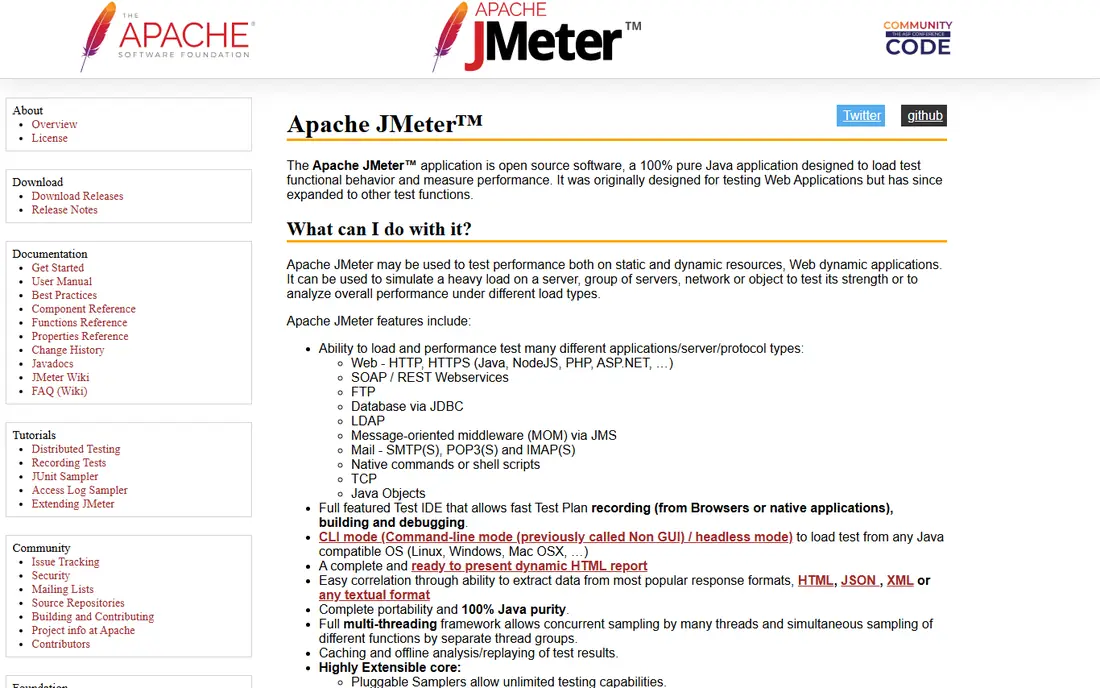
Apache JMeter remains the most widely used free performance testing tool, and its protocol breadth is the reason. HTTP, JDBC, JMS, FTP, LDAP, SOAP, and many other samplers ship in the core or through plugins, so teams testing APIs, databases, messaging, and mail can often use one tool. A GUI builds test plans, while command-line mode runs them in CI and distributed mode scales across machines.
The limits are well known. JMeter uses more memory per virtual user than k6 or Gatling, manual correlation takes effort, and reporting is basic compared with commercial tools. It also has no JavaScript execution, so it cannot test a single-page app the way a real browser does. For protocol-level backend and API testing with no license budget, JMeter is still the safest free pick.
- Free open source with broad protocol support
- GUI plus command-line runs
- Large plugin ecosystem
- Heavy memory use per thread
- No real browser execution for single-page apps
Grafana k6 is our pick for developer-led teams that want load tests in CI. Tests are JavaScript or TypeScript code, thresholds can fail a build when latency or error rates cross a limit, and results flow into Grafana for dashboards and alerts. The open source engine is free to run on your own machines, and Grafana Cloud k6 adds managed execution with a free tier reported near 500 virtual-user-hours a month.
Protocol coverage is narrower than JMeter, focused mainly on HTTP, WebSocket, and gRPC, so teams testing JDBC, JMS, or mail will need another tool. Cloud billing charges browser virtual users at a much higher rate than protocol users, so budget browser tests separately. For API teams that live in CI, k6 offers the cleanest developer workflow here.
- JavaScript and TypeScript tests as code
- Low memory use per virtual user
- Native CI thresholds and Grafana results
- Protocol coverage is narrower than JMeter
- Browser virtual users cost far more in cloud billing
Gatling suits teams that need high throughput from few machines and already work on the JVM. The open source engine, written in Scala, handles thousands of virtual users per agent with low memory use, and tests are written in a domain-specific language available in Java, Scala, Kotlin, and JavaScript. Reports are detailed, with percentiles, response time distributions, and error breakdowns that help teams find bottlenecks fast.
The domain-specific language takes time to learn, and managed execution, collaboration, and advanced reporting sit in Gatling Enterprise, which is quote-based. For a JVM team with performance engineers who can own the DSL, Gatling delivers strong throughput at no license cost. For a team that wants a GUI recorder first, JMeter or NeoLoad may feel easier.
- High throughput per agent
- Java, Scala, Kotlin, and JavaScript DSL
- Detailed HTML reports
- Enterprise features need a paid plan
- DSL learning curve for new users
Locust is the obvious pick for Python teams. User behavior is plain Python code, so custom logic, data handling, and dynamic flows are natural to write and review. A web UI shows live results and lets operators adjust user counts during a run, and distributed mode scales across machines with a worker model that Python developers understand quickly.
Protocol breadth is narrower than JMeter, since Locust focuses on HTTP with extensibility for other protocols through custom clients. Scaling is self-managed, so teams pay in engineering time rather than license fees. For a Python shop that wants readable, maintainable load tests, Locust is the best fit in this list.
- Plain Python test code
- Web UI for live test control
- Easy distributed runs
- HTTP focus with less built-in protocol breadth
- Self-managed scaling needs engineering time
Artillery suits teams that want readable test definitions without writing a full program for every scenario. YAML defines phases, arrival rates, and flows, while JavaScript handles custom logic, hooks, and data. The open source core is free, and Artillery Cloud adds managed execution, shared reports, and team features, with Team plans reported near $199 per month.
Protocol coverage centers on HTTP, WebSocket, and Socket.io, so teams testing legacy protocols should look at JMeter or LoadRunner. Serverless execution removes the need to run a generator fleet, which appeals to teams that run load tests occasionally rather than daily. For microservices and serverless teams, Artillery balances readability with scale.
- YAML plus JavaScript test definitions
- Serverless and cloud execution options
- Good for microservices
- Paid team features start at $199 per month in reports
- Less protocol breadth than JMeter
BlazeMeter suits teams that already have JMeter, Gatling, or k6 scripts and want to run them at scale without managing generators. Cloud execution runs tests from many geographic regions, reports compare runs over time, and CI integrations gate releases on performance results. A free tier allows small tests, reported near 50 concurrent users for 20-minute runs, which is enough to evaluate the platform.
Paid plans start near $99 per month in older reports, with larger tests billed by virtual users and duration, so long or large runs can cost more than expected. BlazeMeter does not replace the need for good test design, but it removes the infrastructure work that slows many JMeter teams. If your scripts are ready and your bottleneck is scale, BlazeMeter is the practical cloud step.
- Runs JMeter, Gatling, and k6 scripts at scale
- Cloud execution from many regions
- Built-in reporting and CI integration
- Paid plans start near $99 per month in reports
- Costs rise with large or long tests
OpenText LoadRunner, formerly known as LoadRunner Professional and now part of the Professional Performance Engineering family, remains the reference for large enterprise estates. Protocol coverage spans web, API, SAP GUI, Citrix, mainframe, and many legacy systems that open source tools do not cover. Virtual user scripts built in VuGen support C, Java, and JavaScript, and analysis tools help teams diagnose bottlenecks across complex systems.
Pricing is quote-based and enterprise-level, with older reports placing entry costs in the tens of thousands per year, and setup is complex compared with k6 or JMeter. A Community Edition capped near 50 virtual users lets small teams evaluate the tool. For enterprises where SAP, Citrix, or mainframe protocols sit on the critical path, LoadRunner is still the safest enterprise pick.
- Very broad protocol coverage including legacy systems
- Scales to very large loads
- Deep analysis tools
- Quote-based enterprise pricing
- Complex setup and scripting
Tricentis NeoLoad suits enterprise DevOps teams that want both codeless test design and scripted control. Testers can record and design tests visually, while engineers can add JavaScript logic where needed. Support for SAP, Citrix, and other enterprise protocols, plus built-in cloud execution and CI integration, makes NeoLoad a strong fit for agile teams inside large companies.
Pricing is quote-based, with historical entry points near $20,000 per year, so small teams should not shortlist NeoLoad on price. For an enterprise that needs codeless design for QA testers, scripted depth for engineers, and managed scale in one platform, NeoLoad balances usability and power better than LoadRunner for many DevOps teams.
- Codeless design plus JavaScript scripting
- Strong SAP and Citrix support
- Built-in cloud and CI integration
- Quote-based pricing
- Entry cost is high for small teams
WebLOAD, from RadView, suits QA teams testing web, API, and packaged applications together with complex scenarios. JavaScript-based scripting supports deep customization, correlation, and data handling, while the IDE and analytics tools help teams build and diagnose tests without a large performance engineering team. Vendor materials publish entry pricing for some editions, unlike fully quote-only rivals, though final quotes vary by scope.
The community is smaller than JMeter or k6, so answers to unusual questions can take longer to find. Setup and licensing still need a vendor conversation for larger estates. For a QA-led team that wants broad coverage, scripted depth, and a published starting price to anchor a budget discussion, WebLOAD is a strong enterprise alternative to LoadRunner and NeoLoad.
- JavaScript-based scripting
- Broad web, API, and packaged app coverage
- Published entry pricing in vendor materials
- Quote varies by scope
- Smaller community than JMeter or k6
How we picked these
We compared scripting languages, protocol coverage, CI integration, cloud execution, reporting, and pricing across open source and commercial tools, using vendor pages and 2026 comparison guides. We kept tools that are live and maintained in October 2026 and that cover different team profiles: developer-led API testing, Python teams, JVM teams, QA-led browser and packaged app testing, and enterprise legacy estates. Where pricing was quote-based, we marked it as See website rather than repeating a stale estimate as a current price.
What to check before you choose a performance testing tool
Start with the protocol and the user journey. API-only teams can pick k6, Gatling, or Locust, while teams testing JDBC, JMS, SAP, Citrix, or mainframe systems need JMeter, LoadRunner, or NeoLoad. Browser-based testing for single-page apps needs a real browser tool or a browser module, not a protocol-only engine, and browser tests cost far more per virtual user in cloud billing.
Next, settle who will own the tests. A test only one engineer can modify stops being run within a few months, so pick the language your on-call engineers already read. Check CI integration, thresholds that fail a build, and reporting that shows percentiles rather than averages, since averages hide the slow experiences users actually feel.
Finally, model the full cost, not just the license. Open source engines are free, but load hardware, cloud virtual-user-hours, and engineering time add up. Count peak users, test duration, and frequency, then price the same test on each shortlisted tool. Run a small pilot against a staging system, check that results are stable across runs, and confirm the tool can scale to your peak before you commit.
Frequently asked questions
What is the best performance testing tool?
There is no single winner. Grafana k6 suits developer-led API testing in CI, Gatling suits high-throughput JVM teams, Locust suits Python teams, JMeter suits broad protocol coverage for free, and LoadRunner or NeoLoad suit enterprises with legacy protocols. Pick by protocol, team language, and CI needs, not by headline features.
What is the best tool for performance testing of APIs?
Grafana k6 and Gatling lead for API load testing, with k6 offering the simplest JavaScript workflow in CI and Gatling offering higher throughput on the JVM. JMeter also handles API testing well when you need broader protocol support or a GUI. Artillery is a good alternative for YAML-based API scenarios.
Is JMeter still worth using in 2026?
Yes, for protocol-level API and backend tests when you have Java or Groovy skills and no license budget. JMeter covers more protocols than k6 or Locust, offers a GUI and plugins, and runs distributed tests. Its limits are heavy memory use, manual correlation, basic reporting, and no real browser execution.
Which performance testing tools are free?
Apache JMeter, Grafana k6, Gatling, Locust, and Artillery are open source and free to run on your own machines. Grafana Cloud k6 and BlazeMeter add free tiers for managed execution with limits. Remember that free engines still need machines to generate load, so hardware or cloud costs remain.
How much does performance testing software cost?
Open source tools cost nothing in license fees, while managed cloud tiers bill by virtual-user-hours or by plan, with reported starting points near $99 per month for BlazeMeter and $199 per month for Artillery Team. Enterprise tools such as LoadRunner and NeoLoad use quote-based pricing that can reach tens of thousands per year. Price your peak load and test frequency, not just the entry plan.
What is the difference between load testing and performance testing?
Performance testing is the broad term for checking speed, stability, and resource use under expected and peak conditions. Load testing is one type within it, focused on behavior under a specific expected load. Other types include stress testing beyond peak load, endurance testing over long periods, and spike testing for sudden surges.
Sources
See where you really rank - block by block
ProMapRanker scans Google Maps across a grid of your service area. Simple monthly plans from $19, white-label on every plan.
Start freeKeep reading
 bitly alternatives
Bitly Alternatives in 2026: 8 Tools Compared
Compare the best Bitly alternatives for branded short links, with free tiers, custom domains, analytics, and pricing that suits creators and small teams.
Read → bill.com alternatives
Best Bill.com Alternatives in 2026
Looking for bill.com alternatives? We compared 9 bill pay and AP automation tools on price, approvals, and accounting sync to help you switch with confidence.
Read → betterhelp alternatives
BetterHelp Alternatives in 2026
We compared BetterHelp alternatives for online therapy, covering Talkspace, Grow Therapy, Rula, Brightside and more on price, insurance and format in 2026.
Read →