 ProMapRanker
Peer Code Review Software for Startups: Best Picks of 2026


Strict review before merge · Pricing starts at: See website
Direct answer
Our first pick is Gerrit Code Review, best for strict review before merge. Listed starting prices: GitHub Pull Requests from $4 per user a month and GitLab Merge Requests from $15 per user a month. For a different need, Crucible covers collaborative review across plenty of systems and GitHub Pull Requests covers teams already building on GitHub. The other 2 tools in the list cover narrower or pricier cases.
ProMapRanker put together this guide to peer code review software for startups for readers who want a clear shortlist without reading every vendor page. It compares 5 tools on starting price, free plans, who each one suits and where each one falls short.
Key takeaways
- Number one here is Gerrit Code Review, a fit for strict review before merge.
- A free plan is available from 2 of the 5 tools: GitHub Pull Requests, GitLab Merge Requests.
- Before buying GitHub Pull Requests, weigh this: deep features can overwhelm new users.
- Starting prices begin at $4 per user per month with GitHub Pull Requests.
- Review Board is the one to check for private, self-hosted review at scale.
Quick comparison
| Pick | Great for | Pricing starts at | Free tier | |
|---|---|---|---|---|
| Gerrit Code Review | Strict review before merge | See website | Not stated | Visit |
 Crucible | Collaborative review across numerous systems | See website | Not stated | Visit |
 GitHub Pull Requests | Teams already building on GitHub | $4 per user a month | Yes | Visit |
 GitLab Merge Requests | Startups wanting one lifecycle product | $15 per user a month | Yes | Visit |
 Review Board | Private, self-hosted review at scale | See website | Not stated | Visit |
The full peer code review software for startups list
In short, Gerrit Code Review is for strict review before merge. Choose a lighter pull request workflow if your priority is speed, and reserve Gerrit for cases where strict pre-merge control is genuinely required. Each change is reviewed and approved before it lands, which supports disciplined, gatekept workflows.
Downsides: Setup and administration effort.
From a buyer's view, Gerrit has a reputation for a steeper learning curve and more administrative overhead than repository-native pull requests. Also, small teams moving quick may find the ceremony slows them down. Gerrit Code Review does not show a starting price in this comparison, so check the vendor site for current pricing. Trial and free access: Not stated.
- Change-based review model
- Well suited to disciplined workflows
- Steeper ramp-up time
Choose Crucible for collaborative review across numerous systems. Startups with heterogeneous version control, or those wanting review as a distinct activity with structured discussion, can use Crucible to bring changes together for comment and approval regardless of where the code is stored.
What works well: CVS and Perforce.
Trade-offs to know: Separate from the code host.
That brings process weight compared to inline pull requests. No starting price is listed for Crucible here; confirm pricing on the vendor site. Trial and free access: Not stated.
- Supports SVN, Git, Mercurial
- Fits formal review processes
- Heavier than inline pull requests

Choose GitHub Pull Requests for teams already building on GitHub. Changes are proposed as pull requests, discussed inline and merged once approved.
Pick something else if you need dedicated pre-commit review across plenty of version control systems instead of a repository-native pull request model. For everyday use, the workflow is tied to GitHub hosting, so teams on other products would have to migrate or choose differently. Starting cost for GitHub Pull Requests: $4 per user per month. You can start on GitHub Pull Requests without paying.
Drawbacks to consider: Best value inside the GitHub ecosystem.
- Wide ecosystem and integrations
- Familiar pull request workflow
- Deep features can overwhelm new users

GitLab Merge Requests was built for startups wanting one lifecycle system. GitLab Merge Requests brings peer review into GitLab, described as an intelligent orchestration system with context and governance across the software lifecycle. On top of that, consider a more straightforward repository-native choice if your team only needs light approvals, or a dedicated review product if review across numerous systems is the priority.
Drawbacks to consider: System breadth brings complexity.
More specifically, the product spans a lot, and smaller teams may find the surface area heavier than a plain review tool. Teams propose changes as merge requests, review them inline and link them to pipelines and issue tracking. What you pay to start with GitLab Merge Requests: $15 per user per month. GitLab Merge Requests has a free plan.
- Review integrated with delivery pipeline
- Merge request discussion threads
- Setup effort grows with features enabled
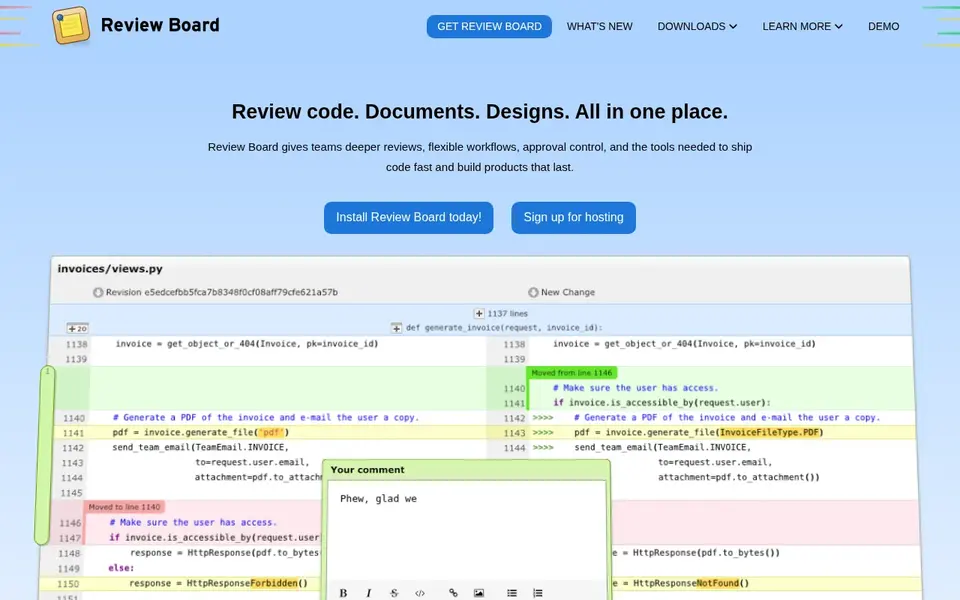
Review Board makes the most sense for private, self-hosted review at scale. Since it is self-hosted, someone on the team must install, maintain and upgrade it, which is real overhead for a small company.
Beyond that, the interface is functional instead of refined. Review Board shows no starting price here, so confirm the cost on the vendor site. Trial and free access: Not stated.
The main drawbacks: Interface feels more utilitarian.
- Manages code and document review
- On-prem and private deployment
- Needs self-hosting effort
Pre-purchase checklist
- Get a written quote from Gerrit Code Review, Crucible and Review Board; the list shows no starting price for them.
- Look at free plan limits closely: GitHub Pull Requests and GitLab Merge Requests have one, and the caps decide whether it is usable for real work.
- Read the limits listed for Gerrit Code Review first: steeper ramp-up time.
- The entry price of Crucible is only the starting point; model the full cost with seats and extras.
- Run a one or two week pilot of Gerrit Code Review with the people who will use it every day.
Frequently asked questions
Is Gerrit Code Review the right pick for everyone comparing peer code review software for startups?
No single tool suits every team. Gerrit Code Review comes first because it fits strict review before merge, while Crucible suits collaborative review across many systems and GitHub Pull Requests suits teams already building on GitHub. Match the tool to your own size, budget and workflow before deciding.
Is self-hosted review worth the maintenance effort?
Self-hosting provides control over where code and review data live, which matters for some teams. The tradeoff is installation and upgrade work.
Can I try these tools before paying?
Often, yes. GitHub Pull Requests and GitLab Merge Requests have a free plan. Use your own data and a real task during the test, and check what the free tier or trial limits before you rely on it. For the full picture, the cards above cover all 5 entries of this peer code review software for startups list, including price, free plan and limits.
Which options for peer code review software for startups have a free plan?
GitHub Pull Requests and GitLab Merge Requests offer a free plan in this list. Free plans usually cap users, projects or features, so check the limits on the vendor page.
What is the cheapest option for peer code review software for startups in this list?
On published monthly entry prices, GitHub Pull Requests is the lowest here at $4 per user per month. Entry price is only part of the cost, because seats, add-ons and billing terms can change the total. Prices, free plan details and limits for all 5 tools in this peer code review software for startups roundup sit on the individual cards above.
Sources
See where you really rank - block by block
ProMapRanker scans Google Maps across a grid of your service area. Simple monthly plans from $19, white-label on every plan.
Start freeBrowse all guides
← 5 Best Garage Door Review Management Software for 2026Peer Code Review Software: Best Picks of 2026 →
 best code review tools for remote developers
6 Best Code Review Tools for Remote Developers in 2026
6 best code review tools for remote developers, with entry costs, free tiers and the buyer each one serves. Each profile ends with a plain caveat. No hype.
Read → best automated code review tools
Automated Code Review Tools: Best Picks of 2026
Searching for the best automated code review tools? Here are 6 options with prices and free plans. Every pick includes one clear drawback. Start here.
Read → best white label reputation management software
5 Best White Label Reputation Management Software for 2026
Searching for the best white label reputation management software? Here are 5 options with prices and free plans. Each tool gets a one-line verdict. No hype.
Read → how to respond to google reviews
How to Respond to Google Reviews (Good and Bad) Like a Pro
Templates and tactics for responding to positive and negative Google reviews to protect your reputation.
Read → best employee performance review software
6 Strong Employee Performance Review Software Options in 2026
Compare 6 picks for the best employee performance review software, with prices, free plans and who each fits. The catches are listed up front. Start here.
Read → reputation management white label
Reputation Management White Label Services: What Agencies Should Know
What agencies should look for in a white label reputation management service, and how to price it.
Read →More in Reviews & Reputation · All guides A to Z by date · Latest guides