 ProMapRanker
6 Best Code Review Tools for Remote Developers in 2026


Teams wanting a self-hosted review suite · Pricing starts at: See website
Direct answer
Our first pick is Phabricator, best for teams wanting a self-hosted review suite. Listed starting prices: GitLab Merge Requests from $15 per user per month and GitHub Pull Requests from $4 per user per month. Bitbucket Pull Requests fits Atlassian-centered teams reviewing in Bitbucket; Review Board fits private, on-prem review at scale. Prices, free plans and limits for all 6 tools follow.
This ProMapRanker guide covers 6 code review tools for remote developers. Each profile lists a starting price, free plan details, strengths and drawbacks, so you can drop poor fits quickly.
Key takeaways
- Number one here is Phabricator, a fit for teams wanting a self-hosted review suite.
- What to know about Bitbucket Pull Requests first: Review depth is entry-level compared to dedicated servers.
- GitHub Pull Requests has the lowest monthly starting price in this list: $4 per user per month.
- GitHub Pull Requests is the one to check for teams already hosting code on GitHub.
Quick comparison
| Pick | Great for | Pricing starts at | Free tier | |
|---|---|---|---|---|
| Phabricator | Teams wanting a self-hosted review suite | See website | Not stated | Visit |
 Bitbucket Pull Requests | Atlassian-centered teams reviewing in Bitbucket | See website | Not stated | Visit |
 Review Board | Private, on-prem review at scale | See website | Not stated | Visit |
 GitLab Merge Requests | Teams wanting review inside one product | $15 per user per month | Yes | Visit |
 Crucible | Teams reviewing across several version control systems | See website | Not stated | Visit |
 GitHub Pull Requests | Teams already hosting code on GitHub | $4 per user per month | Yes | Visit |
Tool-by-tool breakdown
Choose Phabricator for teams wanting a self-hosted review suite. It appeals to remote teams that want control over their environment and are comfortable operating their own software instead of relying on a hosted service.
Honest limits: Development activity has slowed in recent years.
Pricing for Phabricator is not stated here, so ask the vendor for current figures. Free access: Not stated.
- Bundles review with other developer tools
- Self-hosted, so you control the environment
- Requires significant setup and maintenance
Bitbucket Pull Requests
Great for: Atlassian-centered teams reviewing in Bitbucket
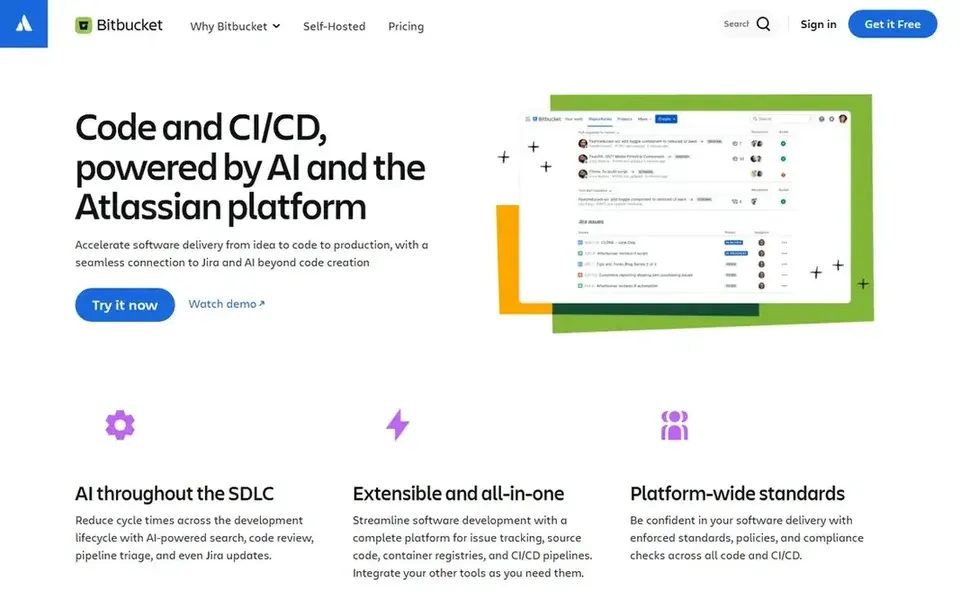
Where Bitbucket Pull Requests fits: Atlassian-centered teams reviewing in Bitbucket. Bitbucket Pull Requests is the review workflow inside Bitbucket, a code hosting service from Atlassian. As a hosting-integrated review flow, it provides fewer formal review controls than dedicated tools built around strict approval processes.
Teams with complicated review policies or plenty of repository types may outgrow it. Developers open pull requests, comment on diffs and approve changes before merging. Pricing for Bitbucket Pull Requests is not stated here, so ask the vendor for current figures. Free access: Not stated.
Where it is weaker: Review depth is entry-level compared to dedicated servers.
- Suits teams already using Atlassian tools
- Pull requests sit next to hosted repositories
- Value relies on staying within the Atlassian ecosystem
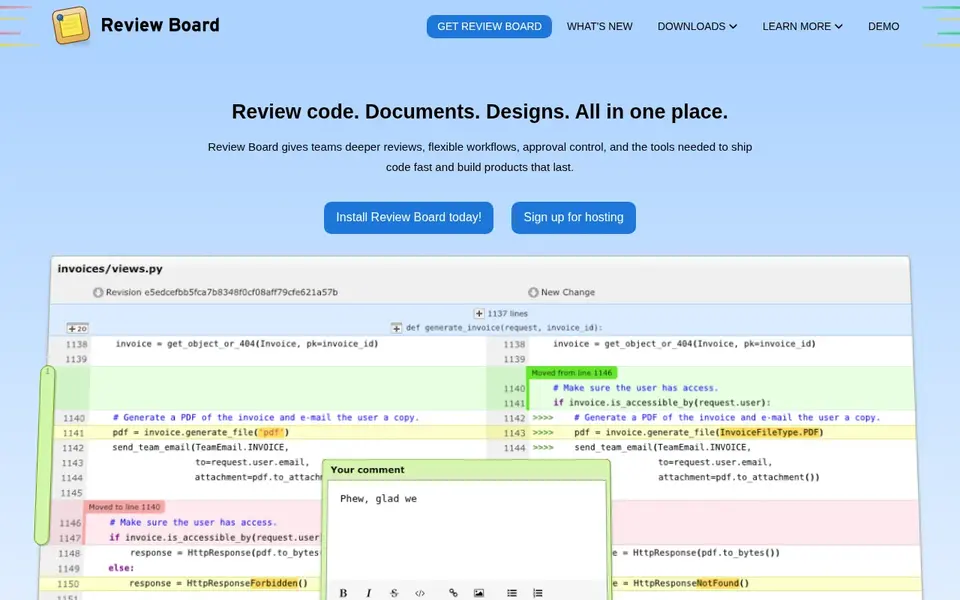
Review Board is a good fit for private, on-prem review at scale. Teams that prefer managed services and straightforward setup may be better served by review built into GitHub, GitLab or Bitbucket.
Where it is weaker: Needs you to run and maintain the server.
Beyond that, Review Board is a code and document review tool made for scale, with private and on-premises deployment. Check the vendor site for Review Board pricing; none is listed in this comparison. As for free access: Not stated.
- Deals with code and document review
- On-prem and private deployment choices
- Interface is less modern than hosted systems

In short, GitLab Merge Requests is for teams wanting review inside one product. Consider a standalone review tool if you only need review and want to keep your existing hosting and workflows unchanged.
Also, the system is wide, so smaller teams may find the surface area bigger than they need for straightforward review. Starting cost for GitLab Merge Requests: $15 per user per month. GitLab Merge Requests offers a free plan.
What to check first: Feature depth can feel heavy for small teams. Reasons to shortlist it: Merge requests link to planning and pipelines.
- Governance features for bigger organizations
- Review and delivery
- Best experience includes the full system
Choose Crucible for teams reviewing across several version control systems. Crucible is a standalone product, so it layers on another system to configure and maintain alongside your repositories.
It makes most sense for teams already invested in Atlassian tooling. Crucible does not show a starting price in this comparison, so check the vendor site for current pricing. Free options: Not stated.
Upsides: CVS and Perforce.
Watch-outs: Separate tool to administer alongside hosting.
- Collaborative review with defect tracking
- Supports SVN, Git, Mercurial
- Best fit when Atlassian tools are already in use

Where GitHub Pull Requests fits: teams already hosting code on GitHub. GitHub Pull Requests is the review layer inside GitHub, a widely adopted developer product that also hosts code, issues and automation.
On cost, GitHub Pull Requests starts like this: $4 per user per month. You can start on GitHub Pull Requests without paying.
Watch-outs: Advanced review depth relies on extras.
- Review lives beside code
- Familiar pull request workflow for most developers
- Best value when the entire team stays on GitHub
Questions to settle before buying
- Get a written quote from Phabricator, Bitbucket Pull Requests, Review Board and Crucible; the list shows no starting price for them.
- Read the fine print on the free plans from GitLab Merge Requests and GitHub Pull Requests; seat, project and feature caps differ.
- Read the limits listed for Phabricator first: needs significant setup and maintenance.
- A short pilot of Review Board with your real workflow tells you more than a feature table.
- Check whether Bitbucket Pull Requests bills monthly or annually, and what cancelling early costs.
Frequently asked questions
Which options for code review tools for remote developers have a free plan?
GitLab Merge Requests and GitHub Pull Requests offer a free plan in this list. Free plans usually cap users, projects or features, so check the limits on the vendor page.
How does Gerrit differ from pull request workflows?
Gerrit centers on individual changes that are reviewed and approved before merging, which enforces a disciplined gate on the central branch. Pull request workflows in hosting products offer a similar idea with a lighter process.
Should I use review built into my hosting platform or a separate tool?
Built-in review in GitHub, GitLab or Bitbucket is typically simplest when all your code lives there, since there is nothing additional to run.
What makes a code review tool a decent match for remote developers?
Remote teams depend on written, asynchronous review, so clear diff views, threaded comments and visible approval states matter most. Tight integration with your code hosting cuts context switching.
Do these tools publish their prices?
Not all of them. Phabricator, Bitbucket Pull Requests, Review Board and Crucible publish no starting price, so expect a quote request for those. The rest, GitLab Merge Requests included, show a starting price, though seats and billing terms still change the final cost.
Is Phabricator the right pick for everyone comparing code review tools for remote developers?
No single tool suits every team. Phabricator comes first because it fits teams wanting a self-hosted review suite, while Bitbucket Pull Requests suits Atlassian-centered teams reviewing in Bitbucket and Review Board suits private, on-prem review at scale. Match the tool to your own size, budget and workflow before deciding.
Sources
See where you really rank - block by block
ProMapRanker scans Google Maps across a grid of your service area. Simple monthly plans from $19, white-label on every plan.
Start freeBrowse all guides
← Automated Code Review Tools: Best Picks of 20265 Best Garage Door Review Management Software for 2026 →
 best white label reputation management software
5 Best White Label Reputation Management Software for 2026
Searching for the best white label reputation management software? Here are 5 options with prices and free plans. Each tool gets a one-line verdict. No hype.
Read → best secure code review software for startups
5 Best Secure Code Review Software for Startups in 2026
Weighing the best secure code review software for startups? We lined up 5 products by cost, free access and fit. Caveats come with every verdict. Details below.
Read → best review software for stores
Review Software for Stores: Best Picks of 2026
Weighing the best review software for stores? We lined up 5 products by cost, free access and fit. Weak spots flagged for every entry. Straight answers.
Read → review management software
Review Management Software: How to Choose the Right Platform
What to look for in review management software and how it streamlines generating and responding to reviews.
Read → best online reputation repair companies
Best Online Reputation Repair Companies in 2026
Compare the best online reputation repair companies for 2026, with honest notes on pricing models, timelines, limits, and what no firm can promise today.
Read → best performance management software
Best Performance Management Software in 2026
Compare the best performance management software for reviews, goals, and feedback in 2026, with pricing notes and honest trade-offs for every team today.
Read →More in Reviews & Reputation · All guides A to Z by date · Latest guides