 ProMapRanker
Best Open Source API Gateway Tools

Teams that want a foundation-governed gateway with live configuration · Pricing starts at: Free (open source)
Key takeaways
- Apache APISIX is the safest default for most teams, with Apache 2.0 licensing, Apache Foundation governance, live configuration through etcd and one of the largest plugin catalogues.
- Kong Gateway has the richest plugin ecosystem, but since version 3.10 in 2025 Kong no longer ships prebuilt open-source images, so new deployments effectively mean the commercial offering.
- Tyk, Gravitee, KrakenD and WSO2 all keep a genuinely open core, yet each holds back the dashboard, developer portal or advanced analytics for the commercial edition.
- KrakenD is the pick for response aggregation, since it composes one response from several services with a stateless design and a declarative file, and it needs no database.
- Licence and release policy matter as much as features, because a gateway that changes its open-source terms can force a migration, so check the current licence before you commit.
Quick comparison
| Pick | Great for | Pricing starts at | Free tier | |
|---|---|---|---|---|
| Apache APISIX | Teams that want a foundation-governed gateway with live configuration | Free (open source) | Yes | Visit |
 Kong Gateway | Teams that want the largest plugin ecosystem and broad community knowledge | Free (open source to 3.9) | Yes | Visit |
 Tyk | Teams that want a fast Go gateway with native GraphQL support | Free (open source) | Yes | Visit |
 Gravitee | Teams that need event-driven and async APIs alongside REST | Free (open source) | Yes | Visit |
 KrakenD | Teams that need response aggregation at high speed | Free (open source) | Yes | Visit |
 WSO2 API Manager | Teams that want a full open-source API management platform | Free (open source) | Yes | Visit |
 Traefik | Kubernetes teams that want a cloud-native edge router | Free (open source) | Yes | Visit |
 Higress | Teams that want an AI-native gateway built on Envoy | Free (open source) | Yes | Visit |
The best open source API gateway tools
Apache APISIX
Great for: Teams that want a foundation-governed gateway with live configuration
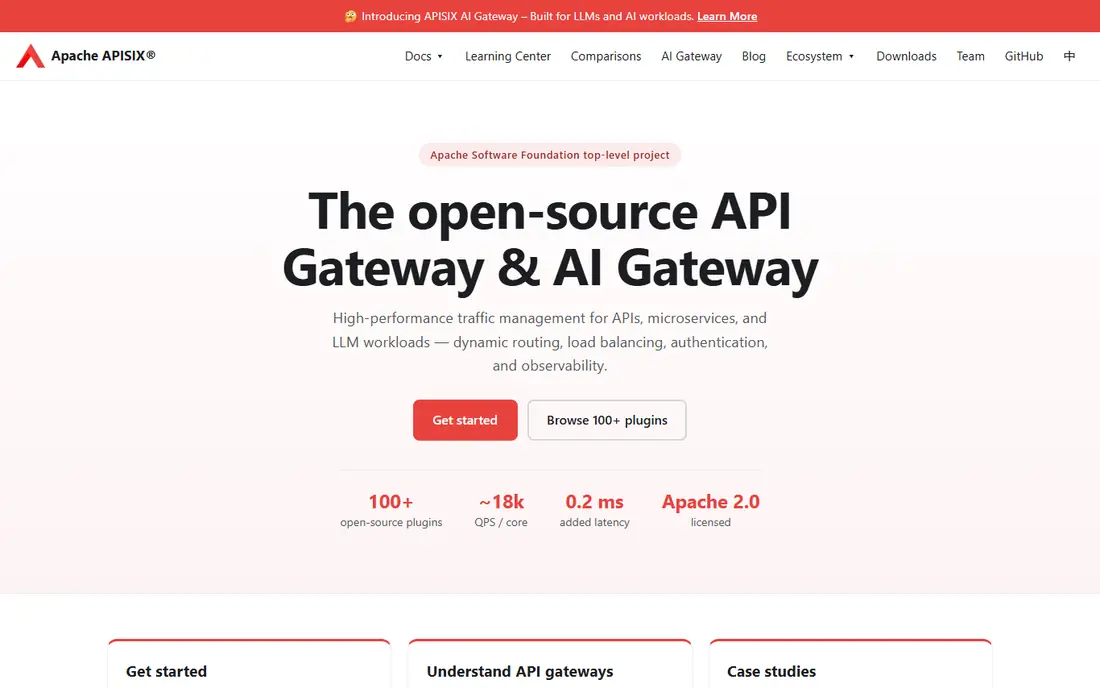
Apache APISIX is a cloud-native API gateway built on NGINX and OpenResty, and it is a top-level project of the Apache Software Foundation. It stores configuration in etcd and applies changes live without restarts, which suits teams that deploy often and want routing, authentication and rate limiting to update without downtime. Its plugin catalogue is one of the largest in this market, covering authentication, traffic control, observability and AI workloads, and it handles roughly 18,000 requests per second per core with about 0.2 milliseconds of added latency.
Foundation governance is the real attraction. Because the project is Apache 2.0 licensed and community governed, no single vendor can change the licence, which protects a team that builds its API platform around the gateway. Commercial support comes from API7.ai for teams that want help. The trade-off is operational: etcd must be run and backed up, and there is no built-in developer portal, so a team that needs one will add a separate tool or build a simple front end.
- Apache 2.0 licence under the Apache Software Foundation, with no single-vendor control
- Live configuration through etcd with no restarts, plus 100 plus plugins
- Etcd adds an operational component to run and back up
- No built-in developer portal, so teams add their own
Kong Gateway
Great for: Teams that want the largest plugin ecosystem and broad community knowledge

Kong Gateway was long the open-source reference for API gateways, and it still has the richest plugin ecosystem and the largest body of community knowledge. Built on NGINX and OpenResty, it covers routing, authentication, rate limiting, logging and transformations, and it runs across hybrid and multi-cloud environments. Teams that already know Kong can move fast, and the commercial Kong Konnect control plane adds a managed console, analytics and governance for larger organizations.
The licence picture changed in 2025. Since version 3.10 Kong no longer ships prebuilt open-source images, and the licence-free mode has been removed from the enterprise edition, so choosing Kong today effectively means choosing its commercial offering, even though the 3.9 branch code remains under Apache 2.0. A team that wants a purely open-source gateway should weigh that change carefully, since it affects upgrades, support and long-term cost. Kong still earns its place for teams that value its ecosystem and are willing to buy the commercial edition.
- Richest plugin ecosystem of any gateway in this list
- Large community and deep documentation from years of use
- Since version 3.10 in 2025 Kong no longer ships prebuilt open-source images or packages
- Lifecycle management, governance and per-customer analytics are commercial only
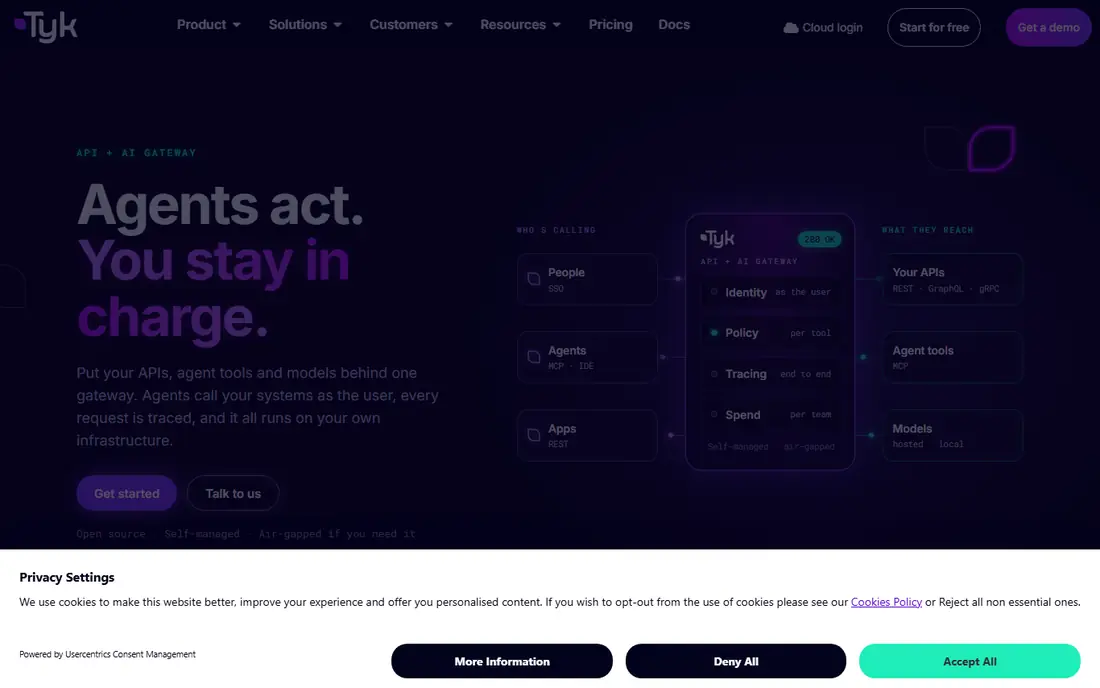
Tyk is an API gateway and management layer written in Go, distributed under the MPL 2.0 licence, and it performs well under load while supporting REST, GraphQL, gRPC and async APIs. The open-source gateway covers routing, security, governance and analytics, and it deploys anywhere, on premises, in the cloud or in a hybrid setup. Its policy management is flexible, letting teams define access rules, quotas and transformations per API and per consumer without writing custom code.
The split between open and commercial is clear. The gateway is open source, but the dashboard, developer portal and multi-site deployment belong to the commercial offering, so a team that runs only the open core manages everything through the API and config files. That suits a GitOps team that prefers files over a console, yet it slows down a team that wants a visual dashboard and self-service onboarding for API consumers. Tyk Cloud offers a hosted path for teams that want the dashboard without running it.
- Open-source gateway under the MPL 2.0 licence, written in Go for speed
- Native GraphQL support and flexible policy management
- The dashboard, developer portal and multi-site deployment are part of the commercial offering
- Without them, everything runs through the API and config files
Gravitee is a full API management platform whose community edition is published under Apache 2.0, and it goes beyond a gateway to include a console, a developer portal and policy management in the open core. It stands out for event-driven APIs, with support for Kafka, MQTT and WebSocket alongside REST, which suits teams that run streaming data or real-time messaging next to their regular APIs. The platform also covers agentic AI systems and unified management of APIs and event streams.
The enterprise edition holds back advanced features and the federation of third-party gateways, so a team that manages many gateways from different vendors will need the commercial tier. The Java-based stack also needs more memory than the Go gateways in this list, which matters on small clusters. Gravitee suits a team that wants a complete platform with a portal included, rather than a bare gateway, and that works with async protocols as well as REST.
- Full platform with gateway, console and developer portal in the community edition
- Strong support for Kafka, MQTT and WebSocket APIs
- Advanced features and federation of third-party gateways belong to the enterprise edition
- Java-based stack needs more memory than Go gateways
KrakenD is a stateless API gateway written in Go, and its core, called Lura, is hosted by the Linux Foundation under Apache 2.0. It relies on no database: the entire configuration lives in a declarative file, which suits teams that work with GitOps and want the gateway config versioned next to the code. Its speciality is aggregation, composing one response from several backend services, which cuts the number of round trips a client must make and simplifies mobile and web front ends.
Performance is a strong point, with the project reporting over 80,000 requests per second on commodity hardware. The trade-off is tooling: the community edition has no admin interface or developer portal, so teams manage the gateway through files and the command line. The plugin set is smaller than APISIX or Kong, and custom logic usually means writing Lua or Go code. KrakenD fits a performance-focused team that values a simple, stateless design and is comfortable working in configuration files.
- Stateless design with a declarative config file and no database to run
- Aggregation composes one response from several services, at over 80,000 requests per second
- No admin interface or developer portal in the community edition
- Fewer plugins than APISIX or Kong, so custom logic needs Lua or Go code
WSO2 API Manager
Great for: Teams that want a full open-source API management platform
WSO2 API Manager is a full API management platform whose gateway, publisher and developer portal are open source under Apache 2.0, which makes it one of the most complete open offerings in this list. It covers the full API lifecycle, from design and publishing through security, analytics, monetization and developer onboarding, and it runs across multi-cloud and on-premises environments. It is also strong for AI-heavy stacks, with features for LLM workloads and AI gateway use cases that newer teams are starting to need.
The cost of that completeness is weight. WSO2 runs more components than a bare gateway, so it needs more memory, setup time and operational care, which makes it a better fit for a platform team than for a small team that wants a single binary. A commercial WSO2 subscription adds support and additional features, and most production teams will want one. WSO2 suits an organization that wants one open platform for the whole API lifecycle rather than assembling a gateway, a portal and analytics from separate tools.
- Gateway, publisher and developer portal are open source under Apache 2.0
- Strong for multi-cloud and AI-heavy API stacks
- Commercial subscription is needed for support and some additional features
- Heavier footprint than a bare gateway, with more components to run
Traefik is an open-source cloud-native edge router that many Kubernetes teams already run as their ingress controller, and it doubles as a capable API gateway for services that live in containers. It discovers services automatically from Kubernetes, Docker and other providers, so new services get routes without manual config, and its middleware handles authentication, rate limiting, headers, retries and circuit breakers. The configuration is simple and the dashboard gives a clear live view of routes and services.
As a pure API gateway, Traefik is lighter than the dedicated platforms in this list. Full API management features, including a managed developer portal, advanced analytics and API catalogues, belong to Traefik Hub, the commercial offering, and the plugin set is smaller than APISIX or Kong. Traefik fits a Kubernetes team that wants one tool for ingress and gateway duties, with the option to add Traefik Hub later, rather than a team that needs a standalone API management platform from day one.
- Open-source edge router with automatic service discovery in Kubernetes and Docker
- Simple configuration with middleware for auth, rate limiting and headers
- Full API management features need Traefik Hub, the commercial offering
- Smaller API gateway plugin set than APISIX or Kong
Higress is an open-source, AI-native cloud API gateway built on Istio and Envoy, and it is one of the newer names in this space. It handles the standard gateway duties of routing, security, traffic control and observability, and it adds built-in support for LLM workloads, including AI API routing, token limits and model provider management, which suits teams that are putting AI features behind their APIs. Its Envoy base gives it a proven data plane with strong performance and a large ecosystem of filters.
The trade-off is maturity. Higress is a newer project with a smaller community outside China, and its documentation and community support are thinner in English than the established gateways in this list. A team that adopts it should expect to read source code and upstream issues more often. Higress fits a team that is building AI features into its APIs and wants a gateway designed for that workload from the start.
- Open-source, AI-native gateway built on Istio and Envoy, with strong traffic control
- Built-in support for LLM workloads and AI API routing
- Newer project with a smaller community outside China
- Documentation and community support are thinner in English
How we chose
We compared vendor licence pages, documentation and feature lists for open-source API gateways, and we checked licences and release policies in November 2026. We ranked tools on licence terms, governance, plugin breadth, performance, protocol support and whether the dashboard and portal are open or commercial. We gave extra weight to projects with foundation governance and a genuinely open core, since a gateway that changes its licence can force a costly migration. We did not test the products hands-on, and we did not count review scores or awards. Licences and editions change quickly, so confirm the current licence on the project site before you commit.
| Team and stack | First look | Why it fits | | Small team, standard REST APIs | Apache APISIX | Foundation governed, large plugin set, live config | | Kubernetes team | Traefik | Automatic discovery, one tool for ingress and gateway | | Aggregation and mobile backends | KrakenD | Stateless, fast, composes one response from many services | | Event-driven and async APIs | Gravitee | Kafka, MQTT and WebSocket support in the open core | | GraphQL heavy stack | Tyk | Native GraphQL in a fast Go gateway | | Full platform team | WSO2 API Manager | Gateway, publisher and portal all open source | | AI workloads | Higress | Built for LLM routing on Envoy | | Existing Kong users | Kong Gateway | Largest ecosystem, but plan for commercial terms |
What to check before you buy
Check the licence first. Confirm which version is open source, which licence covers it and whether the vendor still ships prebuilt open-source releases, since Kong stopped shipping them after version 3.10 and that change affects upgrades. Ask which features sit in the commercial edition, including the dashboard, developer portal, analytics and support, because those gaps decide whether the open core is enough or the team will need a subscription within a year.
Check the operational cost next. A gateway that needs etcd, a Java stack or a full platform install takes more servers, monitoring and backup work than a single stateless binary, so map the components against your cluster and your on-call capacity. Test the plugin model too, since a gateway with a large catalogue covers more use cases without custom code, while a gateway with a small catalogue will need Lua, Go or Java work for the same result. Run a load test with your own traffic shape before you commit, since published request-per-second figures use vendor test rigs.
Frequently asked questions
Which open-source API gateway is best for beginners?
Apache APISIX is the best starting point for most teams, because it is Apache 2.0 licensed, governed by the Apache Software Foundation, well documented and supported by a large plugin catalogue. Its live configuration through etcd means changes apply without restarts, and its community is active. A team that wants the simplest setup should also look at KrakenD, whose declarative file and stateless design are easy to learn.
Is Kong Gateway still open source?
Partly. The 3.9 branch code remains under Apache 2.0, but since version 3.10, released in 2025, Kong no longer ships prebuilt open-source images or packages, and the licence-free mode has been removed from the enterprise edition. Choosing Kong today effectively means choosing its commercial offering, Kong Enterprise or Konnect, so a team that needs a purely open-source gateway should pick APISIX, Tyk, Gravitee or KrakenD instead.
Do open-source API gateways include a developer portal?
Some do and some do not. Gravitee and WSO2 API Manager include a developer portal in their open-source editions, while Tyk, KrakenD and Apache APISIX keep the portal in the commercial offering or leave it out entirely. A team that needs self-service onboarding for API consumers should confirm the portal is included before choosing, since adding one later takes real work.
What is the difference between an API gateway and API management?
An API gateway routes, secures and monitors traffic to your APIs, while API management covers the full lifecycle, including design, publishing, developer onboarding, analytics, monetization and governance. Tools such as WSO2 API Manager and Gravitee are full management platforms, while KrakenD and Traefik are closer to pure gateways. Pick a gateway when traffic control is the need, and a management platform when the whole lifecycle matters.
Can I run an open-source API gateway in Kubernetes?
Yes. All eight tools in this list run in Kubernetes, and Traefik and Higress are built for it, with automatic service discovery and native ingress support. Apache APISIX, Kong, Tyk, Gravitee, KrakenD and WSO2 all ship Helm charts or operators for Kubernetes deployment. Confirm the chart is maintained for your version, and test upgrades in staging before you roll them out.
Sources
See where you really rank - block by block
ProMapRanker scans Google Maps across a grid of your service area. Simple monthly plans from $19, white-label on every plan.
Start freeKeep reading
 best scheduling software for med spas
Best Scheduling Software for Med Spas in 2026
Compare the best scheduling software for med spas, with real prices and calendar features, so you can run staff schedules and waitlists without double bookings.
Read → best scheduling software for law firms
Best Scheduling Software for Law Firms
Compare the best scheduling software for law firms, with real 2026 prices, intake forms, and calendar sync, so clients can book easily without phone tag.
Read → best scheduling software for gyms
Best Scheduling Software for Gyms in 2026
Compare the best scheduling software for gyms, with real prices and timetable features, so you can run classes, coaches and waitlists without double bookings.
Read →