 ProMapRanker
Best Microsegmentation Tools in 2026

Key takeaways
- Microsegmentation limits lateral movement by controlling which workloads, devices and users can talk to each other, even inside a trusted network.
- Agent-based tools offer deep workload control, while agentless and identity-based tools suit mixed IT, OT and IoT environments.
- Almost all enterprise tools are quote based and priced per workload, so a pilot on your real environment matters more than a feature list.
- Policy design is the hard part, so check visibility, policy testing and gradual enforcement before you commit to a vendor.
Quick comparison
| Pick | Great for | Pricing starts at | Free tier | |
|---|---|---|---|---|
 Illumio | Hybrid workload segmentation | See website | No | Visit |
 Akamai Guardicore Segmentation | Data center visibility | See website | No | Visit |
 VMware NSX | VMware environments | See website | No | Visit |
 Cisco Secure Workload | Cisco-centered networks | See website | No | Visit |
 Zscaler Workload Segmentation | Agentless zero trust | See website | No | Visit |
 Tigera Calico Enterprise | Kubernetes workloads | See website | Free trial | Visit |
 ColorTokens | Zero trust platform | See website | No | Visit |
 Elisity | Agentless identity-based control | See website | No | Visit |
 Zero Networks | Fast automated deployment | See website | Free trial | Visit |
The best microsegmentation tools
We compared official feature pages, product documentation and public reviews for microsegmentation tools live in October 2026. The list covers workload, network and identity-based approaches, so a data center team, a cloud team and a mixed IT and OT team can each find a fit. Pricing is quote based for most vendors, so we wrote See website where a full public price was not verified.
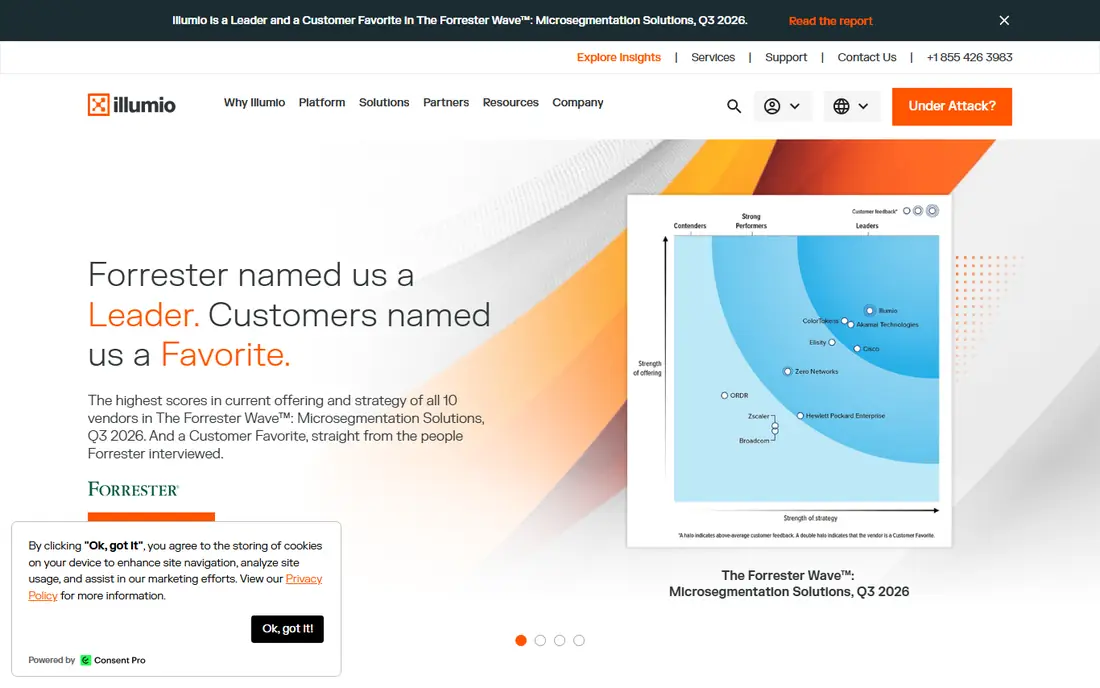
Illumio is the benchmark many teams compare other tools against, thanks to its workload visibility and host-based enforcement. It maps how workloads communicate, then lets teams build and test policies before enforcing them, which reduces the risk of breaking an application. That visibility-first approach suits hybrid environments with data center, cloud and container workloads. The trade-off is effort. Designing effective policies at scale needs skill and time, and pricing is quote based per workload. Teams should run a pilot on real workloads to judge both policy effort and cost. For workload-centered segmentation, Illumio remains a top shortlist pick.
- Strong workload visibility
- Policy enforcement across data center and cloud
- Breach containment focus
- Policy design takes skill at scale
- Quote-based pricing
Akamai Guardicore Segmentation, formerly Guardicore, combines agent sensors, network collectors and cloud flow logs to build a detailed view of infrastructure activity. That view helps teams write precise policies and spot possible breaches quickly. Its labeling and automation features also help keep policies tied to real business context. The downside is cost complexity, since pricing varies by workload count and tier, and some deployments need careful planning for agent coverage. Smaller teams may find the platform larger than they need. For data center and hybrid environments that need deep visibility, Guardicore is a strong contender.
- Granular visibility
- Agent and network data collection
- Breach detection features
- Pricing varies by tier and workload count
- Deployment needs planning
VMware NSX is the natural choice for teams already running VMware infrastructure, since its distributed firewall and segmentation controls are built into that stack. Policies can follow workloads as they move, and Kubernetes integration extends control to container environments. For a VMware-heavy estate, that native fit reduces extra agents and tooling. The limit is portability. Teams with little VMware footprint will get less value and may face licensing complexity. NSX is also a broad platform, not a single-purpose segmentation tool. For VMware shops, it is often the simplest path to segmentation.
- Distributed firewall built for VMware
- Kubernetes integration
- Policy at scale
- Best value inside VMware
- Licensing complexity for non-VMware estates
Cisco Secure Workload, formerly Tetration, offers workload segmentation with policy recommendations and compliance mapping, which helps teams move from visibility to enforcement. Its strength is in Cisco-centered networks and large enterprises that already use Cisco security and networking tools. Compliance reporting is a practical bonus for regulated teams. The trade-off is ecosystem fit and pricing. Non-Cisco estates may find integration less smooth, and pricing requires a quote. For a Cisco-heavy enterprise, Secure Workload deserves a pilot alongside Illumio and Guardicore.
- Workload segmentation with policy recommendations
- Compliance mapping
- Cisco ecosystem fit
- Quote-based pricing
- Best inside Cisco networks
Zscaler Workload Segmentation applies zero trust policies between workloads without relying on heavy agent deployment in the same way as older tools. That cloud-native approach suits teams already using the Zscaler Zero Trust Exchange, where workload policies can sit alongside user and application access controls. Visibility into workload communication helps teams build policies with less guesswork. The catch is platform fit. Teams outside Zscaler may get less value, and pricing is quote based per workload. It is also a newer segmentation offer than Illumio or Guardicore, so references matter. For a Zscaler shop, it is a natural addition to evaluate.
- Zero trust workload policies without heavy agents
- Cloud-native visibility
- Ties to Zero Trust Exchange
- Best value inside the Zscaler platform
- Per-workload pricing needs a quote
Tigera Calico Enterprise is built for Kubernetes-native segmentation, where network policy, compliance and observability must work inside clusters. Teams running container workloads at scale benefit from policies that follow pods and namespaces, rather than trying to force a data center tool into Kubernetes. Its compliance mapping also helps regulated container estates. The limit is scope. Outside Kubernetes, Calico Enterprise is not a general data center segmentation tool, so mixed estates may need another tool alongside it. For a cloud-native team, though, its Kubernetes focus is a strength, not a weakness.
- Kubernetes-native network policy
- Compliance features
- Strong for container estates
- Narrower focus outside Kubernetes
- Pricing is subscription based
ColorTokens offers a zero trust platform that combines microsegmentation with visibility and policy automation across cloud and data center workloads. That breadth suits teams that want one vendor for segmentation plus related zero trust controls, rather than stitching several point tools together. Its policy features aim to reduce manual rule writing. The trade-off is evaluation effort. A broad platform needs a structured pilot to judge which modules you actually need and what they cost. Pricing is quote based. For a team planning a wider zero trust program, ColorTokens is worth including in the shortlist.
- Zero trust platform with segmentation and visibility
- Cloud and data center coverage
- Policy automation
- Platform breadth needs evaluation time
- Quote-based pricing
Elisity takes an agentless, identity-based approach, enforcing policy on infrastructure teams already run rather than installing agents on every asset. That suits mixed environments with IT, OT and IoT devices that cannot easily run agents. Identity-based enforcement also ties access to who or what a device is, not just its network address. The risk is maturity relative to the longest-established agent vendors. Teams should check references in environments like theirs and test policy enforcement on their hardest device types. For mixed estates where agents are impractical, Elisity offers a compelling alternative model.
- Agentless enforcement on existing infrastructure
- Identity-based policies
- Good for IT, OT and IoT
- Newer approach than agent leaders
- References and scale checks needed
Zero Networks focuses on fast, automated deployment, with policies built from observed traffic and access that can require multi-factor authentication. That automation appeals to teams that want segmentation without a long manual policy project. Its trial option also lets teams test the approach before a larger commitment. The trade-off is vendor maturity and scale proof. Very large, complex estates should verify performance, policy depth and support at their size. For a team that has delayed segmentation because policy work looked too heavy, Zero Networks is a practical way to start.
- Automated policy creation
- Fast deployment
- MFA-triggered access options
- Younger vendor than Illumio or Akamai
- Check depth for very large estates
How we picked these
We compared official feature pages, product documentation and public reviews for microsegmentation tools live in October 2026. We favored tools with clear visibility, policy testing, gradual enforcement and coverage for data center, cloud or Kubernetes workloads. Where pricing is quote based or not fully published, we wrote See website rather than presenting a marketplace or third-party figure as a vendor price. We did not claim hands-on testing in a production network.
What to check before you choose a segmentation tool
Start with a visibility pilot on your real environment. Map traffic between workloads, devices and cloud services for at least a few weeks, and see which tool gives you a clear, usable map. A tool that cannot explain your traffic will not help you write safe policies. Include your hardest cases, such as legacy systems, OT devices and cloud workloads, in that pilot. Next, test policy enforcement in stages. Build policies in monitor mode first, check what would break, then enforce in small groups. Ask how the tool handles policy exceptions, emergency access and rollback, since a bad policy can cause an outage. Also check integration with your firewall, identity, SIEM and ticketing tools, since segmentation does not live alone. Finally, model total cost and effort, not just license price. Count workloads, agents or hosts, professional services, and the staff time needed to design and maintain policies. Ask for references in an environment like yours, and confirm support hours and update processes. Segmentation is a long-term control, so choose the vendor whose policy model your team can actually maintain.
Frequently asked questions
What are the best microsegmentation tools for a hybrid cloud?
Illumio and Akamai Guardicore Segmentation are strong hybrid picks, with workload visibility and enforcement across data center and cloud. Zscaler Workload Segmentation suits cloud-native and Zscaler-centered teams. Run a pilot on your real workloads to compare policy effort and cost.
What is the best microsegmentation software for Kubernetes?
Tigera Calico Enterprise is built for Kubernetes-native policy, compliance and observability. Illumio and VMware NSX also cover container workloads, but Calico is the most focused Kubernetes choice. Choose based on whether Kubernetes is your main estate or one part of a wider mix.
Is microsegmentation the same as a firewall?
No, a traditional firewall usually controls traffic at network borders, while microsegmentation controls traffic between individual workloads, devices and applications inside the network. That finer control limits lateral movement if one workload is compromised. Many teams use both together.
How much do microsegmentation tools cost?
Most enterprise tools are quote based and priced per workload, host or asset, so a published monthly price is rarely meaningful. Your total depends on workload count, deployment model and services. Ask each vendor for a quote based on your actual workload inventory.
Can microsegmentation work without agents?
Yes, agentless and identity-based tools such as Elisity and Zscaler Workload Segmentation offer options that do not rely on agents on every asset. Agent-based tools still offer deep workload control in many cases. The right model depends on your device types, especially for OT and IoT assets that cannot run agents.
How long does microsegmentation take to deploy?
A focused pilot can show visibility in weeks, but full enforcement across a large estate often takes months, since policy design and testing take time. Automated tools such as Zero Networks aim to shorten that path. Plan for staged enforcement and policy maintenance, not a single switch-on date.
Sources
- https://www.illumio.com
- https://www.akamai.com/products/akamai-segmentation
- https://www.vmware.com/products/cloud-infrastructure/nsx
- https://www.cisco.com/site/us/en/products/security/secure-workload.html
- https://www.zscaler.com/products/workload-segmentation
- https://www.tigera.io
- https://colortokens.com
- https://www.elisity.com
- https://www.zeronetworks.com
- https://accuknox.com/blog/microsegmentation-tools-zero-trust
- https://www.elisity.com/blog/top-microsegmentation-solutions
See where you really rank - block by block
ProMapRanker scans Google Maps across a grid of your service area. Simple monthly plans from $19, white-label on every plan.
Start freeKeep reading
 who has best internet service
Who Has the Best Internet Service in 2026
Who has best internet service for US homes? We compare fiber, cable, fixed wireless and satellite providers on speed, price, availability and terms today.
Read → which survey tool has the best analytics
Which Survey Tool Has the Best Analytics in 2026
Find which survey tool has the best analytics in 2026, comparing Qualtrics, SurveyMonkey, Typeform, Alchemer, and more on reports, text, and stats today.
Read → which streaming service has the best movies
Which Streaming Service Has the Best Movies in 2026
Answering which streaming service has the best movies, with Netflix, Max, Criterion and more compared on libraries, prices and free options in this guide.
Read →