 ProMapRanker
Best Marketing Attribution Software in 2026

Key takeaways
- The best marketing attribution software depends on your CRM, your sales cycle, and how much spend you need to explain.
- B2B teams with long sales cycles should favor account-level tools such as Dreamdata and HockeyStack.
- Ecommerce brands should favor store-centric tools such as Triple Whale and Northbeam.
- Teams already on HubSpot often get the fastest value from HubSpot attribution, since the CRM data is already there.
Quick comparison
| Pick | Great for | Pricing starts at | Free tier | |
|---|---|---|---|---|
 HubSpot | Teams already using HubSpot CRM | Free | Yes | Visit |
 Dreamdata | B2B account-level attribution | Free | Yes | Visit |
 HockeyStack | B2B revenue teams | See website | No | Visit |
 Ruler Analytics | Call and form lead tracking | See website | No | Visit |
 Triple Whale | Shopify ecommerce brands | $219 per month | Yes | Visit |
 Northbeam | High spend paid media teams | See website | No | Visit |
 Wicked Reports | Direct response and ecommerce | $499 per month | No | Visit |
 Google Analytics 4 | Free baseline measurement | Free | Yes | Visit |
 Factors.ai | Account analytics and attribution | $199 per month | Yes | Visit |
The best marketing attribution software
We compared tools on attribution models, CRM links, ad platform links, ease of setup, and price. The list below mixes free starting points with paid platforms for larger teams.
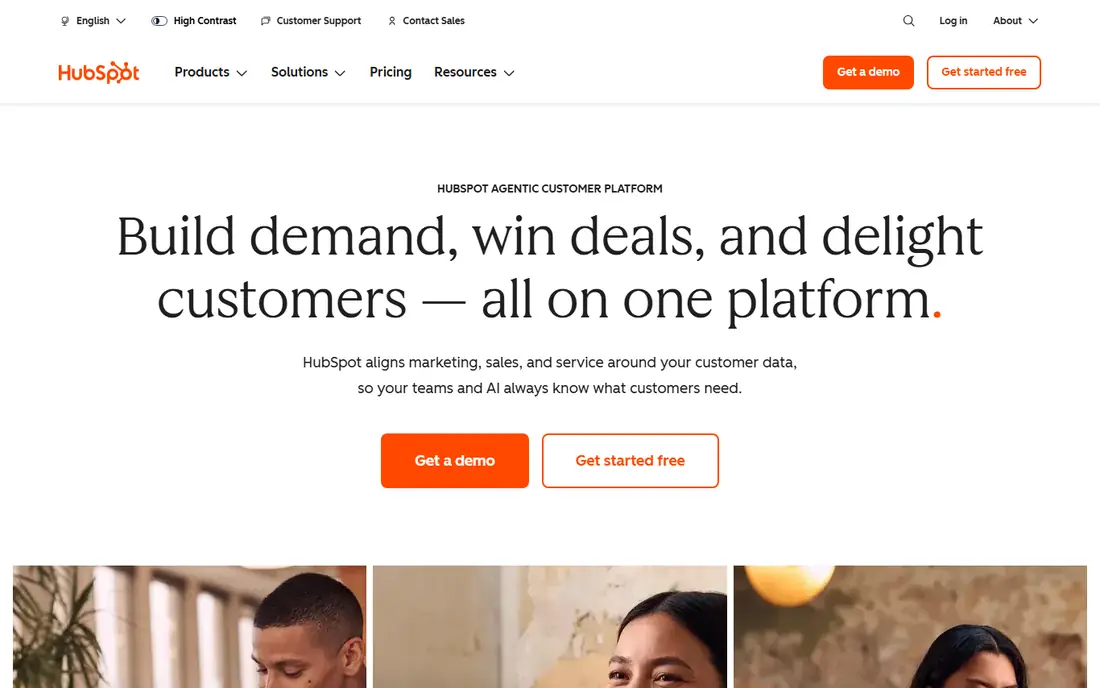
HubSpot is the easiest attribution choice for a team that already runs marketing and sales in HubSpot. Contacts, deals, ads, and emails share one record, so attribution reports can link a first touch to closed revenue without a separate integration project. That single source of truth is why many small and mid-size teams start here.
The limit is scope. If your CRM is Salesforce and your ads live elsewhere, HubSpot attribution adds a second system to maintain. Paid Marketing Hub tiers are also needed for the fuller attribution reports, so check the tier price, not just the free CRM.
- Attribution sits inside the CRM
- No separate data sync for HubSpot users
- Wide marketing and sales tools
- Full attribution reports need paid Marketing Hub tiers
- Weaker for teams not on HubSpot
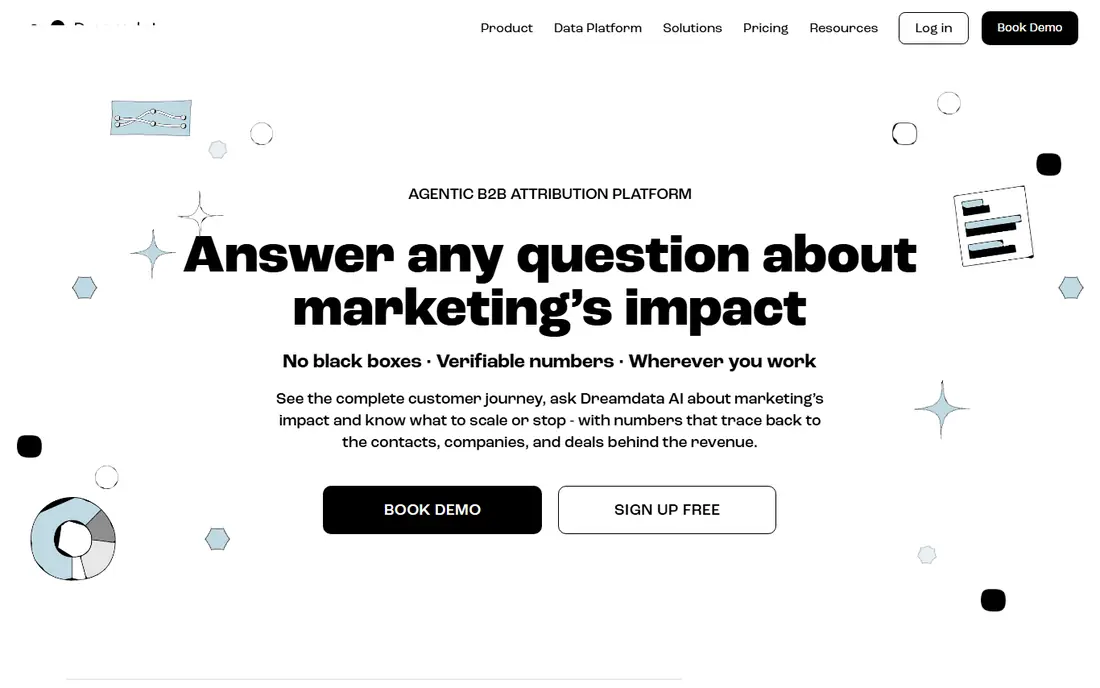
Dreamdata is built for B2B teams where several people from one company touch ads, content, and sales calls before a deal closes. It stitches those touches into one account journey, which helps a team see which channels create pipeline, not just which ad got the last click. A free tier lets a team test the data model before paying.
The trade-off is effort. Cleaning CRM stages, ad links, and tracking takes work, and paid pricing is custom. Teams with low ad spend or very short sales cycles may not need this depth, while B2B SaaS teams with long cycles will get the most value.
- Account journeys across many contacts
- Free tier for evaluation
- CRM links for HubSpot and Salesforce
- Paid plans are quote based
- Setup takes time for complex data
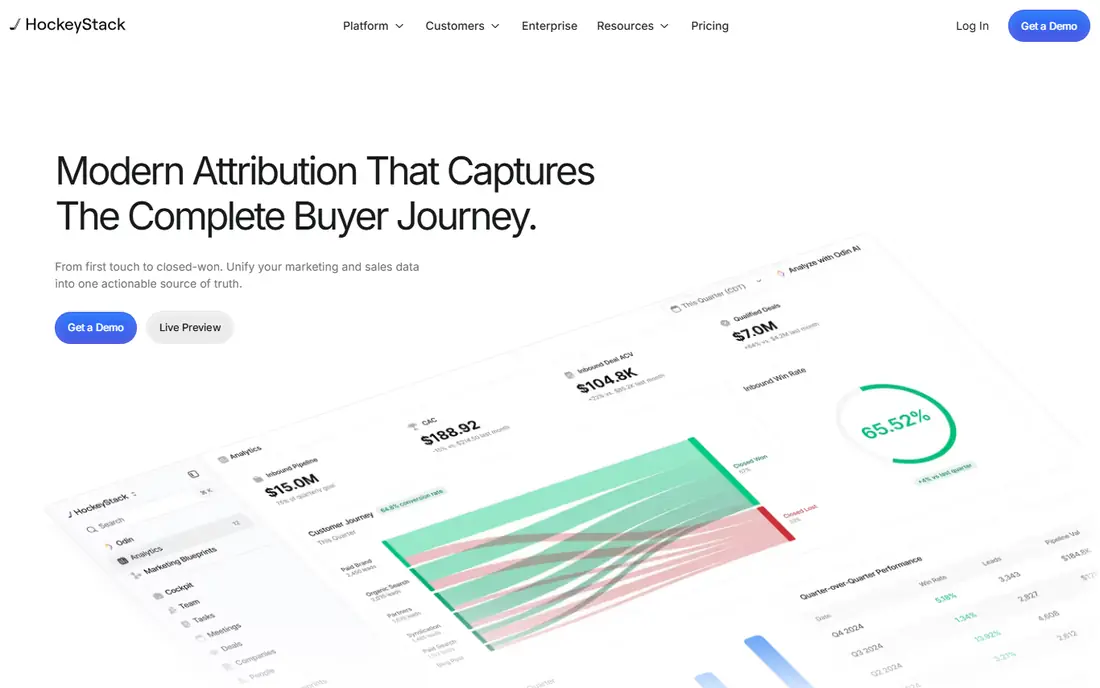
HockeyStack suits B2B revenue teams that want one view from first touch to closed-won deal. It brings together website behavior, ad spend, CRM pipeline, and product usage, which helps marketing and sales agree on what worked. That breadth is valuable when deals take months and involve many stakeholders.
Cost and fit are the limits. Pricing is quote based and reported at a level that suits larger teams, not a small startup. Smaller teams should start with HubSpot or Dreamdata free tier and move to HockeyStack when pipeline volume justifies the spend.
- Links web, ads, CRM, and product data
- Useful dashboards for revenue teams
- Cookieless tracking options
- Quote based pricing
- Best suited to larger B2B teams with budget
Ruler Analytics is a strong pick for businesses that win work by phone or form, such as agencies, clinics, and service firms. It tracks the source of each call and form, then links that lead to CRM revenue. That closes a gap that ad platforms alone cannot fill, since they often stop at the lead.
It is less suited to a pure ecommerce brand that needs order-level profit and media mix views. For lead generation, though, the call and form link is the key feature, and Ruler does that job more directly than a general analytics tool.
- Ties calls, forms, and chats to revenue
- Multi-touch models
- Useful for lead generation businesses
- Pricing is quote based
- Less focused on ecommerce order data
Triple Whale is made for Shopify brands that need to link ad spend to orders and profit in one dashboard. Its Foundation plan is listed at $219 per month, with a free tier for basic attribution views. For a store spending heavily on Meta, Google, and TikTok, that single view saves hours of spreadsheet work.
The limit is platform fit. A B2B company or a non-Shopify store will get less from it. Shopify brands should also check how pricing changes as order volume grows, since the monthly cost is not fixed for every store.
- Built for Shopify stores
- Combines attribution, profit, and ad data
- Free tier for basic views
- Paid price rises with store size
- Less useful outside Shopify
Northbeam suits ecommerce teams with large paid budgets that need to judge spend across channels, not just last-click results. It blends click tracking with modeled views, which helps when privacy rules limit direct tracking. Media teams use it to shift budget toward channels that truly drive orders.
It is not a small-brand tool. Pricing is quote based and aimed at advertisers with meaningful spend. A small store should start with Triple Whale or Google Analytics 4 and consider Northbeam when ad spend and channel mix grow complex.
- Click and modeled cross-channel views
- Useful for large paid budgets
- Media planning support
- Quote based and aimed at larger advertisers
- Setup needs clean ad and order data
Wicked Reports is built for direct response advertisers who want to link clicks to lifetime customer value. Its Measure plan is listed at $499 per month, and it supports long lookback windows that help subscription brands judge early ads against later renewals. That lifetime view is its main strength.
Price is the barrier. Small brands with low spend will struggle to justify $499 per month. Larger direct response and subscription teams that already track orders carefully will get more from it, since the data quality drives the result.
- First-party click attribution
- Lifetime lookback on many plans
- Strong for subscription and direct response
- $499 per month entry is high for small brands
- Setup needs accurate order and lead data
Google Analytics 4 is the free baseline every team should set up, even if they later buy a paid tool. It offers a data-driven attribution model, conversion reporting, and links to Google Ads. For a small team with a simple funnel, it may be enough on its own.
Its limits show in B2B and offline sales. It does not link calls, CRM stages, and closed revenue without extra work, and long multi-contact journeys are harder to read. Use it as the foundation, then add a CRM-based tool when revenue attribution becomes the main question.
- Free
- Data-driven attribution model
- Wide adoption and help resources
- No CRM revenue link out of the box
- Attribution is limited for long B2B cycles
Factors.ai suits account-based teams that want to see which companies visit, engage, and convert, even before a form is filled. Its Lite plan is listed at $199 per month, with a free option for basic use. That makes it a mid-priced step between free analytics and enterprise attribution platforms.
The trade-off is breadth. It does not replace a full CRM or a large marketing suite, and some teams will still need HubSpot or Salesforce for sales work. For ABM reporting and account journeys, it is a focused and fairly priced option.
- Account identification and journey views
- Lite plan at $199 per month
- Useful for ABM teams
- Smaller ecosystem than HubSpot
- Higher tiers are quote based
How we picked these
We compared official pricing pages, product descriptions, and public comparisons, and we favored tools still sold in 2026. We looked for real CRM and ad links, clear attribution models, and a fit for B2B, ecommerce, or lead generation. Where pricing is quote based, we wrote See website rather than repeating an unverified figure as fact.
How to choose attribution software
Start with the question you need to answer. If the question is which ad drove a sale today, an ecommerce tool is enough. If the question is which channels created pipeline over six months, you need account and CRM attribution. Write that question down before you demo any tool.
Check data quality first
Attribution is only as good as the data fed into it. Check that your CRM stages are clean, your ad accounts are linked, and your website tracking is correct. A paid tool will not fix broken CRM data, and it may make bad data look more confident than it is.
Match the model to your cycle
First click, last click, linear, and data-driven models tell different stories. Test two models on the same period and see which one matches what sales actually sees. If the model hides the early touches that start deals, it will push budget to the wrong channels.
Frequently asked questions
What is the best marketing attribution software for B2B?
Dreamdata and HockeyStack lead for B2B revenue attribution, while HubSpot is best for teams already on HubSpot. Dreamdata offers a free tier and account journeys, and HockeyStack adds product data for larger teams. Choose based on CRM, budget, and sales cycle length.
What is the best marketing attribution tool for ecommerce?
Triple Whale is a strong pick for Shopify brands, and Northbeam suits high spend media teams. Wicked Reports fits direct response and subscription brands that need lifetime value views. Google Analytics 4 remains a useful free baseline for all three.
What is a revenue attribution tool?
A revenue attribution tool links marketing touches to pipeline and closed revenue, not just clicks or leads. It uses CRM data to show which channels and campaigns helped create and close deals. That link is what separates it from basic web analytics.
How much does marketing attribution software cost?
Prices range from free for Google Analytics 4 and HubSpot CRM to $199 per month for Factors.ai Lite, $219 per month for Triple Whale Foundation, and $499 per month for Wicked Reports Measure. Enterprise tools such as HockeyStack and Northbeam are quote based.
Do I need attribution software if I use Google Analytics?
Google Analytics 4 is enough for simple funnels and free baseline reporting. You need a paid attribution tool when you must link marketing to CRM revenue, track calls and offline sales, or judge long B2B account journeys. Start free, then upgrade when the revenue question matters.
Sources
See where you really rank - block by block
ProMapRanker scans Google Maps across a grid of your service area. Simple monthly plans from $19, white-label on every plan.
Start freeKeep reading
 twitch alternatives
Twitch Alternatives in 2026
Explore the best Twitch alternatives in 2026 for live streaming, with free platforms, monetisation options, audiences, chat tools, and tips for new streamers.
Read → firebase alternatives
Best Firebase Alternatives in 2026
Looking for Firebase alternatives? We compare 9 backend platforms for auth, databases, realtime, storage, functions, self-hosting, and pricing for your app.
Read → companies with best work life balance
Companies With Best Work Life Balance in 2026
See companies with best work life balance in 2026, ranked by employee ratings, with flexible work options, benefits, and what to check before applying.
Read →