 ProMapRanker
Best Logistics Management Software in 2026


Small business parcel shipping · Pricing starts at: $14.99 per month
Key takeaways
- ShipStation and Shippo are the best starting points for small businesses that ship parcels, with clear monthly prices and carrier integrations.
- MercuryGate, Oracle Transportation Management, and SAP Transportation Management suit large shippers with complex freight networks.
- Shipwell and Descartes sit in the middle, with freight focus, visibility, and compliance tools for growing shippers.
- Enterprise logistics pricing is usually quote based, so a demo on your real shipment volume is the only reliable budget check.
- Pick software by shipment type first: parcel, LTL freight, truckload, or ocean, since no single tool covers all four equally well.
Quick comparison
| Pick | Great for | Pricing starts at | Free tier | |
|---|---|---|---|---|
| ShipStation | Small business parcel shipping | $14.99 per month | Free trial | Visit |
 Shippo | Simple parcel labels for startups | Free | Yes | Visit |
 Descartes | Cross border and compliance freight | See website | No | Visit |
 MercuryGate | Complex multimodal freight | See website | No | Visit |
 Oracle Transportation Management | Global enterprise logistics | See website | No | Visit |
 SAP Transportation Management | SAP ecosystem shippers | See website | No | Visit |
 Blue Yonder | Enterprise supply chain planning | See website | No | Visit |
 Manhattan Associates | Warehouse and transport at scale | See website | No | Visit |
 Shipwell | Modern freight TMS for mid sized shippers | See website | No | Visit |
The best logistics management software
Logistics management software covers a wide job: planning shipments, booking carriers, tracking freight, managing warehouses, and settling freight bills. A parcel tool for an online store and a freight system for a manufacturer solve different problems, so this list mixes both, with a clear note on who each tool fits. We compared official product pages, pricing pages, and feature descriptions, and we kept only tools that are live in October 2026.
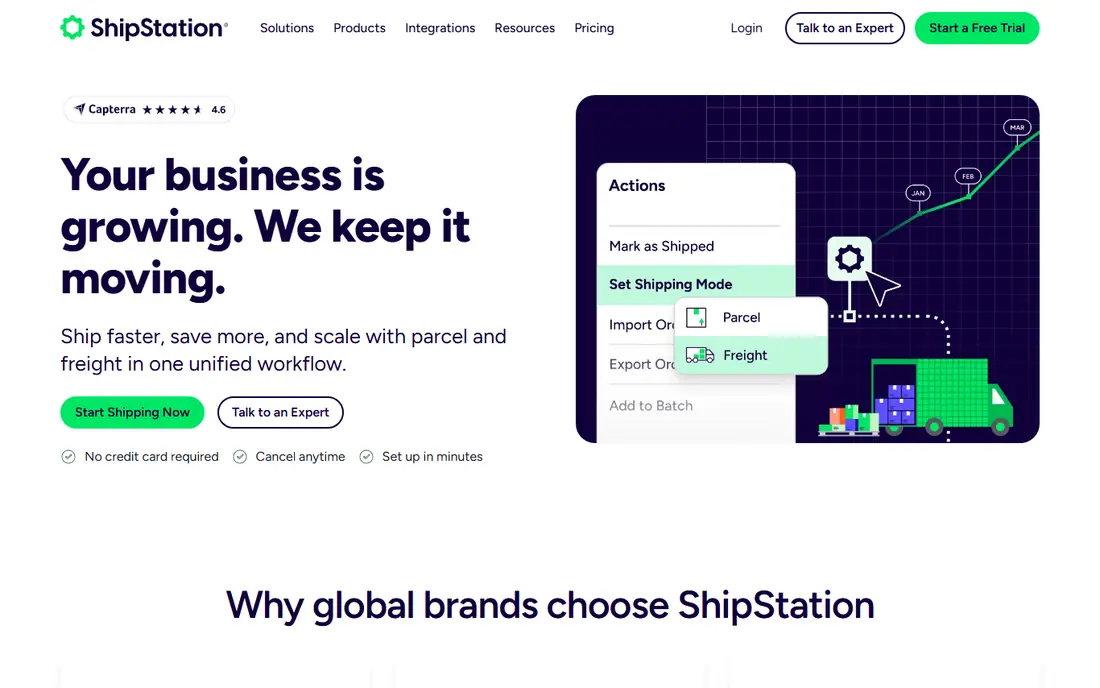
ShipStation is the most practical logistics starting point for a small business that ships parcels. It connects online stores and marketplaces, pulls orders in, compares carrier rates, prints batch labels, and handles customs forms and returns. Starter costs from 14.99 dollars per month for 50 shipments in recent comparisons, with Standard from 29.99 dollars per month and higher plans for larger volumes, and a 30 day free trial lets a store test the workflow.
The limits are volume and seats. Price rises with every shipment tier, and Starter caps users at three in published descriptions, with more seats on higher plans. ShipStation also focuses on parcel and LTL shipping, not on full truckload freight planning, so a manufacturer with complex freight needs a different tool. For an online store shipping parcels daily, ShipStation is our pick for most small businesses.
- Many carrier and store integrations
- Batch labels and rate shopping
- Returns portal on higher plans
- Price rises with shipment volume
- User seats are capped by plan
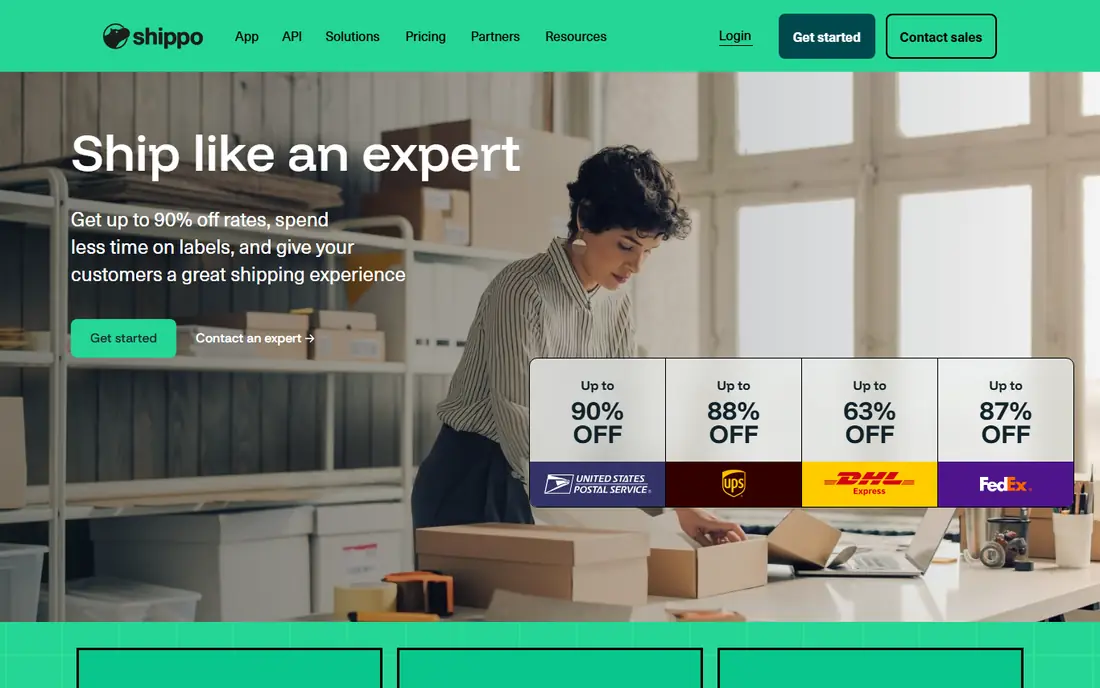
Shippo is the simplest route to a shipping label for a startup. You can start free, connect a store, compare parcel rates, print labels, and track shipments, paying for labels as you go rather than committing to a monthly tier. That model suits a new store with irregular volume, where a fixed monthly fee would waste money in slow months. The API also lets developers build shipping into a checkout or an order system.
Depth is the trade-off. Shippo does not replace a full transport management system for freight, warehouse management, or complex multi leg shipments, and higher volume features sit on paid plans. Use Shippo when parcel shipping is the main job and simplicity matters, and move to ShipStation or a freight TMS when volume, returns, or freight complexity grows. For a first shipping tool, Shippo is hard to beat on ease.
- Free to start with pay as you go labels
- Simple API and dashboard
- Many carrier options for parcels
- Less depth for freight, warehousing, and complex logistics
- Paid plans needed for higher volume features

Descartes offers a broad set of logistics products, from transport management and routing to customs, compliance, and global trade tools. That breadth helps cross border shippers, freight brokers, and 3PLs that need to handle customs documents, export controls, and multi country freight in one system. Descartes Aljex, a broker focused product in the Descartes family, is often cited as a more affordable, customisable option for freight brokers.
The product range is also the challenge. Descartes is not one simple app, and a buyer needs guidance to pick the right modules, pricing, and implementation scope. Pricing is tiered and often quote led, so we list it as See website. For a shipper with cross border or compliance heavy freight, Descartes is a strong shortlist pick. For a simple parcel store, it is far more than needed.
- Global multimodal coverage
- Customs and compliance tools
- Strong for freight brokers and cross border shippers
- Pricing is tiered and quote led
- Product range is broad, so picking the right module takes guidance
MercuryGate Transportation Management System is built for companies with complex, global logistics networks that need to plan, execute, and settle freight across modes. It covers multimodal planning, carrier management, optimization, and analytics, with a high degree of configurability for shipper specific workflows. That flexibility is why it appears in enterprise shortlists for retail, manufacturing, and 3PL operations.
Pricing is not public, and recent reviews note low transparency, with a demo and quote required, so we list it as See website. Implementation also takes a real commitment, and dependence on a single TMS can create lock in over time. MercuryGate suits a large shipper that needs a configurable, global TMS and has the team to run it. A small shipper should start with a parcel tool instead.
- Highly configurable TMS
- Global logistics and analytics
- Strong for complex shipper networks
- No public price
- Implementation needs time and expertise
- Risk of vendor lock in over time
Oracle Transportation Management, often called OTM, is an enterprise system for global logistics, covering air, ocean, rail, parcel, LTL, intermodal, and truckload shipments. It pairs well with Oracle Fusion Cloud ERP and Oracle Warehouse Management, giving a unified flow from order to delivery to freight settlement. Machine learning tools for delivery ETA prediction and re-drive help flag transit issues early, and global trade features cover customs documentation and trade agreements.
The cost and complexity are high. Published third party comparisons list a starting figure near 450 dollars per month, but enterprise licensing, implementation, and integration costs run far higher in practice, so we list it as See website and recommend a formal quote. The interface is also described as complex for new users. OTM is best for a large shipper already in the Oracle ecosystem, and less suited to a small team outside it.
- Deep global trade and multimodal coverage
- Strong fit with Oracle ERP and warehouse systems
- Machine learning ETA tools
- Steep learning curve
- High licensing and implementation cost
- Complex for non Oracle stacks
SAP Transportation Management, or SAP TM, is the freight and transport module for companies already running SAP. It plans and optimizes freight, manages carriers and tenders, tracks shipments, and settles freight costs inside the SAP system, so order, inventory, and finance data stay connected. That integration is the main reason to choose SAP TM over a standalone TMS, since it avoids rekeying data between systems.
Licensing is an add on to SAP, and implementation needs SAP expertise, so total cost is quote led and often high. A company outside SAP will find a standalone TMS simpler and cheaper to run. SAP TM suits a large manufacturer, retailer, or distributor already committed to SAP, where transport planning must sit inside the same system as orders and warehouses. For a standalone logistics need, MercuryGate or Shipwell may be simpler.
- Deep integration with SAP ERP and warehouse systems
- Strong freight planning and settlement
- Enterprise scale
- Add on licensing and implementation cost
- Needs SAP expertise to run well
Blue Yonder, formerly JDA, covers supply chain planning, warehousing, and transport at enterprise scale, with advanced analytics and predictive tools for large networks. Its transport and logistics modules help large retailers and manufacturers plan capacity, optimize routes, and manage complex, multi region networks. That breadth is useful when logistics is one part of a wider supply chain transformation, not a standalone shipping job.
Implementation cost and complexity are high, with third party estimates for enterprise users running into tens of thousands of dollars a year, so we list pricing as See website. A small or mid sized shipper will find Blue Yonder heavy, slow to roll out, and expensive for the job at hand. For a large enterprise that needs predictive planning across supply chain and transport, Blue Yonder belongs on the shortlist alongside Oracle and SAP.
- Advanced analytics and predictive planning
- Broad supply chain coverage beyond transport
- Enterprise scale
- High implementation cost
- Complex rollout
- Overkill for a small shipper
Manhattan Associates is known for warehouse management, and its transport and supply chain platform pairs warehouse execution with transport planning for large retailers and distributors. That combination helps when the warehouse and the truck must work as one system, with inventory, picking, and outbound transport planned together. Large scale operations benefit most, since the platform is built for high volume distribution.
Pricing and implementation are enterprise level and quote led, so we list it as See website. A small business will not need this depth, and a mid sized shipper may find a standalone TMS plus a simpler warehouse tool more practical. Manhattan Associates suits a large distributor or retailer that already runs, or plans to run, Manhattan warehouse software and wants transport in the same platform.
- Strong warehouse and transport combination
- Proven at large retail and distribution scale
- Unified supply chain platform
- Enterprise pricing and implementation
- Needs a dedicated team to run well
Shipwell is a modern transport management system that aims for faster onboarding than legacy enterprise TMS products. It covers load planning, carrier tendering, tracking with predictive ETAs, freight audit, and settlement, with integrations for NetSuite, QuickBooks, and payment tools. Third party comparisons list a starting figure near 1,000 dollars per month, but pricing is custom by volume and features, so we list it as See website.
The focus is freight, not last mile parcel delivery or branded tracking pages, so a parcel heavy store should pair Shipwell with a parcel tool or choose ShipStation instead. International shipping is also limited in some comparisons, which matters for cross border shippers. For a mid sized shipper that wants a modern freight TMS without a legacy rollout, Shipwell is a strong pick, provided the demo confirms coverage for your lanes.
- Modern interface and fast onboarding for a TMS
- Multimodal visibility and predictive ETAs
- Integrations with NetSuite and QuickBooks
- Primarily freight focused, with limited last mile tools
- Custom pricing hides the budget until a demo
How we picked these
We compared official product pages, pricing pages, and feature descriptions for software that manages logistics, from parcel shipping to freight transport and warehousing. We included small business tools and enterprise systems, because the other keywords cover both small business logistics and top logistics management software. Where pricing was custom or varied between sources, we wrote See website rather than publishing a figure that could mislead a budget.
What to check before you buy
Start with shipment type and volume. Count parcels, LTL shipments, truckloads, and ocean shipments per month, and list the carriers and lanes you use most. A parcel tool will not plan truckload freight well, and a freight TMS will be overkill for 50 parcels a month. That count alone narrows the list to two or three tools.
Next, test integrations with your real systems. Connect a store, an ERP, or a warehouse system in a trial, and check that orders, tracking, and freight bills flow without manual rekeying. Finally, model total cost, not just the monthly fee. Add implementation, integration, training, and per shipment fees, and ask for a quote on your exact volume. Enterprise tools in particular can look affordable on a monthly figure and expensive once implementation is added.
Best logistics software for small business: a short guide
For a small business, start with Shippo if volume is low and irregular, and move to ShipStation when daily parcel volume, returns, and automation grow. Add a freight broker or a freight TMS only when LTL or truckload shipments become regular.
Best software for logistics: parcel versus freight
Parcel tools optimize labels, carrier rates, and tracking for small packages, while freight tools optimize loads, tenders, and settlement for pallets and truckloads. Many growing businesses need both, with a parcel tool for online orders and a freight TMS for inbound and wholesale freight. Buying one tool for both jobs usually means a compromise on one side, so check which side drives your cost and service first.
Frequently asked questions
What is the best logistics management software for a small business?
ShipStation is the best all round pick for a small business shipping parcels, with clear plans, many integrations, and a trial. Shippo is better for a very small or irregular volume, since it starts free and charges per label. For freight, a small shipper should talk to a broker or a mid sized TMS such as Shipwell before committing to an enterprise system.
What is the difference between a TMS and shipping software?
Shipping software, such as ShipStation or Shippo, focuses on parcel labels, carrier rates, and order fulfilment for online stores. A transport management system, such as MercuryGate, Oracle OTM, or Shipwell, plans and settles freight across modes, manages carriers and tenders, and handles complex logistics networks. The right choice depends on whether parcels or freight drive your business.
How much does logistics management software cost?
Small business parcel tools start free or near 15 dollars per month, with higher tiers as volume grows. Mid sized freight TMS products are often quoted near 1,000 dollars per month in third party comparisons, while enterprise systems such as Oracle, SAP, Blue Yonder, and Manhattan are quote led and can cost far more once implementation is included. Always get a quote on your real volume.
Can logistics software track shipments in real time?
Yes, most tools on this list offer tracking, but depth varies. Parcel tools track carrier scans, while freight TMS products add predictive ETAs, exception alerts, and carrier visibility across modes. Check whether tracking covers your carriers and lanes, and whether alerts reach your team or your customers in a useful form, not just in a dashboard.
What is the best logistics software for e-commerce?
ShipStation is the strongest e-commerce pick on this list, thanks to store integrations, batch labels, rate shopping, and returns tools. Shippo is a simpler, lower cost alternative for startups. For a store that also ships wholesale freight, pair a parcel tool with a freight TMS, rather than forcing one tool to cover both jobs.
Do I need warehouse software as well as logistics software?
It depends on volume and complexity. A small store can manage inventory in a store platform and shipping in ShipStation without a separate warehouse system. A larger distributor with picking, packing, and multi warehouse stock needs warehouse management, and a platform such as Manhattan Associates or an SAP warehouse module may fit better. Start with shipping, and add warehouse software when picking errors or stock accuracy become a real problem.
Sources
See where you really rank - block by block
ProMapRanker scans Google Maps across a grid of your service area. Simple monthly plans from $19, white-label on every plan.
Start freeKeep reading
 whats the best ai app to use
Whats the Best AI App to Use in 2026
Wondering whats the best ai app to use in 2026? We compare ChatGPT, Claude, Gemini, Copilot, and more on price, free plans, and best everyday uses today.
Read → life360 alternatives
Life360 Alternatives in 2026
Life360 alternatives compared: 9 family location apps with live maps, arrival alerts and privacy controls to help your family stay in touch every day.
Read → captcha alternatives
CAPTCHA Alternatives in 2026
CAPTCHA alternatives compared: 9 reCAPTCHA alternatives that block bots with less friction, from free Turnstile to privacy-first proof-of-work tools included.
Read →