 ProMapRanker
Best Local SEO Tools for Chimney Sweeps in 2026
Direct answer
Moz Local is my first pick for chimney sweeps because listing accuracy across the directories that feed Google Maps matters most for a single-van or small-crew business, and Moz Local keeps those citations consistent. It has no free plan stated, so check its pricing page. For review requests after a sweep and inspection, GatherUp fits well, and CallTrackingMetrics helps you see which service areas and keywords actually produce phone calls.
I compared these tools from vendor documentation and public sources, not from hands-on testing. My focus was on what a chimney sweep actually needs: correct listings, steady reviews, calls tied to service areas, and rank checks around a small service radius.
Key takeaways
- Citation consistency across data aggregators and major directories is the base layer of local visibility for a chimney sweep, so listing tools come before content tools.
- Review requests sent after a completed sweep and inspection, without filtering customers, support both Google's guidelines and your Maps ranking.
- Rank tracking for a chimney sweep should be checked at the neighbourhood or postcode level, because a sweep business serves a tight radius rather than a whole country.
- Call tracking separates calls from people searching "chimney sweep near me" from calls about dryer vent cleaning or stove installs, which helps you judge which service pages earn their place.
- Seasonal demand means you should review your Google Business Profile categories, services and photos before the heating season, not in the middle of it.
Quick comparison
| Pick | Great for | Pricing starts at | Free tier | |
|---|---|---|---|---|
 Moz Local | Citation and listing consistency | See website | Not stated | Visit |
 GatherUp | Review requests after each job | See website | Not stated | Visit |
 CallTrackingMetrics | Calls by service and area | See website | Free trial | Visit |
 Local Viking | Grid rank tracking around your base | See website | Free trial | Visit |
 BrightLocal | Citation building plus audit reports | See website | Free trial | Visit |
 Whitespark | Finding local citation opportunities | See website | Not stated | Visit |
 Yext | Multi-location listing control | See website | Not stated | Visit |
The best local SEO tools for chimney sweeps compared
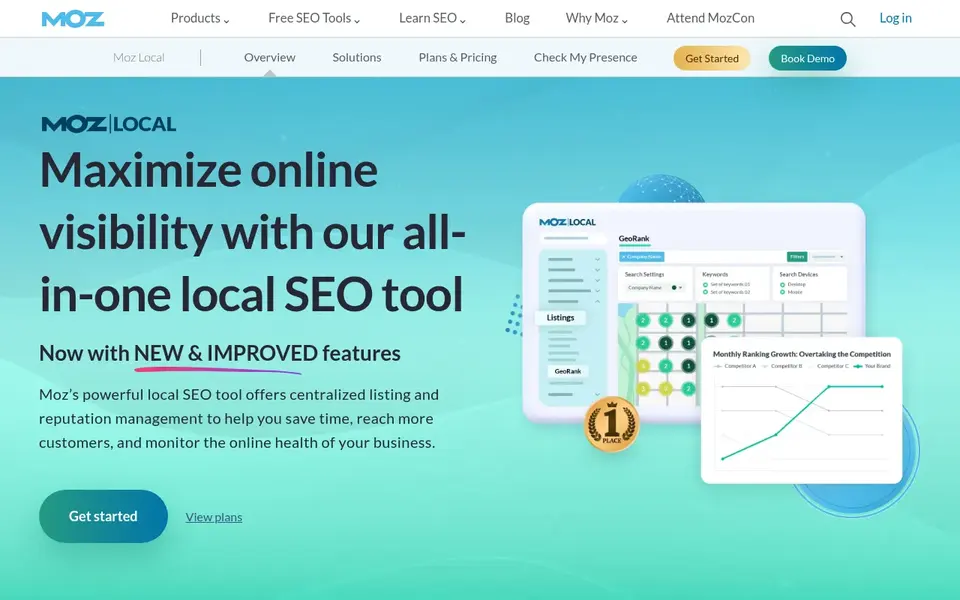
Moz Local is a listing management tool built around the idea that your business name, address, phone number, hours and categories should match everywhere. For a chimney sweep with one base and a service radius, that is the foundation. If your old address still sits on a directory from a previous unit, or your phone number changed when you switched to a business mobile, this is the kind of tool that surfaces it.
In practice you claim your Google Business Profile first, then use Moz Local to push consistent details to the directories that feed Maps and local search. For a sweep, set categories around chimney sweeping and chimney cleaning, add services like inspection, sweeping, cap fitting and dryer vent cleaning, and keep hours accurate because winter bookings depend on people seeing you as open.
The limit is market coverage. If you operate outside the US or in a country where its data partners are thin, the value drops and you should check coverage before paying. Skip it if you only want rank tracking.
- Distributes business data to major directories and data aggregators
- shows duplicate and inconsistent listings
- fits a single-location sweep business
- Data coverage is strongest in the US and select markets
- no free plan stated
GatherUp is a review management tool. For a chimney sweep, reviews are often the deciding factor because customers are letting a stranger into their home and onto the roof. A steady flow of recent reviews about tidiness, punctuality and clear explanations does more for trust than any keyword work.
The workflow that fits a sweep is simple: after the job, the office sends one invitation asking for an honest review, with no filtering and no incentive. You then reply to every review, including the critical ones, in plain language. Because chimney work is seasonal, you can time requests so they land the same day rather than a week later when the customer has moved on.
Skip it if you do fewer than a handful of jobs a week and can ask personally; a spreadsheet and a short message can carry you for a while.
- Sends review invitations by email or SMS
- brings reviews from multiple platforms into one inbox
- supports replies from one place
- Needs a reliable customer list
- no free plan stated
CallTrackingMetrics is a call tracking platform. Chimney sweeps live on phone calls: someone sees soot on the fireplace surround or hears birds in the flue and rings the first business that looks legitimate. Tracking numbers let you see which pages, ads and service areas produce those calls.
A practical setup is one tracking number for the main site and separate numbers for paid ads or a specific landing page for, say, dryer vent cleaning. Route calls to the mobile the crew actually answers. Over a season you learn whether stove installation enquiries come from the services page or from Maps, and you can put effort where the calls are.
The limit is that tracking numbers add a layer of management, and you must display them consistently so Google does not see conflicting numbers. Skip it if you already ask every caller how they found you and record it.
- Tracks calls against marketing sources
- supports multiple tracking numbers
- call recording and routing options
- Setup and number planning take time
- call tracking numbers must be shown clearly on the site
Local Viking is a Google Business Profile and local rank tracking tool. Its grid view shows where you appear in Maps across a set of points around your base. For a chimney sweep, that is more useful than a single national rank, because you serve a radius and the customer three streets away sees a different result from the one across town.
Use it to check whether your profile shows up in the towns and suburbs you actually cover, and to compare before and after you add services or photos. Geo-tagged job photos, taken with permission at real jobs, are a legitimate way to show activity in an area.
The caution is interpretation. A weak grid point at the edge of your radius may simply mean you do not serve there often. Skip it if you only work one small town and can check Maps by hand.
- Grid-based Maps rank views
- Google Business Profile management features
- geo-tagged photo support
- Grid scores can look alarming without context
- no free plan beyond the trial
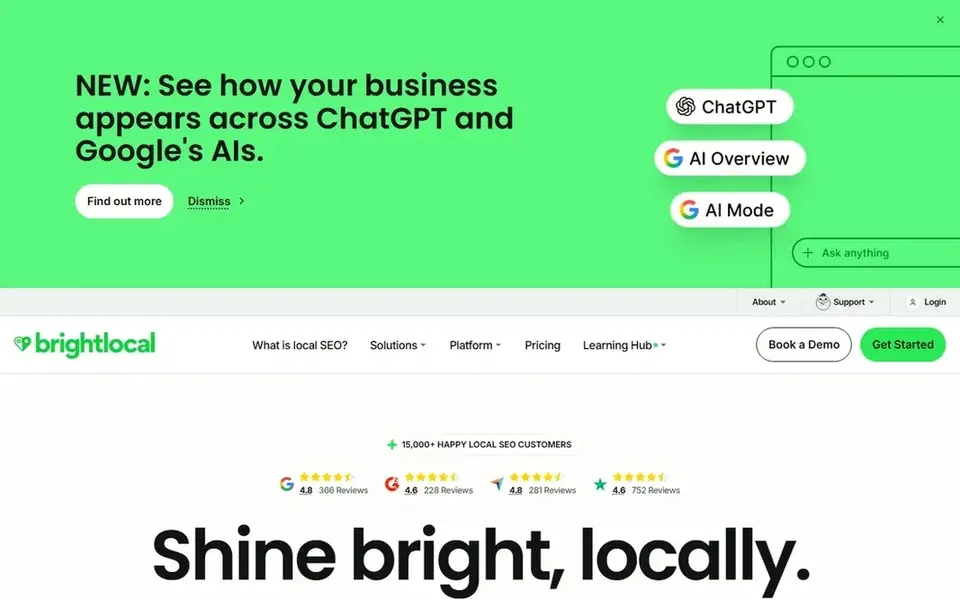
BrightLocal is a local SEO platform with citation, rank, review and audit tools. For a sweep who wants one dashboard rather than four subscriptions, it covers the basics: find inconsistent listings, build new ones, and check where you rank in the towns you serve.
The citation audit is the part I would use first. It lists where your business appears and flags mismatches in name, address or phone. Fixing those is unglamorous but it is the work that makes everything else easier. Reports also help you show a landlord or letting agent why your profile is worth linking to.
The limit is breadth. If you only need review requests, a dedicated tool is simpler. Skip it if you dislike dashboards and prefer doing one job at a time.
- Citation audit and building in one place
- local rank reports
- review and listing tools under one login
- Broad feature set can be overwhelming at first
- some tasks are better done manually
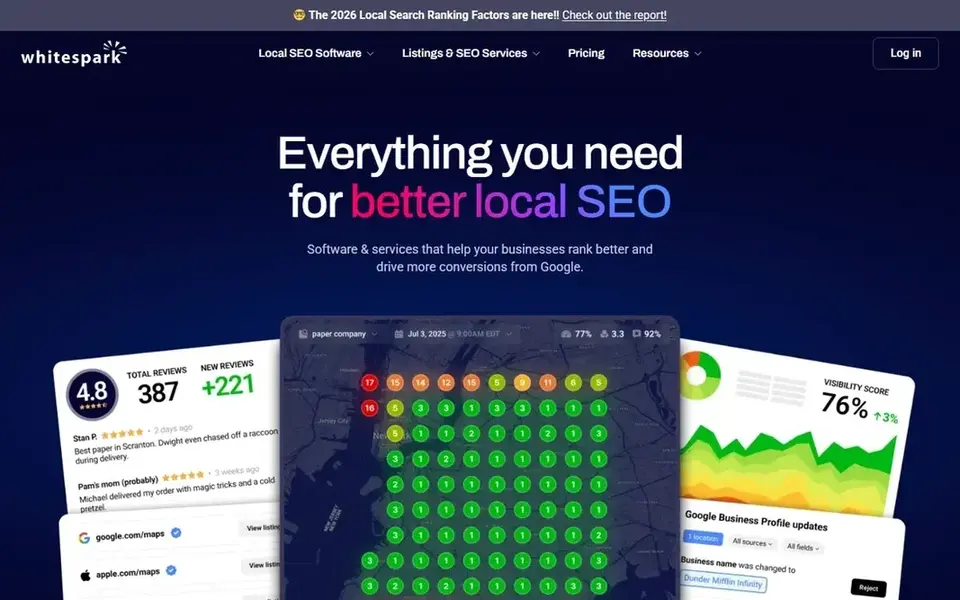
Whitespark is a local search tool set known for citation finding and building. Where a submission tool pushes your data out, Whitespark helps you discover the directories and local sites that matter for your area, including chambers of commerce, trade associations and regional listings.
For a chimney sweep, that matters because trade bodies and local organisations often link to members. A listing with a hearth or stove trade association, or a local business directory run by the council, can carry more weight than a generic aggregator. You then add the listing yourself with consistent details.
The trade-off is effort. It is not a push-button service, and building citations by hand takes time. Skip it if you want everything automated and are happy with the coverage a submission tool gives you.
- Citation finder built around local directories
- strong local search research tools
- citation building service available
- More manual than automated submission tools
- no free plan stated
Yext is an listings and digital presence platform. It suits a chimney business with several branches, or a franchise with vans across a region, because you update details once and they flow to many publishers. A single sweep with one address rarely needs this level of control.
If you do run multiple bases, Yext helps keep each location's hours, phone number and service list correct, which matters when a customer in one town calls the number for another. It also gives you a structured way to present services such as sweeping, inspection and stove fitting per location.
The limit is cost and complexity relative to a one-van business. Skip it unless you have several locations or a franchise model.
- Central control of business data across many publishers
- structured fields for services and hours
- fits franchises and multi-van operations
- Priced for larger operations
- overkill for a single-van sweep
How I chose
I compared these tools from vendor documentation and public sources, and I did not run hands-on tests. My starting point was the job a chimney sweep has to do locally: be found in Maps for the towns served, look legitimate through reviews, and know which calls come from which service. Tools that only make sense for national brands or large agencies did not make the list.
The second filter was fit and limits. I looked at whether each tool covers the basics for a small service business, whether its data coverage matches the markets a sweep is likely to work in, and where the tool stops being worth the effort. I also avoided anything that encourages review gating, bought reviews or keyword-stuffed business names, because those break Google's guidelines and put the profile at risk. Where I was unsure about a free plan, I said so rather than guessing.
What to check before you buy
- Whether the tool's directory and data coverage includes the country and region you actually sweep in, not just the US.
- Whether it can handle a service-area business with a hidden address, since many sweeps work from home and travel to customers.
- How review requests are sent and whether the tool allows you to filter or gate customers, which you should not do.
- Whether rank tracking can be set to a radius or grid around your base rather than a single city.
- Whether call tracking numbers can be displayed clearly and consistently alongside your main number.
- The contract length and cancellation terms, because chimney work is seasonal and you may want to pause in summer.
Frequently asked questions
Do I need a service-area business setup on Google Business Profile as a chimney sweep?
Yes, if you travel to customers and do not serve them at your own address. Set the business as a service-area business, hide the street address, and list the areas you cover. Keep the address accurate in the backend for verification. This matches how most sweeps operate from a home base or a yard.
How many reviews should a chimney sweep aim for?
There is no target number, and you should not chase a figure. Ask every customer after a completed job, without filtering, and reply to each review. A steady trickle of recent, specific reviews about punctuality, tidiness and clear advice is more useful than a burst of vague ones. Never offer incentives or buy reviews.
Should I create separate pages for each town I serve?
Only where you have something real to say. A page for a town you genuinely cover, with local details, job photos taken with permission and clear service information, is fine. Do not spin up dozens of near-identical pages with swapped town names, and never stuff keywords into your business name.
Can I track Maps rankings for a chimney sweep without a big budget?
Yes. You can check Maps manually from a few locations, or use a tool with a free trial to see a grid around your base. Start with the towns that produce most of your work. A single grid check before and after profile changes tells you more than a daily rank number.
What should I fix first if my Maps ranking is weak?
Start with your Google Business Profile: correct categories, accurate hours, real service list, and recent photos. Then fix inconsistent listings in directories, because wrong addresses and old phone numbers undermine trust. Reviews and calls come after that. Content and links matter, but the profile and citations are the base for a local service business.
Sources
See where you really rank - block by block
ProMapRanker scans Google Maps across a grid of your service area. Simple monthly plans from $19, white-label on every plan.
Start freeBrowse all guides
← Best Local SEO Software for Pet Stores in 2026Best Local SEO Tools for Golf Courses in 2026 →
 best local seo software for managed service providers
Best Local SEO Software for MSPs in 2026
A practical guide to the best local SEO software for managed service providers in 2026, covering multi-location listings, reviews, rank tracking and reporting.
Read → best local seo software for laundromats
Best Local SEO Software for Laundromats in 2026
A practical guide to the best local SEO software for laundromats in 2026, covering listings, reviews, rank tracking and call tracking for multi-location wash-and-fold.
Read → best local seo software for escape rooms
Best Local SEO Software for Escape Rooms in 2026
A practical guide to the best local SEO software for escape rooms in 2026, covering rank tracking, listings, reviews and calls, with vendor sources.
Read → ai local visibility for plumbers
AI Local Visibility Index for Plumbers: Who ChatGPT and Gemini Recommend
A first-of-its-kind AI visibility index for plumbers: which firms ChatGPT, Gemini, and Perplexity recommend and why.
Read → local seo for acupuncture clinics
Local SEO for Acupuncture Clinics
A local SEO guide for acupuncture clinics: Google Business Profile setup, reviews, and alternative-medicine local SEO.
Read → local seo for day spas
Local SEO for Day Spas
A local SEO guide for day spas: Google Business Profile setup, reviews, and spa treatment listings and review generation.
Read →More in Local SEO & Google Maps · All guides A to Z by date · Latest guides