 ProMapRanker
Best Local Rank Tracking Tools for Tuxedo Rental Shops in 2026

Grid local rank tracking with history · Pricing starts at: See website
Direct answer
SE Ranking is my top pick for most tuxedo rental shops because it tracks grid-based local rankings across a city and pairs that with rank history you can check during prom and wedding season. It has no free plan stated, so check its pricing page. If you mainly need to watch Google Business Profile visibility, Localo fits well, and Local Dominator is a solid alternative for grid heatmaps on a tighter scope.
I compared these tools from vendor documentation and public sources, not from hands-on tests. My focus was how each one fits the way a tuxedo rental shop actually gets found: people searching near me, searching for a specific event, and checking the map before they call or walk in.
Key takeaways
- A tuxedo shop ranks differently for "tuxedo rental near me" than for "prom tuxedo rental," so you need a tool that tracks several keyword sets at once.
- Grid-based tracking shows where in your city you rank, which matters when customers drive in from suburbs and neighboring towns.
- Seasonal demand around prom and wedding season means rank history over time is more useful than a single snapshot.
- Google Business Profile signals drive most local visibility for rental shops, so GBP-focused tools belong in the mix.
- No tool guarantees rankings; use the data to fix listings, categories, photos and reviews, then re-check.
Quick comparison
| Pick | Great for | Pricing starts at | Free tier | |
|---|---|---|---|---|
| SE Ranking | Grid local rank tracking with history | See website | Not stated | Visit |
 Localo | Google Business Profile visibility | See website | Free trial | Visit |
 Local Dominator | Grid heatmaps for a service area | See website | Not stated | Visit |
 Advice Local | Listing management plus local visibility | See website | Not stated | Visit |
 Synup | Multi-location listing and local presence | See website | Not stated | Visit |
 GatherUp | Review requests and reputation | See website | Free trial | Visit |
 Nimbata | Call tracking from local ads and listings | See website | Free trial | Visit |
The best local rank tracking tools for tuxedo rental shops compared
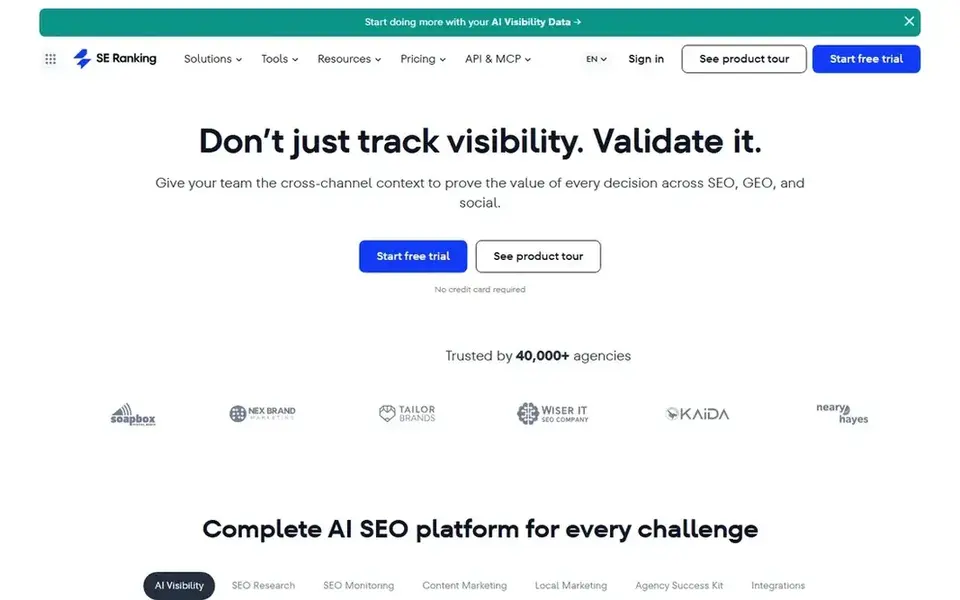
SE Ranking is a general SEO platform with a local rank tracking module that plots rankings on a grid across your service area. For a tuxedo shop, that grid is useful because your customers often come from several towns, and you want to know whether you show up in the map pack for searches made a few miles away.
In practice, I would set up separate keyword groups for event-driven searches like prom, wedding and formal rental, plus general near-me terms. You can then watch how those groups move as prom season approaches and compare this year against last year. The rank history helps you see whether a listing change or a batch of new reviews actually shifted your map position.
The limits are mostly about scope. Grid tracking and deeper local features sit on higher tiers, so a single-location shop may pay for capacity it does not use. If you only want a simple position number for one keyword, this is more tool than you need.
- Tracks local grid rankings across a city
- keeps rank history for seasonal comparison
- combines keyword and competitor tracking in one place
- Local grid features sit on higher plans
- more settings than a small shop needs at first
Localo is built around Google Business Profile, which is where most tuxedo rental searches actually resolve. When someone searches for a rental shop near them, the map pack and the profile panel do most of the work, so a tool that watches those signals closely fits the job.
For a rental shop, that means watching how your profile performs for terms tied to events and location, and spotting gaps in categories, photos or posts that affect visibility. It suits an owner or a small agency contact who wants a clear view of GBP performance without digging through a full SEO platform.
Skip it if you need deep website rank tracking or competitor keyword research across many pages. It is a profile-focused tool, not a full local SEO suite.
- Focused on Google Business Profile performance
- shows local visibility signals in one dashboard
- approachable for a shop owner without an SEO background
- Narrower than a full SEO suite
- less useful if you need broad keyword research
Local Dominator centers on grid-based local rank tracking, showing your position across a map rather than a single point. For a tuxedo shop near a city border, that view answers a practical question: do I rank for people searching from the next town over, where a lot of my customers live?
I would use it to map the towns you actually draw from, then check the heatmap before and after listing cleanups or review pushes. The visual report is easy to share if you work with an agency or want to show a partner where visibility is thin.
The trade-off is depth. It does not replace a full SEO platform for on-page work, and if you need keyword research or content planning, you will need another tool alongside it.
- Grid heatmap view of local rankings
- useful for seeing suburb-level visibility
- straightforward reporting for clients or owners
- Narrower feature set than full platforms
- less depth on website-side SEO
Advice Local focuses on listing management, keeping your shop's name, address, phone, hours and categories consistent across directories. That consistency matters for a rental shop because customers check hours and location before an event, and mismatched data sends them elsewhere.
Alongside listings, it supports local visibility monitoring, so you can see how your presence holds up as you add or correct data. For a shop that has moved, changed hours for prom season, or opened a second counter, this is the kind of cleanup that supports map rankings.
It is a broader service than a pure rank tracker, so if all you want is a position number, look elsewhere. It fits shops that need listing hygiene first.
- Manages business listings across directories
- supports local visibility monitoring
- useful for keeping name, address and phone consistent
- Rank tracking is part of a wider service
- more than a pure tracker
Synup is a listing and local presence platform aimed at businesses with multiple locations. A single tuxedo shop with one storefront will find it heavier than needed, but a rental business with several counters across a metro area gets a consistent way to manage listings and watch local presence.
For a multi-location shop, the value is consistency: the same hours, categories and service descriptions everywhere, which supports map visibility across each area. You can then monitor how each location's presence holds up.
The limits are cost and complexity. Setup takes effort, and a one-location shop should weigh whether the listing management alone justifies it.
- Handles listings across many directories
- supports local presence monitoring
- scales to several locations
- Built for larger operations
- heavier setup for a single shop
GatherUp handles review requests and reputation management. For a tuxedo shop, reviews are a big part of local trust: a groom or prom customer reads recent reviews before choosing where to rent, and steady fresh reviews support your profile.
I would connect it to your rental workflow so a request goes out after a pickup or return, then respond to reviews in one place. Following Google's guidelines means asking every customer, not filtering for happy ones, and never offering incentives for positive reviews.
It does not track rankings, so pair it with a tracker. If reviews are already handled manually and volume is low, you may not need it yet.
- Automates review requests after a rental
- pulls reviews into one place
- supports responding to reviews
- Not a rank tracker by itself
- review volume alone does not move rankings
Nimbata is a call tracking tool. Tuxedo rentals often start with a phone call about availability, sizing or a group order, so knowing which listing or ad produced the call tells you where to spend effort.
I would use it to see whether calls come from your Google Business Profile, a local ad or a directory listing, then compare that with your rank data. If map visibility rises but calls do not, the profile or the offer may need work.
It does not track rankings at all, so it is a companion tool. Skip it if almost all your bookings come through the website or walk-ins.
- Tracks calls from local campaigns and listings
- ties calls to source
- useful for measuring phone-driven rentals
- No rank tracking
- only useful if phone calls are a main channel
How I chose
I started from each vendor's own documentation and public material, then checked how the tool's features map to how a tuxedo rental shop gets found. That means I weighted local grid tracking, Google Business Profile visibility, listing consistency and review flow, because those are the levers that matter for event-driven, location-based searches. I did not run hands-on tests, so treat the notes as a starting point for your own trial.
I also looked at limits. A one-location shop does not need a multi-location listing platform, and a shop that rarely gets phone calls does not need call tracking. Where a tool is broader than a pure rank tracker, I said so, because paying for capacity you will not use is a common mistake. Pricing changes, so I pointed you to each vendor's page rather than quoting figures.
What to check before you buy
- Confirm the tool tracks rankings on a grid across the towns you actually draw customers from, not just one city center point.
- Check whether you can group keywords by event, such as prom, wedding and general formal rental, so seasonal shifts are easy to read.
- Make sure rank history is included, so you can compare this prom season against last year.
- Ask whether Google Business Profile signals are covered, since the map pack drives most rental searches.
- Check how many locations and keywords your plan allows before you commit, and whether you can add a second counter later.
- Confirm the tool follows Google's guidelines on reviews and listings, and avoid anything that gates or buys reviews.
Frequently asked questions
Do tuxedo rental shops really need a local rank tracker?
Yes, if you want to know where you show up in the map pack for near-me and event searches. A tracker shows whether your listing changes, reviews and categories are moving you up or leaving you flat, which is hard to judge by searching manually from one location.
How many keywords should a single shop track?
Start with a small set grouped by intent: general near-me rental terms, prom terms, wedding terms and formalwear terms. Add the towns you draw from. A focused list you actually review beats a long list you ignore, and you can expand once you see which groups move.
Can I track rankings without paying for a full SEO platform?
Yes. Profile-focused tools and grid trackers cover local visibility without a full suite. The trade-off is depth: you may need a second tool for website work. Start with the free trial where one is offered and check whether the local features you need are included.
Does call tracking help with local rankings?
Not directly. Call tracking measures which listing or ad produced a call, which helps you judge whether visibility turns into bookings. Pair it with rank data: if rankings rise but calls do not, look at your profile, hours and offer rather than assuming the tracker is wrong.
How often should I check local rankings?
Weekly is enough for most shops, with a closer look in the weeks before prom and wedding season. Daily checks mostly add noise. What matters is the trend across a season and whether a specific change, like a listing fix or a review push, moved your position.
Sources
See where you really rank - block by block
ProMapRanker scans Google Maps across a grid of your service area. Simple monthly plans from $19, white-label on every plan.
Start freeBrowse all guides
← Best Local Rank Tracking Tools for Spin Studios in 2026Best Local SEO Software for Butcher Shops in 2026 →
 best local rank tracking tools for granite countertop companies
Best Local Rank Tracking Tools for Granite Countertop Companies (2026)
A guide to local rank tracking tools for granite countertop companies, compared from vendor docs and public sources, with GBP and map grid notes.
Read → best local rank tracking tools for christmas tree farms
Best Local Rank Tracking Tools for Christmas Tree Farms in 2026
A practical guide to the best local rank tracking tools for Christmas tree farms in 2026, covering grid maps, GBP checks and seasonal reporting.
Read → best listing management software for orchards
Best Listing Management Software for Orchards in 2026
A practical guide to the best listing management software for orchards in 2026, covering Google Business Profile, seasonal hours, reviews and local rankings.
Read → local seo for home services
Local SEO for Home Services Businesses: The Master Guide
A master local SEO guide for home services businesses to win service-area searches.
Read → best geo grid rank tracking tools
Best Geo-Grid Rank Tracking Tools in 2026 (Compared)
The best geo-grid rank tracking tools in 2026 compared on accuracy, AI features, and cost.
Read → where gemini gets local business info
Where Does Gemini Get Local Business Information?
Where Gemini sources local business information and how to influence what it recommends.
Read →More in Local SEO & Google Maps · All guides A to Z by date · Latest guides