 ProMapRanker
Literature Review Software in 2026: Top 8 Compared

Researchers who want reference management plus a social academic network · Pricing starts at: Free (2GB storage)
Direct answer
For researchers who want reference management plus a social academic network, Mendeley is where this list starts. Listed starting prices: Rayyan from $4.99 per seat a month, Scite from $20 per user a month ($12 per user per month billed annually) and EndNote from $275 (one-time license; student pricing from about $124.95). Look at Rayyan for budget-conscious teams running systematic review screening, and at Scite for verifying whether citations support, contrast, or just mention a claim. The remaining 5 options are covered below with prices and limits.
If you are comparing literature review software, this page covers 8 tools in one place: what each is best for, what it costs to start, whether it has a free plan, and the main limit to know about.
Key takeaways
- This list starts with Mendeley, which is built for researchers who want reference management plus a social academic network.
- Covidence suits Cochrane-aligned teams needing standardized review workflows.
- What to know about Rayyan first: screening only, no extraction or synthesis tools.
- Only 5 of the 8 tools have a free plan (Mendeley, Rayyan, Scite, Zotero, Connected Papers), so check the caps.
- The cheapest monthly starting price in the list is $4.99 per seat per month, offered by Rayyan.
Quick comparison
| Pick | Great for | Pricing starts at | Free tier | |
|---|---|---|---|---|
| Mendeley | Researchers who want reference management plus a social academic network | Free (2GB storage) | Yes | Visit |
 Rayyan | Budget-conscious teams running systematic review screening | $4.99 per seat a month (billed yearly) | Yes | Visit |
 Scite | Verifying whether citations support, contrast, or just mention a claim | $20 per user a month ($12 per user per month billed annually) | Yes | Visit |
 EndNote | Researchers at institutions that standardize on it | $275 (one-time license; student pricing from about $124.95) | Free trial | Visit |
 Zotero | Students and researchers who want free reference management | Free (300MB storage; extra storage from $20 a year) | Yes | Visit |
 Connected Papers | Exploring a field visually from one seed paper | $6 a month (Academic, billed yearly) | Yes | Visit |
 MAXQDA | Researchers who want stable mixed-methods qualitative analysis | $114 a year (student; standard subscriptions from $299) | Free trial | Visit |
 Covidence | Cochrane-aligned teams needing standardized review workflows | $339 per review a year | Free trial | Visit |
8 options for literature review software in detail
Mendeley
Great for: Researchers who want reference management plus a social academic network
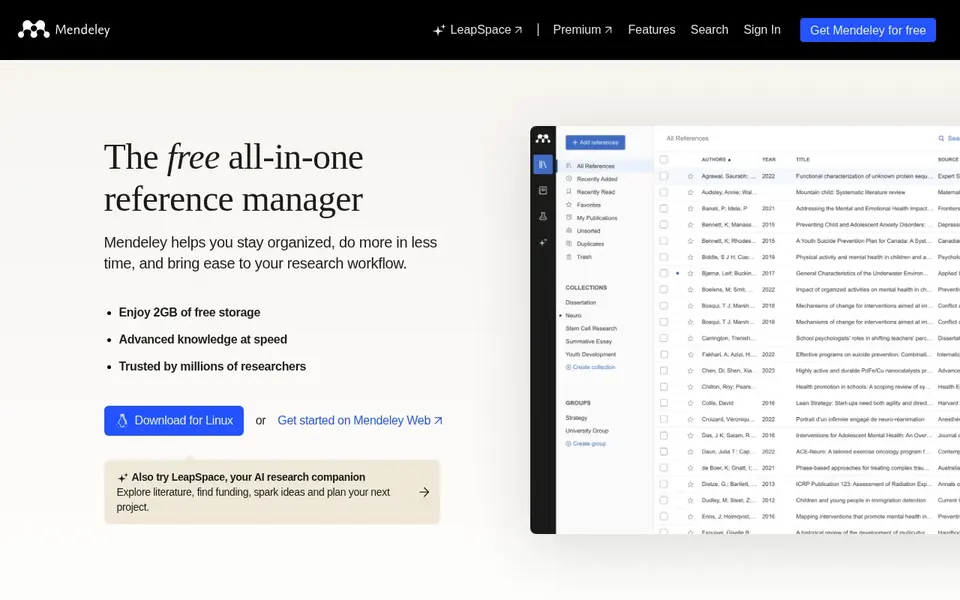
Mendeley is aimed squarely at researchers who want reference management plus a social academic network. The free level contains 2GB of cloud storage, noticeably more generous than Zotero's 300MB, and the PDF reader with annotation is genuinely decent.
Points against: 2GB still fills up with heavy PDF use.
Mendeley cost at the entry level: Free. You can start on Mendeley without paying.
- Clean PDF reader and annotation
- Free 2GB storage beats Zotero's free level
- Development has slowed under Elsevier
Where Rayyan fits: budget-conscious teams running systematic review screening. It is deliberately narrow.
Downsides: Screening only; Free plan caps at 3 active reviews.
For small teams and student-led reviews, Rayyan's combination of a real free level and low premium prices makes it the default starting point for screening. Rayyan pricing: $4.99 per seat per month. Free access exists with Rayyan.
- Ample free tier with AI relevance predictions
- Fast interface aimed at high-volume screening
- No extraction or synthesis tools
Scite
Great for: Verifying whether citations support, contrast, or just mention a claim
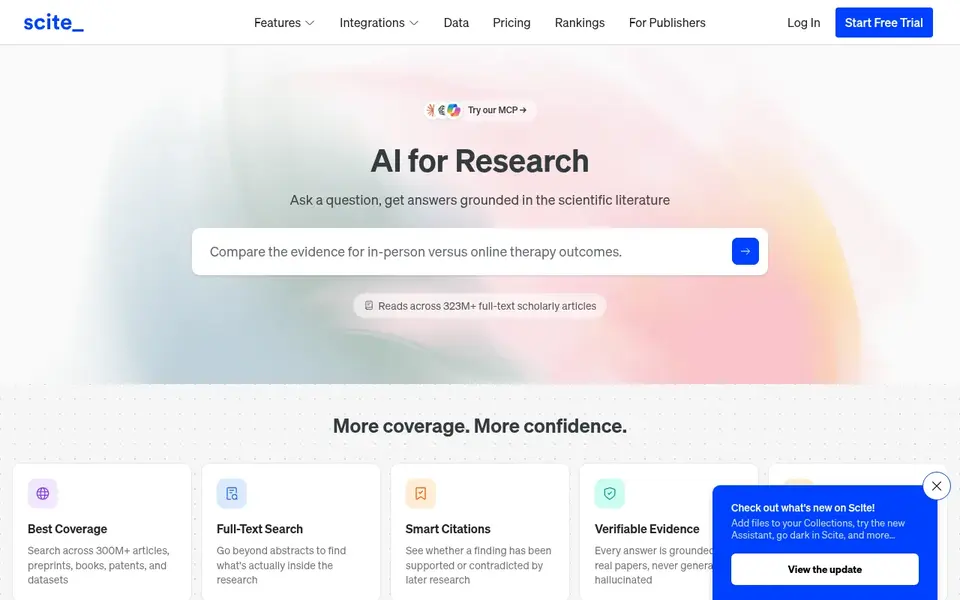
Scite is designed for verifying whether citations support, contrast, or just mention a claim. Scite answers a question citation counts cannot: how was this paper actually used by the papers citing it?
Downsides: AI assistant needs a premium plan.
Also, use it as the quality-control layer on top of your search strategy, not as the strategy itself. More specifically, Pro at $50 brings API access and patent, clinical trial, and grant datasets. The starting price for Scite: $20 per user per month. Free access exists with Scite.
- Flags retractions and editorial notices
- Smart Citations display the context around every citation
- $20 per month is steep for individual researchers
EndNote is built with researchers at institutions that standardize on it in mind. The interface presents its age and the ramp-up time is real.
Downsides: Costly for individuals.
If you are buying out of pocket, try Zotero first and only switch if you hit a specific wall. Price to start with EndNote: $275. Trial and free access: Free trial.
- Retraction alerts protect your bibliography
- Deepest Word integration of any manager
- Interface feels dated
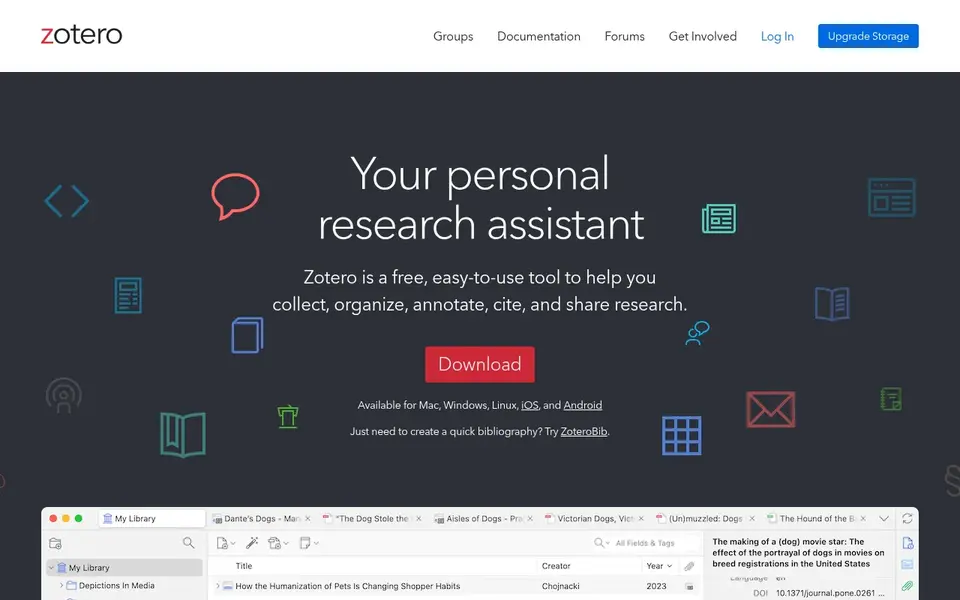
Zotero works best for students and researchers who want free reference management. Zotero is the reference manager most researchers recommend to students.
Limits to weigh: Interface looks dated.
The price explains why: the full product is free, including unlimited references, Word and Google Docs integration, and the browser connector that saves papers with one click. It is open source, so a community of plugins extends it into everything from duplicate detection to journal-abbreviation handling. Zotero starts at: Free. Free access exists with Zotero.
- Open source with a huge plugin ecosystem
- Very good browser connector for saving papers
- PDF annotation weaker than commercial rivals
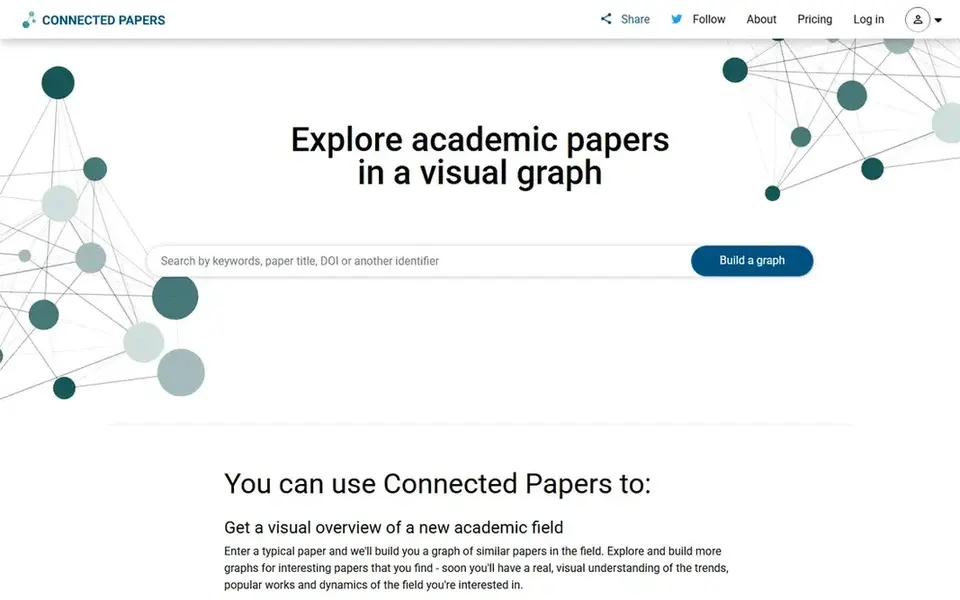
Connected Papers is a good fit for exploring a field visually from one seed paper. Prior works and derivative works split into two views, making it simple to trace how ideas evolved.
Drawbacks to consider: Desktop browsers only.
In daily use, the free plan provides you 5 graphs per month with every feature included, enough for occasional exploration. The starting price for Connected Papers: $6 per month. Connected Papers offers a free plan.
- Beautiful similarity graphs reveal related work keyword searches miss
- Free tier contains all features
- Free plan capped at 5 graphs a month
MAXQDA is designed for researchers who want stable mixed-methods qualitative analysis. AI-assisted coding helps with the first pass through large datasets, and team features with secure cloud sharing support collaborative projects.
Points against: Ramp-up time costs days of productivity.
If you are choosing freely and want the calmer, more predictable choice, MAXQDA deserves the first look. MAXQDA cost at the entry level: $114 per year. As for free access: Free trial.
- Solid mixed-methods and stats integration
- Transparent licensing
- Export workflows feel clunky
Covidence
Great for: Cochrane-aligned teams needing standardized review workflows
Covidence is built with Cochrane-aligned teams needing standardized review workflows in mind. Individuals pay per review: $339 for a single review valid 12 months with unlimited collaborators, or $907 for a package of three.
Where it falls short: $339 per review brings up across several projects.
That is costly next to Rayyan's free level, and the price only makes sense when you need the full pipeline and the methodological credibility. Beyond that, for narrative or scoping reviews that do not need Cochrane-grade process, it is overkill. Starting cost for Covidence: $339 per review per year. Free access: Free trial.
- Unlimited collaborators per review
- Risk-of-bias in one workflow
- Individual pricing stings without institutional backing
A buyer's checklist
- Prices are a starting point; Rayyan shows $4.99 per seat per month to start, so verify what your seat count would cost.
- Read the fine print on the free plans from Mendeley, Rayyan, Scite and others; seat, project and feature caps differ.
- Use real work to test the free trial from EndNote, MAXQDA and Covidence, rather than a demo project.
- Read the limits listed for Mendeley first: development has slowed under Elsevier.
- Look at the help docs and support options for Scite before you commit.
- Confirm you can export your data from Mendeley, so leaving later does not mean losing records.
Frequently asked questions
Can I try these options before paying?
Often, yes. Mendeley, Rayyan, Scite and others have a free plan and EndNote, MAXQDA and Covidence offer a free trial. Use your own data and a real task during the test, and check what the free tier or trial limits before you rely on it.
How are the tools for literature review software ordered?
Mendeley sits first and Covidence last because the order follows typical fit for literature review software, then price clarity and free access. It is a judgement call, so read each profile for fit and limits.
Which tool is a good match for a systematic review?
For most readers this guide would start with Mendeley, built for researchers who want reference management plus a social academic network. Rayyan is the alternative for budget-conscious teams running systematic review screening, and Scite for verifying whether citations support, contrast, or just mention a claim. The right answer depends on budget and workflow.
Do these tools publish their prices?
Yes. Every tool from Mendeley to Covidence shows a starting price, though seats, add-ons and billing terms still change the final cost.
Is Zotero really free?
Yes. The core product is free and open source with no limits on references or citations. You get 300MB of cloud storage free, with additional storage from $20 per year.
What is the cheapest option for literature review software in this list?
On published monthly entry prices, Rayyan is the lowest here at $4.99 per seat per month. Entry price is only part of the cost, because seats, add-ons and billing terms can change the total.
Sources
See where you really rank - block by block
ProMapRanker scans Google Maps across a grid of your service area. Simple monthly plans from $19, white-label on every plan.
Start freeBrowse all guides
← 2026 Guide to the Best Creative Review SoftwareOnline Reputation Management Software for Law Firms (2026) →
 best ai document review software for mid size law firms
6 Best AI Document Review Software for Mid Size Law Firms for 2026
Best AI document review software for mid size law firms: 6 tools compared on price, free plans and fit. Cost notes and weak points included. Updated for 2026.
Read → best ai document review software for law firms
6 AI Document Review Software for Law Firms Ranked for 2026
Best AI document review software for law firms: 6 contenders ranked by fit, with entry costs and free tiers. Short verdicts, no fluff. Read the profiles.
Read → best survey software for franchises
6 Best Survey Software for Franchises in 2026
Compare 6 best Survey software for franchises, with prices, free plans and who each fits. Each pick comes with its main catch. Current for November 2026.
Read → best software to create forms
Best Software to Create Forms in 2026
Best software to create forms, compared by our team: we review Jotform, Typeform, Google Forms, Cognito Forms and more for surveys, signups and orders.
Read → best survey apps for money
Best Survey Apps for Money in 2026
Compare the best survey apps for money in 2026, including payouts, cashout minimums, and which paid survey apps fit your spare time best, with pricing.
Read → getfeedback alternatives
Best GetFeedback Alternatives in 2026
Searching for getfeedback alternatives? We compare 9 feedback tools on Salesforce links, NPS surveys, follow-up workflows, pricing, and ease of setup.
Read →More in Reviews & Reputation · All guides A to Z by date · Latest guides