 ProMapRanker
Best Lead Generation Companies in 2026

Key takeaways
- Apollo is the best all-round pick for small and mid-sized teams because it combines a large contact database with built-in outreach.
- ZoomInfo remains the enterprise standard for North American data, intent signals and org charts, at a much higher contract price.
- Cognism is the strongest choice for European prospecting, with phone-verified mobile numbers and compliance-focused sourcing.
- Lusha and RocketReach are better for quick, individual lookups than for running a full outbound program.
- Data quality varies by region and role, so run a trial against your own ideal customer list before signing an annual contract.
Quick comparison
| Pick | Great for | Pricing starts at | Free tier | |
|---|---|---|---|---|
 Apollo | All-in-one data and outreach | $49 per month | Yes | Visit |
 ZoomInfo | Enterprise data and intent | See website | No | Visit |
 Lusha | Fast individual contact lookups | $37.45 per month | Yes | Visit |
 RocketReach | Executive and recruiter lookups | See website | No | Visit |
 Cognism | European and compliant data | See website | No | Visit |
 Seamless.AI | Real-time contact search | See website | Yes | Visit |
 LeadIQ | LinkedIn to CRM capture | $15 per month | Yes | Visit |
 UpLead | Verified emails with a guarantee | $99 per month | No | Visit |
 LinkedIn Sales Navigator | Social selling on LinkedIn | $119.99 per month | No | Visit |
The best lead generation companies
We compared these companies on database coverage, contact accuracy, outreach features, pricing transparency and regional strength. A lead generation company here means a platform that helps you find and contact business buyers, not a done-for-you agency that books meetings on your behalf.
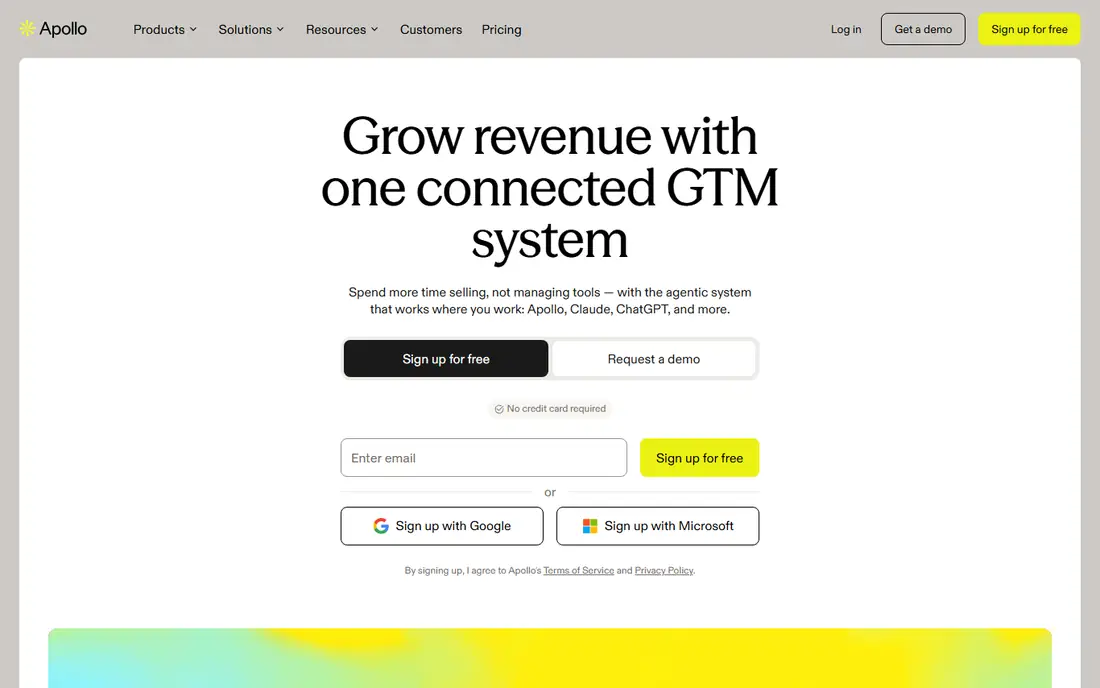
Apollo is our pick for most small and mid-sized sales teams because it does two jobs in one subscription. You can build a list from its contact database, then run email sequences and calls from the same tool, without buying a separate engagement platform. Paid plans start at $49 per user per month when billed annually, and the free plan gives you a limited credit allowance to test the data.
The catch is that Apollo is not the deepest source for every market. Its phone coverage and job-title accuracy can be thinner outside the United States, and credits burn faster when you pull phone numbers. If your market is mainly North American and your team wants one tool for prospecting and outreach, Apollo is hard to beat on value. If you sell mainly into Europe, pair it with or replace it by Cognism.
- Large contact database with built-in sequences and dialer
- Public per-seat pricing
- Free plan for testing
- Phone data is weaker outside North America
- Credit system needs watching on large teams
- Data accuracy varies by segment
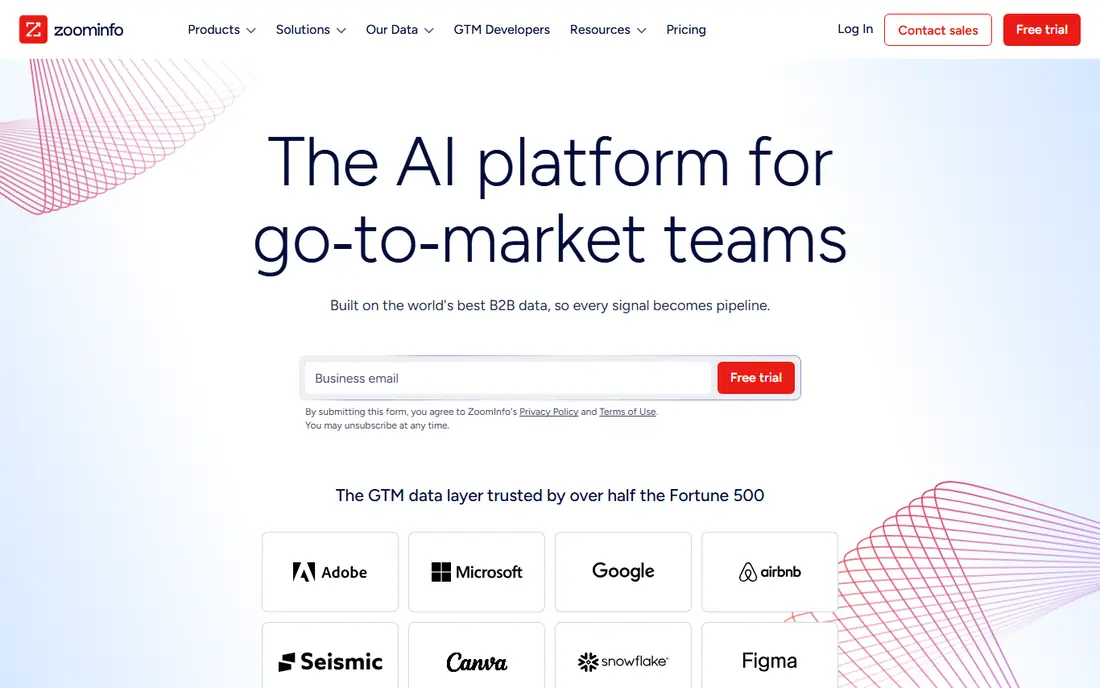
ZoomInfo is the platform larger revenue teams compare everything else against. Its database covers companies and contacts in depth, and its intent data helps teams spot accounts that are actively researching a topic. The newer workspace features add AI summaries and outreach drafting, which suit teams that already run a structured sales process.
The price is the reason many teams look elsewhere. ZoomInfo does not publish a standard price, and reported annual contracts run into five figures, which only makes sense if several reps use it daily. There is a free Lite tier with a small monthly credit allowance, but it is a taste rather than a working plan. Choose ZoomInfo when data depth, intent and scale justify the contract. Choose Apollo when they do not.
- Deep North American company and contact data
- Intent signals and org charts
- Strong CRM integrations
- Pricing is quote-based and expensive
- Annual contracts are the norm
- Smaller teams can pay for depth they never use
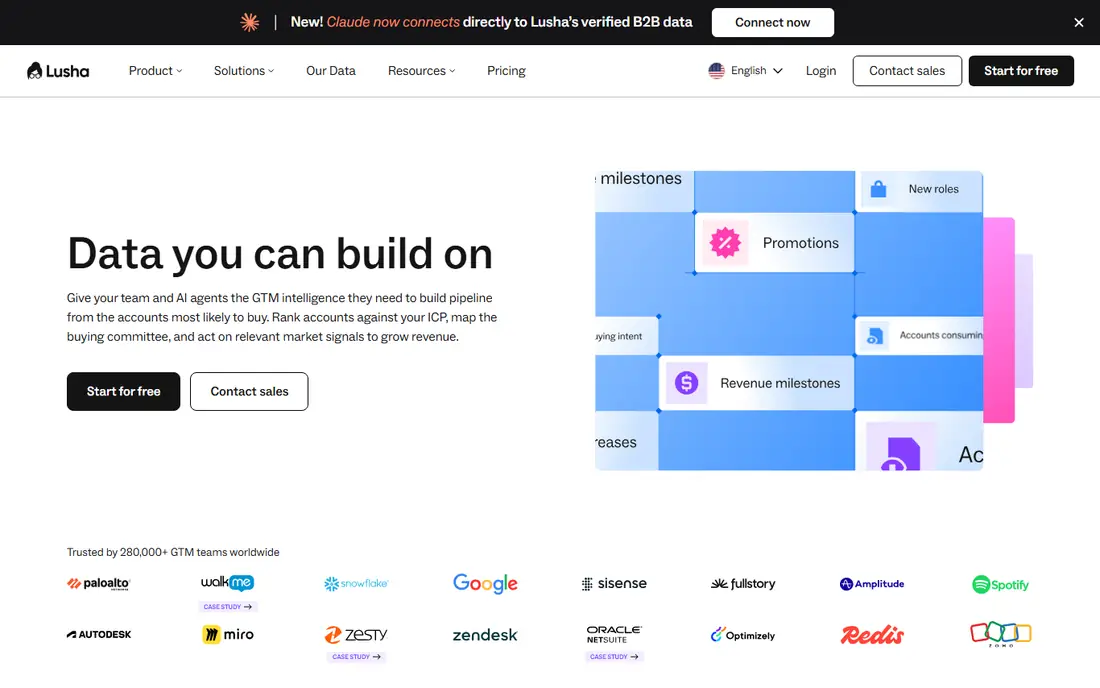
Lusha is built for speed. A rep browsing LinkedIn can reveal a contact and add it to a list in a few clicks, which makes it a good fit for individual sellers and small teams that do not need a full sequencing platform. The free plan includes a monthly credit allowance, and the starter paid plan is $37.45 per user per month when billed annually.
Lusha will frustrate a team that tries to use it as a bulk list builder, since credits run out fast and the tool is not designed for large outbound campaigns. It also sits behind the enterprise tools on phone coverage. Used for what it is, a fast and simple lookup tool with honest pricing, Lusha earns its place. Used as a ZoomInfo replacement, it will disappoint.
- Quick browser extension for LinkedIn and company sites
- Clear starter pricing
- Buying signals and ideal customer scoring
- Credit limits bite on high-volume prospecting
- Phone data is not as deep as Cognism or ZoomInfo
- Best as a lookup tool, not a full platform
RocketReach is a practical database for finding people at named companies, especially senior executives who are hard to reach through general lists. Recruiters use it for the same reason: you can search by title, company and location, then export contacts for outreach. Higher plans add sequences and an AI email writer, which helps small teams that do not want a second tool.
The weakness is transparency. RocketReach has listed different entry prices over time, so treat any single figure you see in a review as a starting point and check the current pricing page. It also lacks the intent and org-chart depth of ZoomInfo. If your job is finding specific people rather than scoring whole accounts, RocketReach is a solid, focused choice.
- Large profile database with email and phone lookup
- Useful for executives and recruiters
- Built-in outreach on higher plans
- Pricing and plan details change often, so confirm before buying
- Accuracy varies for hard-to-find roles
- Less intent data than ZoomInfo
Cognism is the lead generation company we recommend first for teams selling into Europe. Its Diamond Data mobile numbers are phone-verified, which matters when a wrong number wastes a rep's day, and its sourcing is built around European privacy rules with do-not-call screening. That combination is hard to match with a US-first database.
The trade-off is cost and focus. Pricing is quote-based, and smaller teams may find the entry point steep compared with Apollo or Lusha. North American teams will also get less value from its European strength. If Europe is a core market and phone outreach matters, Cognism is worth the sales conversation. If it is a side market, a cheaper tool plus a regional supplement may be enough.
- Phone-verified mobile numbers for European contacts
- Compliance-focused sourcing and do-not-call checks
- Intent data on higher plans
- Quote-based pricing with a higher entry cost
- North American coverage is not its main strength
- Best value comes with multi-seat deals
Seamless.AI takes a different approach from a static database. It searches the web in real time to find contact details, which can surface people and roles that a fixed list has not yet captured. That makes it useful for niche industries, newly funded companies and roles that change often. The free plan includes a monthly credit allowance for testing.
Real-time search is also its weakness, since a result found live is not always as clean as a verified database record. Expect to verify emails before a large send, and expect paid pricing to require a sales call. Seamless.AI works best as a supplement to a main database, or as the main tool for a team that chases fresh, hard-to-find contacts every week.
- Real-time search finds contacts that static databases miss
- Free plan for testing
- Browser extension for LinkedIn prospecting
- Paid plans are quote-based
- Accuracy varies and needs verification
- Can be expensive at scale
LeadIQ is the smallest tool on this list, and that is a strength if your prospecting already happens on LinkedIn. A rep can capture a prospect, enrich the contact and push it to a CRM or sequencing tool without copying details by hand. The free plan is useful for testing, and the Pro plan starts at $15 per month when billed annually.
LeadIQ will not replace a full database for building large lists from scratch, and teams that prospect mainly by company search may prefer Apollo or UpLead. For sales development teams that live on LinkedIn, though, LeadIQ removes a daily friction point and keeps data cleaner. It is a workflow tool first and a database second, so judge it on time saved rather than list size.
- One-click capture from LinkedIn into a CRM or sequencer
- Job change tracking
- Low-cost Pro plan
- Not a standalone database at the same depth as Apollo
- Best inside a LinkedIn workflow
- Credit limits apply on lower plans
UpLead competes on trust rather than size. It promises 95 percent accuracy on its data and refunds credits for records that bounce, which reduces the risk of paying for a list full of dead emails. Its filters include technology usage, which helps teams target companies running a specific stack. Paid plans start at $99 per month, with a lower annual equivalent.
The database is smaller than the leaders, so very niche searches may return fewer results. Phone numbers also cost extra attention on lower plans. If your team has been burned by bad data, or if email deliverability is a top concern, UpLead's guarantee is a genuine reason to choose it over a cheaper, unverified list.
- 95 percent data accuracy guarantee with credit refunds for bad records
- Technographic filters
- Month-to-month option on some plans
- Smaller database than ZoomInfo or Apollo
- Higher entry price than Lusha
- Phone data is an add-on for many users
LinkedIn Sales Navigator is not a traditional lead database, but it belongs on this list because so much B2B prospecting starts on LinkedIn. Its search filters, saved leads, account alerts and InMail credits help reps find buyers, follow job changes and reach out through a professional network rather than a cold list. The Core plan is $119.99 per seat per month, with higher tiers for larger teams.
The limitation is that Sales Navigator gives you people and context, not always a verified email or phone number, so many teams pair it with Lusha, LeadIQ or Apollo for contact details. It is also priced per seat, which adds up quickly. Choose it when relationship-led selling and LinkedIn activity are central to your motion, not when you need a cheap bulk email list.
- Search across the LinkedIn network with detailed filters
- Lead recommendations and account alerts
- Warm introduction paths
- Contact details still often need a separate enrichment tool
- Price rises fast per seat
- Not a bulk list export tool
How we picked these
We compared official pricing pages, database and feature descriptions, and public comparisons of data accuracy and regional coverage. We favored companies that actually sell a working product in 2026, publish or clearly quote pricing, and serve a distinct buyer, from solo reps to enterprise teams. We left out generic marketing agencies and tools that only offer email sending without a prospecting database.
How to choose the right lead generation company
Start with your market, not the tool. If your buyers are in North America, ZoomInfo and Apollo have the deepest coverage. If they are in Europe, Cognism should be on your shortlist. If they are a narrow niche, test whether a real-time tool like Seamless.AI finds people your main database misses.
Next, run the same test list through two or three tools. Pick 50 real target accounts, check how many contacts each tool returns, and verify a sample of emails before you judge accuracy. A vendor's claimed database size tells you little about your market. A trial against your own list tells you almost everything.
Finally, price the full cost, not just the seat price. Add credits for phone numbers, CRM seats, enrichment add-ons and the time your team spends cleaning bad data. A cheap tool that returns poor contacts can cost more in wasted rep time than a pricier tool with cleaner data.
Frequently asked questions
What is the best lead generation company?
For most small and mid-sized teams, Apollo is the best lead generation company because it combines data and outreach at a clear price. ZoomInfo is the best choice for large teams that need deep North American data and intent signals. Cognism is the best choice for European prospecting.
What are the best B2B lead list companies?
Apollo, ZoomInfo, Cognism, UpLead and RocketReach are the strongest B2B lead list companies in this comparison. Apollo and UpLead suit teams that want verified contacts at a published price, while ZoomInfo and Cognism suit teams that need depth or regional strength and can handle quote-based pricing.
What is the best lead generation company for small business?
Apollo and Lusha are the best fits for small businesses. Apollo gives a small team data plus outreach in one tool, while Lusha gives individual reps fast lookups at a lower price. Both have free plans, so you can test data quality before committing.
How much do lead generation companies cost?
Costs range from free plans with limited credits to five-figure annual enterprise contracts. Apollo starts at $49 per user per month billed annually, Lusha starts at $37.45 per user per month billed annually, and LinkedIn Sales Navigator Core is $119.99 per seat per month. ZoomInfo, Cognism and Seamless.AI use quote-based pricing, so request a quote for your seat count.
Are lead generation databases accurate?
Accuracy varies by provider, region and job type, and vendor claims are marketing figures rather than independent benchmarks. The safest approach is to trial each tool against your own target list, verify a sample of emails, and check bounce rates before signing. UpLead is notable for offering a credit refund for inaccurate records.
Should I use one lead generation tool or several?
Many teams use one main database plus one specialist tool. A common pairing is Apollo for lists and outreach plus Cognism for European phone numbers, or LinkedIn Sales Navigator for research plus Lusha for contact details. Start with one tool, measure results, and add a second only when it fills a clear gap.
Sources
See where you really rank - block by block
ProMapRanker scans Google Maps across a grid of your service area. Simple monthly plans from $19, white-label on every plan.
Start freeKeep reading
 best seo management software
Best SEO Management Software in 2026
We compared the best seo management software for audits, rank tracking and keyword research, so you can choose a tool that fits your budget and team today.
Read → best pos software
Best POS Software in 2026: 8 Systems Compared
Compare the best POS software in 2026 for retail and restaurants, with starting prices, processing rates, hardware notes and honest trade-offs for each pick.
Read → best podcast hosting platform
Best Podcast Hosting Platform in 2026
Compare the best podcast hosting platforms for 2026, with pricing, free plans, upload limits, analytics, and distribution, to pick a host for your show.
Read →