 ProMapRanker
Best KYC Software in 2026


Transparent self-serve ID checks · Pricing starts at: $0.80 per verification
Key takeaways
- Veriff and Sumsub are the most transparent choices, with published per-verification pricing from $0.80 and $1.35 respectively.
- Socure suits US-focused teams that want fraud signals and light checks before asking for documents.
- Entrust IDV, Jumio and Trulioo suit large, regulated teams that need broad document coverage and enterprise controls.
- Most KYC pricing is per check, so minimums, retries and add-ons matter as much as the headline rate.
- No KYC tool replaces your compliance duties: check coverage, data handling and audit trails against your own legal advice.
Quick comparison
| Pick | Great for | Pricing starts at | Free tier | |
|---|---|---|---|---|
| Veriff | Transparent self-serve ID checks | $0.80 per verification | Free trial | Visit |
 Sumsub | KYC, AML and monitoring in one | $1.35 per verification | Free trial | Visit |
 Entrust IDV | Enterprise orchestration | See website | No | Visit |
 Jumio | Large audited enterprises | See website | No | Visit |
 Persona | Flexible verification workflows | $250 per month | Free trial | Visit |
 Socure | US fraud and identity signals | $0.80 per evaluation | Free trial | Visit |
 Trulioo | Global data-source coverage | See website | Free trial | Visit |
 Alloy | Orchestration and risk decisions | See website | No | Visit |
 iDenfy | Pay-per-verification flexibility | $0.50 per verification | Free trial | Visit |
The best KYC software
These nine platforms verify identity at onboarding and beyond. They differ in pricing transparency, document coverage, fraud controls and whether they suit a startup, a fintech or a large regulated business.
Veriff is the easiest KYC vendor to price, which is part of its appeal. Self-serve plans start at $0.80 per verification, with a monthly minimum on paid tiers, and document checks, selfie matching and liveness are bundled into the session. That clarity suits startups and mid-sized platforms that want to start without a long sales process.
The catch is add-on pricing. AML screening and other checks sit on top of the base rate, so the total per user can be higher than the headline figure. Model your full check set, including retries, before you compare Veriff with a bundled platform such as Sumsub.
- Published self-serve pricing
- Document and selfie checks in one session
- No annual commitment on smaller tiers
- AML screening is an add-on
- Enterprise features need a higher tier
- Pricing rises with extra checks

Sumsub is a full lifecycle platform rather than a single check. It covers identity verification, business verification, AML screening and ongoing transaction monitoring, which suits fintech, crypto and marketplace platforms that need more than onboarding. Published pricing starts at $1.35 per identity verification, with AML checks priced separately.
That breadth needs configuration. Rules, risk levels and monitoring settings take time to set up properly, and smaller teams may find the platform larger than they need. For teams that want one vendor from onboarding to ongoing monitoring, it is a strong choice.
- KYC, KYB, AML and transaction monitoring in one platform
- Published pricing
- Wide document coverage
- Higher entry price than Veriff
- Monthly minimum applies
- The platform takes time to configure well
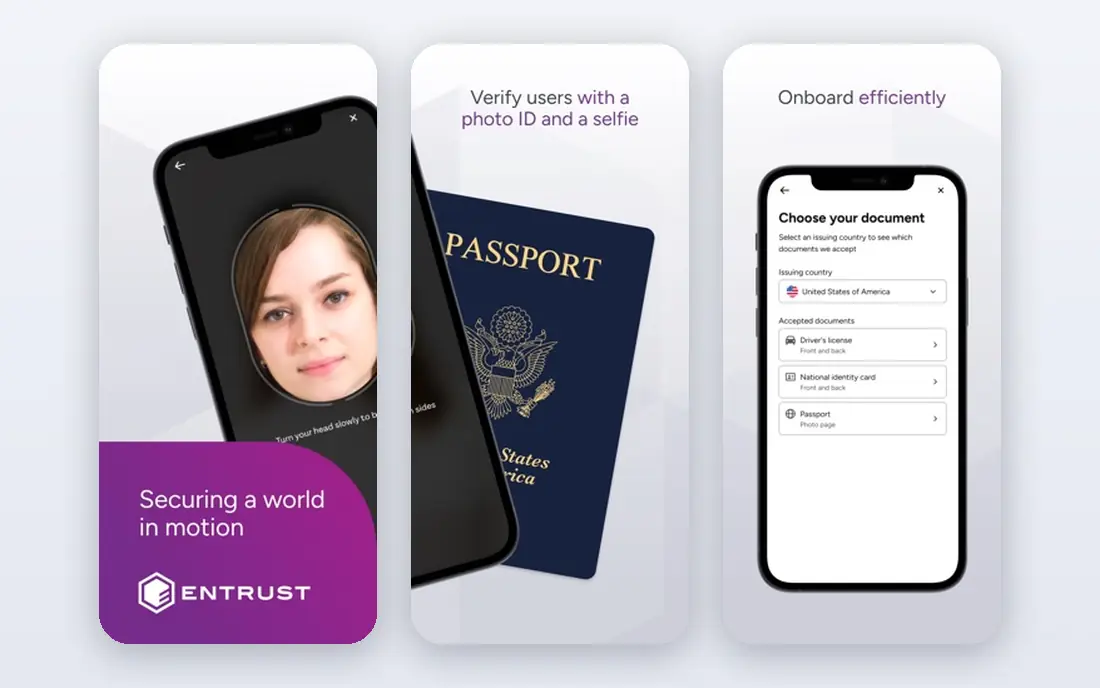
Entrust IDV, formerly Onfido, is now part of Entrust's identity portfolio. Its strength is orchestration: Workflow Studio lets teams build multi-step verification flows, combine document, biometric and database checks, and adjust rules by risk. That suits tech-led companies with varied user types and risk levels.
Pricing is quoted, and the sales process is enterprise-shaped, so small teams will find Veriff or Sumsub easier to start with. Large teams that need orchestration, compliance reporting and broad coverage will find the depth worth the process.
- Workflow orchestration for complex flows
- Developer SDKs
- Broad document coverage
- Quote-based pricing
- Enterprise sales process
- Less transparent for small teams
Jumio positions itself for large, audited enterprises, and its pricing reflects that. It offers document verification, biometric matching and liveness checks, backed by a large history of past transactions that helps flag repeat fraud patterns. Banks, large fintechs and regulated platforms are its core audience.
Small teams should look elsewhere: pricing is quoted, contracts are typically annual, and the platform is built for scale. For a large team that needs audit trails, compliance support and proven enterprise delivery, Jumio is a serious contender.
- Long track record with large enterprises
- Liveness and document checks
- Identity graph from past transactions
- Quote-based enterprise pricing
- Annual contracts typical
- Overkill for small volumes
Persona suits teams whose users do not all need the same checks. Its workflow builder lets you chain document checks, selfie verification, database lookups and watchlist screens into one flow, and branch by user type, country or risk. That flexibility is valuable for marketplaces and platforms with several onboarding paths.
Entry pricing is listed from $250 per month, with higher tiers quoted. The modular model means you only pay for the checks you use, but it also means the bill depends on your flow design. Keep flows as simple as compliance allows, and test the cost per completed user before launch.
- Visual workflow builder
- Modular checks you pay for as used
- Strong for varied user journeys
- Pricing beyond the entry tier is quoted
- Complex flows need careful design
- Costs rise with check mix
Socure stands out for US-focused teams. Its self-serve Launch tier publishes clear rates: $0.80 per document verification evaluation, $0.90 with watchlist screening, and $1.00 for a KYC, fraud and watchlist flow that steps up to document checks only for risky users. That light-first design reduces friction for low-risk users.
The limits matter. Launch is built for US verification, with a daily cap and a per-second limit, and business verification sits on the Enterprise tier. International teams should check coverage carefully, and growing teams should confirm when they need to move from Launch to Enterprise.
- Published self-serve pricing
- Light checks before document steps
- Fraud scoring and watchlist screening
- Built mainly for US users
- Production limits on the self-serve tier
- Business verification needs Enterprise
Trulioo is built for international verification. It draws on hundreds of data sources across many countries, which helps teams that onboard users in markets where document checks alone are not enough. It also covers business verification, which suits B2B platforms.
Pricing is quoted and depends on country coverage, transaction volume and check types, so get a detailed quote for your actual markets. Teams with a single-country user base may not need this breadth, but global platforms will value it.
- Hundreds of data sources across many countries
- Business and person verification
- Strong for international onboarding
- Quote-based pricing
- Usage depends on country and check type
- Setup needs planning
Alloy is an orchestration and decision platform rather than a single document checker. It connects many data vendors, fraud signals and compliance checks into one flow, then applies your rules to approve, review or reject an applicant. That design suits banks, lenders and fintechs that need consistent decisions across products.
It is an enterprise product with quoted pricing, and integration takes real effort. Small teams that need a simple document check should start with Veriff or Socure. Teams that need to manage many vendors and rules in one place will find Alloy's model compelling.
- Orchestrates many data vendors in one decision flow
- Risk and fraud rules
- Strong for US financial services
- Quote-based pricing
- Enterprise focus
- Needs integration effort
iDenfy appeals to smaller businesses with unpredictable volume. Its per-verification pricing starts around $0.50, with options to pay per approved user or per completed verification on some plans, which helps teams that cannot commit to a monthly minimum. It covers document verification, biometric matching, AML screening and fraud checks.
The trade-off is scale and support depth. iDenfy is less established than the largest enterprise vendors, so large regulated teams should test it thoroughly and check references. For startups and mid-sized platforms that want flexible, low-commitment KYC, it is a practical option.
- Low per-verification pricing
- Pay for approved or completed checks on some plans
- AML and fraud tools included
- Pricing in euros on some listings
- Smaller brand presence than Jumio or Entrust
- Support quality varies by plan
How we picked these
We compared official pricing pages, product documentation and independent KYC comparisons for platforms live in October 2026. We kept vendors that offer real identity verification with document and biometric checks, and we left out vendors that only sell data or only offer consulting. Where pricing is published, we used it; where it is quoted, we wrote See website rather than repeating third-party estimates as fact.
How to choose the right KYC platform
Start with your users and your regulator. List the countries you serve, the documents your users hold, and the checks your compliance team requires, including AML screening and ongoing monitoring. Then check document coverage and liveness testing for those markets, since a vendor that is strong in the US may be weaker elsewhere.
Pricing, minimums and the real per-user cost
KYC is usually sold per check, but the real cost includes monthly minimums, retries, failed checks and add-ons such as AML screening. Ask each vendor what counts as a billed check, whether a retry bills again, and what happens when a user abandons a flow. Run a small pilot with real users and measure the cost per approved user, not just the headline rate.
Data, privacy and audit trails
Check where user data is stored, how long it is kept, and what audit trail you get for each decision. Ask about certifications, data processing terms and how the vendor handles biometric data. A clean audit trail matters when a regulator or a partner asks why an applicant was approved or rejected, so test reporting before you commit.
Frequently asked questions
What is the best KYC software for startups?
Veriff and iDenfy are strong startup choices because of published, low per-verification pricing and self-serve starts. Sumsub also suits startups that expect to need AML and monitoring soon, since it covers the full lifecycle.
What is the best KYC platform for large enterprises?
Entrust IDV, Jumio and Trulioo suit large enterprises that need broad coverage, orchestration and compliance reporting. Alloy suits financial firms that need to manage many vendors and decision rules in one flow.
How much does KYC software cost?
Published rates range from $0.50 to $1.35 per verification for self-serve vendors, while enterprise vendors quote by volume and contract. Add minimums, retries and AML add-ons to get the real per-user cost.
What is the best tool for KYC and AML together?
Sumsub is the clearest all-in-one choice here, with KYC, KYB, AML screening and transaction monitoring in one platform. Veriff and iDenfy also offer AML as an add-on or included check, depending on plan.
Do KYC tools work internationally?
Yes, but coverage varies by country and document type. Trulioo is built for global data coverage, Sumsub lists wide document coverage, and Socure is mainly US-focused. Check your actual markets before you choose.
What is the difference between KYC and identity verification?
Identity verification checks that a person is real and matches their document. KYC is the wider compliance process around that check, including risk assessment, AML screening and ongoing monitoring. Most platforms on this list cover both, but the balance differs.
Sources
See where you really rank - block by block
ProMapRanker scans Google Maps across a grid of your service area. Simple monthly plans from $19, white-label on every plan.
Start freeKeep reading
 whats the best ai app to use
Whats the Best AI App to Use in 2026
Wondering whats the best ai app to use in 2026? We compare ChatGPT, Claude, Gemini, Copilot, and more on price, free plans, and best everyday uses today.
Read → life360 alternatives
Life360 Alternatives in 2026
Life360 alternatives compared: 9 family location apps with live maps, arrival alerts and privacy controls to help your family stay in touch every day.
Read → captcha alternatives
CAPTCHA Alternatives in 2026
CAPTCHA alternatives compared: 9 reCAPTCHA alternatives that block bots with less friction, from free Turnstile to privacy-first proof-of-work tools included.
Read →