 ProMapRanker
Best Inventory Optimization Software in 2026

Key takeaways
- Netstock is the clearest pick for mid-market companies that already run an ERP and need formal planning on top of it.
- StockTrim and Prediko offer the most accessible entry points, at $199 and $49 per month respectively.
- RELEX, EazyStock and Slimstock serve larger, more complex networks, but all price by quote.
- Lokad suits data teams that want programmable forecasting rather than a packaged dashboard.
- Count SKUs, locations and sales channels before trialling, since those drive the price more than company size.
Quick comparison
| Pick | Great for | Pricing starts at | Free tier | |
|---|---|---|---|---|
 Netstock | ERP-driven mid-market planning | $900 per month | No | Visit |
 StockTrim | SMBs needing AI forecasting | $199 per month | Free trial | Visit |
 Prediko | Shopify brands starting with forecasting | $49 per month | Free trial | Visit |
 Inventory Planner by Sage | Multi-channel sellers on major platforms | See website | Free trial | Visit |
 EazyStock | Cloud replenishment for distributors | See website | No | Visit |
 RELEX Solutions | Enterprise retail network optimization | See website | No | Visit |
 Slimstock | Demand sensing across channels | See website | No | Visit |
 Lokad | Programmable forecasting for data teams | See website | No | Visit |
 Cin7 | Connected inventory and order management | $349 per month | Free trial | Visit |
The best inventory optimization software
Inventory optimization software answers a cash question, not just a stock question. Every overstocked item ties up money, and every stockout hands a sale to a competitor, so the right tool forecasts demand, sets safety stock and sizes purchase orders with real data instead of gut feel. We compared official feature pages, pricing pages and public reviews, focusing on tools that plan and optimise stock rather than tools that only record it.
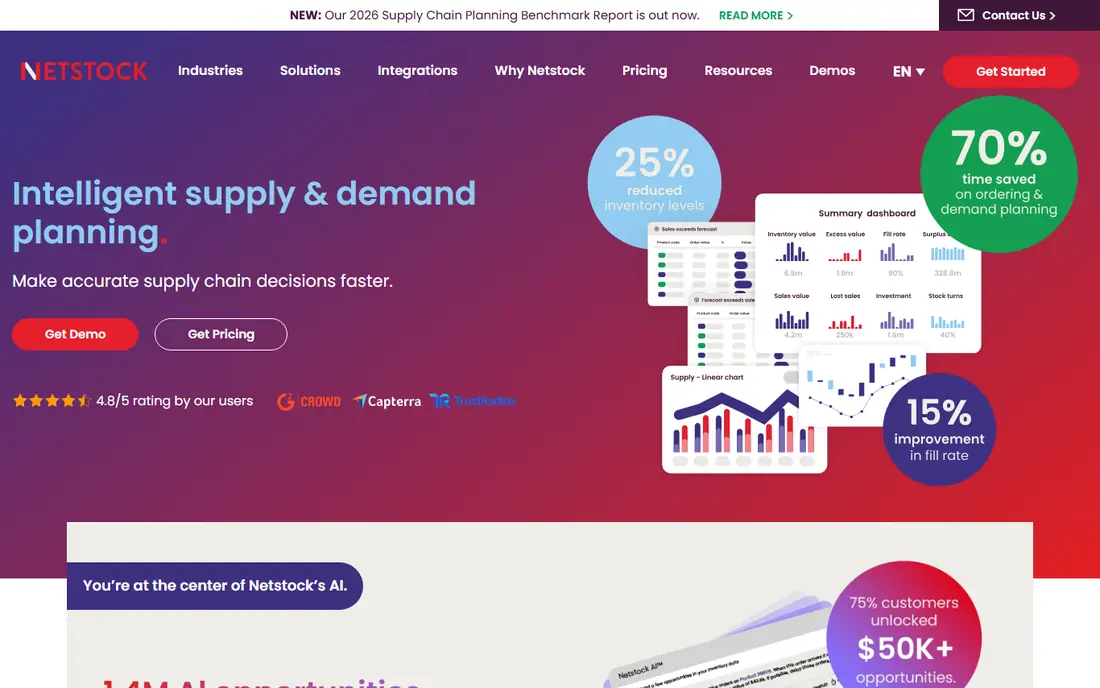
Netstock is the established choice for mid-market companies that already run their business on an ERP. It connects to NetSuite, Sage, Acumatica and similar systems, then layers demand forecasting, order planning, safety stock and supplier performance tracking on top. Its official pricing FAQ puts the starting point at $900 per month, which positions it clearly above the small business apps and gives buyers a real number to budget around.
The product behaves like formal planning software rather than a store add-on. It handles multi-location inventory, transfer orders and constrained supply scenarios, with an AI pack that assists with the analytical work. For wholesale distributors and manufacturers with thousands of SKUs, that depth matters. The trade-off is commitment, since pricing is based on annual subscriptions and implementation takes weeks, not days.
- Published starting price
- Integrates with more than 60 ERP systems
- Forecasting, ordering and supplier performance in one place
- Annual subscription model
- Implementation typically takes 6 to 10 weeks
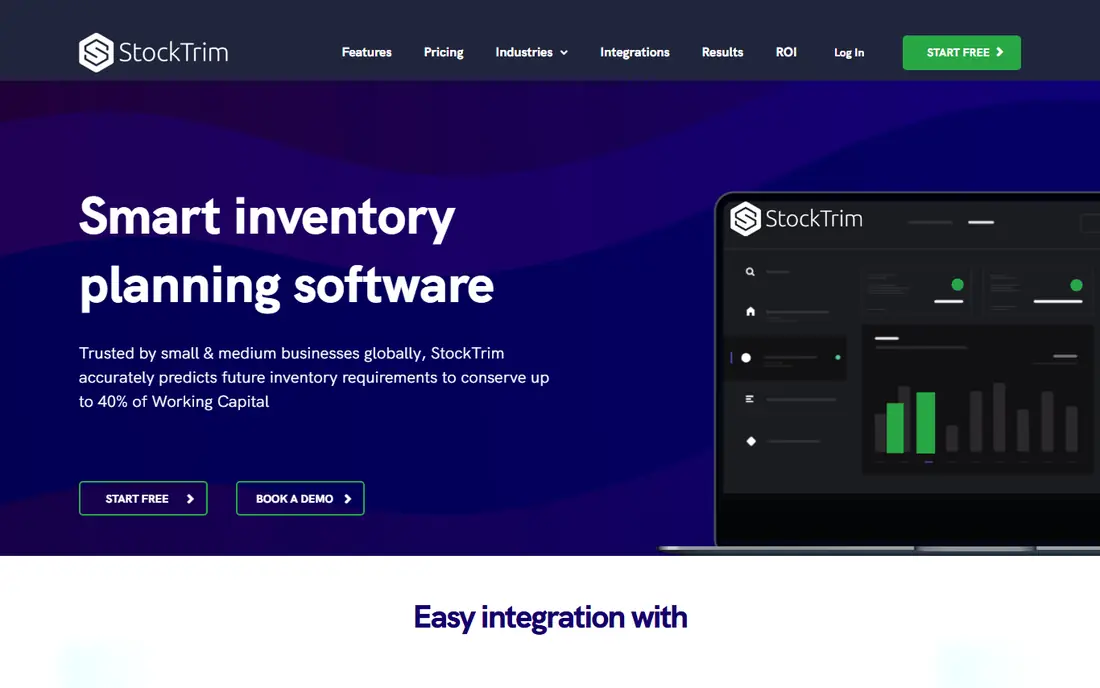
StockTrim sits in a sensible middle ground for small and mid-size businesses in wholesale, manufacturing, retail and ecommerce. Its plans run at $199, $299 and $399 per month, with enterprise pricing by quote, and cover AI forecasting, order planning, new product forecasting, manufacturing and multi-location support. That breadth makes it a strong step up from a spreadsheet without the enterprise sales process of the larger platforms.
The honest catch is tier progression. As SKU counts, locations or users grow, the monthly price climbs, so buyers should map their current and next year needs before choosing a tier. StockTrim also does not publish a numeric forecasting accuracy figure, so a trial against your own sales history is the best way to judge it. For an SMB that needs credible planning fast, it is one of the most practical options here.
- Accessible entry price for serious forecasting
- AI forecasting with order planning
- Multi-location and manufacturing support
- Monthly price climbs quickly across tiers
- No published forecasting accuracy figure
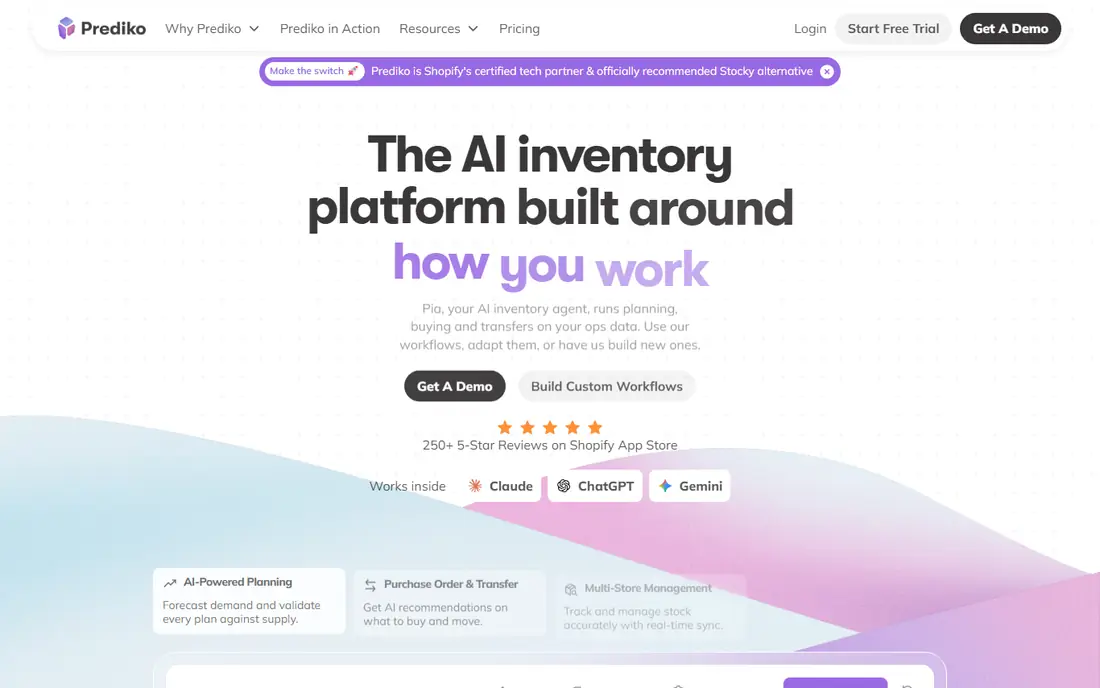
Prediko is built for direct to consumer Shopify brands that need demand planning and purchasing without hiring a planner. From $49 per month, it forecasts demand, suggests purchase orders and helps brands avoid the twin traps of overstock and stockouts on their best sellers. Because it reads the store directly, setup is fast compared with an ERP integration project, and a small team can be planning within days.
The limit is scope. Prediko is a Shopify-first tool, so a wholesaler or manufacturer running an ERP will need a broader platform such as Netstock or StockTrim. It also covers planning depth for a growing brand rather than full network optimisation. For a Shopify brand taking its first serious step beyond spreadsheets, its price and focus make it an easy first trial.
- Lowest entry price on this list
- Built for Shopify demand planning and purchasing
- Quick to set up
- Shopify focused, so ERP-led businesses will outgrow it
- Narrower scope than full planning suites
Inventory Planner by Sage serves multi-channel brands that sell across Shopify, Amazon and other major platforms and need replenishment based on demand rather than fixed reorder points. It forecasts by channel, sizes purchase orders and supports multi-warehouse planning, which helps sellers who hold stock in more than one location. Being part of Sage gives it accounting and ERP adjacencies that standalone apps lack.
Pricing is the weak point for comparison shoppers. Sage does not publish a list price for Inventory Planner, and third party coverage puts single warehouse plans around $119.99 a month with multi-warehouse plans quoted from about $245. Buyers should get a written quote for their warehouse count and channel mix. For a multi-channel seller already close to the Sage world, it is a natural fit.
- Demand based replenishment across channels
- Sage backing and integrations
- Handles multi-warehouse planning
- Pricing is not published
- Multi-warehouse plans are quoted separately
EazyStock is a cloud replenishment tool aimed at distributors and wholesalers that need to keep service levels up without carrying excess stock. It forecasts demand, accounts for supplier lead times and seasonality, and generates replenishment suggestions that planners can review before ordering. That focus on the distributor workflow, with many SKUs and many suppliers, sets it apart from store-first forecasting apps.
The drawback is transparency. Pricing is quote-only and no free trial is published, so evaluation means a sales conversation and a demo on your own data. Smaller businesses will find StockTrim or Prediko easier to trial. For a distributor with a complex supplier base and a real replenishment problem, EazyStock's depth is worth the longer buying process.
- Cloud replenishment built for distributors
- Demand forecasting with supplier lead time handling
- ERP integrations
- Quote-only pricing
- No free trial published
RELEX Solutions is the enterprise answer when the problem is not what to reorder, but how to optimise inventory across an entire network of stores, warehouses and suppliers. Its AI-native planning covers forecasting, replenishment, allocation and promotions at scale, for retailers, wholesalers and manufacturers with high SKU and network complexity. Companies with seasonal demand, promotions and many locations get the most from its modelling depth.
That power comes with an enterprise buying process and no published pricing, so smaller businesses should not shortlist it. Implementation and change management are significant, and the tool rewards organisations that already have clean data and a planning team. For a large retailer or wholesaler whose network is the problem, RELEX is one of the strongest names in the field.
- Enterprise grade AI planning across the whole network
- Strong for retail, wholesale and manufacturing scale
- End to end optimisation
- Public pricing is unavailable
- Clearly aimed at larger, more complex organisations
Slimstock, through its Slim4 platform, focuses on demand sensing across channels, helping distributors and retailers forecast more accurately when demand shifts with seasons, promotions and market changes. It combines forecasting, inventory optimisation and supplier collaboration, and it has a long track record in European and global distribution. Teams that struggle with lumpy demand and long supplier lead times tend to get the most from it.
Pricing is quote-only, and the platform leans enterprise in implementation, so a small business will find faster routes elsewhere. The value shows up for mid-market and larger operations where a few points of forecast accuracy translate into real cash freed from stock. If your demand is seasonal and your supplier base is wide, Slimstock deserves a place on the shortlist.
- Slim4 demand sensing across channels
- Long track record with distributors and retailers
- Handles seasonality and promotions
- Quote-only pricing
- Enterprise leaning implementation
Lokad is the outlier on this list, and deliberately so. Instead of a fixed set of forecasting screens, it gives data teams a programmable platform to build forecasting and optimisation logic around their own business rules, constraints and data. That flexibility suits companies with unusual demand patterns, complex constraints or very large catalogues that packaged tools handle poorly.
The trade-off is skill. Lokad rewards teams with analysts or engineers who can build and maintain models, and it will frustrate a planner who wants a ready-made dashboard on day one. Pricing is quote-only. For a data driven company that has outgrown packaged forecasting, Lokad offers control that no dashboard tool can match.
- Programmable forecasting for unusual business rules
- Handles large SKU counts
- Strong for data driven teams
- Needs technical skill to get value
- No packaged dashboard experience for non-technical planners
Cin7 earns its place as the connected option, combining inventory management, order management and channel connections in one platform. Its Core plan starts at $349 per month, and it integrates with a wide range of ecommerce, accounting, warehouse and shipping tools, which helps multichannel brands keep stock, orders and fulfilment in sync. For a brand outgrowing basic inventory apps, that connected view prevents overselling and manual reconciliation.
Cin7 is not a dedicated optimisation engine in the same way as Netstock or RELEX. Its forecasting and replenishment features are useful, but a company whose main problem is network optimisation will want a specialist planning tool alongside or instead of it. For a scaling multichannel brand that needs inventory and orders joined up first, Cin7 is a strong, practical choice.
- Published Core pricing
- Connects inventory, orders and channels in one system
- More than 700 integrations
- Price jumps quickly with scale
- Optimisation depth is thinner than dedicated planning tools
How we picked these
We compared official feature pages, pricing pages and public reviews, and we used vendor published prices where they exist. We favoured tools whose core job is forecasting, safety stock and replenishment optimisation, rather than basic stock recording, and we covered the spread from Shopify apps to enterprise network planning. Where pricing is quote-only, we say so instead of inventing a number.
How to choose the right inventory optimization tool
Start with where your sales data lives. A Shopify brand needs a tool that reads the store directly, a wholesaler on NetSuite or Sage needs planning that sits on top of the ERP, and a distributor with tens of thousands of SKUs needs forecasting that handles seasonality, promotions and supplier lead times without manual work.
Next, count what drives price: SKUs, locations, sales channels and users. A tool that looks cheap at 500 SKUs can cost far more at 20,000, and a quote-only enterprise tool can still be good value if it frees serious cash from excess stock. Trial on your own history where possible, and measure forecast accuracy on your top sellers before committing.
Finally, check who will own planning day to day. A programmable tool needs an analyst, an enterprise tool needs a planning team, and a Shopify app needs a founder or ops lead with a few hours a week. The best tool is the one your team will actually run every week, not the one with the longest feature list.
Frequently asked questions
What is inventory optimization software?
Inventory optimization software forecasts demand, sets safety stock levels and sizes purchase orders so a business holds enough stock to meet demand without tying up excess cash. It goes beyond basic inventory tracking by using sales history, seasonality, lead times and promotions to plan what to buy and when.
How is inventory optimization different from inventory management?
Inventory management records what you have, where it is and what sold. Inventory optimization plans what you should have, using forecasts and replenishment logic to prevent stockouts and overstock. Many businesses need both, and some platforms combine them.
Which inventory optimization tool is best for a small business?
Prediko at $49 per month suits Shopify brands starting out, while StockTrim at $199 per month suits small wholesalers, manufacturers and multichannel sellers that need broader planning. Both offer free trials, so a small business can test forecasting on its own sales data before committing.
How much does inventory optimization software cost?
Entry prices on this list run from $49 per month for Prediko to $900 per month for Netstock, with Cin7 Core at $349 per month and StockTrim at $199 per month. Enterprise tools such as RELEX, EazyStock, Slimstock and Lokad price by quote, and the final cost depends on SKUs, locations and scope.
Do I need an ERP to use inventory optimization software?
No, but it helps at scale. Shopify apps read store data directly, and mid-market tools integrate with major ERPs such as NetSuite and Sage. A business without an ERP should choose a tool built for its sales channels, and move to an ERP-led planner when order and stock complexity grows.
Can inventory optimization software handle seasonality and promotions?
Yes, the stronger tools factor seasonality, promotions, trends and supplier lead times into forecasts. During a trial, test this directly by checking forecasts for a seasonal product and a promoted product against what actually sold, rather than trusting a general claim.
Sources
See where you really rank - block by block
ProMapRanker scans Google Maps across a grid of your service area. Simple monthly plans from $19, white-label on every plan.
Start freeKeep reading
 who has best internet service
Who Has the Best Internet Service in 2026
Who has best internet service for US homes? We compare fiber, cable, fixed wireless and satellite providers on speed, price, availability and terms today.
Read → which survey tool has the best analytics
Which Survey Tool Has the Best Analytics in 2026
Find which survey tool has the best analytics in 2026, comparing Qualtrics, SurveyMonkey, Typeform, Alchemer, and more on reports, text, and stats today.
Read → which streaming service has the best movies
Which Streaming Service Has the Best Movies in 2026
Answering which streaming service has the best movies, with Netflix, Max, Criterion and more compared on libraries, prices and free options in this guide.
Read →