 ProMapRanker
Best Insurance Analytics Software in 2026


Large P and C carriers on one platform · Pricing starts at: See website
Key takeaways
- Guidewire is our pick for large property and casualty carriers that want pricing, core systems, and analytics on one cloud platform.
- Earnix and Akur8 lead for pricing teams that need fast, transparent rate models and governed deployment to production.
- Duck Creek suits carriers that want a configurable cloud platform with analytics, rating, and insights in one suite.
- SAS, Verisk, and Moody's suit firms that need deep statistical modeling, external data, or catastrophe and risk insight at portfolio scale.
Quick comparison
| Pick | Great for | Pricing starts at | Free tier | |
|---|---|---|---|---|
| Guidewire | Large P and C carriers on one platform | See website | No | Visit |
 Duck Creek | Configurable P and C cloud suite | See website | No | Visit |
 Earnix | Pricing and product optimization | See website | No | Visit |
 Akur8 | Transparent actuarial pricing models | See website | No | Visit |
 SAS | Deep statistical and risk modeling | See website | No | Visit |
 Verisk | External data and industry insight | See website | No | Visit |
 Shift Technology | Claims fraud and automation insight | See website | No | Visit |
 LexisNexis Risk Solutions | Risk data for underwriting and claims | See website | No | Visit |
 Moody's | Catastrophe and portfolio risk analytics | See website | No | Visit |
The best insurance analytics software
Insurance analytics turns policy, claims, pricing, and external data into decisions about risk, price, and reserves. The best insurance analytics tools below serve carriers, managing general agents, and brokers, and they differ sharply in focus, so a pricing team, a claims team, and a portfolio team may each need a different tool.
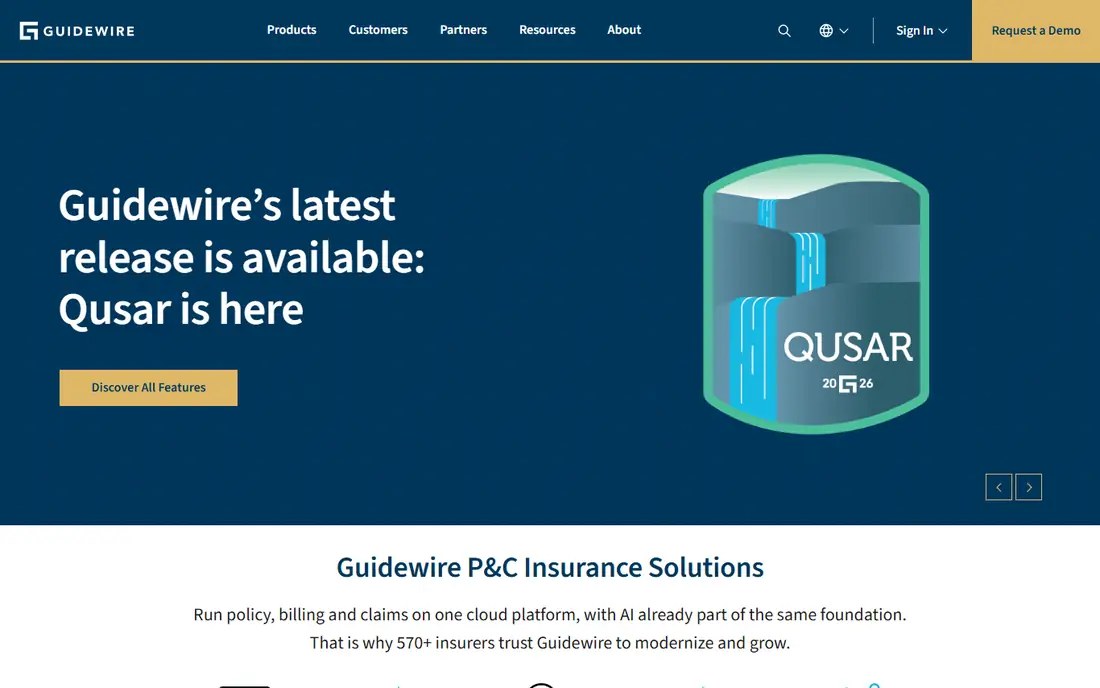
Guidewire is the platform many large property and casualty insurers trust for core operations plus analytics. InsuranceSuite covers policy, claims, and billing, while PricingCenter unifies pricing and rating in one application, letting actuarial, pricing, and IT teams model, test, and deploy rate changes faster. Data Studio and HazardHub add analytics and risk data that feed those decisions.
The trade-off is enterprise scale. Pricing is quote-based, implementation involves planning and partners, and a small carrier or agency will find the platform heavier than needed. For a large carrier that wants core systems and analytics governed together, with a large marketplace of partner apps, Guidewire is the most complete single-vendor choice on this list.
- Pricing, policy, claims, and billing on one cloud platform
- PricingCenter unifies modeling and rating
- Large partner marketplace
- Quote-based enterprise pricing
- Implementation effort is significant
- Smaller carriers may find it more platform than needed
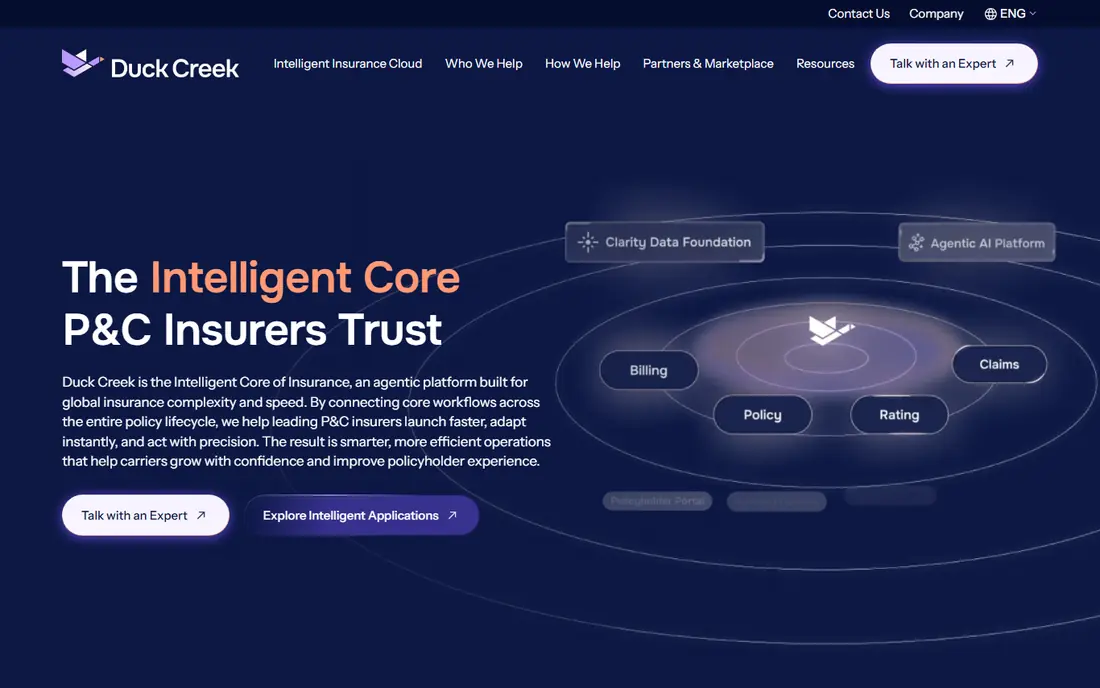
Duck Creek is a cloud-native platform for property and casualty carriers and managing general agents that want to shape the system to their products. Low-code configuration tools let teams build workflows and products without rewriting code, while open APIs connect outside data and systems. Duck Creek Insights handles data management and analytics, and Duck Creek Rating covers product definition, scenario analysis, and quoting.
Flexibility is also the catch. Complex configuration can require consultants, and teams should plan for training and a long runway on larger rollouts. For a mid-market or large carrier that values configurability and wants analytics close to rating and product work, Duck Creek is a strong alternative to Guidewire.
- Low-code configuration and open APIs
- Duck Creek Insights for data and analytics
- Rating and product definition tools
- Quote-based pricing
- Complex configuration can need consultants
- Learning curve for large rollouts
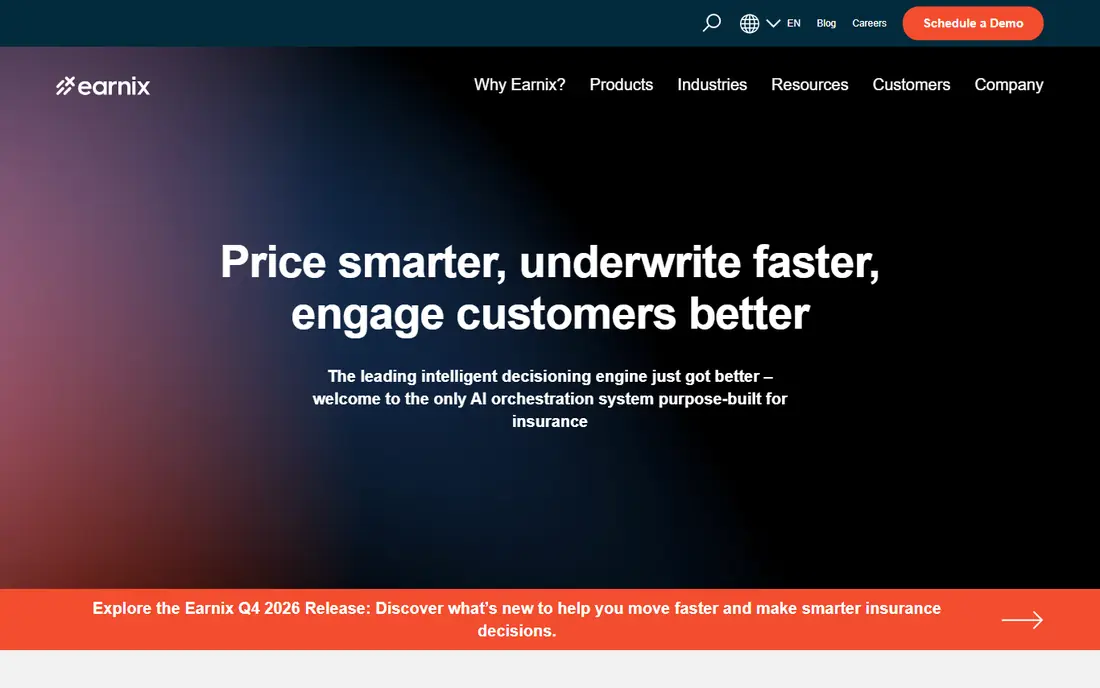
Earnix focuses on the pricing decision itself: building models, optimizing prices across a portfolio, and deploying those prices into quoting and rating. It supports traditional statistical models and machine learning models, with optimization tools that handle complex rating structures, regulatory needs, and multi-product portfolios. Pricing is tied to premium book size and transaction volume rather than per seat, which matches how insurers earn revenue.
Earnix is not a policy or claims core system, so carriers still need those platforms beside it. Implementation also needs close work between actuarial, pricing, and IT teams to govern models from design to production. For a carrier whose main analytics need is faster, better-governed pricing, Earnix is one of the strongest specialist picks available.
- Pricing, rating, and personalization in one platform
- Optimization across portfolios and products
- Model governance support
- Quote-based pricing tied to premium and volume
- Implementation needs actuarial and IT alignment
- Not a full core system
Akur8 builds actuarial pricing software that automates risk modeling while keeping models transparent and under actuary control. It speeds data preparation and model building, produces more predictive models, and supports deployment into rating systems, including through its partnership work with Duck Creek. Recent agent features guide users through workflows while keeping final decisions with actuaries, a useful design for regulated work.
The focus is pricing, so claims, fraud, and portfolio analytics still need other tools. Pricing is quote-based, and onboarding benefits from actuarial involvement from the start. For a pricing team that wants speed without giving up transparency or control, Akur8 is a leading choice, especially for property, casualty, life, and annuity lines.
- Transparent AI-driven actuarial modeling
- Faster data preparation and modeling
- Governed deployment with human control
- Quote-based pricing
- Pricing focus means other analytics need separate tools
- Enterprise onboarding takes planning
SAS is a long-standing analytics platform used across insurance for pricing, reserving, fraud detection, risk management, and forecasting. Its statistical depth, data management, and model governance suit firms that build custom models and need audit trails for regulated decisions. Many insurers already use SAS in actuarial and risk teams, which eases adoption where skills exist.
The platform requires specialist skills, and pricing is quote-based at enterprise levels. A small carrier that only needs pricing models may find Akur8 or Earnix more focused. For a firm that needs one analytics foundation across pricing, risk, claims, and finance, with strong governance, SAS remains a dependable and powerful choice.
- Mature statistical, forecasting, and risk modeling tools
- Strong data management
- Widely used in regulated industries
- Quote-based enterprise pricing
- Specialist skills needed
- Platform breadth can feel heavy for a single use case
Verisk provides data, analytics, and insight that many carriers use beside their own models. Its products cover underwriting data, claims history, property and catastrophe insight, and industry benchmarks, helping underwriters and actuaries price risk with external evidence rather than internal history alone. That outside view matters most in lines where a single carrier sees too little data to price confidently.
Verisk is a data and analytics provider rather than a single pricing model builder, so buyers must scope which products they need and confirm how each one integrates with core and pricing systems. Pricing is quote-based by product. For a carrier that needs trusted external data at scale, Verisk is a standard part of the analytics stack.
- Broad insurance data, benchmarks, and analytics
- Claims and underwriting data products
- Catastrophe and risk insight
- Quote-based pricing by product
- Product range is broad, so scoping needs care
- Not a pricing model builder alone
Shift Technology applies AI to claims and fraud decisions, helping carriers spot suspicious claims, automate document handling, and speed legitimate claims. Its models analyze claims data, documents, and networks to flag risk and support handlers with clear reasons, which helps both loss ratios and customer experience when genuine claims move faster.
The focus is claims, so pricing and underwriting analytics still need separate tools such as Earnix, Akur8, or Guidewire PricingCenter. Pricing is quote-based, and integration with claims systems needs planning. For a carrier whose analytics priority is claims leakage and fraud, Shift is one of the most specialized and widely used options.
- AI-driven fraud detection and claims automation
- Document and claims insight at scale
- Used by large global carriers
- Quote-based pricing
- Claims focus means pricing teams need separate tools
- Integration planning needed
LexisNexis Risk Solutions supplies risk data that underwriters and claims teams use to assess applicants, price policies, and investigate claims. Its data covers identity, driving and claims history, property attributes, and fraud signals, giving carriers a fuller risk picture than application data alone. That depth supports faster underwriting decisions and more accurate pricing inputs.
Data use carries compliance duties, including permissible purpose and consumer notice rules where they apply, so legal and compliance teams should review each product before rollout. Pricing is quote-based and varies by product and volume. For a US carrier or broker that needs trusted third-party risk data, LexisNexis is a core analytics supplier.
- Deep risk data for underwriting, pricing, and claims
- Identity and fraud insight
- Broad US insurance data coverage
- Quote-based pricing
- Data products need careful compliance handling
- Integration scope varies by product
Moody's insurance analytics, including its RMS catastrophe modeling heritage, help carriers understand portfolio risk from hurricanes, earthquakes, floods, and other large events. Models estimate potential losses by location and portfolio, support reinsurance decisions, and feed capital and pricing discussions for catastrophe-exposed books. Climate and economic scenarios extend that view beyond historical loss data.
Catastrophe models need specialist interpretation, and they do not replace daily pricing or underwriting tools. Pricing is quote-based. For a carrier with material catastrophe exposure, or a broker advising on reinsurance, Moody's analytics provide a portfolio view that policy-level tools cannot, and they belong beside pricing and claims systems rather than instead of them.
- Catastrophe models and portfolio risk analytics
- Climate and economic scenario insight
- Strong insurance industry research
- Quote-based pricing
- Catastrophe focus means daily pricing needs separate tools
- Models need specialist interpretation
How we picked these
We compared official product pages, vendor announcements, and public reviews, and we kept only tools that are live in October 2026 and truly serve insurance analytics, pricing, underwriting, claims, or portfolio risk. We favored tools with clear product focus, governed model deployment where claimed, and real carrier use, and we marked all enterprise pricing as See website rather than repeating unverified figures. This is general information about business software, not financial advice, and carriers should confirm regulatory, model governance, and data rules for their lines and states before buying.
What to check before you buy
Start with the decision you need to improve. Pricing teams need model transparency, governance, and fast deployment. Underwriting teams need risk data and decision support at quote time. Claims teams need fraud detection and automation. Portfolio teams need catastrophe and capital insight. Buying one broad platform for all four decisions often leaves at least one team underserved, so shortlist by decision first and by vendor second.
Next, test model governance end to end. Ask how a model moves from design to testing to production, who approves changes, how results are traced, and how a bad model is rolled back. Check data sources, including whether external data is licensed, refreshed, and compliant for your use. Finally, confirm integration with core policy, claims, and rating systems, since analytics that cannot reach production decisions will not change loss ratios no matter how accurate the model looks in a demo.
Pricing, underwriting, and claims
Pricing analytics should show why a rate changed, not just the new number, since regulators, agents, and customers will ask. Underwriting analytics should return a decision or a clear risk signal inside the quote workflow, not in a separate report read days later. Claims analytics should prioritize handlers, explain flags, and track false positives, since a fraud tool that slows genuine claims harms retention as well as costs.
Portfolio, data, and governance
Portfolio analytics should aggregate risk across lines, regions, and perils, and support stress tests for events that have not happened yet. Data quality matters more than model complexity: missing, stale, or biased inputs produce confident but wrong answers. Keep a model inventory, version history, and validation record, and review models on a schedule, since risk, regulation, and customer behavior all change over time.
Frequently asked questions
What is the best insurance analytics software overall?
Guidewire is our overall pick for large property and casualty carriers that want core systems and analytics together. Earnix and Akur8 lead for pricing specialists, Duck Creek suits configurable cloud suites, and SAS, Verisk, and Moody's lead for statistical depth, external data, and catastrophe insight. The best tool depends on which decision you need to improve first.
What are the best insurance analytics tools for pricing?
Earnix and Akur8 are the strongest pricing specialists in this list, with transparent models, optimization, and governed deployment. Guidewire PricingCenter and Duck Creek Rating suit carriers that want pricing close to core policy systems. SAS suits firms that build custom statistical models in-house and need deep governance.
How much does insurance analytics software cost?
All tools in this list use quote-based enterprise pricing, so we mark starting prices as See website. Cost depends on premium volume, lines of business, users, data products, and implementation scope. Expect a sales-led quote and a scoping phase, and budget separately for implementation, integration, and model validation.
Do small insurance agencies need analytics software?
Most small agencies do not need carrier-grade analytics platforms, since they use carrier rating and agency management systems for quotes and service. Agencies benefit more from agency management tools, comparative raters, and CRM systems. Analytics platforms in this list suit carriers, managing general agents, and larger brokers with their own pricing or portfolio decisions.
How is insurance analytics different from business intelligence?
General business intelligence reports past sales, claims, and operations, while insurance analytics adds risk models, pricing optimization, fraud detection, and catastrophe simulation. The difference is predictive and decision-focused: insurance analytics aims to price risk, detect fraud, and manage portfolio exposure before losses occur, not only to report them after the fact.
What data and compliance issues should carriers check?
Carriers should check data licensing, refresh rates, permissible use, consumer notice duties, and model governance rules for each line and state. Pricing models need traceability and validation, fraud tools need false-positive monitoring, and external data must be handled under applicable privacy and insurance regulations. Involve compliance and legal teams early, before a model reaches production.
Sources
- https://www.guidewire.com
- https://www.duckcreek.com
- https://www.earnix.com
- https://www.akur8.com
- https://www.sas.com
- https://www.verisk.com
- https://www.shift-technology.com
- https://risk.lexisnexis.com
- https://www.moodys.com
- https://www.guidewire.com/about/press-center/press-releases/20251028/guidewire-unveils-pricingcenter-a-unified-pricing-and-rating-application-that-accelerates-product
- https://gitnux.org/best/insurance-pricing-software/
- https://www.selecthub.com/insurance-software/duck-creek-vs-sapiens-insurance/
See where you really rank - block by block
ProMapRanker scans Google Maps across a grid of your service area. Simple monthly plans from $19, white-label on every plan.
Start freeKeep reading
 who has best internet service
Who Has the Best Internet Service in 2026
Who has best internet service for US homes? We compare fiber, cable, fixed wireless and satellite providers on speed, price, availability and terms today.
Read → which survey tool has the best analytics
Which Survey Tool Has the Best Analytics in 2026
Find which survey tool has the best analytics in 2026, comparing Qualtrics, SurveyMonkey, Typeform, Alchemer, and more on reports, text, and stats today.
Read → which streaming service has the best movies
Which Streaming Service Has the Best Movies in 2026
Answering which streaming service has the best movies, with Netflix, Max, Criterion and more compared on libraries, prices and free options in this guide.
Read →