 ProMapRanker
Best ERP Software for Manufacturing in 2026

Key takeaways
- Small manufacturers should start with Odoo or MRPeasy, which offer lower entry prices and faster setup than enterprise systems.
- Mid-market manufacturers get the best balance from Oracle NetSuite, Microsoft Dynamics 365 Business Central, Acumatica, and Epicor Kinetic.
- SAP S/4HANA and Infor CloudSuite Industrial fit large, complex, multi-site operations, but they need partners, longer projects, and larger budgets.
- Most enterprise manufacturing ERP pricing is quoted, so the license fee is only part of the total, with implementation often costing as much or more.
- The right system depends first on manufacturing mode, such as discrete, process, or make-to-order work, and second on company size.
Quick comparison
| Pick | Great for | Pricing starts at | Free tier | |
|---|---|---|---|---|
 SAP S/4HANA | Large global manufacturers | See website | No | Visit |
 Oracle NetSuite | Growing mid-market manufacturers | See website | No | Visit |
 Microsoft Dynamics 365 Business Central | Microsoft-based small and mid-size makers | $70 per month | No | Visit |
 Infor CloudSuite Industrial | Discrete manufacturers needing depth | See website | No | Visit |
 Epicor Kinetic | Discrete and make-to-order makers | See website | No | Visit |
 Acumatica | Growing makers wanting flexible licensing | See website | No | Visit |
 Odoo | Small makers starting with modular apps | $24.90 per month | Free trial | Visit |
 MRPeasy | Small makers with complex bills of materials | $49 per month | Free trial | Visit |
The best ERP software for manufacturing
Manufacturing ERP ties together inventory, production planning, purchasing, shop floor work, quality, and finance in one system. The wrong choice can slow a plant for years, so fit matters more than feature count. We compared systems across small, mid-market, and enterprise sizes, and across discrete, process, and make-to-order work.
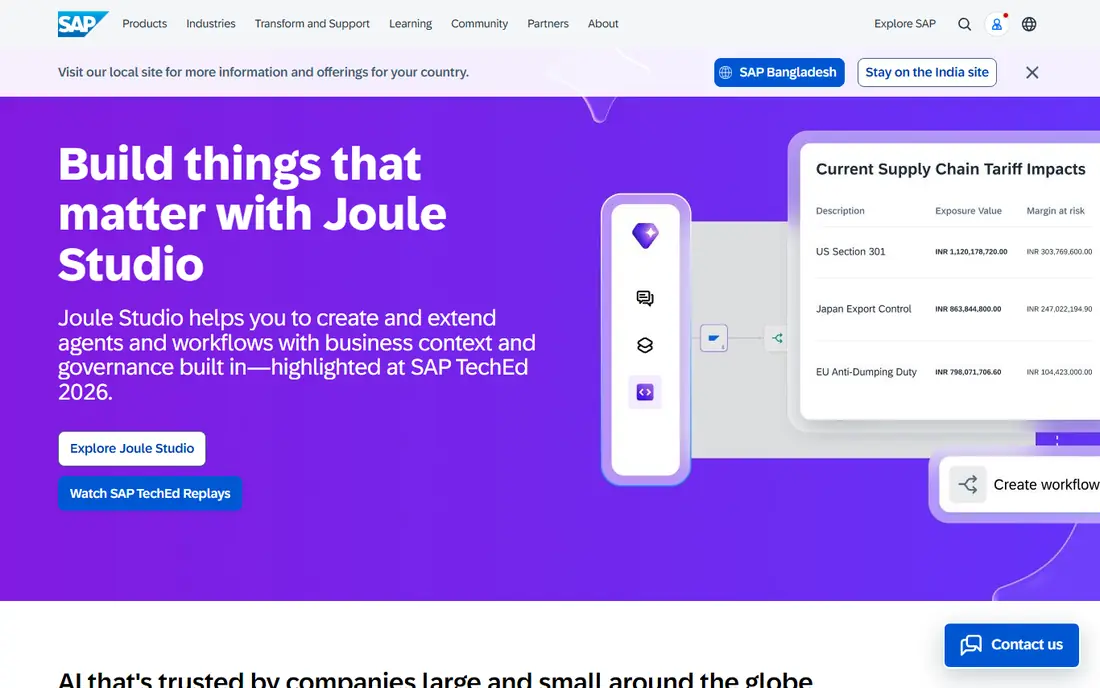
SAP S/4HANA is the enterprise standard for large manufacturers with complex global operations. It handles discrete and process manufacturing, supply chain, quality, and finance at scale, with multi-currency, multi-plant, and regulatory depth that smaller systems cannot match. Companies with many sites and long supply chains benefit most from that breadth.
The cost and effort are equally large. Pricing is quoted, implementation needs a partner and a dedicated internal team, and rollouts can run for a year or more. Small and mid-size makers should not start here unless they have enterprise scale and a clear reason to need SAP depth. For large global factories, it remains the benchmark other systems are judged against.
- Deep manufacturing, logistics, and finance in one platform
- Strong global compliance and multi-site support
- Real-time analytics
- Quote-only pricing with very large total costs
- Projects often run many months and need a partner
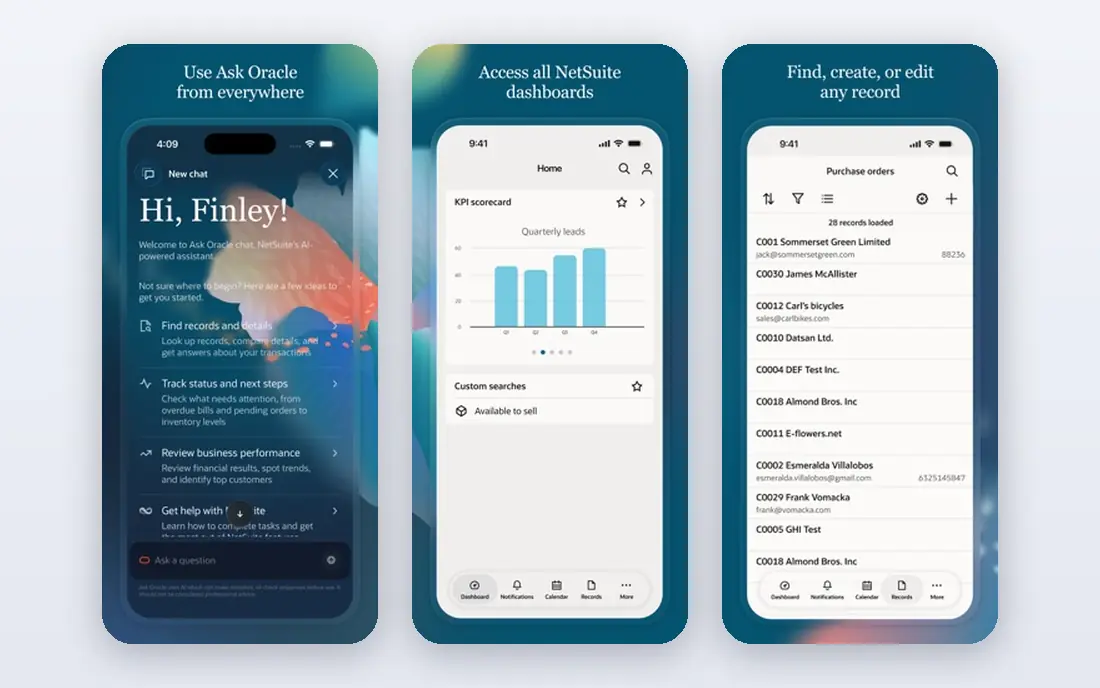
Oracle NetSuite suits mid-market manufacturers that are growing fast and need one cloud system for finance, inventory, orders, and production. Its single codebase and multi-subsidiary support help companies that add entities, warehouses, or sales channels without rebuilding finance each time. Industry templates can shorten the path to go-live compared with a fully custom enterprise project.
Pricing is quoted, and the total depends on modules, users, and implementation scope. NetSuite is also less deep than specialist manufacturing systems on some shop floor and scheduling needs, so complex discrete makers should test those workflows in a demo. For growing makers that value unified finance and scalability, NetSuite is a strong middle path.
- Unified cloud financials, inventory, and manufacturing
- Multi-subsidiary support
- Industry templates for faster go-live
- Quote-only pricing
- Manufacturing depth can be lighter than Epicor or Infor for complex shop floor needs
Microsoft Dynamics 365 Business Central
Great for: Microsoft-based small and mid-size makers
Business Central is a natural pick for manufacturers already running Microsoft 365, Outlook, Teams, and Excel. Staff can work with familiar tools, data flows into Power BI for reporting, and the system covers inventory, production orders, purchasing, and finance without a separate finance platform. Published pricing at $70 per user per month for the Essentials tier helps small teams budget the license cost.
The limit is depth for very complex plants. Advanced planning, shop floor execution, and some process manufacturing needs may require add-ons or partner extensions, which add cost and project time. For small and mid-size makers with standard discrete or light assembly work, Business Central offers a practical balance of price, familiarity, and function.
- Familiar Microsoft 365 and Excel integration
- Published per-user pricing
- Manufacturing, inventory, and finance in one app
- Complex manufacturing may need add-ons or partners
- Per-user costs rise as teams grow
Infor CloudSuite Industrial, built on Infor SyteLine heritage, targets discrete manufacturers that need strong planning, scheduling, and shop floor control. Its industry-specific features suit makers with complex bills of materials, configure-to-order products, and multi-site production. Cloud deployment removes much of the infrastructure work that older on-premise systems required.
Pricing is quoted, and the project needs a partner who knows your manufacturing mode well. Infor is not a quick small-shop install, and buyers should budget for configuration, training, and data migration. For mid-market to enterprise discrete makers that outgrow general ERP, Infor is one of the deepest specialist options.
- Industry-specific manufacturing depth
- Advanced planning and scheduling tools
- Cloud deployment on a major platform
- Quote-only pricing
- Implementation and tuning take time for complex plants
Epicor Kinetic is purpose-built for manufacturers, not adapted from a generic business system. It handles job costing, scheduling, shop floor data collection, quality, and multi-site production in ways that matter daily on a plant floor. Make-to-order and engineer-to-order makers benefit from its handling of custom jobs, revisions, and costing.
As with other mid-market to enterprise systems, pricing is quoted and implementation needs planning. Epicor is also a poor fit for simple inventory-only shops, since its depth adds cost and complexity that a small maker may not need. For discrete makers with real shop floor complexity, it is one of the first systems to shortlist.
- Purpose-built for discrete and make-to-order work
- Shop floor visibility and scheduling depth
- Multi-site support
- Quote-only pricing
- Setup and training need a focused project team
Acumatica appeals to growing manufacturers because it does not charge per user. Instead, pricing is based on resources consumed, so a plant with many occasional users on the shop floor, in the warehouse, and in sales does not pay a seat fee for every person. That model can save money as teams grow, and its modular design lets makers add manufacturing, distribution, and finance as needed.
The trade-off is that resource-based pricing is harder to compare at a glance, since the total depends on transaction volume and modules. A partner is also needed to configure manufacturing well. Buyers should ask for a written estimate tied to their actual transaction levels, not a generic quote, and test manufacturing workflows before signing.
- Licensing by resources, not per user, so many occasional users cost less
- Modular cloud ERP
- Strong distribution and manufacturing modules
- Quote-only pricing based on resources used
- Partner needed for setup and manufacturing configuration
Odoo is the best starting point for small manufacturers that want ERP without enterprise cost. Its modular design lets a shop start with inventory, sales, and accounting, then add manufacturing, purchasing, and quality apps as it grows. Enterprise pricing starts at $24.90 per user per month, and a free Community edition exists for teams with in-house technical skills.
The risk is fragmentation. Because Odoo is modular, a poorly planned setup can turn into many loosely connected apps rather than one clean system. Small makers should map their core flows first, such as order to production to shipment, and configure only the apps those flows need. For shops with that discipline, Odoo offers the lowest-cost credible path into manufacturing ERP.
- Low entry price for Enterprise
- Modular apps let you start small and add manufacturing later
- Large app ecosystem
- Manufacturing depth depends on modules chosen
- Setup needs care to avoid a patchwork of apps
MRPeasy is built for small manufacturers that need real production planning, not just inventory tracking. It handles bills of materials, production scheduling, shop floor reporting, purchasing, and stock control in one focused system. Starting at $49 per user per month for its Starter plan, with a free trial, it is affordable for a small plant that needs MRP depth.
The limit is breadth. MRPeasy is not a full finance and CRM suite at the level of NetSuite or Business Central, so many users pair it with an accounting tool such as QuickBooks Online or Xero. That pairing works well when the maker values production depth first and is happy to keep finance in a separate system. For small makers with complex BOMs, MRPeasy is a strong, focused pick.
- Strong MRP and production planning for small makers
- Shop floor control and serial tracking
- Clear per-user pricing
- Less full finance depth than NetSuite or Business Central
- Integrations needed for some accounting and sales tools
How we picked these
We compared vendor product pages, published pricing where available, and current 2026 roundups of manufacturing ERP systems. We kept systems that are live, cover production planning and inventory as core functions, and serve a distinct size or manufacturing mode. Where a vendor does not publish pricing, we wrote See website rather than repeating third-party estimates as list prices.
How to choose manufacturing ERP software
Start with how you make things, then match size and budget. A system that fits your production mode will save more time than a longer feature list that misses it.
Map your manufacturing mode first
Discrete makers need bills of materials, routing, and shop floor control. Process makers need batch, formula, and lot traceability. Make-to-order makers need job costing and revision control. Shortlist only systems that handle your mode well in a demo using your own products, not a generic sample.
Count the total cost, not just the license
Implementation often costs as much as the first year of licenses, and sometimes more, especially for enterprise systems. Ask for a written total that includes partner fees, training, data migration, integrations, and first-year support. A low license price with a long implementation can cost more than a higher license with a faster go-live.
Pilot with one plant or one product line
Roll out to a single plant or product line first, and measure planning accuracy, stock accuracy, and order lead time before expanding. A pilot exposes data problems, such as inaccurate bills of materials or stock counts, while they are still cheap to fix. Do not roll out to every site at once on an untested configuration.
Check integrations with the shop floor and sales channels
Confirm how the ERP connects to your machines, barcode scanners, warehouse tools, accounting system, and sales channels. Weak integration means manual data entry, which erodes the value of the whole system. Ask for the exact connector or method for each tool you already use, and test it during the pilot.
Frequently asked questions
What is the best ERP software for manufacturing?
It depends on size and manufacturing mode. Odoo and MRPeasy fit small makers, NetSuite, Business Central, Acumatica, and Epicor Kinetic fit mid-market makers, and SAP S/4HANA and Infor CloudSuite Industrial fit large, complex makers. Start with your manufacturing mode and company size, then shortlist two or three systems for demos.
How much does manufacturing ERP software cost?
Entry license prices range from $24.90 per user per month for Odoo Enterprise and $49 per user per month for MRPeasy to $70 per user per month for Business Central. Most mid-market and enterprise systems are quote-based, and total first-year costs including implementation can run from tens of thousands to hundreds of thousands of dollars depending on size and complexity.
What is the best ERP for a small manufacturing business?
Odoo is the best general starting point for small makers that want a modular, low-cost system, while MRPeasy is better when production planning and complex bills of materials are the main need. Business Central is a strong choice for small makers already invested in Microsoft 365. All three are far cheaper and faster to set up than enterprise systems.
Is SAP S/4HANA worth it for a mid-size manufacturer?
Usually not, unless the company has global, multi-site, or regulatory complexity that smaller systems cannot handle. SAP projects are long and costly, and mid-size makers often get better value from NetSuite, Epicor Kinetic, Infor, or Business Central. SAP makes sense when scale and global depth clearly outweigh cost and project time.
What is the difference between MRP and ERP software?
MRP software focuses on materials planning, production scheduling, and inventory for manufacturing. ERP software covers MRP plus finance, purchasing, sales, human resources, and other business functions in one system. Small makers may start with MRP-focused tools such as MRPeasy, then move to full ERP as finance and sales needs grow.
How long does manufacturing ERP implementation take?
Small systems such as Odoo or MRPeasy can go live in weeks with a focused setup, while mid-market systems often take three to six months. Large enterprise systems such as SAP S/4HANA can take a year or more. Data cleanup, especially bills of materials and stock accuracy, is usually the part that takes longer than expected.
Sources
See where you really rank - block by block
ProMapRanker scans Google Maps across a grid of your service area. Simple monthly plans from $19, white-label on every plan.
Start freeKeep reading
 best seo management software
Best SEO Management Software in 2026
We compared the best seo management software for audits, rank tracking and keyword research, so you can choose a tool that fits your budget and team today.
Read → best pos software
Best POS Software in 2026: 8 Systems Compared
Compare the best POS software in 2026 for retail and restaurants, with starting prices, processing rates, hardware notes and honest trade-offs for each pick.
Read → best podcast hosting platform
Best Podcast Hosting Platform in 2026
Compare the best podcast hosting platforms for 2026, with pricing, free plans, upload limits, analytics, and distribution, to pick a host for your show.
Read →