 ProMapRanker
Best Enterprise Search Software in 2026

Key takeaways
- Glean suits mid-market to enterprise teams that want workplace search plus an AI assistant across many apps.
- Coveo suits customer support and eCommerce teams that need relevance tuning for external search.
- Elastic suits engineering-led teams that want to build and control their own search infrastructure.
- GoSearch and Sinequa suit teams that want governed AI search with faster deployment or strong enterprise controls.
Quick comparison
| Pick | Great for | Pricing starts at | Free tier | |
|---|---|---|---|---|
 Glean | Workplace search and AI assistant | See website | No | Visit |
 Coveo | Customer support and eCommerce relevance | See website | No | Visit |
 Elastic | Build-your-own search infrastructure | See website | Yes | Visit |
 Lucidworks | Complex search programs with heavy control | See website | No | Visit |
 Algolia | Fast customer-facing product search | See website | Yes | Visit |
 Sinequa | Governed enterprise AI search | See website | No | Visit |
 GoSearch | Fast AI workplace search | Free | Yes | Visit |
 Azure AI Search | Teams building on Microsoft Azure | See website | No | Visit |
The best enterprise search software
These eight platforms cover workplace knowledge search, customer-facing search, and developer search infrastructure. Enterprise search pricing is usually quoted per deployment, so most entries list See website. Ask vendors about connector coverage, permission handling, and data residency before a pilot.
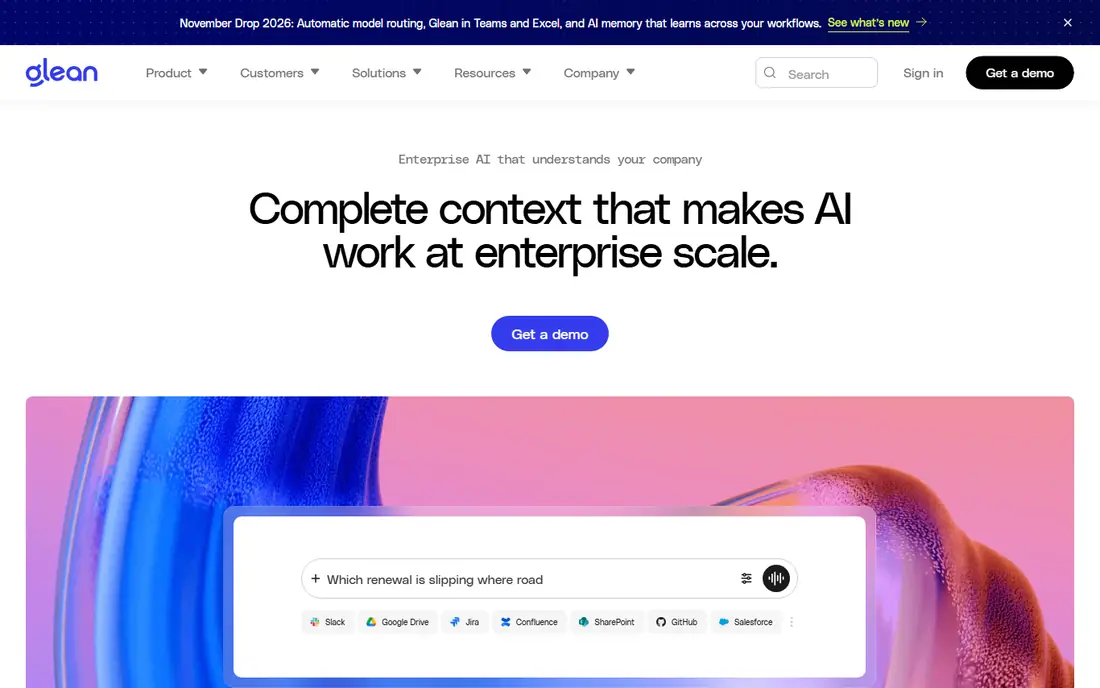
Glean is the workplace search platform most large teams evaluate first. It connects to many workplace apps, indexes their content, and returns permission-aware results and AI-generated answers with citations to the source documents. That permission handling matters, since employees should only see content they are already allowed to access.
The trade-off is enterprise scope. Pricing is quoted, deployment needs planning around connectors and permissions, and smaller teams may find the entry point high. For a mid-market or enterprise company that wants one search and assistant layer across its tools, Glean is a strong starting point for a pilot.
- Broad connector coverage across workplace apps
- Permission-aware search and AI answers
- Assistant and agent features for everyday work
- Enterprise pricing requires a quote
- Deployment and governance setup take time and internal effort
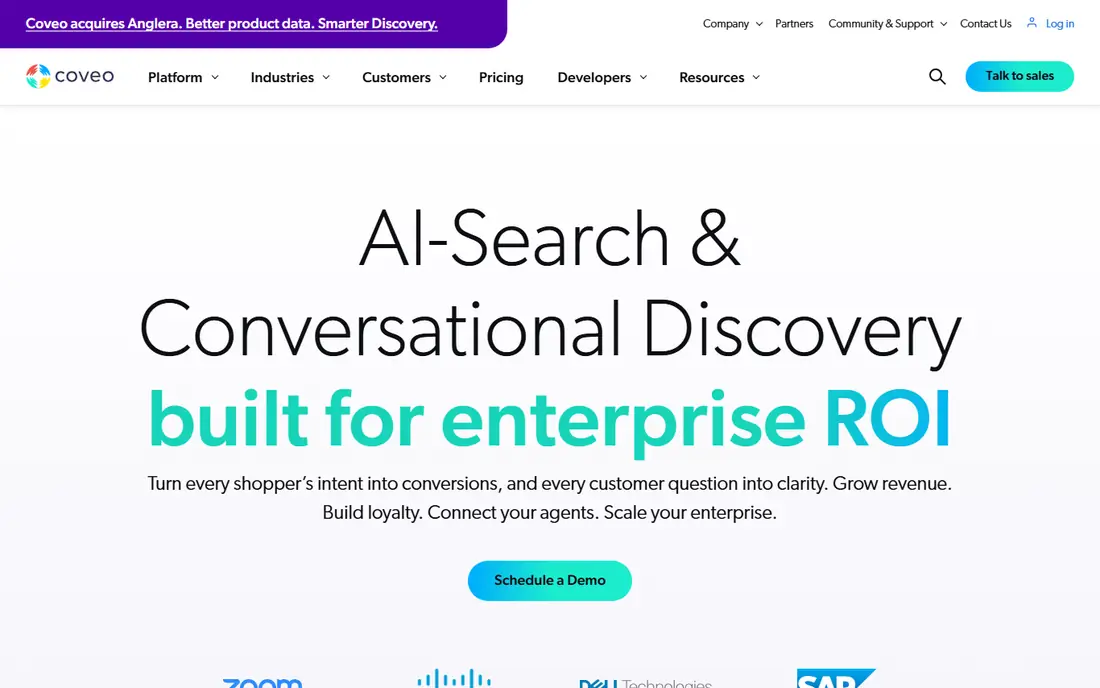
Coveo is strongest where search faces customers or support agents rather than only employees. Its relevance platform tunes results for support portals, help centres, and eCommerce sites, using usage signals and machine learning to improve ranking and recommendations. Integrations with Salesforce and ServiceNow make it a natural fit for support teams already using those systems.
That external focus is also a boundary. Coveo can serve workplace search, but teams whose main problem is internal knowledge discovery may compare Glean, GoSearch, or Sinequa first. For customer-facing relevance, Coveo remains one of the most proven platforms available.
- Strong relevance tuning for support and commerce
- Machine learning models for ranking and recommendations
- Integrations with Salesforce, ServiceNow, and web content
- Enterprise contract model
- Best value needs tuning and analytics effort over time
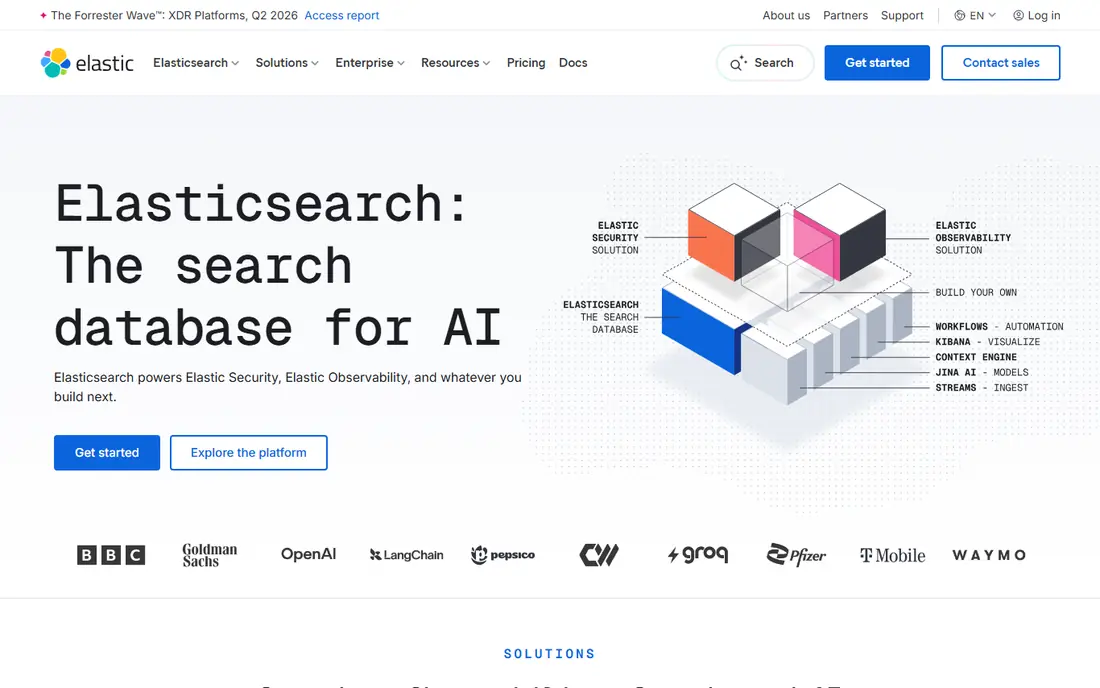
Elastic, built around Elasticsearch, is the infrastructure choice. It gives engineering teams a powerful search engine they can shape for internal search, app search, logging, or analytics, with keyword, vector, and hybrid retrieval options. The open-source foundation and large developer community make it flexible and well documented.
Flexibility has a cost in engineering time. Elastic is not a turnkey workplace assistant, and teams without search engineers will spend longer building relevance, connectors, and permissions than they would with Glean or GoSearch. For engineering-led organisations that want control, Elastic is the right foundation.
- Open-source foundation with cloud options
- Flexible keyword, vector, and hybrid search
- Huge developer ecosystem and documentation
- Needs engineering effort to build and run well
- Enterprise features and support are paid
Lucidworks suits organisations with complex search requirements that off-the-shelf relevance cannot satisfy. Its platform gives search teams deep control over pipelines, ranking signals, and machine learning models, which matters for large catalogues, regulated content, or multi-source search programs. Professional services support implementation for teams that need help.
That depth is not for everyone. Smaller teams, or teams without search specialists, may find Lucidworks heavier than Glean, Coveo, or GoSearch, and pricing is enterprise and quote-based. For large, complex programs where control is the priority, Lucidworks deserves evaluation.
- Deep control over search pipelines and relevance tuning
- Strong for complex, large-scale search programs
- Professional services for implementation
- Enterprise pricing and services model
- Needs skilled teams to get full value
Algolia is the developer favourite for customer-facing search. It powers fast, typo-tolerant search on websites and apps, with APIs and a dashboard that let developers index content and tune ranking quickly. A free tier lets small projects start without a sales conversation, which is rare among enterprise search vendors.
The limit is scope. Algolia excels at product, documentation, and site search, but it is not a full workplace knowledge platform with broad app connectors and permission-aware AI answers. Use Algolia when the search box faces customers, and use Glean or GoSearch when it faces employees across many internal systems.
- Very fast hosted search for websites and apps
- Developer-friendly APIs and dashboard
- Free tier for small projects
- Primarily customer-facing search, not full workplace knowledge search
- Usage-based pricing can grow with traffic
Sinequa is the governed enterprise pick. It combines natural language search with strong permission enforcement, audit controls, and connectors across enterprise content, which suits regulated industries and large organisations where data governance cannot be an afterthought. Its AI search and agent features build on that governed foundation.
Enterprise scope means enterprise process. Deployment, connector testing, and permission validation take time, and pricing is quoted. For organisations where governance, audit, and large-scale content coverage matter most, Sinequa is a strong alternative to Glean and Coveo.
- Strong governance, permissions, and audit controls
- Natural language and semantic search across many sources
- Enterprise AI and agent features
- Enterprise deployment and pricing model
- Evaluation needs time for connector and permission testing
GoSearch positions itself as a faster, more flexible alternative to larger workplace search platforms. It offers a free plan, published Pro pricing, broad connectors across workplace apps, and cited AI answers with no-code agent features. That transparency suits smaller and mid-market teams that want to try AI workplace search without an enterprise sales process first.
The honest caveat is maturity. GoSearch is a newer brand than Glean, Coveo, or Sinequa, so buyers should check reference customers, security documentation, and support terms before a wide rollout. For a fast pilot with clear pricing, GoSearch is an appealing starting point.
- Free plan and published Pro pricing
- Broad app connectors
- Cited AI answers and no-code agent features
- Newer brand than Glean or Coveo, so check long-term support and reference customers
- Enterprise features need a custom plan
Azure AI Search suits teams already building on Microsoft Azure. It provides managed search with AI enrichment, vector search, and scaling on Azure infrastructure, which lets developers build search into apps, portals, and internal tools without running their own search clusters. Microsoft-centric teams benefit most, since identity, storage, and AI services sit in the same cloud.
It is a building block, not a finished workplace assistant. Teams still need to design the search experience, connectors, and permissions, and engineering effort is required. For Azure-based development teams, it is a practical, scalable choice. For a ready-made employee search product, Glean or GoSearch will feel more complete.
- Native Azure integration with AI and vector search
- Scales with Azure infrastructure
- Fits Microsoft-centric teams
- Needs Azure and engineering skills to build a full search experience
- Not a turnkey workplace assistant
How we picked these
We compared official product pages, pricing pages, and documentation for enterprise search platforms that are available in 2026 and serve workplace, customer-facing, or developer search use cases. We favoured platforms with broad connectors, permission-aware results, and a distinct strength, and we left out products that are no longer open to new customers. We did not claim hands-on testing, and we based the write-ups on published features, pricing, and public comparisons.
How to choose the best enterprise search platform
Start with the search problem, not the AI label. Workplace knowledge search, customer support search, and product search need different connectors, permissions, and ranking signals, and a platform built for one may struggle with another. Define your top ten search tasks, the systems they span, and who should be allowed to see each result, before you invite vendors to demo.
Test permissions and connectors in a pilot
Run a small pilot on real content with real user groups, and test whether search respects existing permissions, including for leavers and role changes. Check connector coverage for your core systems, such as Google Drive, SharePoint, Confluence, Slack, Jira, and Salesforce, and confirm how often content reindexes. A demo on sample data will not reveal permission or connector gaps.
Plan for relevance tuning and ownership
Search quality fades without ownership. Assign an owner for relevance, analytics, and content gaps, and agree how you will measure success, such as fewer repeat questions to support or faster time to find key documents. Ask vendors what tuning tools, analytics, and support are included, since a platform without an owner often becomes a search box nobody trusts.
Frequently asked questions
What is the best enterprise search software?
Glean is a strong all-round pick for workplace search and AI assistance, while Coveo suits customer support and eCommerce relevance. Elastic suits engineering-led teams that want to build their own search, and GoSearch suits teams that want a faster pilot with published pricing.
What is the best enterprise search platform for workplace knowledge?
Glean, GoSearch, and Sinequa are the strongest workplace knowledge picks here, with broad connectors and permission-aware results. Glean suits larger enterprises, GoSearch suits faster pilots and mid-market teams, and Sinequa suits governed, regulated environments. Pilot all three on your own content if possible.
What are the best enterprise search tools for customer-facing search?
Coveo and Algolia are the best enterprise search tools for customer-facing search. Algolia suits fast product and site search with developer-friendly APIs, while Coveo suits support portals and eCommerce sites that need relevance tuning and recommendations. Choose based on whether you need site search speed or support relevance depth.
How much does enterprise search software cost?
Most enterprise search software is quoted per deployment, based on users, content volume, and connectors, so prices vary widely. GoSearch publishes a free plan and Pro pricing, Elastic offers open-source and cloud usage options, and Algolia offers a free tier for small projects. Request quotes on the same scope to compare fairly.
Does enterprise search respect document permissions?
Good enterprise search platforms respect existing permissions, so users only see content they are allowed to access. Test this in a pilot with real user groups, role changes, and restricted documents, and confirm how the vendor handles permission changes and reindexing. Never assume permission handling from a marketing page alone.
Sources
See where you really rank - block by block
ProMapRanker scans Google Maps across a grid of your service area. Simple monthly plans from $19, white-label on every plan.
Start freeKeep reading
 best tour operator software
Best Tour Operator Software in 2026
Compare the best tour operator software for bookings, channel management, waivers and payments, with pricing models for day tours and multi-day trips.
Read → best time clock app for small business
Best Time Clock App for Small Business in 2026
We compare the best time clock app for small business options, with free plans, GPS clock ins, scheduling and payroll links for hourly teams and payroll help.
Read → best test automation tools
Best Test Automation Tools in 2026
Compare the best test automation tools, from Playwright and Selenium to Cypress, Katalon and BrowserStack, with prices, languages and best uses explained.
Read →